Quotex trade history
Quotex Trade History: How to Review Your Decisions
Learn how to review Quotex trade history without judging only wins and losses. Build a practical trade journal, score decision quality and find patterns that improve discipline.
Quick answer
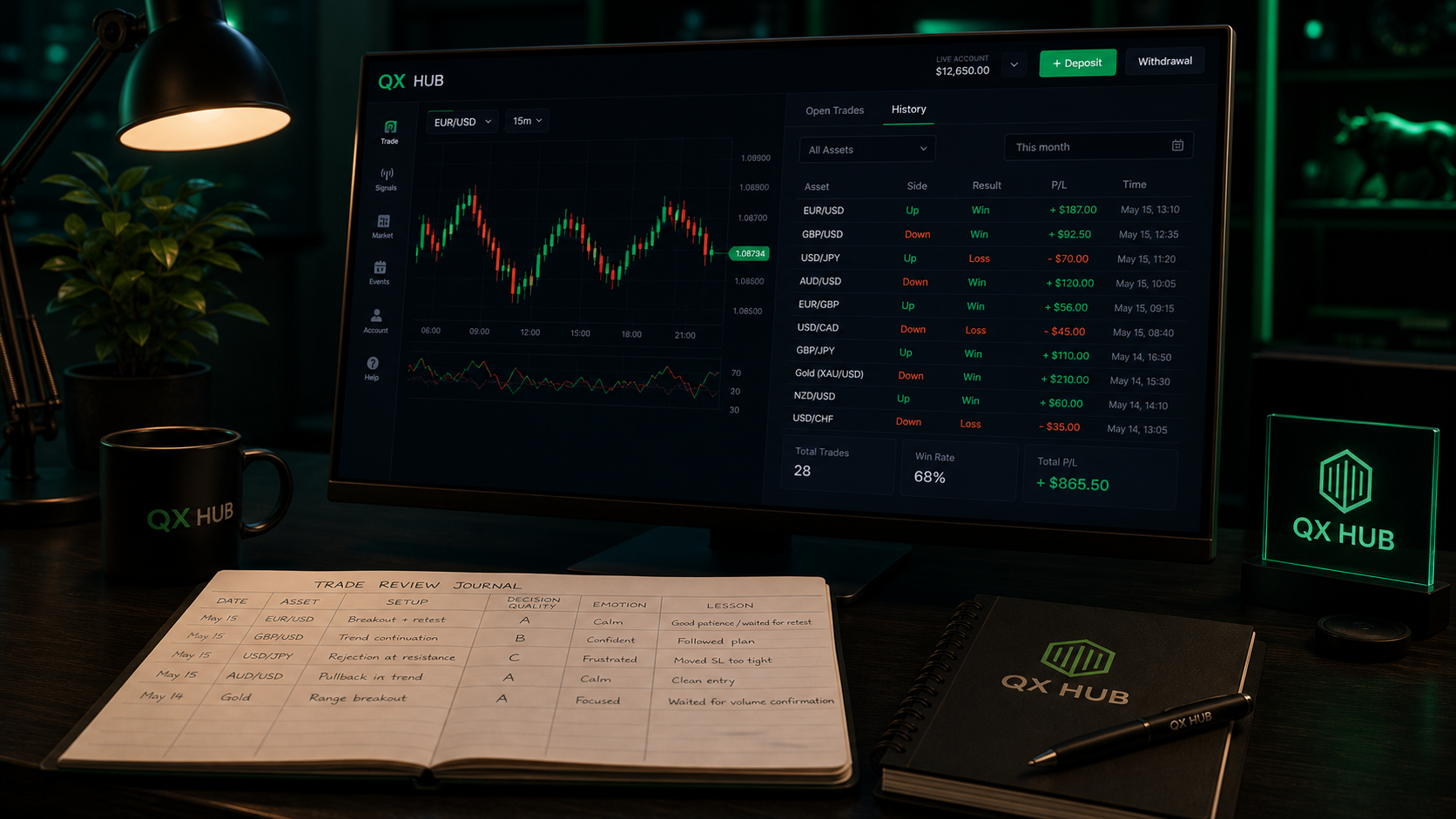
Quotex trade history becomes useful when you treat it as evidence, not a scoreboard. Review the asset, market context, setup, timing, amount, expiry and emotional state behind each decision. Then record one lesson and one action for the next session. A win can hide a weak decision, while a loss can still come from a disciplined process.
- Review decision quality before judging the financial outcome.
- Use trade history to find repeated behaviour across assets, times and sessions.
- Pair the platform record with a simple journal that explains why you entered.
- End every review with one practical lesson and one change for the next session.
Trade history is evidence, not a scoreboard
Most beginners open trade history to check whether the last position finished positive or negative. That reaction is natural, but it leaves the most valuable information untouched. A useful history review asks what asset was chosen, when the entry happened, how many trades were opened, whether the amount stayed consistent and whether the sequence followed a plan. Once those facts are visible, trading stops being a collection of emotional memories. It becomes a process that can be inspected, measured and improved.
Why decision quality matters more than one result
A winning trade can be poorly planned, and a losing trade can be correctly executed. Random timing, an oversized amount and no clear setup do not become good habits just because one result was positive. Likewise, a disciplined entry can lose even when the trader waited for confirmation and respected risk. Review should separate outcome from process. The goal is not to praise every win or punish every loss. The goal is to identify which decisions deserve to be repeated and which ones only survived through luck.
What to capture from every completed trade
A practical review needs a small set of consistent fields. Record the asset, direction, market condition, setup, entry timing, amount, expiry, result, emotional state and one lesson. The platform history usually gives part of this record; your journal fills the gaps. Do not create a complicated spreadsheet before the habit exists. Ten honest fields reviewed regularly are more useful than a beautiful system that is abandoned after two sessions.
1. Review the asset choice first
Start with the market you selected and the reason it was on your screen. Beginners often switch between assets because movement looks exciting, then struggle to explain why a particular chart was traded. Look across your history for concentration and consistency. You may discover that decisions are calmer on one familiar currency pair and more impulsive on fast-moving or unfamiliar assets. That does not automatically prove one asset is better, but it tells you where your current reading and discipline are strongest.
2. Rebuild the market context
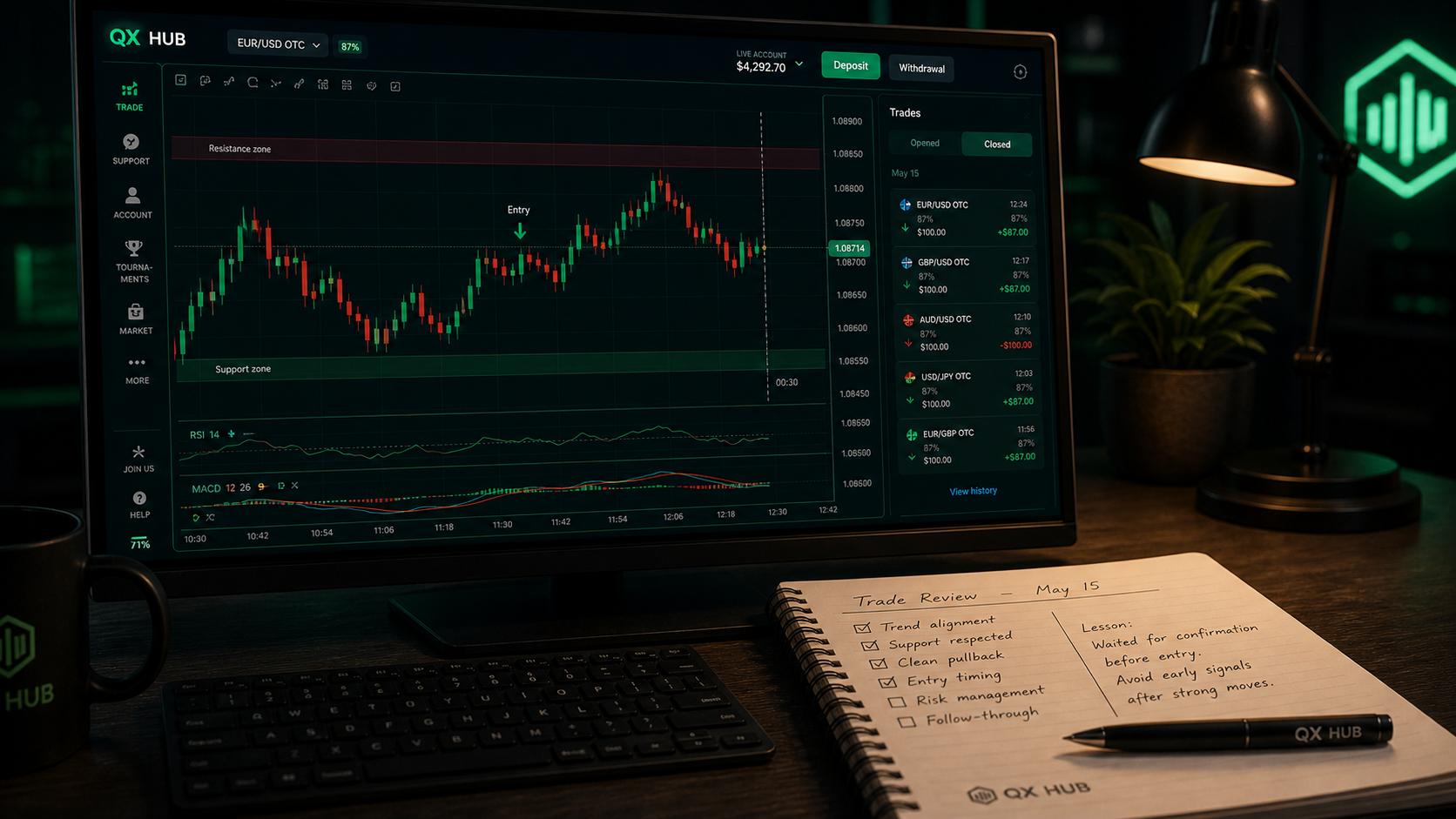
The same setup behaves differently in a trend, a range and a noisy market. When reviewing, reconstruct what price was doing before the entry. Was the move directional or sideways? Was the trade near support, resistance or a breakout level? Were candles clean enough to read, or was the chart full of conflicting wicks? A screenshot is useful here because trade history alone cannot preserve the full chart context. Many weak entries become obvious only after the market is viewed without the pressure to click.
3. Explain the setup and entry in one sentence
A review becomes sharper when the entry idea can be described simply: pullback in an uptrend, rejection from resistance, breakout retest or another defined setup. If the explanation requires a long story, the original decision may not have been clear. Then examine timing. Was the entry early, late or properly confirmed? Did you wait for the chart to support the idea, or enter because the move seemed about to disappear? Trade history proves that an entry happened; your review decides whether that entry was earned.
4. Audit execution, risk and emotion
Many trading mistakes are behavioural rather than analytical. Check whether the amount matched the plan, whether expiry suited the setup and whether the trade came after a loss, a win or a long period of boredom. Note any increase in size, revenge entry, rushed click or broken session stop. Emotional context matters because the same chart can produce a different decision when the trader feels calm, frustrated or overconfident. A history sequence often reveals this change before the trader is willing to admit it.
Use a decision-quality scorecard
To avoid judging only the result, score each trade on five points: market context, setup clarity, timing, risk control and emotional control. Give one point for every area that followed the plan. A five-point trade is a high-quality decision even if the result was negative. A one-point win is a warning, not a model to repeat. The scorecard is deliberately simple. Its purpose is to make good process visible and stop random wins from teaching the wrong lesson.
Combine Quotex trade history with a simple journal
The platform record tells you what happened. A journal explains why it happened. For each reviewed trade, write the date, asset, direction, setup, context, amount, expiry, decision-quality score, emotion and lesson. Add a screenshot when possible. The journal does not need motivational speeches or complex statistics. It needs honest, repeatable notes that make patterns easier to recognise. One clear sentence written after every session is more powerful than trying to remember everything at the end of the month.
A realistic trade-review example
Imagine a EUR/USD up trade built around a pullback in an uptrend. Price returned to a support zone, but the entry came slightly before bullish confirmation. The planned amount was respected, the trader felt calm and the trade finished negative. A useful review would label the market context and risk as good, timing as weak and the overall decision as acceptable but incomplete. The lesson is not to avoid every future pullback. It is to wait for stronger confirmation before using the same idea again.
A ten-minute post-session review routine
Review after the session, not while emotion is still driving the next click. Open history and choose no more than five important trades. Rebuild the context, score decision quality and write one lesson for each. Then answer three questions: which decision should be repeated, which behaviour should be removed and what rule matters most in the next session? Finish by closing the platform. A short review completed consistently is more valuable than an exhausting analysis that makes you avoid the habit.
Build a weekly review that finds patterns
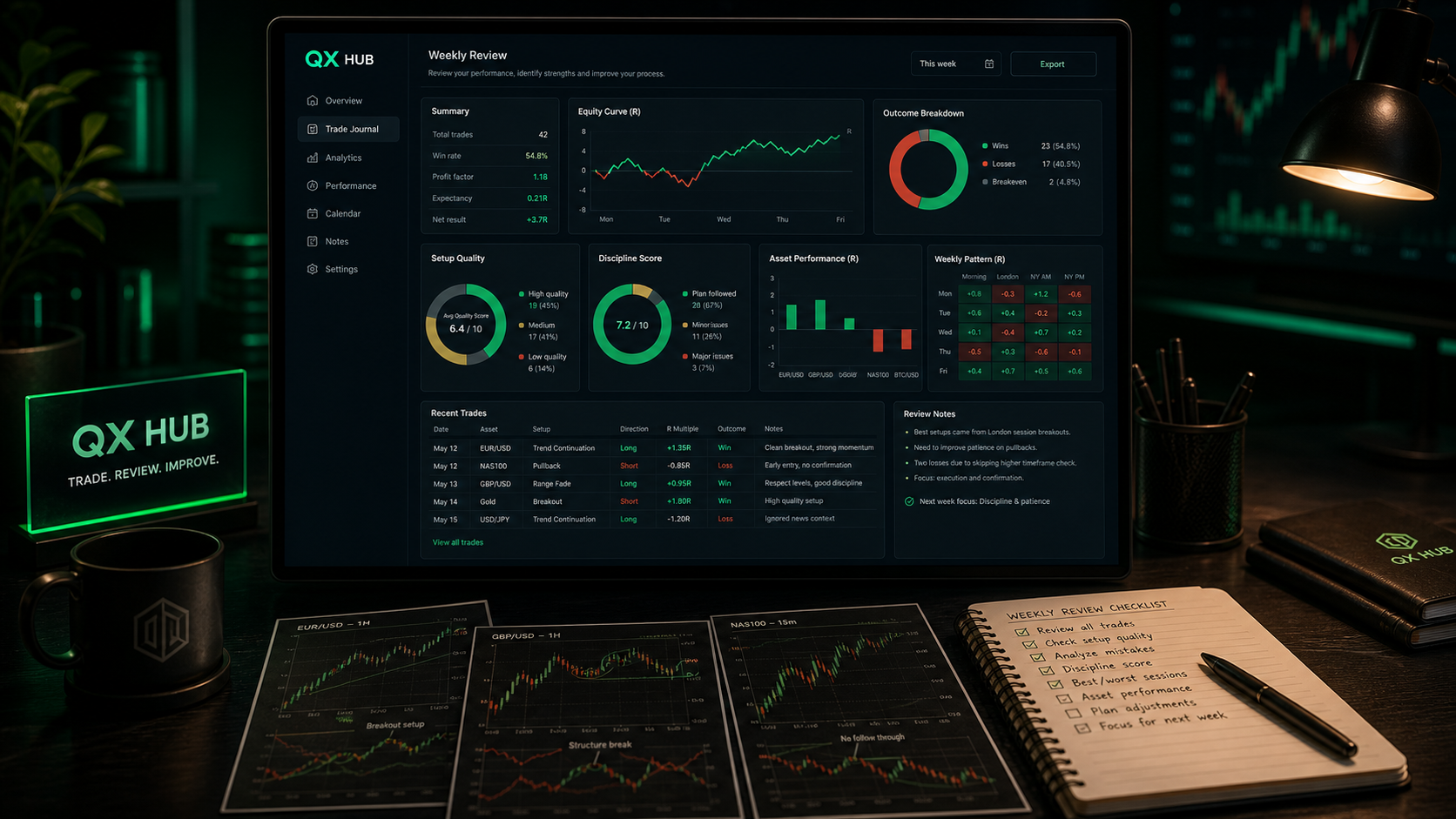
Daily review teaches individual lessons; weekly review shows what repeats. Once a week, group recent trades by asset, setup, time of day, decision score and emotional state. Look for patterns such as early entries after losses, better discipline on familiar assets or weak results during noisy sessions. Do not rebuild the entire strategy after one difficult week. Choose one process adjustment, test it on demo or with controlled risk and review again. Improvement becomes measurable when each week has one clear focus.
Common review mistakes to avoid
The most common mistake is looking only at profit and loss. Others include ignoring weak decisions that happened to win, reviewing while angry, changing strategy before checking execution, saving screenshots without writing lessons and attacking yourself instead of studying behaviour. A strong review is honest but constructive. It should make the next decision clearer, not create shame or pressure. Trade history is useful because it turns vague frustration into specific evidence that can guide a practical change.
Final advice: fewer random trades, better reviewed decisions
A beginner rarely needs more activity. The bigger advantage comes from understanding the activity that already happened. Treat Quotex trade history as a training archive. Review both wins and losses, score the process, keep the journal simple and revisit patterns every week. Over time, the record will show where discipline is reliable, where it breaks and which decisions genuinely deserve more trust. Growth becomes real when the next trade is shaped by evidence rather than the emotion of the previous result.
Practical route for Quotex trade history
Use this route after reading the guide. It turns Quotex trade history into a repeatable routine: one idea, one chart check, one risk limit and one clear Quotex action instead of impulsive entries.
- Learn how to review Quotex trade history without judging only wins and losses. Build a practical trade journal, score decision quality and find patterns that improve discipline.
- Use trade history to find repeated behaviour across assets, times and sessions.
- Why decision quality matters more than one result
- What to capture from every completed trade
Write the reason you opened this page in one sentence. Compare it with the guide's core point: Review decision quality before judging the financial outcome. If the reason is still vague, stay on demo and sharpen the rule before touching a live balance.
Open one asset and connect the idea with the section "Trade history is evidence, not a scoreboard". Do not jump between markets. A clean rehearsal means the same timeframe, the same expiration logic and the same condition for skipping the trade.
Before any real click, set the amount, the daily stop and the maximum number of attempts. Keep this filter beside the chart: Trading involves risk. Compare the platform, read the rules and never trade funds you cannot afford to lose. A strong trader protects attention first, capital second and ego never.
If the checklist still holds, use the most relevant path: Registration. If the context changes, compare it with Fast entry or Android app. The best route is the one that matches the reader's goal, not the loudest button.
Use the guide like a trading plan
A visitor searching for Quotex trade history usually needs a direct answer, not hype. This guide connects that question with Learn how to review Quotex trade history without judging only wins and losses. Build a practical trade journal, score decision quality and find patterns that improve discipline. and keeps the focus on the decision a beginner actually has to make next.
A calm trader does not turn one paragraph into a signal. Read the key points, compare them with the chart, then ask whether timing, amount and risk still agree. The strongest idea in this page is simple: Review decision quality before judging the financial outcome.
When the idea is clear, move in order: open the right Quotex route, practise the workflow on demo and only then decide whether Registration, Fast entry or Android app fits the session. If the rule feels rushed, the better decision is patience.
- Use trade history to find repeated behaviour across assets, times and sessions.
- Pair the platform record with a simple journal that explains why you entered.
- End every review with one practical lesson and one change for the next session.
- Trading involves risk. Compare the platform, read the rules and never trade funds you cannot afford to lose.
Quick answers
Why should I review Quotex trade history?
It helps replace emotional memory with evidence about assets, timing, risk, frequency and repeated behaviour.
Should I review only losing trades?
No. Winning trades can contain weak habits, while losing trades can still be disciplined and well planned.
What is the main goal of a trade review?
The goal is to judge decision quality and identify which actions should be repeated, changed or removed.
Do I need a journal if the platform already has trade history?
A journal is useful because platform history records the action, while your notes record context, emotion and the reason behind it.
How often should I review my trades?
A short review after each session and a broader weekly review create a practical rhythm for spotting both mistakes and habits.
What should I write in a trading journal?
Record asset, setup, market context, timing, amount, expiry, result, emotion, decision score and one useful lesson.
How do I score decision quality?
Use a simple five-point score: one point each for context, setup clarity, timing, risk control and emotional control.
Can a losing trade be a good decision?
Yes. A disciplined setup can lose because no single market outcome is guaranteed. Review whether the process followed the plan.
Can a winning trade be a bad decision?
Yes. A random or oversized trade can win once and still teach a dangerous habit if it is not reviewed honestly.
What if I cannot explain why I entered?
Treat that as useful evidence. The setup was probably unclear or emotional, so the next-session rule should require a one-sentence reason before entry.
How should a beginner use Quotex trade history?
Treat Quotex trade history as a decision filter, not as a signal by itself. Start with the page's main idea: Review decision quality before judging the financial outcome. Then check one chart, one timeframe and one amount on demo before any real-money step.
What should I check before applying Trade history is evidence, not a scoreboard?
Check whether the market still matches the section "Trade history is evidence, not a scoreboard", whether Use trade history to find repeated behaviour across assets, times and sessions. is true on the chart and whether your amount fits the planned risk. If one part is missing, skipping is the professional choice.
Next step
Choose a topic by task: brokers for platform selection, guides for access, strategies for setups, risk for discipline and investing for longer market logic.