Quotex demo trading exercises
Best Demo Trading Exercises for Quotex Beginners
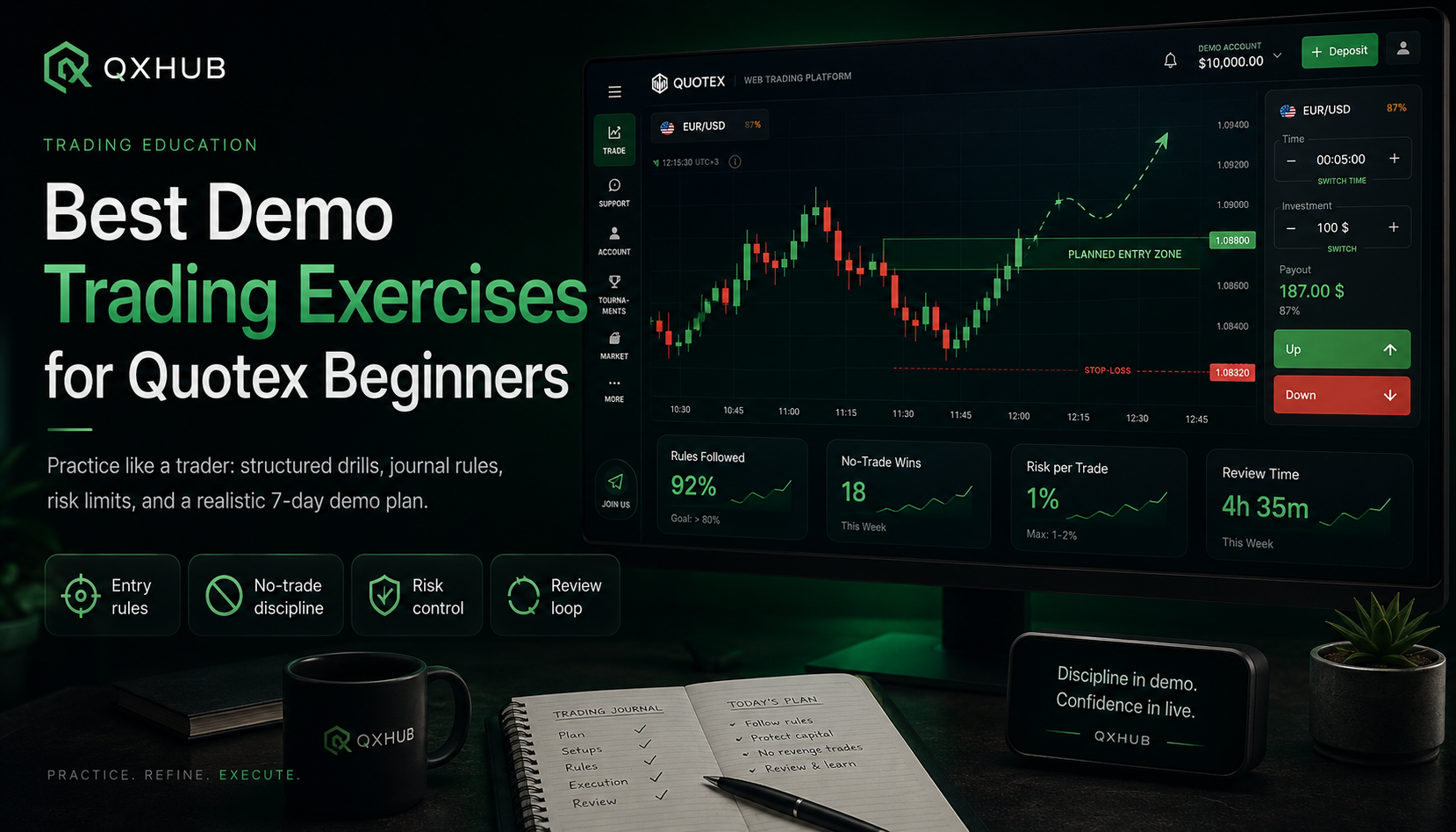
Practical Quotex demo trading exercises for beginners: one-setup drills, candle reading, no-trade discipline, risk-control simulation, journal review and a realistic 7-day practice plan.
Quick answer
The best Quotex demo trading exercises train one skill at a time: waiting for one clean setup, reading candles before entry, respecting support and resistance, testing expiry timing, skipping weak trades, using fixed risk and reviewing every decision. Demo practice is useful only when it builds repeatable behaviour instead of random confidence.
- Use the demo account as a training room, not as a fast-money simulator.
- Practice one setup per session so your results are readable.
- Count correct skips as wins because no-trade discipline protects capital.
- Use fixed demo risk, session limits and a stop rule before real money is involved.
Why beginners need structured demo exercises
A Quotex demo account can become a serious training room or a place where bad habits grow for free. The platform gives virtual balance, charts, expiry choices and order buttons, but it does not automatically give discipline. A beginner who clicks every active candle may feel busy, yet learn almost nothing. The goal of demo practice is not to create excitement. The goal is to build a repeatable process that still makes sense after the session is over.
What good demo practice should train
Good demo training has three jobs. First, it teaches the interface so a trader is not confused by basic buttons. Second, it teaches market selection, because not every chart deserves attention. Third, it protects decision quality when price becomes noisy. If your demo session does not train patience, entry logic, expiry timing, risk control and review, it is only screen time. The exercises below turn that screen time into trading practice.
Before you start: make demo feel serious
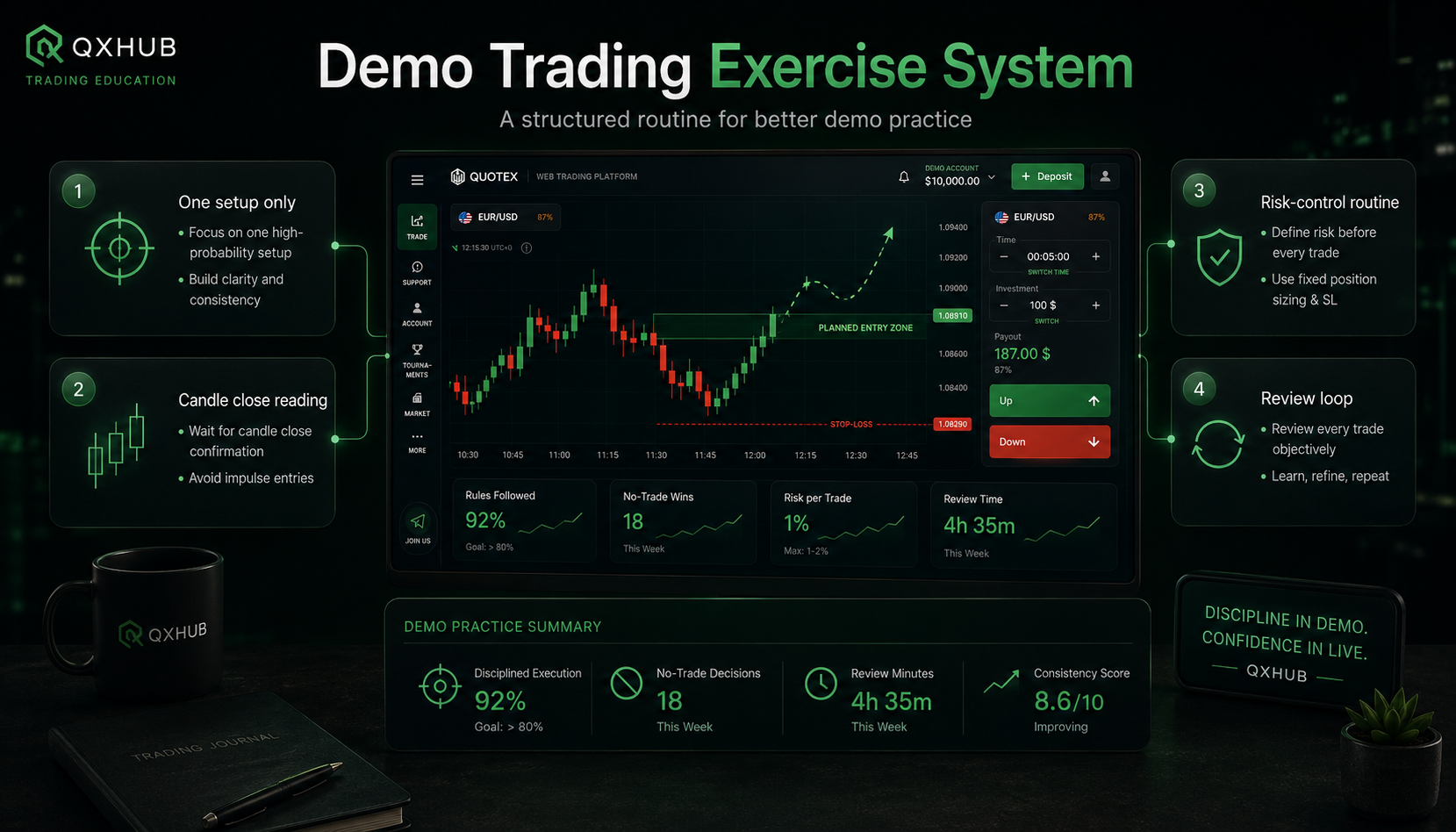
Virtual money does not create the same pressure as real money, and that is normal. Do not pretend the emotions are identical. Instead, add structure. Choose one or two assets for the session, use one timeframe, set a 20 to 30 minute timer, limit the session to five to eight planned trades and write the goal before you begin. A clean goal might be: today I will wait for candle close before entry. The stop rule is just as important: stop after two emotional mistakes, three low-quality setups or the end of the planned time.
Exercise 1: the one-setup-only drill
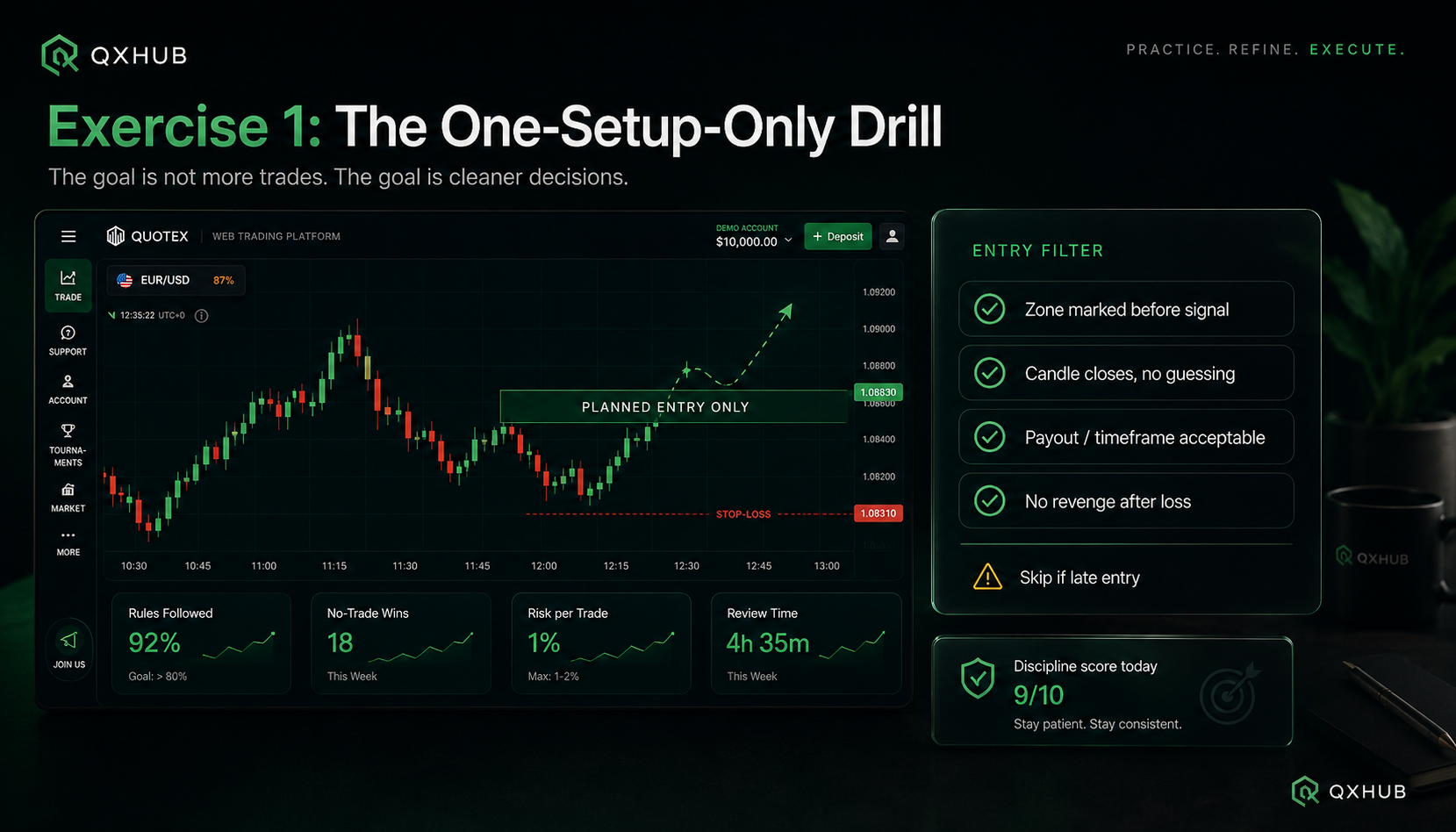
This is the strongest demo exercise for beginners because it removes the habit of changing opinions every few minutes. Pick one setup for the whole session: trend pullback, support reaction, resistance rejection, breakout retest or candle rejection at a marked zone. Write three conditions before the session starts. If all three appear, take the demo trade with the same stake size. If they do not appear, do nothing. The point is not to prove that the setup always wins. The point is to learn when the setup is actually present.
How to review the one-setup drill
After each attempt, mark the setup as clean, average or forced. A clean trade follows all written conditions. An average trade has the basic idea but weak timing. A forced trade exists mainly because the trader wanted action. This rating is more useful than a simple win or loss. A forced winner is still a warning. A clean loser can still be a good decision. That mindset is the foundation of serious demo practice.
Exercise 2: candle-by-candle reading
Many beginners search for signals before they understand what the candles are saying. For this drill, choose one chart and watch the next 20 candles without trading. For each candle, write one short label: strong bullish, weak bullish, rejection, inside candle, strong bearish or unclear. After 20 candles, summarize the market in one sentence. Only then can you consider a setup. This exercise trains the trader to read pressure, hesitation and momentum before touching the trade button.
Exercise 3: support and resistance reaction drill
Support and resistance are not magic lines. They are areas where price may react because traders remember previous turning points. Mark zones before price arrives, not after the signal appears. Then wait. A touch is not a reaction. Look for a rejection wick, a failed breakout, a close back inside the zone or momentum slowing near the level. If price breaks the zone strongly and does not reject it, the professional choice is to skip.
Exercise 4: expiry timing drill
Short-term trading is not only about direction. Timing changes everything. Beginners often choose expiry because it feels right, then blame the market when the idea needed more time or less time. Pick one setup and one expiry rule for the whole session. After every trade, review where price was one candle later and three candles later. Write whether your timing was early, late, too short, too long or acceptable. Repeat for at least 20 similar demo trades before changing the rule.
Exercise 5: the no-trade discipline drill
This exercise rewards doing nothing, which is exactly why it works. Open a demo session with the goal of finding at least five correct no-trade situations. Each time you want to enter but the setup is incomplete, screenshot the chart and label it skip. Write the reason: late entry, no clear zone, messy candles, emotional urge or bad timing. At the end, review the skipped trades. Many beginners discover that their best decision of the day was the trade they did not take.
Exercise 6: risk-control simulation
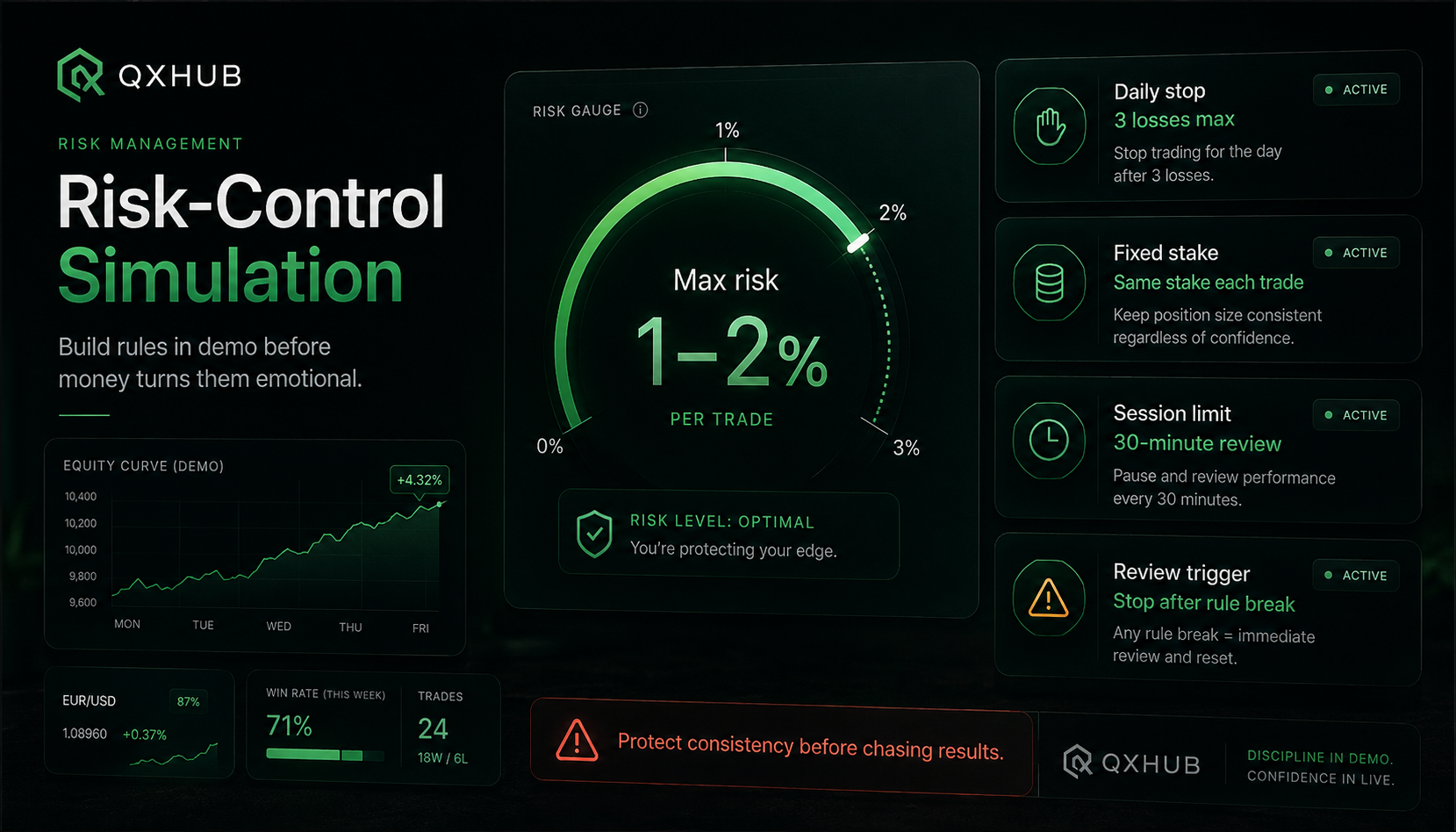
Demo money is virtual, but risk habits are real. Choose a small fixed demo stake and keep it unchanged for the whole session. Set a maximum number of trades before you start. Set a mistake stop, such as stopping after two emotional entries or three rule breaks. Never increase stake after a loss. The important moment is not the chart; it is the decision you make when frustration asks for a bigger next trade. If you can protect structure in demo, you are closer to protecting structure later.
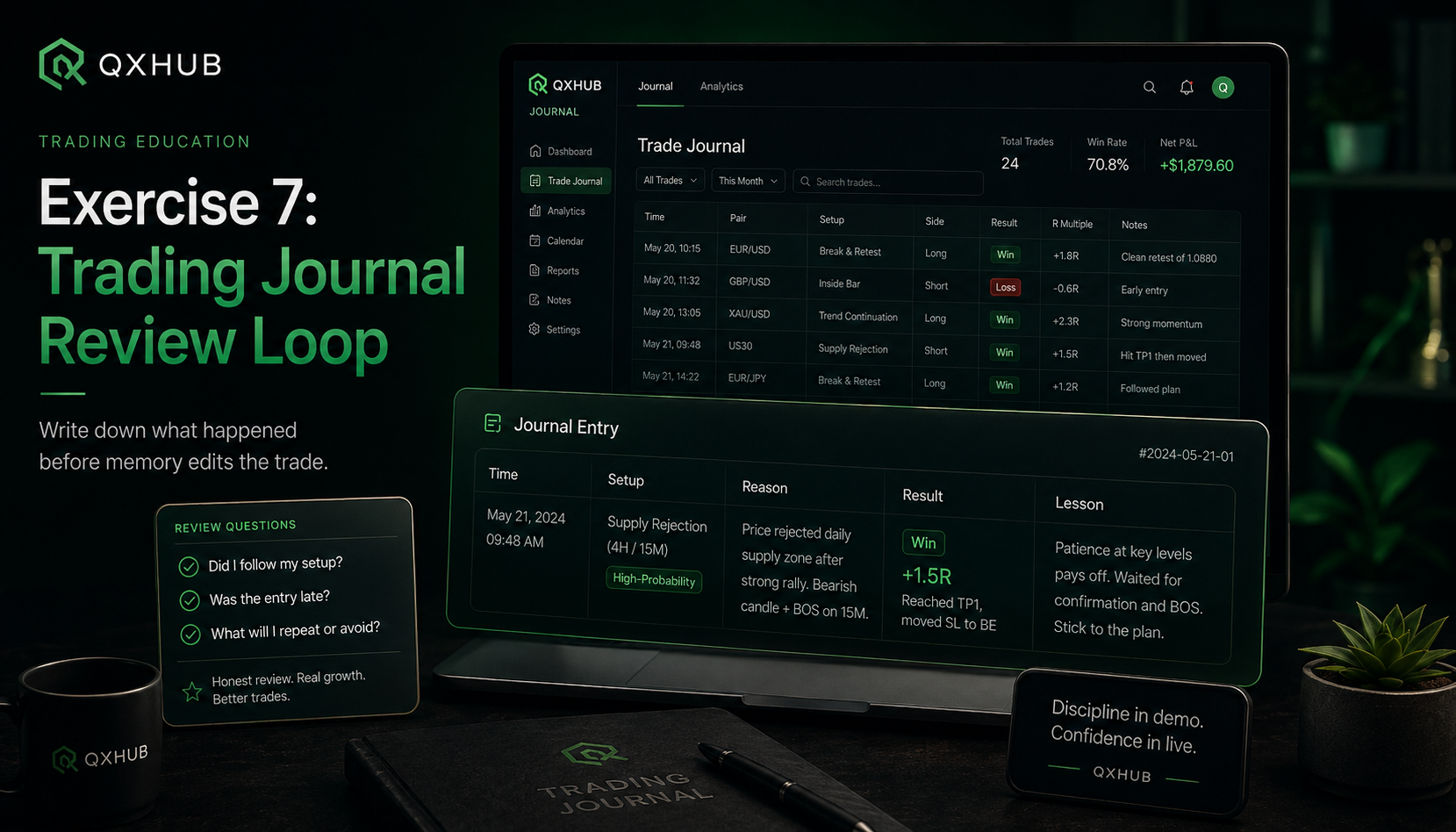
Exercise 7: trading journal review loop
Without review, demo trading becomes a blur. You remember the big wins, forget the ugly entries and build a fantasy version of your progress. A journal gives evidence. For every trade, write the asset, setup, entry reason, market condition, expiry, result, emotional state and one lesson. Tag the decision as clean, average, forced, late, emotional or skipped correctly. Change only one rule for the next session. Do not rewrite the whole system after one loss.
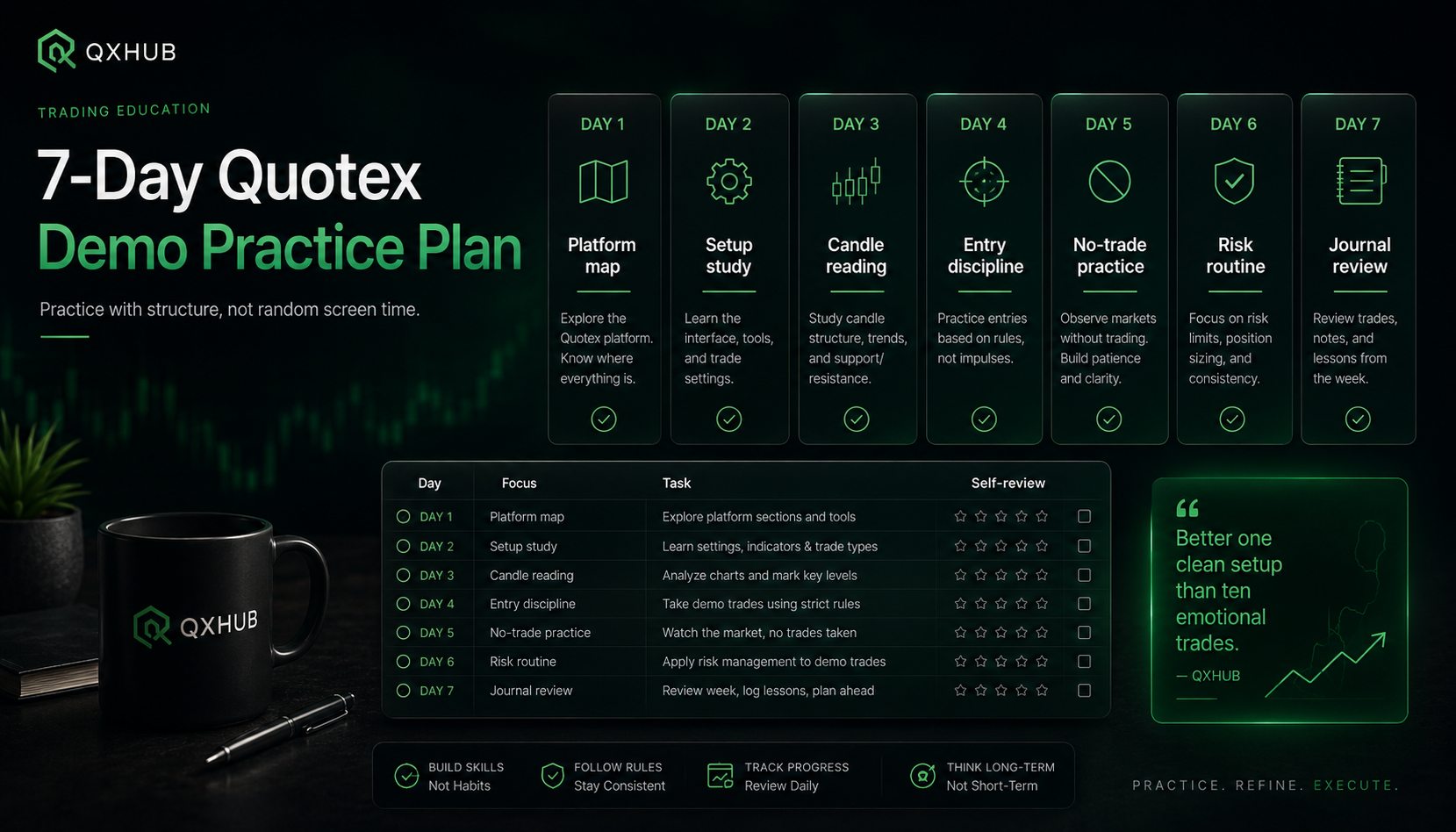
A realistic 7-day Quotex demo practice plan
Day 1 is platform mapping: learn where assets, chart tools, trade history and account settings live. Day 2 is one-setup study. Day 3 is candle reading without trading. Day 4 is entry discipline with strict rules. Day 5 is no-trade practice. Day 6 is fixed-risk routine. Day 7 is journal review and weekly planning. This plan will not make a beginner a master in a week, but it can stop random practice and start building useful feedback.
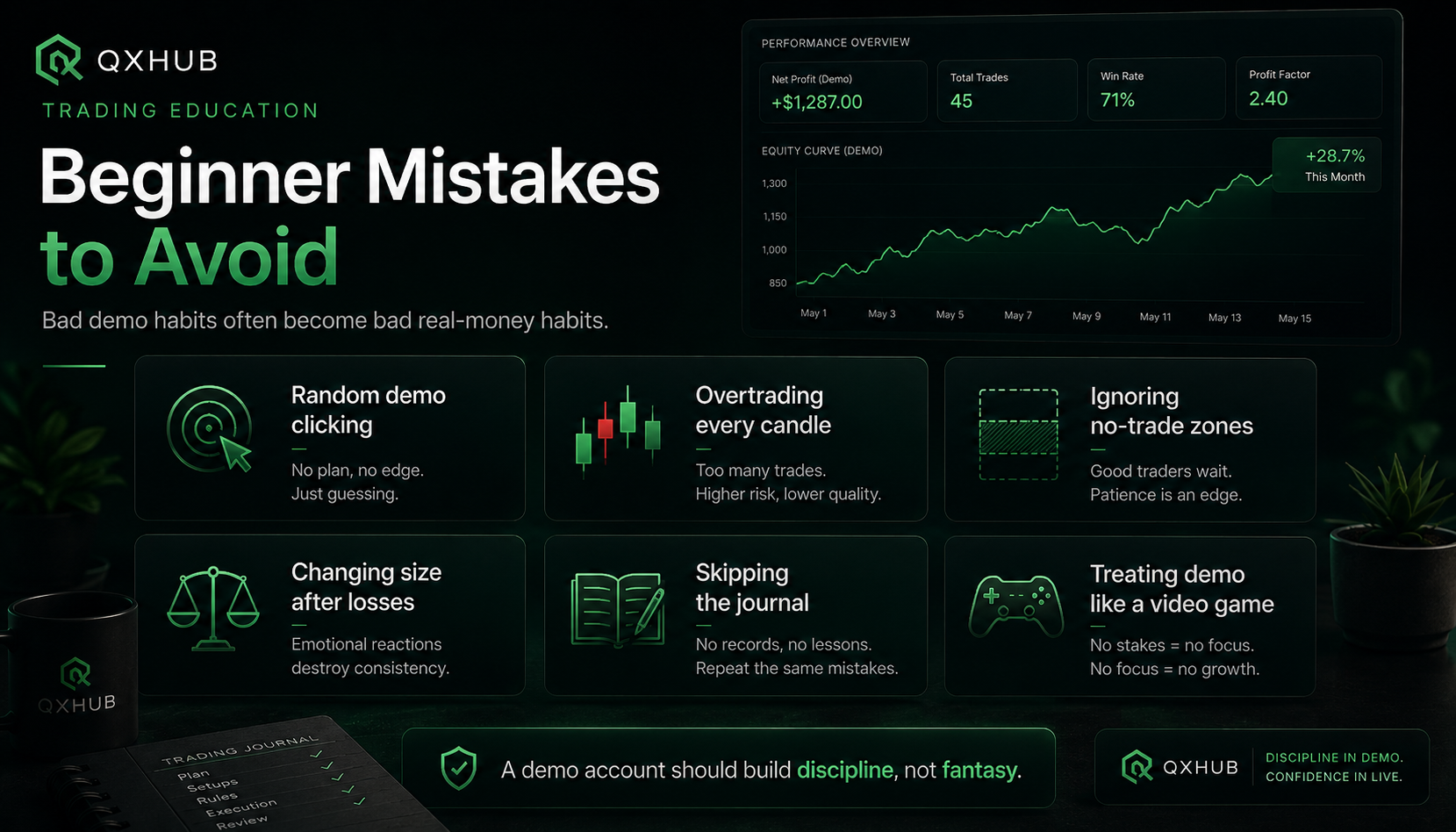
Beginner mistakes that make demo useless
The biggest mistake is treating demo like a game. Other mistakes are changing strategy after every loss, using huge virtual stakes, counting demo profit as skill, trading every market condition, ignoring screenshots and practicing while tired or angry. A demo account should build discipline, not fantasy. If the session produces no notes, no screenshots and no lesson, it probably produced very little growth.
Risk rules for demo trading
Use the same stake for the whole session. Avoid martingale-style recovery logic. Limit total trades. Stop after rule breaks, not only after losses. Review decision quality separately from the result. Never move from demo to real money because of one lucky session. A good day can happen by accident; a good process can be repeated. The process matters more than the virtual balance.
Demo practice task for today
Choose one setup for the whole session. Set a timer for 25 minutes. Take a maximum of six demo trades. Screenshot every trade and at least three skipped trades. Use the same stake size every time. After the session, tag each decision as clean, average, forced, late or emotional. Then write one rule you will keep tomorrow and one behaviour you will remove. This simple task is enough to turn the next session into real training.
Final thought: train decisions before confidence
The best demo trading exercises for Quotex beginners are not complicated. They are specific. One session trains one skill: waiting for a setup, reading candles, respecting zones, testing expiry, skipping bad trades, controlling risk or reviewing screenshots. When demo becomes a decision lab, confidence starts to come from evidence instead of luck. That is the kind of confidence worth carrying forward.
Practical route for Quotex demo trading exercises
Use this route after reading the guide. It turns Quotex demo trading exercises into a repeatable routine: one idea, one chart check, one risk limit and one clear Quotex action instead of impulsive entries.
- Practical Quotex demo trading exercises for beginners: one-setup drills, candle reading, no-trade discipline, risk-control simulation, journal review and a realistic 7-day practice plan.
- Practice one setup per session so your results are readable.
- What good demo practice should train
- Before you start: make demo feel serious
Write the reason you opened this page in one sentence. Compare it with the guide's core point: Use the demo account as a training room, not as a fast-money simulator. If the reason is still vague, stay on demo and sharpen the rule before touching a live balance.
Open one asset and connect the idea with the section "Why beginners need structured demo exercises". Do not jump between markets. A clean rehearsal means the same timeframe, the same expiration logic and the same condition for skipping the trade.
Before any real click, set the amount, the daily stop and the maximum number of attempts. Keep this filter beside the chart: Trading involves risk. Compare the platform, read the rules and never trade funds you cannot afford to lose. A strong trader protects attention first, capital second and ego never.
If the checklist still holds, use the most relevant path: Registration. If the context changes, compare it with Fast entry or Android app. The best route is the one that matches the reader's goal, not the loudest button.
Use the guide like a trading plan
A visitor searching for Quotex demo trading exercises usually needs a direct answer, not hype. This guide connects that question with Practical Quotex demo trading exercises for beginners: one-setup drills, candle reading, no-trade discipline, risk-control simulation, journal review and a realistic 7-day practice plan. and keeps the focus on the decision a beginner actually has to make next.
A calm trader does not turn one paragraph into a signal. Read the key points, compare them with the chart, then ask whether timing, amount and risk still agree. The strongest idea in this page is simple: Use the demo account as a training room, not as a fast-money simulator.
When the idea is clear, move in order: open the right Quotex route, practise the workflow on demo and only then decide whether Registration, Fast entry or Android app fits the session. If the rule feels rushed, the better decision is patience.
- Practice one setup per session so your results are readable.
- Count correct skips as wins because no-trade discipline protects capital.
- Use fixed demo risk, session limits and a stop rule before real money is involved.
- Trading involves risk. Compare the platform, read the rules and never trade funds you cannot afford to lose.
Quick answers
What are the best demo trading exercises for Quotex beginners?
The best exercises are one-setup practice, candle reading, support and resistance reaction training, expiry timing, no-trade discipline, fixed-risk simulation and trading journal review.
How long should I practice on a Quotex demo account?
Practice until you can follow written rules across many sessions. The number of days matters less than repeatable discipline after wins and losses.
Should I use indicators during demo practice?
You can, but keep them simple. One setup and one or two tools are enough for a beginner. Too many indicators often hide poor price reading.
Is demo trading the same as real trading?
No. Demo removes most financial pressure. That is why rules, stake limits and review habits must be strict before real money is involved.
How many demo trades should a beginner take per day?
Five to eight planned trades are enough for focused practice. The point is to review each decision, not to create a large number of random entries.
What should I write in a trading journal?
Record the date, asset, setup, entry reason, expiry rule, result, screenshot, emotional state, whether rules were followed and one improvement for the next session.
When should I stop a demo session?
Stop when planned time ends, the trade limit is reached or you break your rules emotionally. Stopping after a rule break is a professional habit.
Can demo practice guarantee success on a real account?
No. Demo practice cannot guarantee results. It can help you learn the platform, test ideas and build routines, but trading always involves risk.
What is the most important demo rule for beginners?
Use one setup, one stake size and one clear stop rule per session. Consistency makes your review useful.
Why should I screenshot skipped trades?
Skipped trades show whether your discipline is improving. A correct skip can protect the account as much as a good entry.
When is a beginner ready to move beyond demo?
Only after several sessions show consistent rules, fixed risk, clear notes and no emotional size increases after losses.
Can I practice Quotex on mobile demo?
Yes, but mobile practice should be even stricter. Smaller screens can encourage fast clicks, so use a written plan and avoid trading from distraction.
How should a beginner use Quotex demo trading exercises?
Treat Quotex demo trading exercises as a decision filter, not as a signal by itself. Start with the page's main idea: Use the demo account as a training room, not as a fast-money simulator. Then check one chart, one timeframe and one amount on demo before any real-money step.
What should I check before applying Why beginners need structured demo exercises?
Check whether the market still matches the section "Why beginners need structured demo exercises", whether Practice one setup per session so your results are readable. is true on the chart and whether your amount fits the planned risk. If one part is missing, skipping is the professional choice.
Next step
Choose a topic by task: brokers for platform selection, guides for access, strategies for setups, risk for discipline and investing for longer market logic.