
Crypto exchange review
Binance Review 2026: Fees, KYC, Security, Pros and Cons
Read a current Binance review covering fees, KYC, regional restrictions, spot and derivatives, deposits, withdrawals, security, risks and beginner steps.

Crypto trading and custody involve loss, operational and counterparty risk. This review is educational, not personal investment advice.
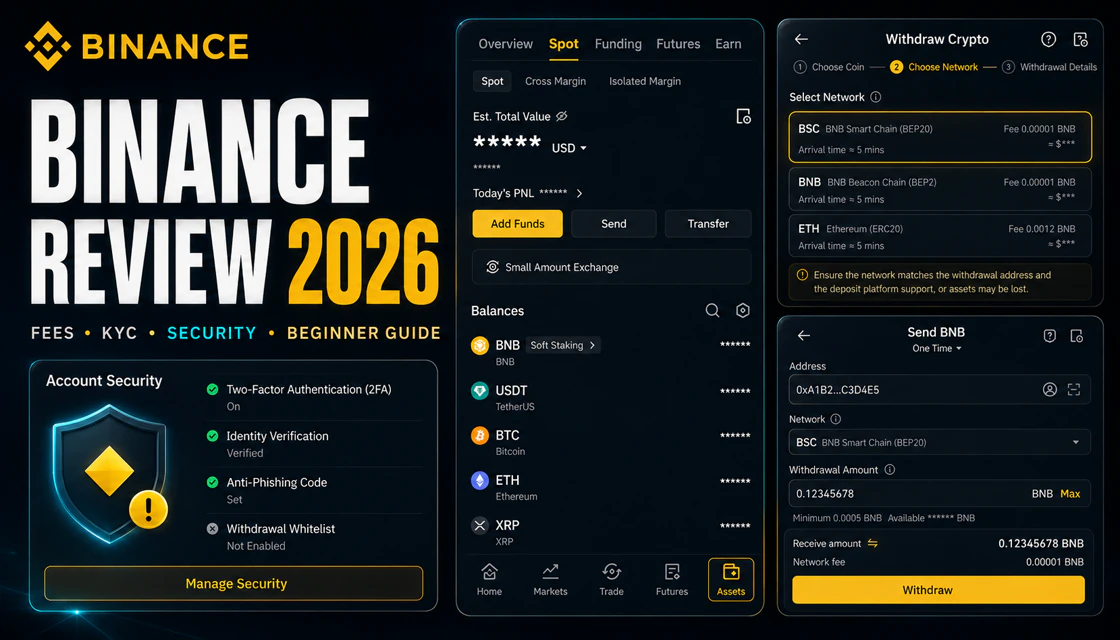
Binance review: the short answer
- Binance offers deep spot markets and a broad product range, but access, funding routes and advanced products vary by country and account eligibility.
- The published regular-user spot baseline is 0.10% maker and taker before eligible discounts; always confirm the live pair, tier and order preview.
- A safer beginner route is honest KYC, strong account security, one liquid spot pair, a small first deposit and a test withdrawal on the exact network.
Who Binance suits — and who should skip it
Potentially suitable for
- Eligible beginners who want to buy a major crypto asset on spot and learn order execution.
- Active traders who need broad market coverage, order types, APIs or high-volume fee tiers.
- Users who want a single platform for spot, conversion, staking and selected payment routes where available.
- Traders who will verify reserve inclusion, enable strong account controls and keep only active funds online.
Usually a poor fit for
- Residents of unsupported jurisdictions or users whose required product is restricted locally.
- Anyone expecting insured deposits, guaranteed redemptions or zero counterparty risk.
- First-time buyers drawn primarily to futures, margin, copy trading or changing headline yields.
- Long-term holders who do not need exchange liquidity and can safely manage self-custody.
Availability and material regional restrictions
There is no single global Binance product set. Binance.com, local entities and product-specific terms differ by residence, customer classification and regulatory status. United States users are not served through the global Binance.com exchange and should not attempt to bypass location controls. Canada and the Netherlands have appeared on recent Binance product restriction lists; a 2023 official notice placed Dutch residents into withdrawal-only status. UK retail clients face limited access to certain products, while EEA users are affected by MiCA-related stablecoin and promotional restrictions. Derivatives, P2P, Card, Pay, Earn, tokenized securities and individual trading pairs can each have narrower eligibility than spot.
Restrictions change. On 20 August 2026, Binance announcements still instruct users to complete verification and check eligibility for the exact product and residence. Do not rely on an old country list, a VPN tutorial or another user’s account. Open the current Terms, the product page and the live verification screen before depositing.
Regulation must also be read at entity level. The Binance pages accessed for this review describe specific ADGM entities and permissions, while other regions may be served by different legal companies or no Binance service at all. A licence held by one entity for one activity should not be presented as worldwide supervision of every Binance product. Check the contracting entity shown during onboarding and the protections that actually apply to that account.
Account creation and KYC
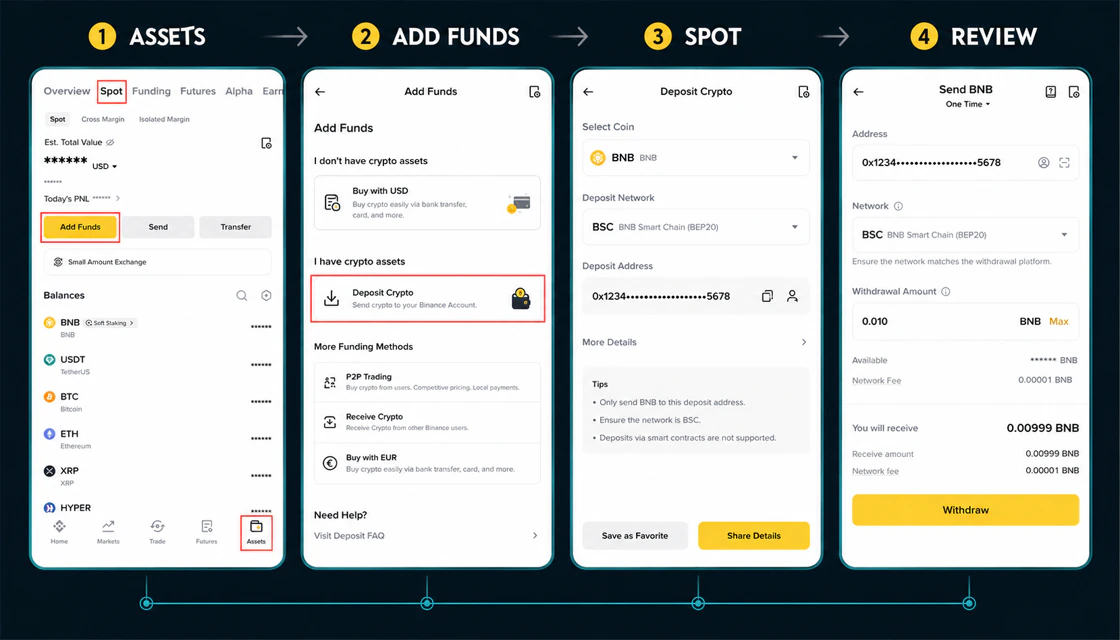
A disciplined route begins with eligibility and security, then a small deposit, spot purchase and optional self-custody.
How to register safely
- Open binance.com directly or use the official app-store listing. Check the domain and app publisher before entering information.
- Register with an available email, phone, Apple, Google or other supported method. Use a unique password saved in a password manager.
- Enter the one-time code and complete account creation. Binance says identity verification is required before trading.
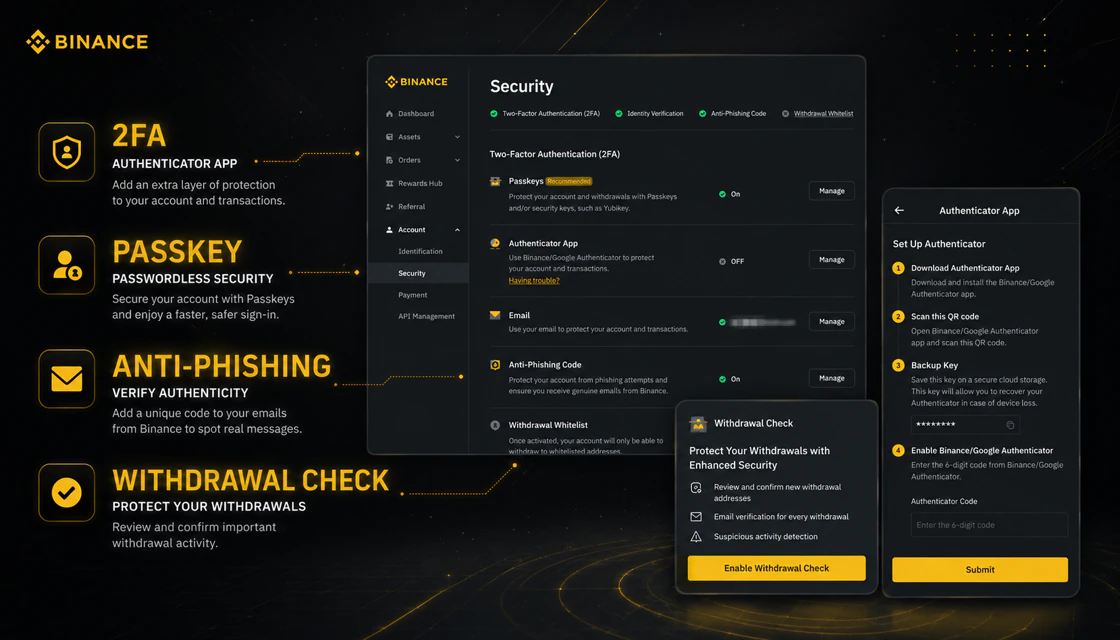
- Enable a passkey or authenticator-app 2FA immediately. Add an anti-phishing code and review active devices.
- Complete KYC before funding so a document problem does not trap an avoidable deposit.
What verification can require
Binance’s beginner guide says personal verification normally includes basic information, a government-issued identity document and facial verification. Proof of address can also be required, and enhanced checks may request source-of-funds or source-of-wealth evidence. Documents, accepted formats and limits depend on residence and account type. Names, date of birth and address should match the evidence exactly.
Use only the in-account verification flow. No genuine support agent needs your password, seed phrase or authenticator code. If a verification update places the account in withdrawal-only mode, follow the official status instructions rather than creating a second account or submitting edited documents.
Markets and products
Binance’s 2026 beginner guide describes hundreds of cryptocurrencies across Spot, Margin, Futures and Options. Counts change with listings and delistings, and not every user sees every market. A listing does not guarantee good liquidity, safe custody, regulatory approval or token quality.
For a beginner, product selection matters more than feature count. Spot ownership still carries market and custody risk, but it avoids borrowing, liquidation and funding. Convert may be easier to operate, yet the final quote should be compared with the spot order book. Earn, staking and on-chain products require separate due diligence because redemption rules and the source of rewards differ by asset.
| Product | Purpose | Beginner position |
|---|---|---|
| Spot / Convert | Buy or sell listed crypto; Convert provides a simple quote while spot exposes the order book. | Best starting area. Compare final quote, spread and fee. |
| Margin | Borrow against collateral to increase spot exposure. | Avoid until borrowing, interest and liquidation are understood. |
| Futures / Options | Trade derivatives linked to price, often with leverage and funding or expiry mechanics. | High risk; losses and liquidation can occur quickly. |
| Earn / staking | Commit eligible assets to flexible, locked or on-chain reward products. | Review source of yield, redemption, counterparty and smart-contract risk. |
| P2P / fiat buy | Trade through available bank, card, provider or peer routes. | Coverage and fees vary; use verified counterparties and platform escrow only. |
| Pay / Card / Wallet | Payments and on-chain access where supported. | Separate terms, entities and regional limits apply. |
| Bots / copy / API | Automate rules, follow traders or connect software. | Automation scales errors; restrict permissions and withdrawals. |
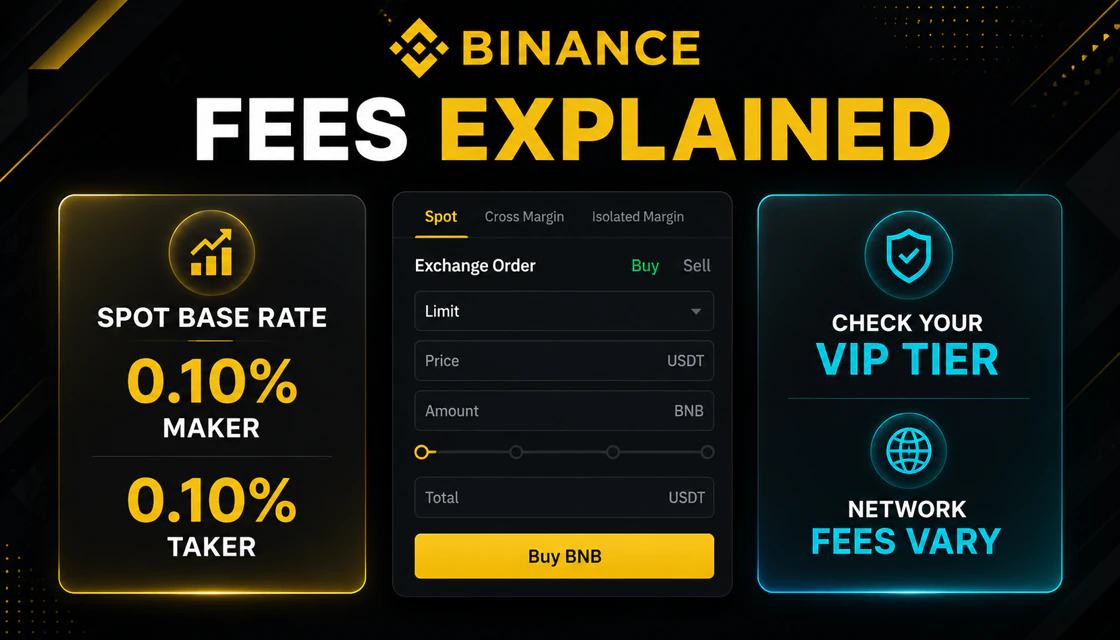
Fees — verified 20 August 2026
Trading fees are only one layer; withdrawal fees and discounts must be checked live.
Binance’s official fee example uses a 0.10% regular-user spot rate. On a $1,000 completed spot order, that equals $1 before an eligible discount. With the full 25% BNB deduction, the trading-fee component would be $0.75, assuming the order and account qualify. That does not include spread, slippage, a second fee when selling, or the withdrawal fee.
A limit order is not automatically a maker order. If it executes immediately against existing liquidity, it is a taker. Always confirm the actual role and fee in order history. For derivatives, compare entry fee, exit fee, funding, slippage and liquidation risk; the headline maker rate is not the total cost.
| Cost layer | Published baseline | What changes the result |
|---|---|---|
| Spot trading | 0.10% standard fee for regular users. | VIP tier, maker/taker role, pair promotion and eligible BNB deduction. |
| BNB deduction | Up to 25% discount on eligible Spot and Margin fees. | Must be enabled with enough BNB; exclusions and campaign terms apply. |
| Futures trading | Separate maker/taker schedule shown on the live Futures fee page. | VIP level, contract, BNB deduction up to 10%, funding and liquidation. |
| Crypto deposit | Binance normally does not charge a platform fee for standard on-chain deposits. | The sending wallet or network can charge. |
| Crypto withdrawal | Asset- and network-specific fee displayed before confirmation. | Network, congestion, asset, minimum and maintenance status. |
| Fiat / card / P2P | Depends on country, currency, provider and payment route. | Bank, card issuer, provider quote, spread and counterparty terms. |
| Convert | Cost is reflected in the quoted conversion rather than a simple universal fee. | Market conditions, pair and quote size. |
Deposits and withdrawals
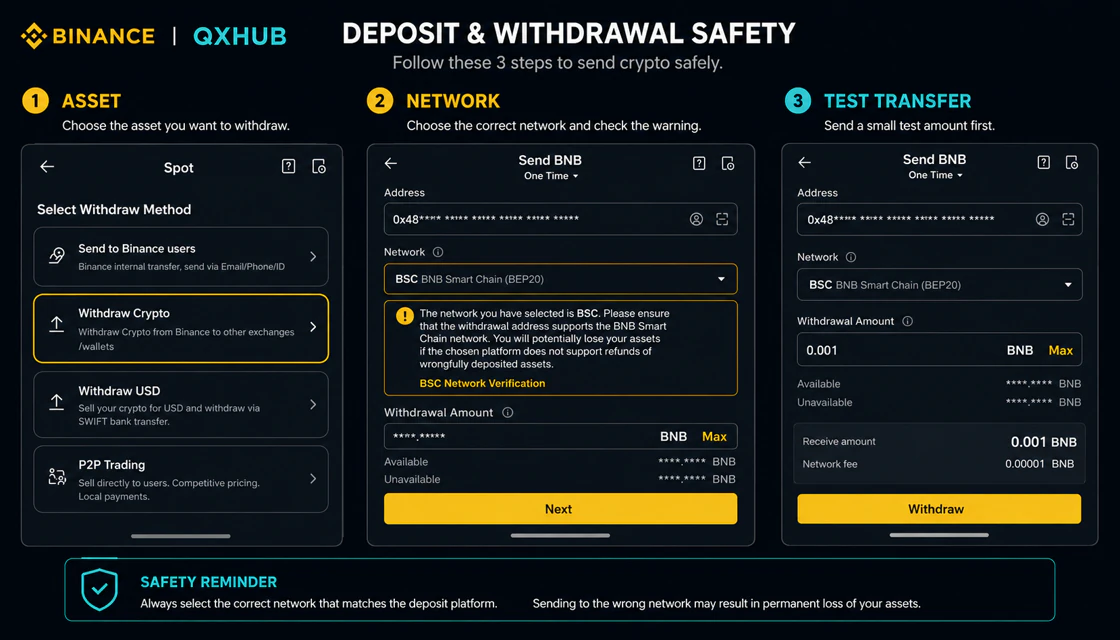
Every transfer should match asset, network, address and memo on both sides before a small test.
Safer crypto deposit workflow
- Choose Deposit, select the exact asset, then select a network supported by both the sending wallet and Binance.
- Copy the address and any required memo or tag. Compare the first and last characters on both devices.
- Check the minimum deposit and current network status. Send a small test amount when practical.
- Save the transaction hash and wait for Binance’s required confirmations before sending more.
Safer crypto withdrawal workflow
- Choose Withdraw, select the asset and enter the receiving address from the destination wallet.
- Select the same network shown by the receiving wallet. Enter a memo or tag when required.
- Review the displayed fee, minimum, arrival amount and any risk-control hold.
- Complete security checks, then verify status and the transaction hash in withdrawal history.
Network mismatch is a common irreversible error. Binance’s official guidance warns that a wrong address or memo can cause loss, and recovery is not always possible. Self-service recovery may help with some confirmed deposits, but it does not cover every asset, contract or withdrawal. Test first and never accept an address sent by an unofficial “support” account.
Security, custody and incident context
Account controls, reserve transparency and SAFU reduce specific risks but do not eliminate exchange or user risk.
Binance offers passkeys, authenticator-based 2FA, device management, anti-phishing codes, address controls and withdrawal risk checks. Its Proof of Reserves uses Merkle trees and zk-SNARKs so users can verify that their balances were included in a monthly snapshot. The official guide says snapshots are taken on the first day of the month and generally released by the seventh. A snapshot is useful transparency, but it is not a live balance sheet or a full audit of every liability and control.
SAFU is a separate emergency reserve established by Binance. Its official FAQ said the fund held crypto assets worth approximately US$1 billion as of February 2026, with value and composition able to change. SAFU is not the same as government deposit insurance and does not guarantee reimbursement for every loss, account compromise or market decline.
The 2019 security breach
On 7 May 2019, Binance disclosed a large-scale breach in which attackers withdrew 7,000 BTC in one transaction. Binance suspended deposits and withdrawals while reviewing security and said the loss would be covered by SAFU without affecting user funds. The event is old but relevant: large exchanges remain targets, and an operator’s current controls should be assessed alongside its incident history rather than treated as proof that another breach is impossible.
Security checklist
- Use a unique password plus a passkey or authenticator app; keep backup codes offline.
- Set an anti-phishing code and verify every domain, app publisher and support contact.
- Review devices, API keys and connected applications monthly; remove anything unused.
- Use withdrawal address controls and cooling periods where available.
- Keep API withdrawal permission disabled unless there is an exceptional, documented need.
- Verify Proof of Reserves inclusion while understanding snapshot and liability limitations.
- Keep long-term holdings off the exchange when self-custody is appropriate and understood.
App, platform usability and support
Binance Lite can reduce visual overload for basic buying and selling, while Pro exposes the order book, charts, order types, margin, derivatives and account transfers. The web platform is better for carefully checking addresses, order settings and fee history; the app is convenient but encourages faster decisions on a smaller screen. Beginners should configure security and complete their first transfer from a calm desktop session.
Binance provides a Support Center and 24/7 chat. Complex KYC, source-of-funds, fraud or recovery cases can require more time than a routine question. A useful request includes the account ID, date, product, asset, network, order or transaction ID, exact error text and redacted screenshots. Never send a seed phrase, password or one-time code.
Support quality is easier to judge through an operational test than a rating. Before holding a meaningful balance, locate the case-history page, learn how to freeze the account, confirm password-recovery access and save the official support route. If a transfer is delayed, communicate with transaction facts rather than opening repeated tickets or trusting anyone who contacts you first.
Advantages and disadvantages
| Advantages | Disadvantages / risks |
|---|---|
| Broad market and product range with deep liquidity on many major pairs. | The interface and product catalogue can overwhelm beginners. |
| Standard 0.10% spot fee and eligible BNB discount. | Total cost also includes spread, slippage, funding, provider and withdrawal fees. |
| Mature web/app tools, APIs and multiple order types. | Leverage, bots and copy features can magnify mistakes quickly. |
| Proof of Reserves tools, SAFU and multiple account controls. | PoR and SAFU are not full audits or government deposit insurance. |
| Multiple funding and withdrawal routes where supported. | Availability changes materially by country, entity, product and bank. |
| 24/7 chat and a large help center. | Compliance and recovery cases may be document-heavy or delayed. |
Practical beginner walkthrough
- Confirm that Binance and the exact product and payment route are available in your residence.
- Create one truthful account, complete KYC and enable passkey or 2FA, anti-phishing code and withdrawal controls.
- Use Demo Trading if eligible, or study the spot interface without placing an order. Learn Market, Limit and Stop concepts.
- Deposit a small amount with a matched network. Save the transaction hash and verify crediting.
- Choose a liquid major spot pair. Compare Convert and spot quotes, then place a small limit or market order.
- Record the spread, fill price, fee role, actual fee and average cost.
- Make a small withdrawal to a wallet you control. Verify asset, network, address, memo and arrival amount.
- Calculate the full round trip before increasing size. Keep only funds needed for the plan on the exchange.
Risk management rules
- Never use emergency funds, borrowed money or money needed for taxes and living expenses.
- Cap total exchange exposure and separate active trading funds from long-term holdings.
- Size spot positions for a severe decline; crypto can remain below your purchase price for years.
- Avoid leverage until you can explain mark price, maintenance margin, liquidation and funding without prompts.
- Do not average down or use martingale sizing simply to recover a loss.
- Treat yield as compensation for extra risk, not as guaranteed interest.
- Maintain transaction records and obtain qualified local tax advice where needed.
Beginner mistakes to avoid
- Registering or depositing before checking country and product eligibility.
- Choosing a cheap network that the receiving wallet does not support.
- Omitting a memo or tag, or pasting an address without independent verification.
- Assuming a limit order always receives a maker fee.
- Comparing only the 0.10% headline while ignoring spread and withdrawal cost.
- Turning on futures, margin, bots or copy trading before mastering spot.
- Leaving all holdings on the exchange because the brand is large.
- Treating Proof of Reserves or SAFU as a guarantee against every loss.
When to avoid Binance
- Your residence, customer type or intended product is restricted.
- You cannot complete KYC or source-of-funds requests honestly.
- You need insured deposits or a locally supervised bank-like product.
- You are trying to recover losses with leverage or a larger deposit.
- The selected network is suspended, unsupported or unclear on either side.
- You are being guided by an unofficial manager, recovery agent or messaging account.
- You do not understand the final quote, fee, custody route or withdrawal process.
Comparison context
Compared with WhiteBIT, Binance generally offers a wider global product catalogue and deeper liquidity on many major pairs, while WhiteBIT may feel more regionally focused for some European users. Compared with Phemex, Binance provides a broader ecosystem beyond active derivatives trading, but both platforms require strict separation between beginner spot use and high-risk leveraged products. Compared with a simple broker app, Binance offers more execution control but much more operational complexity. Compared with self-custody, it is easier for trading but requires trust in the exchange and its controls.
Choose by legal availability, liquidity on the exact pair, total cost, withdrawal reliability, security configuration and the task you actually need. No exchange is universally best. QXHUB’s Bybit, BingX and OKX reviews should use the same framework so later comparisons remain consistent.
A practical comparison uses one small real route on each eligible candidate: deposit the same asset, place a comparable spot order, record spread and fee, then withdraw over the same network. That exposes operational differences that feature tables miss. Stop the comparison if country rules, KYC, custody terms or the withdrawal path are unclear; a lower trading fee cannot compensate for an unusable account.
Summary
Binance is a feature-rich centralized exchange with liquid spot markets, a 0.10% standard spot fee, advanced trading products, account-security controls, Proof of Reserves and SAFU. Its scale does not remove risk. Eligibility is fragmented, KYC is required, payment methods vary, leverage can liquidate positions and custody remains with the operator while assets stay on the platform.
A disciplined beginner should check country rules, secure the account, practise first, deposit a small amount, buy only on spot, verify the actual fee and complete a test withdrawal. The best outcome may still be to avoid the platform if the legal route, product, cost or custody model does not fit.
FAQ
Is Binance available in the United States?
The global Binance.com platform is not the route for U.S. users. Do not use location tools or false information to bypass restrictions; check the separately operated local service and applicable law.
Does Binance require KYC?
Binance says identity verification is required before trading. The process typically includes personal information, ID documentation and facial verification, with additional checks possible.
What are Binance spot fees?
The published standard rate for a regular user is 0.10% per completed trade, verified 20 August 2026. VIP tiers, pair promotions and an eligible BNB deduction can change the actual fee.
Does Binance offer a BNB fee discount?
Binance states that eligible users can receive up to 25% off Spot and Margin trading fees and up to 10% off Futures fees when BNB deduction is enabled and conditions are met.
Are Binance crypto deposits free?
Binance normally does not charge a platform deposit fee for standard on-chain deposits, but the sending wallet or blockchain can charge a network fee.
How much is a Binance withdrawal?
The fee and minimum depend on the asset and network and are displayed before confirmation. Check the live screen because network conditions and maintenance change.
Is Binance safe?
Binance has extensive controls, Proof of Reserves and SAFU, but no centralized exchange is risk-free. It suffered a 7,000 BTC breach in 2019, and user mistakes, custody risk and market losses remain possible.
Does Proof of Reserves guarantee solvency?
No. It helps verify included balances and published assets at a snapshot, but it is not a complete real-time financial audit or deposit insurance.
Is Binance good for beginners?
It can be used carefully through Lite or spot, but the broader interface is complex. Beginners should avoid margin and derivatives, start small and test a withdrawal.
Can I use Binance without leverage?
Yes. Spot and Convert can be used without borrowing or futures leverage, subject to regional availability.
Should I keep long-term crypto on Binance?
Keep only what the active plan requires. Consider self-custody for longer-term holdings if you understand seed security, backups and recovery.
What should I do if a deposit is missing?
Check the transaction status, network, address, memo and required confirmations. Use Binance’s official self-service recovery or 24/7 support with the transaction hash; never share keys or codes.
Crypto exchanges
Crypto assets are volatile. Exchange access, products and fees vary by country and can change. Verify the live terms before registration or funding.


