
Crypto exchange review
Bybit Review 2026: Fees, KYC, Security, Pros and Cons
Read an evidence-based Bybit review covering current fees, KYC, regional restrictions, markets, deposits, withdrawals, security and beginner steps.

Crypto trading and custody involve loss, operational and counterparty risk. This review is educational, not personal investment advice.
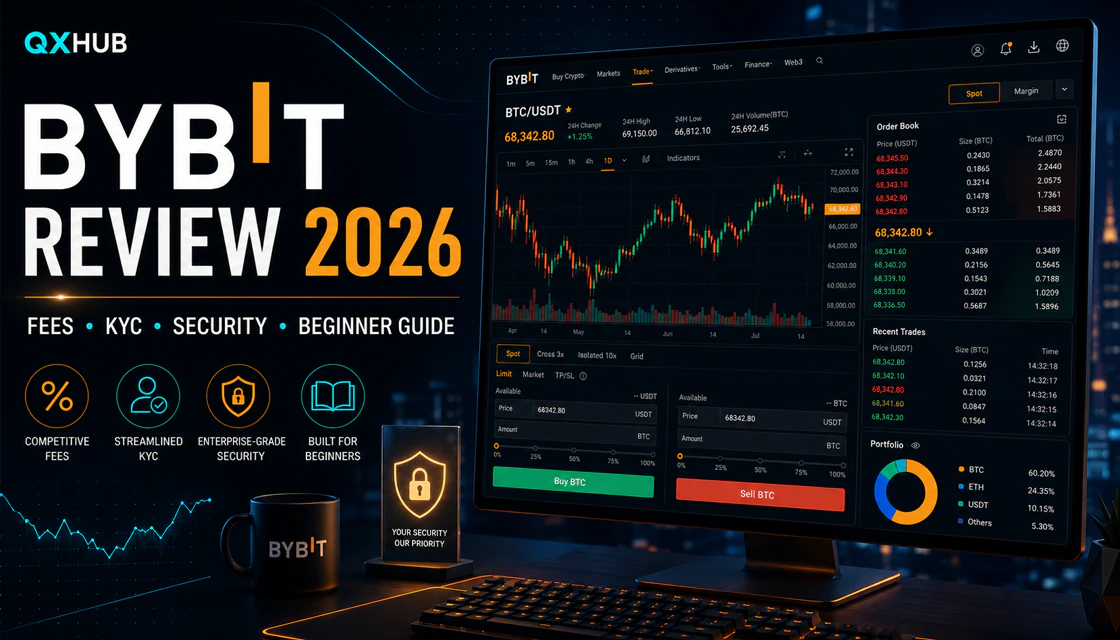
Bybit review: the short answer
- Bybit combines spot and advanced trading products in a capable Unified Trading Account, but access and individual products vary materially by country and legal entity.
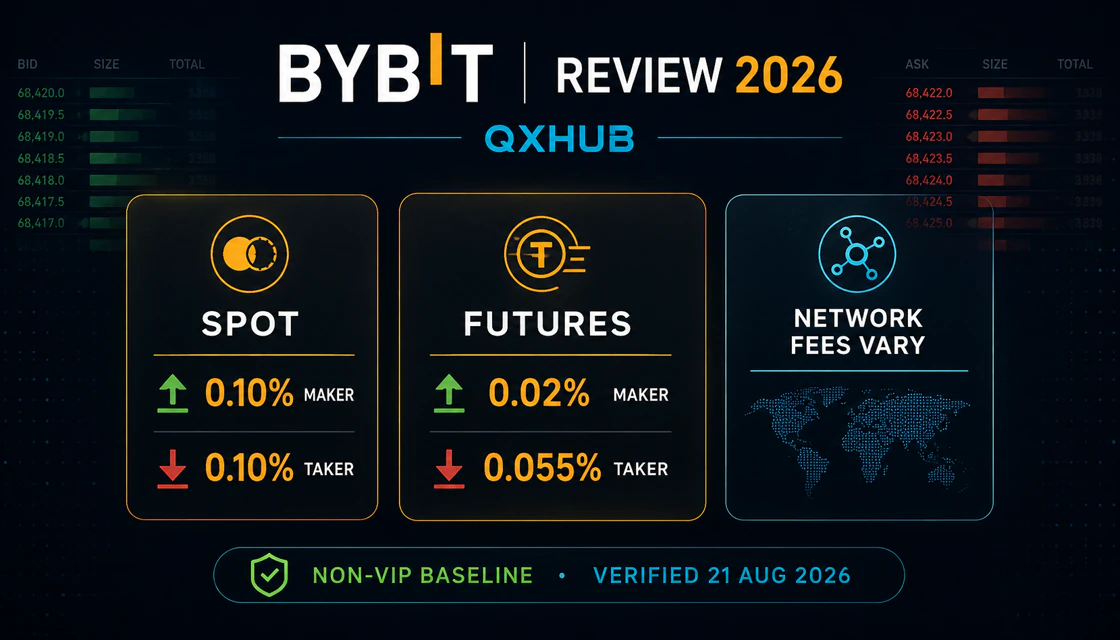
- The published non-VIP baseline is 0.10% maker and taker for crypto spot and 0.02% maker / 0.055% taker for perpetuals and futures; the live account fee page remains the final check.
- A cautious beginner route is honest KYC, strong account security, Demo Trading, a small spot transaction and a verified test withdrawal without leverage.
Who Bybit suits — and who should skip it
Potentially suitable for
- Spot traders who want market, limit and conditional order tools in a structured web or mobile terminal.
- Intermediate users who understand derivatives, funding, collateral and liquidation before opening a position.
- Beginners willing to use Demo Trading first and keep the live account spot-only during the learning phase.
- Users who value passkeys, authenticator 2FA, anti-phishing codes, secure transaction approval and withdrawal-address controls.
- Traders who need one account architecture for spot and eligible derivatives products.
Usually a poor fit for
- Residents of a restricted jurisdiction or users whose required product is not offered by their local Bybit entity.
- Anyone seeking an insured savings account, guaranteed yield or guaranteed asset recovery after an exchange failure.
- First-time buyers likely to confuse a low margin requirement with a small position risk.
- Long-term holders who do not need exchange liquidity and are prepared to manage self-custody correctly.
- Users who cannot complete identity verification or document the source of funds when requested.
Availability and material regional restrictions
Bybit does not provide one identical global service. Its official restricted-countries page, checked on 21 August 2026, lists locations that include the United States, mainland China, Hong Kong, Singapore, Canada, North Korea, Cuba, Iran, Uzbekistan, Sudan and Syria, plus several specifically named territories. The page also notes entity-specific restrictions, including Dubai for one operator. Wording and scope can change, and a locally regulated Bybit entity may use separate terms, onboarding or product limits.
Derivatives, fiat deposits, cards, P2P, Earn products and promotions can have narrower coverage than the main exchange. A service being visible in a search result or app store does not prove that it is permitted for your residency. Read the current restricted-country notice, the terms shown during onboarding and the page for the exact product you want. Do not use a VPN or false residency details to bypass controls; that can trigger failed KYC, withdrawal reviews or account closure.
Account creation and KYC
How to create an account safely
- Open bybit.com from a trusted bookmark or use the official app-store listing. Check the domain and developer before entering credentials.
- Register with an available method. Use a unique password stored in a password manager; never reuse an email password.
- Complete email or phone verification, then sign in from a trusted device and review active sessions.
- Enable a passkey or authenticator-app 2FA, create an anti-phishing code and configure secure transaction approval before funding.
- Complete identity verification through the in-account flow. Ignore anyone offering verification through Telegram, WhatsApp or direct messages.
What KYC normally involves
Bybit’s Individual KYC FAQ says at least Standard identity verification is mandatory for all products and services. Expect legal name, date of birth, country information, a government-issued identity document and a liveness or facial check. Depending on region, product, account activity and risk review, Bybit may request higher verification, proof of address, tax or source-of-funds information. Limits and accepted documents are shown in the current verification flow.
Use clear, uncropped images; enter names exactly as they appear on the document; avoid glare; and complete the process on your own device. KYC does not make trading safe, but it is part of the platform’s access and compliance framework. If a submission fails, use the official support route and never share a password, seed phrase or one-time code.
Markets and products on Bybit
Bybit’s Unified Trading Account can support spot, spot margin, perpetuals, futures and options without constant account switching. That convenience also means collateral relationships can become harder to understand. A beginner should disable or ignore borrowing, margin and derivatives until they can explain notional value, initial margin, maintenance margin, liquidation price and funding in plain language.
| Product | What it does | Beginner view |
|---|---|---|
| Spot | Buys or sells the listed crypto asset for immediate settlement. | Best starting point; still carries volatility, liquidity and custody risk. |
| Convert / Buy Crypto | Uses a simplified quote or third-party payment route. | Convenient; compare the final received amount with the spot order book. |
| Spot margin | Borrows against collateral to enlarge spot exposure. | Adds interest, collateral and liquidation risk; skip while learning. |
| Perpetuals / futures | Trades derivatives linked to an asset price, often with leverage and funding. | High risk; losses and liquidation can develop quickly. |
| Options | Trades time-limited contracts with non-linear risk. | Requires options knowledge; not a beginner product. |
| Earn / staking | Places eligible assets in flexible, fixed or on-chain yield products. | Yield is variable; assess lock-up, counterparty and smart-contract risk. |
| Bots / copy trading | Automates rules or follows another account’s positions. | Automation and popularity do not remove market risk. |
| P2P / Web3 | Provides counterparty-based fiat exchange or on-chain tools. | Adds merchant, scam, wallet, token and smart-contract risks. |
Bybit fees — verified 21 August 2026
Published non-VIP baselines are a comparison starting point; the live order preview remains authoritative.
Maker and taker describe how an order executes, not simply whether it is called limit or market. A limit order that immediately matches resting liquidity can be a taker order. At the published 0.10% spot rate, a $1,000 completed spot trade costs $1 in trading fees before tier adjustments. At 0.055%, a $10,000 futures taker fill costs $5.50 to enter; closing creates another fee, and funding may apply. Leverage changes the required margin, not the notional value used for fee and exposure calculations.
| Fee category | Current published baseline | What can change |
|---|---|---|
| Spot trading | 0.10% maker / 0.10% taker for non-VIP users. | VIP tier, pair, promotion, region and actual maker/taker execution role. |
| Perpetual & futures | 0.02% maker / 0.055% taker for non-VIP users. | Contract, VIP tier, region, liquidation and funding payments. |
| Crypto deposit | Bybit does not charge a platform fee for a standard on-chain deposit. | The sending wallet or blockchain can charge a network fee; minimums apply. |
| Crypto withdrawal | Asset- and network-specific amount shown before confirmation. | Chain conditions, asset, network, minimum and account controls. |
| Fiat / card / P2P | Route-, provider-, currency- and region-dependent. | Payment provider, bank, merchant role, KYC and local pricing. |
| Derivatives funding | Variable transfer between long and short positions at the displayed interval. | Contract and market imbalance; check live rate and next funding time. |
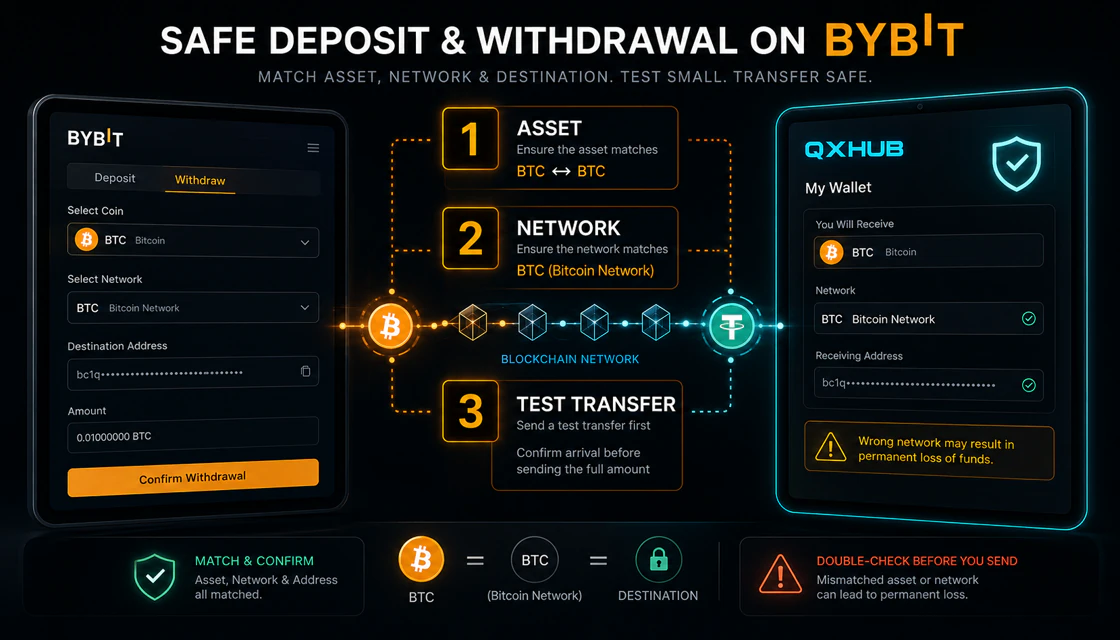
Deposits and withdrawals
A safe transfer matches the asset, network and destination, then confirms a small test before scaling up.
Crypto deposit workflow
- Open Assets, choose Deposit, then select the exact coin and supported network.
- Confirm the sending wallet supports the same network. A token name appearing on two chains does not make the networks interchangeable.
- Copy the deposit address and any required memo or tag. Verify the first and last characters on both devices.
- Check Bybit’s displayed minimum. A deposit below the minimum may not be credited or recoverable.
- Send a small test amount when network economics allow, save the transaction hash and wait for credit before sending more.
Crypto withdrawal workflow
- Open Assets, choose Withdraw, select the coin and a network accepted by the receiving wallet or exchange.
- Paste the destination, add any required memo or tag, and verify the full destination independently.
- Review the minimum, network fee, amount to receive and any risk warning. A risky address warning is a reason to pause, not click through.
- Complete the required email, passkey, 2FA or secure-approval checks and track the blockchain transaction hash.
Fiat deposits and withdrawals depend on KYC, currency, country and banking provider. A card purchase can combine an exchange quote, provider fee and foreign-exchange cost. P2P adds merchant and payment-dispute risk. Compare the final amount received, not only a headline fee. Never accept off-platform payment instructions or release crypto before the payment is irreversibly confirmed in your own bank account.
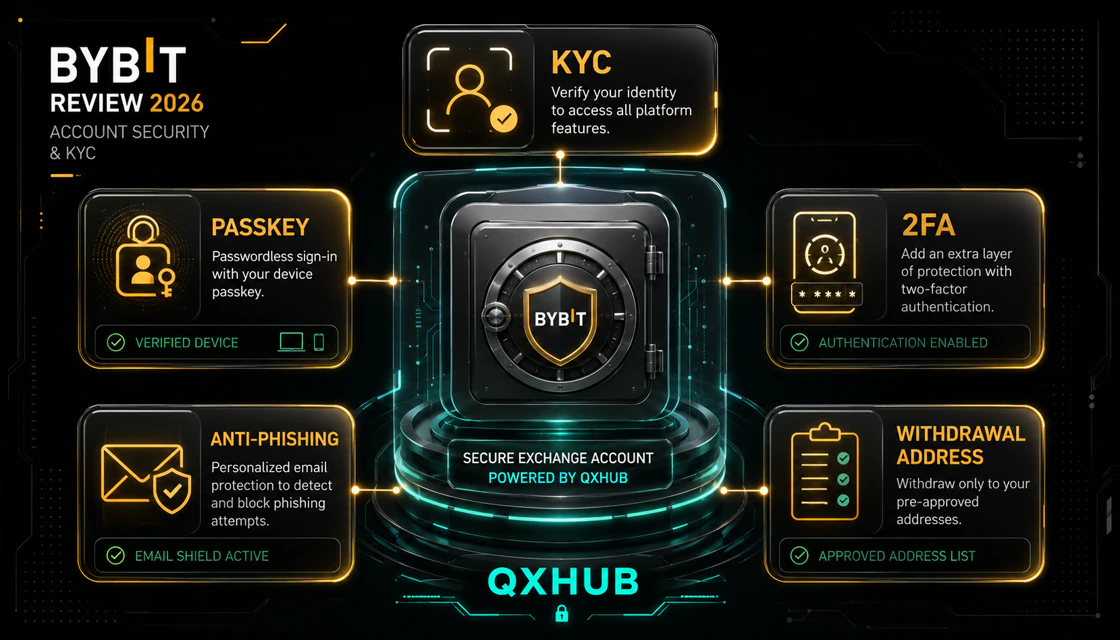
Security, custody and the February 2025 incident
Layered controls reduce account-takeover risk, but no control eliminates exchange or custody risk.
Bybit supports controls such as passkeys, authenticator 2FA, an anti-phishing code, secure transaction approval, device and session review, and approved withdrawal addresses. Its proof-of-reserves process allows eligible users to verify inclusion of balances in a published Merkle-tree snapshot and review wallet-ownership evidence. Proof of reserves is useful transparency, but it is not a complete audit of liabilities, governance, liquidity, legal claims or future solvency.
On 21 February 2025, an attacker manipulated a signing workflow connected to Bybit’s Ethereum cold wallet and moved roughly $1.5 billion in assets. Bybit publicly said the exchange remained solvent, withdrawals continued and client balances were backed. The incident did not mean every customer account was individually hacked, but it demonstrated that cold-wallet operations and third-party signing infrastructure can fail. An honest review should neither ignore the event nor claim that it makes a future loss inevitable.
Practical security setup
- Create a dedicated email address and unique password. Secure the email account with its own passkey or authenticator 2FA.
- Enable a Bybit passkey or authenticator-app 2FA and save recovery material offline. Avoid SMS as the only defense where alternatives exist.
- Set an anti-phishing code. Treat an email without the correct code as suspicious and open Bybit from your bookmark instead of the message.
- Enable secure transaction approval and withdrawal-address controls. Add addresses only after independent verification and a test transfer.
- Review device sessions and API keys regularly. Remove old devices, disable unused keys and never grant withdrawal permission to a trading API.
- Keep only the amount needed for trading or near-term activity. Consider appropriate self-custody for long-term holdings, but learn backup and seed security first.
App, web platform and customer support
The web terminal is information-dense: chart, order book, recent trades, order ticket, positions and account metrics can appear together. Experienced users may value that density; beginners can easily miss whether they are in Spot, Margin or Derivatives. The mobile app offers broad functionality, but a small screen raises the cost of a rushed network selection or oversized order. Use the web version for first-time setup and large transfers when possible, then confirm that app settings match.
Support is available through Bybit’s help center, in-product assistance and case submission. Response time and outcome vary with demand and the complexity of compliance or blockchain investigations. Preserve screenshots, order IDs, transaction hashes, timestamps, UID and network details. A support agent does not need your password, authenticator code or seed phrase. Social-media replies and search ads are common impersonation routes; start from the official site or app.
Practical beginner walkthrough: first spot purchase
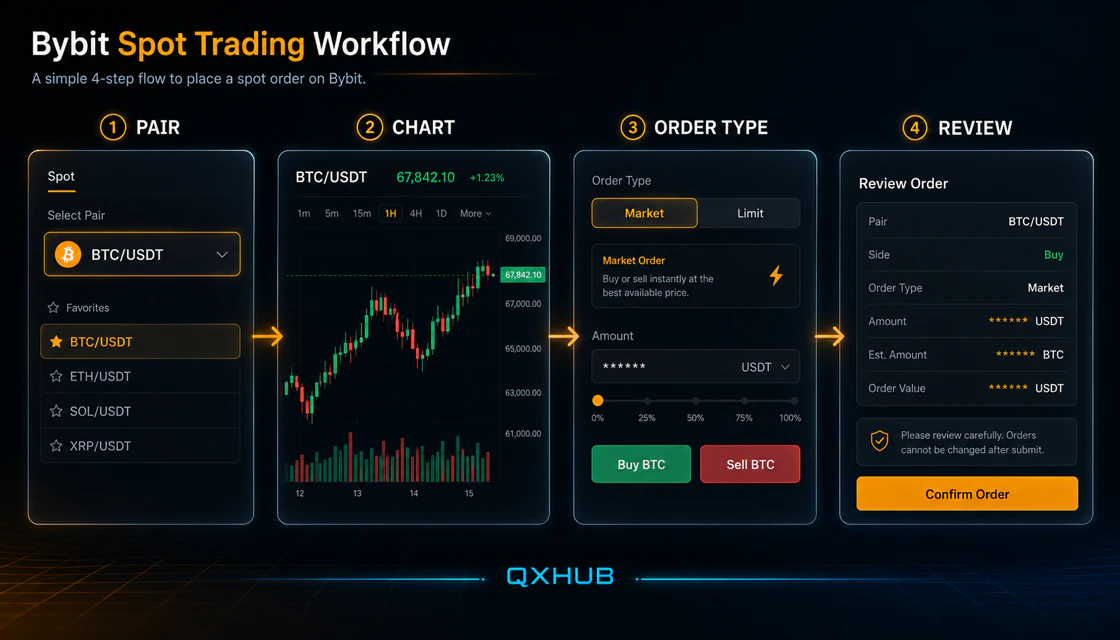
The beginner workflow separates pair selection, chart review, order choice and final confirmation.
- Verify that Bybit and the spot market are available in your jurisdiction. Complete KYC and the security setup before depositing.
- Open Demo Trading. Practise selecting BTC/USDT, switching between market and limit orders, cancelling an open order and finding trade history.
- Fund the live account with a small amount using a supported route. If using crypto, match asset and network and make a test deposit.
- Move only the required balance into the trading account structure shown by your interface. Confirm that borrowing or margin is off.
- Open Spot, select a liquid pair and inspect the spread and order book. Avoid a market order when liquidity is thin or the spread is wide.
- Enter a modest amount. For a limit order, set the maximum acceptable price; understand that the order may remain unfilled.
- Review pair, side, amount, order type, estimated fee and resulting asset before confirming. Save the trade record.
- After the purchase, practise a small withdrawal to a wallet you control or another verified destination. Confirm arrival before increasing size.
Demo practice task: a 12-action proficiency test
Use Bybit Demo Trading or a paper log before funding. The goal is operational accuracy, not simulated profit. Complete all actions without rushing: find a pair; read bid, ask and spread; place and cancel a limit order; place a small market order; locate fees; find order history; find trade history; identify a stop-loss control; switch away from derivatives; locate deposit networks; locate the withdrawal preview; and explain why a wrong network can cause loss. Repeat until every action is intentional.
Record expected price, actual fill, slippage, fee, order status and one sentence about what could go wrong. If you cannot reconstruct the result from history, you are not ready to scale. Demo execution does not reproduce live liquidity, emotions, slippage or withdrawal controls, so pass the test and still begin small.
Risk management rules for Bybit users
- Keep the learning account spot-only. Do not enable margin or derivatives because the interface offers them.
- Define a maximum exchange balance based on custody risk, not only trading opportunity.
- For speculative trades, risk a small pre-defined fraction of capital and size from the stop distance; never size from maximum leverage.
- Assume every transfer can be irreversible. Match asset, network, address and memo, then test.
- Separate trading funds from emergency savings and long-term holdings.
- Avoid concentrated exposure to one coin, stablecoin, exchange or chain.
- Stop after an operational mistake. Fix the process before making another transaction.
Crypto assets can move sharply, stablecoins can lose their peg, exchanges can suspend withdrawals, networks can congest and derivatives can liquidate positions. No security badge, reserve snapshot, VIP tier or stop order removes those risks. Stop orders can slip or fail in dislocated markets, and self-custody introduces seed-loss and transaction risks of its own.
Common beginner mistakes
| Mistake | Why it hurts | Better practice |
|---|---|---|
| Using the wrong product | A futures contract can look like spot while adding leverage, funding and liquidation. | Confirm the market label and keep margin disabled. |
| Choosing a network by fee alone | The destination may not support it, causing delay or loss. | Match both endpoints and test first. |
| Ignoring maker/taker execution | A limit order can still take liquidity and pay the taker rate. | Use the preview and trade history; use post-only only if understood. |
| Keeping everything on-exchange | Convenience creates concentrated custody and platform risk. | Set an exchange-balance policy and withdraw excess appropriately. |
| Trusting a copied trader or bot | Past results hide leverage, survivorship bias and changing conditions. | Understand each rule and cap loss independently. |
| Responding to fake support | Impersonators exploit urgent withdrawals and KYC problems. | Start from the official app/site; never share secrets. |
| Skipping records | Fees, tax reporting and troubleshooting become harder. | Export histories and store transaction hashes regularly. |
Advantages and disadvantages
| Advantages | Disadvantages |
|---|---|
| Broad spot and derivatives toolset in a Unified Trading Account. | Interface breadth can overwhelm beginners and expose them to high-risk products. |
| Competitive published non-VIP spot and futures fees. | Total cost varies with funding, networks, providers, spread and execution. |
| Demo Trading and advanced order controls support structured practice. | Demo performance does not reproduce live liquidity, emotion or custody risk. |
| Passkeys, 2FA, anti-phishing and withdrawal controls are available. | Security controls cannot eliminate platform, operational or counterparty risk. |
| Proof-of-reserves verification offers useful transparency. | A reserve snapshot is not a complete liability, governance or solvency audit. |
| Web and mobile platforms support active trading workflows. | Availability and products differ materially by region and legal entity. |
When to avoid Bybit
- Your country, territory or required product appears on the current restriction list.
- You want a bank account, deposit insurance, guaranteed yield or capital protection.
- You cannot complete KYC or provide legitimate source-of-funds documentation.
- You are prone to revenge trading, excessive leverage, copy-trading dependence or compulsive checking.
- You need a simple occasional purchase and a regulated local on-ramp offers clearer legal recourse and lower total cost.
- You cannot secure email, passkeys, 2FA and withdrawal destinations reliably.
Comparison context: Bybit vs Binance, Phemex and WhiteBIT
Bybit is best compared as an active-trading exchange. Binance generally offers a similarly broad ecosystem and may have stronger local entities or fiat routes in some markets, but access and products still vary. Phemex is also trading-focused and may feel leaner, while Bybit’s Unified Trading Account and product depth can be more extensive. WhiteBIT may be attractive to users focused on selected European and Ukrainian-market rails, though its availability and product range must also be verified locally.
Do not choose by brand size or headline fee alone. Compare legal availability, the exact fiat or crypto route, spot liquidity for your pair, withdrawal networks, account controls, support documentation, incident history and total cost for a realistic transaction. A platform that is excellent for derivatives can be unnecessary for a monthly spot buyer; a simpler regional service can be better if it provides clearer recourse and cheaper funding.
Summary checklist
- Confirm country, Bybit entity, product and payment route before registration.
- Complete Standard KYC and any higher checks legitimately requested.
- Enable passkey or authenticator 2FA, anti-phishing code, secure approval and withdrawal-address controls.
- Practise in Demo Trading; begin live activity with spot and a small balance.
- Check live fees, spread, funding and network charges for the exact transaction.
- Match asset, network, address and memo; test deposits and withdrawals.
- Keep long-term custody and trading liquidity as separate decisions.
FAQ
Is Bybit safe?
No crypto exchange is simply safe or unsafe. Bybit offers meaningful account controls and reserve-verification tools, but users still face market, custody, operational, legal and cybersecurity risk. The February 2025 cold-wallet incident is part of that assessment. Use layered security, limit exchange balances and verify withdrawals.
Does Bybit require KYC?
Yes. Bybit’s current Individual KYC FAQ says at least Standard identity verification is mandatory for all products and services. Higher checks can depend on region, product, limits and risk review.
What are Bybit spot fees?
The published non-VIP baseline checked on 21 August 2026 is 0.10% maker and 0.10% taker. VIP tier, pair, promotion, region and execution role can change the actual fee.
What are Bybit futures fees?
The published non-VIP baseline is 0.02% maker and 0.055% taker for perpetual and futures trading. Funding, liquidation and closing fees can add cost. Derivatives are high risk.
Can US users use Bybit?
Bybit’s official restricted-countries page lists the United States. Do not attempt to bypass the restriction with a VPN or false residency information.
Does Bybit charge crypto deposit fees?
Bybit does not charge a platform fee for a standard supported on-chain deposit, but the sending wallet or blockchain may charge a network fee. The deposit must meet the displayed minimum and use the correct network.
How long does a withdrawal take?
There is no universal time. Internal review, asset, network congestion, confirmation requirements and receiving-platform processing all matter. Use the live status and transaction hash; contact official support with complete evidence if the blockchain status and account status disagree.
Is Bybit good for beginners?
It can be if a beginner uses Demo Trading, keeps the live account spot-only, starts small and follows a transfer checklist. The product density and easy visibility of leverage make it unsuitable for an impulsive beginner.
What is Bybit Demo Trading?
It is a simulated environment for practising platform actions without risking live funds. It helps with mechanics but does not reproduce live liquidity, slippage, emotion, custody or withdrawal conditions.
Should I keep crypto on Bybit?
Keep only the balance needed for intended exchange activity under a written policy. Long-term self-custody can reduce exchange exposure but adds responsibility for seed backups, devices and irreversible transactions.
What should I do if a deposit is missing?
Check the asset, network, destination address, memo or tag, minimum amount and blockchain confirmations. Save the transaction hash and contact official support from the site or app. Never send a seed phrase or one-time code.
Is Bybit better than Binance or Phemex?
There is no universal winner. Compare legal access, required markets, real funding and withdrawal routes, liquidity, total cost, account controls and support in your jurisdiction. Choose the simplest platform that reliably serves the intended task.
Crypto exchanges
Crypto assets are volatile. Exchange access, products and fees vary by country and can change. Verify the live terms before registration or funding.


