
Crypto exchange review
OKX Review 2026: Fees, KYC, Security, Pros and Cons
Read an evidence-based OKX review covering current fees, KYC, restrictions, products, deposits, withdrawals, security and a cautious spot workflow.
Crypto trading and custody involve loss, operational and counterparty risk. This review is educational, not personal investment advice.
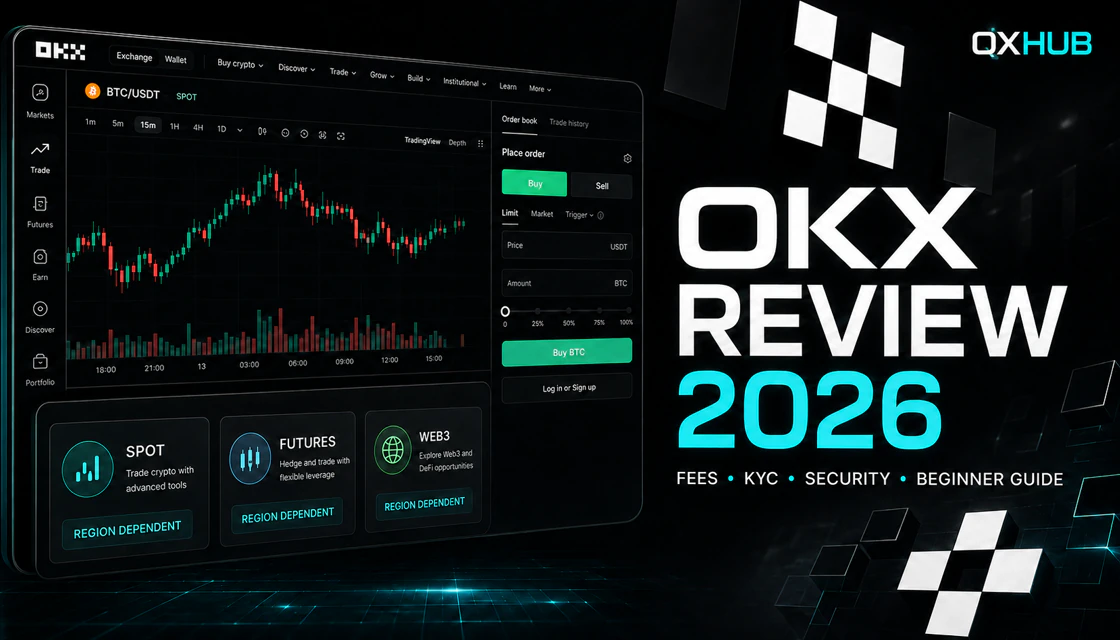
OKX review: the short answer
- OKX combines a mature spot terminal, Demo Trading and broad advanced tools, but the available entity, products and protections differ materially by country.
- The published global regular-user baseline is 0.0800% maker and 0.1000% taker for standard spot groups and 0.0200% maker / 0.0500% taker for futures; confirm the local fee page and order preview.
- A cautious beginner route is honest KYC, layered account security, Demo Trading, a small spot transaction and a verified test withdrawal without leverage.
Who OKX suits — and who should skip it
Potentially suitable for
- Eligible spot traders who want market, limit, stop and conditional order tools.
- Beginners willing to use Demo Trading and keep the first live account spot-only.
- Experienced users who understand derivatives, collateral, funding and liquidation before enabling them.
- Users who value authenticator 2FA, anti-phishing controls, withdrawal allowlists and reserve transparency.
- Traders who may later need APIs, bots, options or Web3 tools and can assess each risk separately.
Usually a poor fit for
- Residents of a restricted location or anyone whose intended product is unavailable under the local entity.
- First-time buyers likely to confuse a polished interface with low market or custody risk.
- Users seeking an insured bank account, guaranteed yield or guaranteed access to withdrawals.
- Long-term holders who do not need exchange liquidity and can manage self-custody correctly.
- Anyone unable to complete KYC or document source of funds when legitimately requested.
Availability and regional restrictions
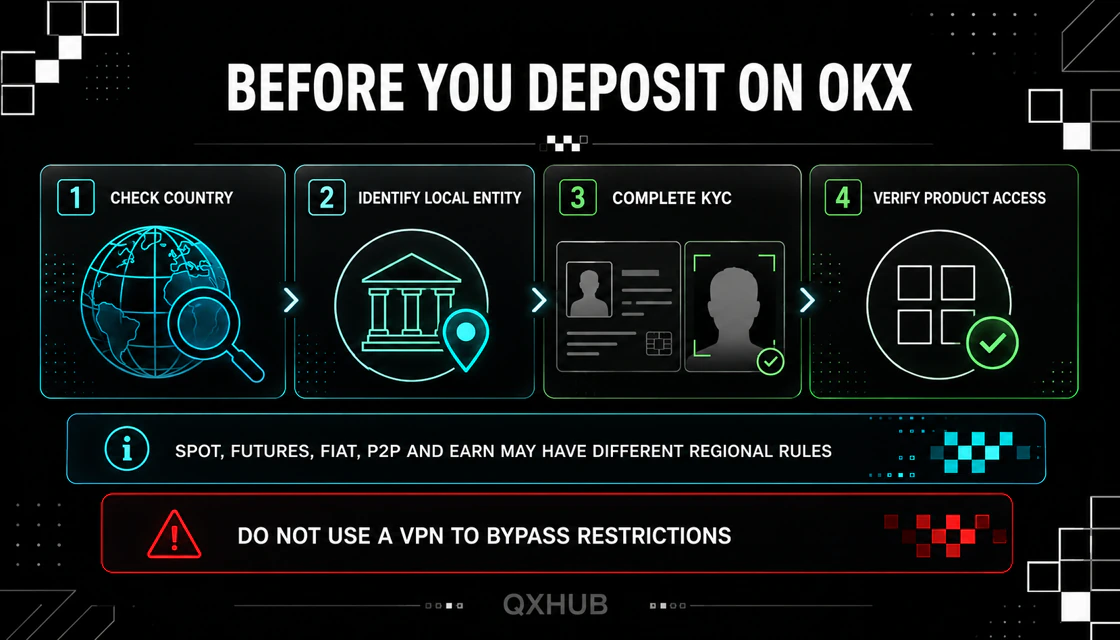
Eligibility must be checked by country, contracting entity, KYC status and exact product.
OKX’s Risk and Compliance Disclosure, checked 22 August 2026, lists restricted locations including Afghanistan, Canada, Cuba, Hong Kong, Iran, India, Japan, Malaysia, Nepal, North Korea, Syria, Uzbekistan and the Crimea, Donetsk and Luhansk regions of Ukraine, plus certain U.S. jurisdictions and territories. The same disclosure names product-specific restrictions in Australia, the Bahamas, Brazil, Eritrea, Russia, South Korea and the United Kingdom.
The general Terms, last updated 24 July 2026, identify several service providers for markets including the EEA, United States, Australia, UAE, Brazil, Latin America and Singapore. A locally available OKX brand does not mean that derivatives, Earn, P2P, fiat and Web3 functions are all available. Read the entity name shown during onboarding and the local fee page. Do not use a VPN, false residence or another person’s identity to bypass controls.
Registration and KYC
How to create an account safely
- Open okx.com from a trusted bookmark or use the verified app-store listing. Check the domain and developer.
- Register with an available email or phone method and create a unique password in a password manager.
- Verify the contact method, then review devices and sessions before funding.
- Enable authenticator 2FA, an anti-phishing code and the available withdrawal allowlist or large-withdrawal protection.
- Complete identity verification only inside the official website or app.
What OKX verification requires
OKX states that an individual account must complete advanced identity verification to trade, deposit and withdraw. The current flow asks for country of residence, nationality, full name, date of birth, residential address and an eligible government-issued ID. It also requires a selfie or facial check and can request proof of address. When proof of address is requested, OKX says it generally must be issued within six months for EEA users and three months in other regions.
Use an unexpired original document, show every corner, avoid glare and never upload a screenshot of an ID. OKX says many reviews can be fast, while further review can take up to 24 hours; this is an estimate, not a promise. Re-verification or enhanced due diligence can be requested later. Support does not need your password, seed phrase or authenticator code.
Markets and products
Do not confuse OKX Exchange with OKX Wallet. The exchange is custodial: OKX controls private keys for exchange balances. The Web3 wallet is self-custodial: the user controls recovery material and approves transactions. Moving between them is an on-chain action with irreversible network and contract risks.
| Product | What it does | Beginner view |
|---|---|---|
| Spot | Buys or sells the listed asset for immediate settlement. | Best starting point; volatility and custody risk remain. |
| Convert / Buy crypto | Uses a simplified quote or regional payment route. | Convenient; compare final received value with spot. |
| Margin | Borrows against collateral to enlarge exposure. | Adds interest and liquidation risk; skip while learning. |
| Perpetual / expiry futures | Trades derivatives with leverage, margin and funding or settlement. | High risk; notional exposure can exceed deposited margin. |
| Options / events | Trades non-linear or outcome contracts where available. | Requires product-specific knowledge. |
| Bots / copy trading | Automates rules or mirrors another trader. | Automation and popularity do not remove drawdowns. |
| Earn / structured products | Offers flexible, on-chain or structured yield routes. | Assess lock-up, counterparty and protocol risk. |
| OKX Wallet / DEX | Self-custody wallet and on-chain trading tools. | Seed, token, bridge and smart-contract risks apply. |
OKX fees — verified 22 August 2026
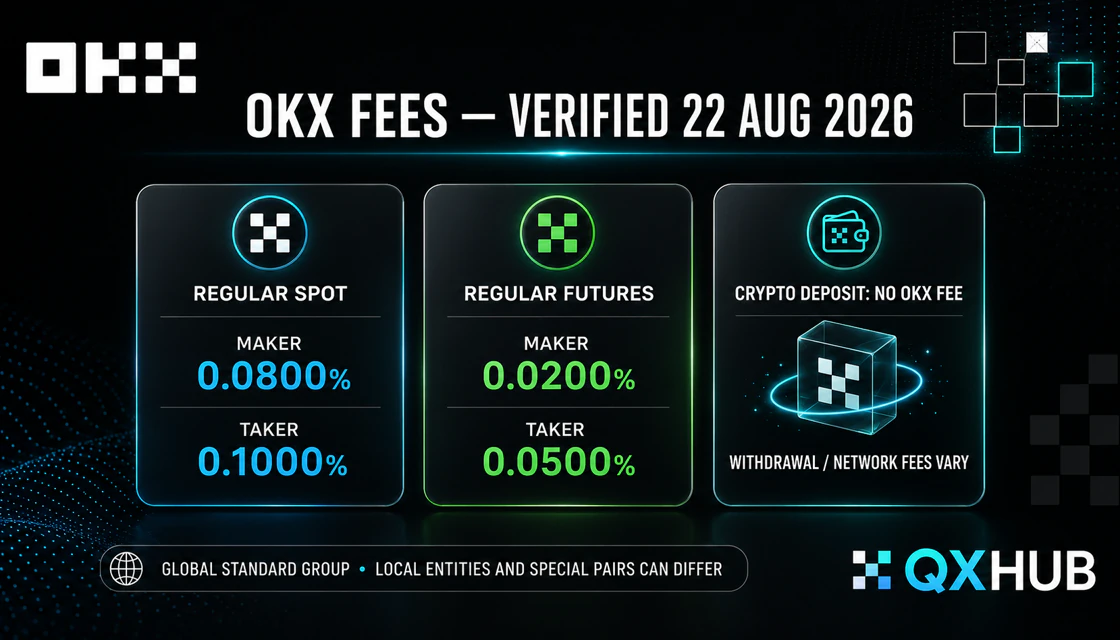
Global regular-user baselines help planning; the local entity and live pair screen remain authoritative.
The global fee framework effective from 25 November 2025 places standard spot pairs in groups. A regular user pays 0.0800% maker and 0.1000% taker on the main groups, while special-rule and zero-fee pairs differ. OKX has announced selected VIP and stablecoin-pair changes effective in September 2026, after this review date. Recheck the live fee page at publication and before trading.
At 0.1000%, a $1,000 spot taker fill costs $1 before spread. At 0.0500%, a $10,000 futures taker fill costs $5 to enter; closing creates another fee and funding may apply. Leverage changes required margin, not notional exposure. A limit order is maker only if it rests on the book; a crossing limit can execute as taker.
| Fee category | Published global baseline | What can change |
|---|---|---|
| Regular spot | 0.0800% maker / 0.1000% taker for standard groups. | Entity, pair group, special pair, tier and promotion. |
| Regular futures | 0.0200% maker / 0.0500% taker. | Eligibility, contract, tier, funding and liquidation. |
| Regular options | 0.0300% maker / 0.0300% taker globally. | Entity, product and tier. |
| Crypto deposit | No OKX receiving fee for a standard deposit. | Sender/network fee, minimum and supported chain. |
| Crypto withdrawal | Asset- and network-specific fee shown live. | Chain, asset, minimum and security review. |
| Fiat / card / P2P | Provider-, bank-, currency- and region-dependent. | Spread, FX, merchant role and local pricing. |
| Futures funding | Variable transfer at the displayed interval. | Contract, side, notional size and holding time. |
Deposits and withdrawals
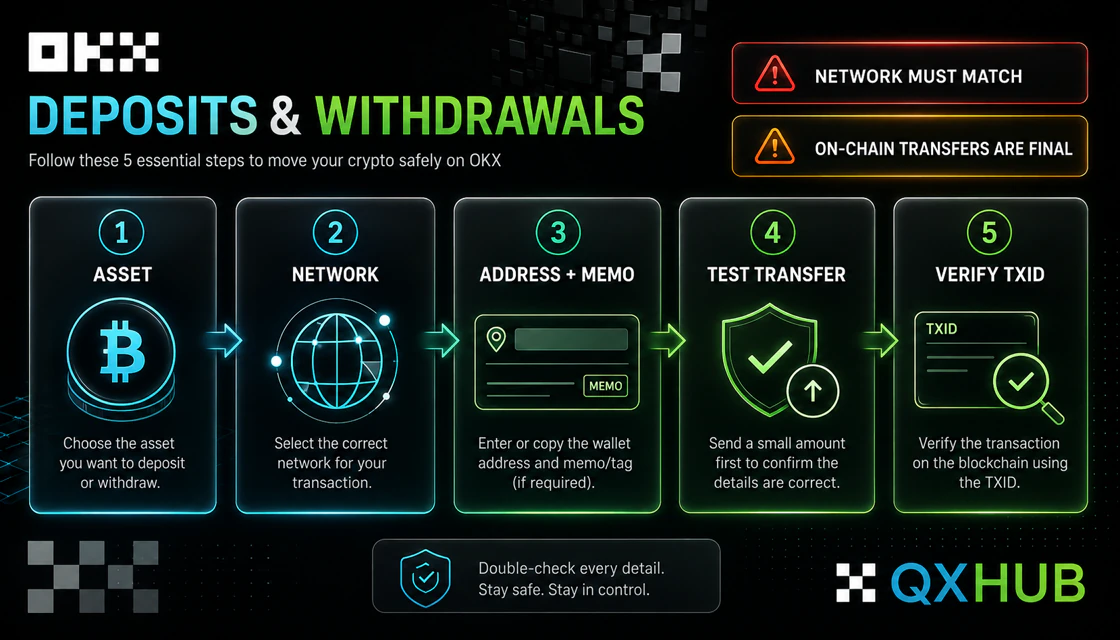
A safe transfer matches asset, network, address and memo, then tests the route before scaling.
Crypto deposit workflow
- Open Assets or Deposit in the official exchange interface and select the exact coin.
- Choose a network supported by both OKX and the sending wallet or exchange.
- Copy the deposit address and required memo or tag; verify it independently.
- Check the minimum and send a small test amount when economical.
- Save the TxID and wait for the credited balance before sending more.
Crypto withdrawal workflow
- Select Withdraw and choose on-chain or internal transfer only when the recipient route is clear.
- Choose the asset and network accepted by the destination; paste the address and memo or tag.
- Review the fee, arrival amount, minimum and security warning. Use an allowlisted address for regular destinations.
- Complete authentication and any requested security review. Do not approve an unexpected prompt.
- Track the TxID. Never send again merely because the first transfer is pending.
OKX states that standard crypto deposits do not carry an OKX receiving fee; the withdrawing side pays the network-related fee. Fiat deposits and withdrawals vary by entity, bank, currency and payment method. The preview screen is authoritative. P2P adds merchant, chargeback and social-engineering risk: stay on-platform and release crypto only after irreversible payment appears in your own account.
Security, custody and incident context
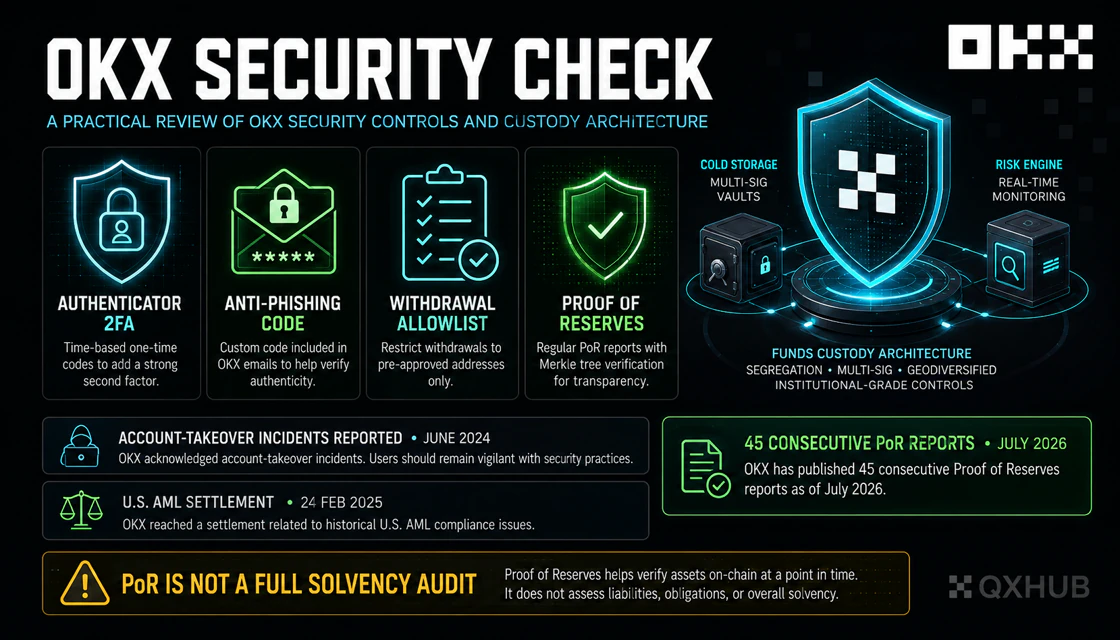
Layered controls and reserve reporting improve visibility but do not eliminate account, exchange or regulatory risk.
OKX provides login and email controls, authenticator 2FA, anti-phishing codes, device review, withdrawal allowlists, API IP restrictions and large-withdrawal protection for eligible verified accounts. Use a dedicated email, secure it independently and remove unused API keys. An API should not have withdrawal permission unless a specific, understood workflow requires it.
OKX reported its 45th consecutive Proof of Reserves publication in July 2026 and supports user verification through Merkle-tree and zero-knowledge methods. Proof of Reserves is useful evidence about assets and inclusion at a snapshot, but it is not a complete audit of liabilities, liquidity, legal claims, governance or future solvency. A reserve report is not insurance.
In June 2024, attackers reportedly took over a small number of OKX user accounts through compromised email or SMS channels; OKX said affected cases would be resolved and controls strengthened. This was not described as a broad hot-wallet breach, but it shows why SMS alone is weak, email security matters and withdrawals should use allowlists and authenticator approval.
Separately, on 24 February 2025, a Seychelles-based OKX entity pleaded guilty in the United States to operating an unlicensed money-transmitting business and agreed to penalties exceeding $504 million. This was a compliance and historical market-access matter, not a customer-wallet hack, but it is material governance context and reinforces why entity-specific restrictions matter.
Practical security setup
- Secure a dedicated email with a unique password and authenticator 2FA or passkey where supported.
- Enable OKX authenticator 2FA and an anti-phishing code; avoid SMS as the only factor.
- Review devices and sessions; remove unfamiliar access and freeze the account if compromise is suspected.
- Enable withdrawal allowlists and large-withdrawal protection where available; test every destination.
- Delete unused API keys and bind trading keys to approved IP addresses.
- Keep only near-term trading capital on the exchange. Learn self-custody before moving long-term holdings.
App, web platform and customer support
OKX offers web, iOS and Android interfaces, plus desktop access in some regions. The terminal can combine chart, order book, recent trades, order ticket and account data. Experienced users may value the density; beginners can accidentally enter margin or derivatives. Use a full-size screen for initial settings and important transfers, and confirm the market label before every order.
Official support is available through the Help Center and in-platform Assistant or case flow. Preserve UID, timestamps, order IDs, TxIDs, screenshots and network details. Response time and outcome depend on complexity. Ignore search ads and unsolicited social accounts. Support will not need a seed phrase, password, authenticator code or transfer to “unlock” the account.
Practical beginner walkthrough: first spot purchase
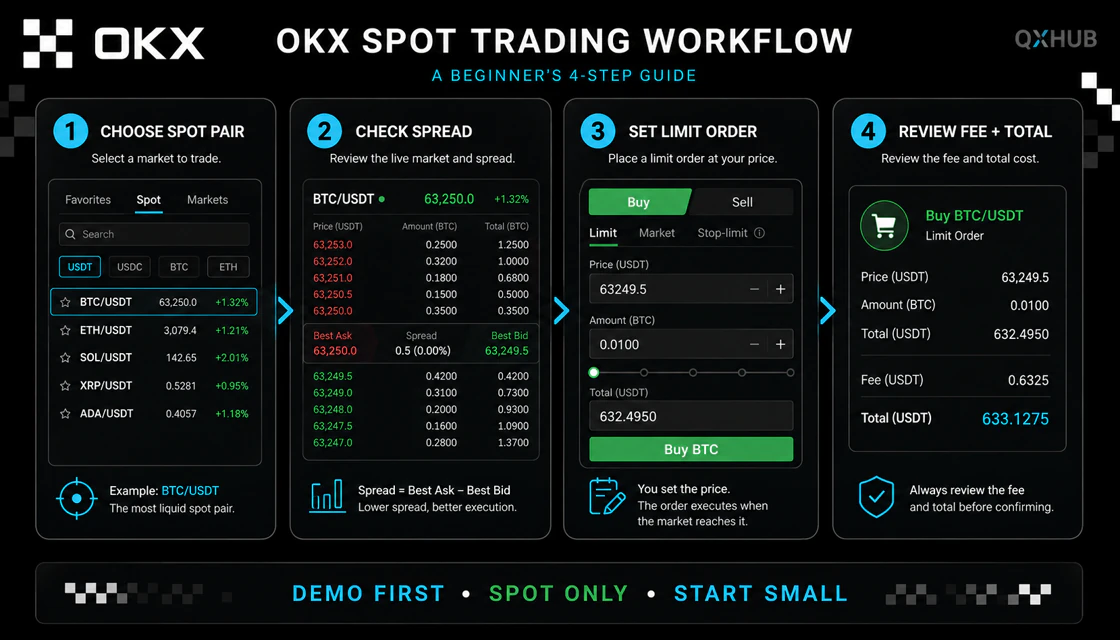
The beginner workflow separates spot-pair selection, spread review, limit price and final cost.
- Confirm country, entity and spot access. Complete KYC and security setup before depositing.
- Open Demo Trading. Practise selecting BTC/USDT, placing and cancelling a limit order and finding history.
- Fund a small amount. For crypto, match asset and network and make a test deposit.
- Open Spot—not Margin, Futures or Options. Choose a liquid pair and inspect bid, ask and spread.
- Select an order type. A market order prioritizes execution; a limit order controls price but may remain unfilled.
- Enter a modest amount and review pair, side, price, quantity, fee and final total before confirming.
- Find the completed order in history and record actual fill, execution role and fee.
- Practise a small withdrawal to an allowlisted destination and confirm arrival before increasing size.
Demo practice task: a 15-action proficiency test
Use OKX Demo Trading or a paper log. Find Spot; locate BTC/USDT; read bid, ask and spread; place and cancel a limit order; identify a market order; locate fees; find order and trade history; return from Futures to Spot; locate funding without opening a position; find deposit networks; find withdrawal preview; explain a required memo; distinguish OKX Exchange from OKX Wallet; and explain why Proof of Reserves is not insurance.
Log twelve simulated trades with setup, order type, intended price, actual fill, slippage, fee and invalidation point. Use the same notional size. Restart after any wrong-product order. Demo trading does not reproduce real emotion, live liquidity, KYC review, withdrawal delays or custody risk.
Risk management rules
- Keep the learning account spot-only; ignore leverage, options, bots and copy trading.
- Set a maximum exchange balance based on custody risk, not the platform limit.
- Define a small maximum risk per speculative trade before calculating position size.
- For derivatives, calculate exposure from notional value and liquidation—not margin. Beginners should skip them.
- Match asset, network, address and memo, then test every transfer route.
- Avoid concentration in one token, stablecoin, exchange, chain or automated strategy.
- Stop after an operational mistake and repair the process before transacting again.
Crypto assets can lose value quickly, stablecoins can depeg, exchange services can be suspended, networks can congest and derivatives can liquidate positions. Stop orders can slip in fast markets. Web3 tools add malicious-token, smart-contract, bridge and seed-loss risks. No security badge, reserve report, VIP tier or automated strategy removes those risks.
Common beginner mistakes
| Mistake | Why it hurts | Better practice |
|---|---|---|
| Using Futures instead of Spot | Leverage, funding and liquidation replace simple ownership. | Confirm the market label every time. |
| Assuming all OKX accounts are identical | Entity, access and fees vary by residence. | Read local terms and fees. |
| Assuming every limit order is maker | A crossing limit can execute immediately. | Check execution role in history. |
| Choosing a network only by fee | A mismatched chain can lose funds. | Compatibility comes first. |
| Confusing Exchange with Wallet | Custodial and self-custodial risks differ. | Identify who controls keys. |
| Treating PoR as insurance | A snapshot is not a full solvency guarantee. | Limit custody exposure. |
| Using social-media support | Impersonators exploit urgent account problems. | Start inside official support. |
Pros and cons
| Advantages | Disadvantages / trade-offs |
|---|---|
| Competitive regular-user global spot baseline. | Local entities, pair groups and rules can differ. |
| Mature terminal and useful Demo Trading. | Dense interface increases wrong-product risk. |
| Broad spot, derivatives, automation and Web3 ecosystem. | Breadth adds leverage and on-chain risks. |
| No OKX receiving fee for standard crypto deposits. | Withdrawal and fiat costs vary by route. |
| Security controls and repeated Proof of Reserves. | PoR is not a full audit; takeovers remain possible. |
| Multiple local entities in supported markets. | Restrictions and product coverage are complex. |
When to avoid OKX
- Your residence or intended product is restricted, or the contracting entity is unclear.
- You need deposit insurance, guaranteed recovery or guaranteed withdrawals.
- Your main reason for joining is leverage, a bot, copied returns or a temporary reward.
- You cannot verify the destination network or complete a withdrawal test.
- You plan to hold all long-term savings on one exchange.
- You are borrowing to trade, under pressure or trying to recover a loss quickly.
Comparison context
This is positioning context, not a universal ranking. Compare the same country, entity, pair, order size, execution role, final cost, withdrawal network and custody amount. More features do not automatically make an exchange better for a beginner.
| Exchange | General strength | Main due-diligence question |
|---|---|---|
| OKX | Broad terminal, demo, automation and Web3. | Which local entity and products apply? |
| WhiteBIT | European-facing spot and fiat orientation. | Which entity and fiat rails fit? |
| Phemex | Trading-focused spot and derivatives. | Do access and risk fit your plan? |
| Binance | Very broad liquidity and local variations. | Which local product set serves you? |
| Bybit | Unified environment and derivatives depth. | Can you manage complexity? |
| BingX | Integrated spot, futures, demo and copy. | Can you ignore leverage and verify access? |
Beginner checklist
- Country, entity and exact product confirmed from current terms.
- KYC completed through the official flow.
- Unique password, secured email, authenticator 2FA and anti-phishing code enabled.
- Demo skills test completed without entering a live leveraged market.
- Local fee tier, pair group and final order cost checked.
- Asset, network, address, memo and minimum verified.
- Small deposit and withdrawal tests completed.
- Maximum exchange balance and trade risk written down.
- Exchange and Web3 wallet risks understood separately.
- Exit plan exists if access, KYC or withdrawals change.
Summary
OKX is a sophisticated crypto platform whose best beginner use is simple: verify access, complete KYC, secure the account, practise in Demo Trading, fund a modest amount, trade spot and test a withdrawal. Its global regular-user fee baseline is 0.0800% maker and 0.1000% taker for standard spot groups; regular futures publish 0.0200% maker and 0.0500% taker. Local entity and pair rules can differ.
The exchange provides meaningful security tools and repeated Proof of Reserves reporting, but neither removes counterparty or takeover risk. June 2024 account incidents and the February 2025 U.S. AML resolution are relevant context. OKX can be a powerful tool for an eligible, disciplined user—not a guarantee of access, safety or profit.
FAQ
Is OKX safe?
No centralized exchange is risk-free. OKX offers account controls and Proof of Reserves, but these do not provide insurance or a complete solvency audit.
Does OKX require KYC?
Yes. OKX says advanced identity verification is required for an individual account to trade, deposit and withdraw.
What are OKX spot fees?
The global regular-user standard-group baseline verified 22 August 2026 is 0.0800% maker and 0.1000% taker. Local rules can differ.
What are OKX futures fees?
The global regular-user baseline is 0.0200% maker and 0.0500% taker. Funding, spread and closing fees add to cost.
Does OKX charge crypto deposit fees?
OKX says it does not charge a receiving fee for standard crypto deposits. The sender or network can charge.
How long does an OKX withdrawal take?
There is no universal time. It depends on review, maintenance, confirmations, congestion and the destination.
Does OKX have demo trading?
Yes. Demo Trading uses simulated assets but cannot reproduce live emotion, liquidity, KYC or withdrawals.
Is OKX Wallet the same as OKX Exchange?
No. The exchange is custodial; the Web3 wallet is self-custodial and adds seed and smart-contract risks.
Can UK users use OKX?
Availability is product-specific. The current disclosure identifies UK restrictions on derivatives, centralized-finance and P2P services.
Should I keep long-term crypto on OKX?
Exchange custody carries counterparty and access risk. Keep only near-term trading capital and learn self-custody before using it.
Crypto exchanges
Crypto assets are volatile. Exchange access, products and fees vary by country and can change. Verify the live terms before registration or funding.


