
Crypto exchange review
Phemex Review 2026: Fees, KYC, Security, Pros and Cons
Read an evidence-based Phemex review covering fees, KYC, supported markets, deposits, withdrawals, security, regional restrictions and beginner steps.
Crypto trading and custody involve loss, operational and counterparty risk. This review is educational, not personal investment advice.
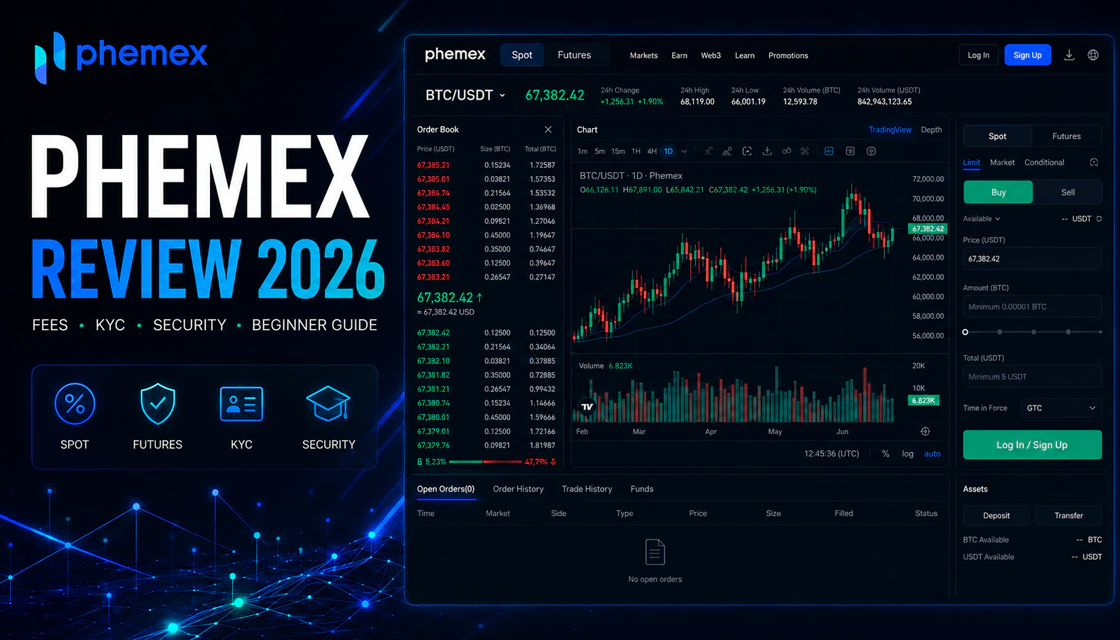
Phemex review: the short answer
- Phemex is primarily an active-trading platform with spot, derivatives and simulated trading; availability and product access must be checked by country.
- Published fee baselines are useful for comparison, but VIP tiers, promotions, payment providers and network costs can change the final result.
- A cautious route is honest KYC, strong security, simulated practice, a small spot transaction and a verified test withdrawal before larger funding.
Who Phemex suits — and who should skip it
Potentially suitable for
- Intermediate traders who want spot and perpetual markets in one terminal.
- Beginners willing to use simulated trading and restrict themselves to spot during the learning phase.
- Users who value published reserve data and want to verify their account balance in a Merkle-tree snapshot.
- Active users who can benefit from the VIP schedule or PT fee deductions after understanding the conditions.
- Traders who need advanced order types, trading bots, sub-accounts or API access.
Usually a poor fit for
- Residents of restricted jurisdictions, including the United States and United Kingdom.
- Anyone looking for insured bank deposits or guaranteed capital protection.
- A first-time buyer who is likely to mistake leverage, copy trading or Earn yield for low-risk saving.
- Long-term holders who do not need exchange liquidity and prefer self-custody.
- Users who cannot verify identity, document source of funds when requested, or use payment methods in their own name.
Availability and regional restrictions
Phemex does not offer one identical global service. The official KYC guide lists full platform restrictions that include the United States, Québec in Canada, Cuba, Bermuda, the United Kingdom, Crimea and Sevastopol, Iran, Syria, Sudan, mainland China, Hong Kong, Singapore, North Korea and other territories. The list can change, and individual products may have stricter geoblocking than the main exchange.
Fiat rails have their own coverage. Phemex’s official Legend Trading article, updated 7 July 2025, lists a larger set of countries where fiat deposits and withdrawals are unavailable, including Canada, Brazil, Netherlands, Poland, Ukraine and the United Kingdom. A user may therefore be able to access some crypto functions while a particular card, bank-transfer, prediction-market or derivatives service remains unavailable.
Account creation and KYC
How to create an account
- Open phemex.com or the official app-store listing. Confirm the domain and developer before entering credentials.
- Register using an available method, such as email or a supported connected login. Use a unique password stored in a password manager.
- Verify the email or phone prompt, then sign in from a trusted device.
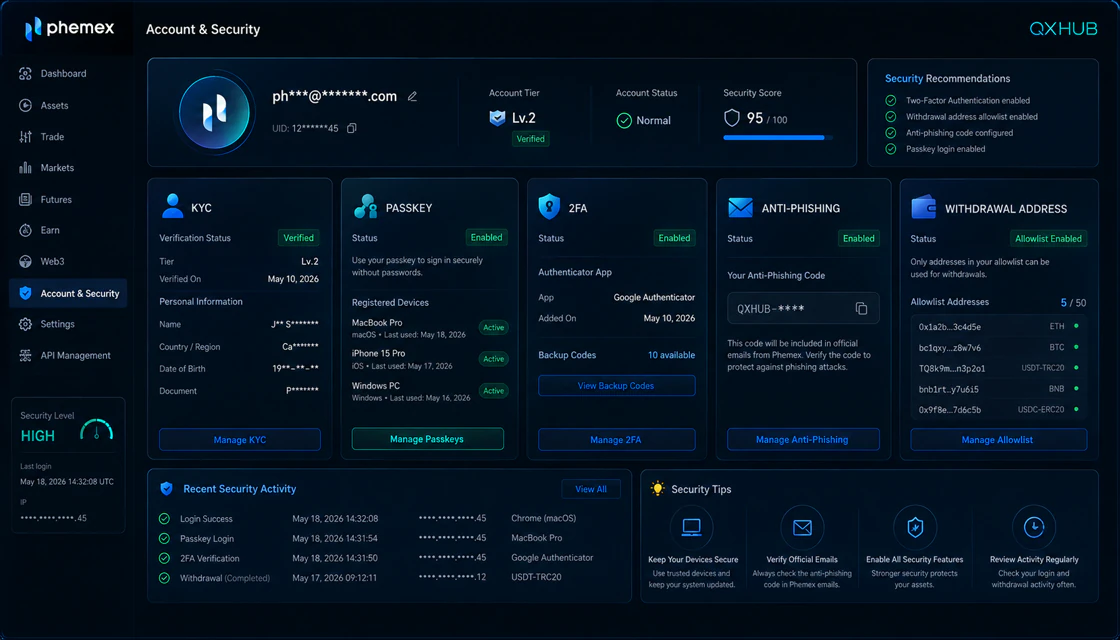
- Immediately enable a passkey or authenticator-app 2FA. Save recovery information offline.
- Complete identity verification before funding if your intended service requires it.
What KYC normally involves
Phemex’s 2026 KYC guide describes identity verification as the gateway to higher limits, fiat functions and wider ecosystem access. Expect personal details, a government-issued identity document and a liveness or facial check. Higher or business verification can require proof of address, tax information, beneficial-owner details, source-of-funds information and recent statements. Requirements vary by entity and region.
Use clear, uncropped images; enter names exactly as they appear on documents; and complete the process on your own device. A verification failure is not a reason to send documents through social media. Use the official in-account flow or support ticket only.
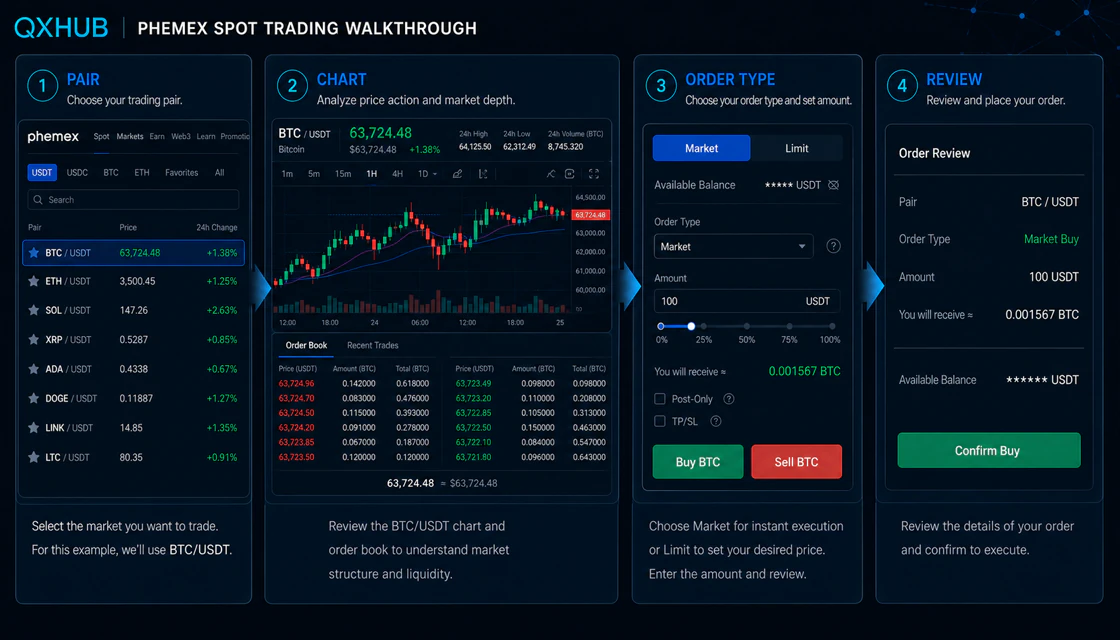
Markets and products on Phemex
Phemex combines spot, futures, Earn and on-chain tools, but each carries a different risk profile.
Phemex’s official 2026 platform guide advertises more than 600 spot pairs and more than 530 futures contracts. Counts change as markets are added or removed, so the live Markets and Fees pages are authoritative. Liquidity also differs substantially: a pair being listed does not mean a large order will execute with low slippage.
| Product | What it does | Beginner view |
|---|---|---|
| Spot | Buys or sells the actual listed crypto asset for immediate settlement. | Best starting point; still exposed to price volatility and custody risk. |
| Perpetual futures | Trades a derivative linked to an asset price, usually with leverage and funding. | High risk; liquidation can close the position rapidly. |
| Margin | Borrows funds against collateral to enlarge spot exposure. | Adds interest, margin-call and liquidation risk. |
| Convert / Buy Crypto | Simplified quote-based purchase or conversion flow. | Convenient, but compare the final quote and provider fee with the order book. |
| Earn / staking | Places eligible assets into flexible, fixed or on-chain yield products. | Yield is not guaranteed; review lock-up, counterparty and smart-contract risk. |
| Bots / copy trading | Automates rules or follows another trader’s positions. | Automation does not remove market risk; copied losses remain your losses. |
| Onchain | Provides selected Web3 trading and yield access. | Adds wallet, token, smart-contract and liquidity risks. |
Phemex fees — verified 17 August 2026
Maker and taker are execution roles, not order names. A limit order that immediately matches existing liquidity can be a taker order. A post-only instruction can prevent immediate execution when supported. For a $1,000 spot fill at the 0.10% standard rate, the trading fee is $1 before discounts. A $1,000 futures position filled as taker costs $0.60 to enter at 0.06%, but leverage means the position’s notional value — not only the posted margin — drives trading fees and market exposure. Closing creates another fee, and funding may also apply.
| Fee category | Current published baseline | What can change |
|---|---|---|
| Spot trading | 0.10% maker / 0.10% taker for Standard users. | VIP level, eligible PT deduction, pair-specific promotion and actual execution role. |
| Futures trading | 0.01% maker / 0.06% taker for Standard users. | VIP tier, PT deduction, special contract, liquidation and funding payments. |
| PT fee deduction | 20% discount on eligible spot fees; 10% on eligible USDT-contract fees. | Requires enough PT; exclusions include API, copy, grid, margin, liquidation and ADL cases. |
| Crypto deposit | Phemex states on-chain deposits and internal sends have no platform deposit fee. | The sending platform or blockchain may charge a network fee. |
| Crypto withdrawal | Asset- and network-specific fee shown before confirmation. | Network conditions, asset, chain and minimum withdrawal. |
| Fiat purchase / transfer | Provider quote, card or bank fee varies by route and region. | Payment provider, currency, jurisdiction, bank and transaction size. |
| Futures funding | Variable transfer between long and short positions, commonly on an interval. | Contract and market imbalance; check the live rate before opening. |
Deposits and withdrawals
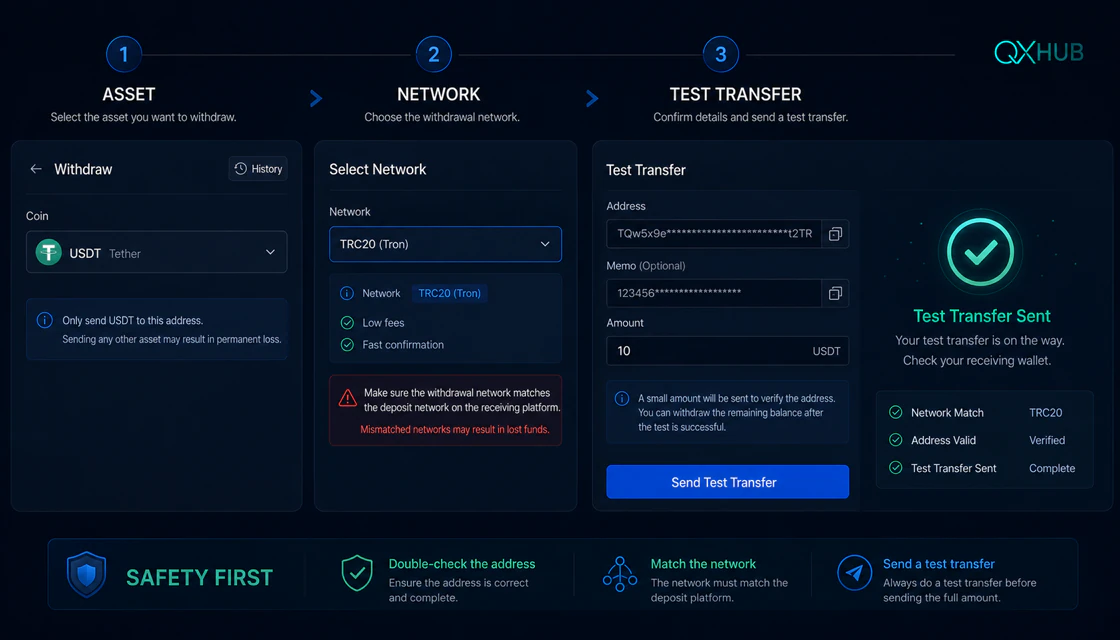
A safe transfer matches asset, network, address and memo before a small test transaction.
Crypto deposit workflow
- Choose Deposit, then select the exact asset and network.
- Confirm the sending wallet supports the same network. Similar token names do not make networks interchangeable.
- Copy the deposit address and any required memo or tag. Verify the first and last characters on both devices.
- Send a small test amount above the minimum when the economics make sense.
- Save the transaction hash and wait for the required confirmations before sending more.
Crypto withdrawal workflow
- Choose Withdraw and the destination type. Select the asset and a network supported by the receiving wallet.
- Paste or scan the destination, enter any required memo or tag, and confirm the displayed minimum, fee and daily limit.
- Review the amount that will arrive. Complete email, 2FA, passkey or risk-control checks.
- Track the status and transaction hash. Phemex says a submitted withdrawal can be cancelled only before it is sent to the blockchain.
A wrong address, network or memo may be irreversible. If a deposit is not credited, support asks for the account UID, asset, network, amount and transaction hash. Do not share a seed phrase, password or one-time code. Fiat availability, limits, processing time and provider charges must be checked in the live route because they depend on region and banking partner.
Security, custody and the January 2025 incident
Security should be judged across account controls, custody architecture and verifiable reserves.
Phemex publishes a layered security model that includes cold and warm wallet separation, multi-signature or institutional custody arrangements, DDoS and web-application protection, monitoring, account 2FA, passkeys and withdrawal-address controls. Its proof-of-reserves system uses Merkle-tree snapshots so a logged-in user can check inclusion of balances and compare published assets with customer liabilities.
Proof of reserves is useful but incomplete. It can demonstrate that selected assets existed against included liabilities at a snapshot or reported point. It does not by itself prove the absence of undisclosed liabilities, the quality of internal controls, legal segregation of customer property or future solvency. A traditional independent financial audit covers a broader question.
What happened on 23 January 2025
Phemex’s own incident timeline says it detected unusual hot-wallet activity at 11:30 UTC on 23 January 2025, isolated affected devices and temporarily suspended deposits and withdrawals. External security researchers estimated the loss at roughly $69 million to more than $85 million across multiple chains; estimates differ because investigators counted assets and subsequent movements differently. Phemex reported that cold wallets were unaffected, published reserve information, restored networks in stages and said all withdrawals were restored by February 2025.
In a February 2026 retrospective, Phemex said user losses were covered from company reserves and that the incident accelerated integration with Fireblocks, expanded MPC infrastructure and monitoring upgrades. These are relevant improvements, not a guarantee against another breach. The practical conclusion is to reduce exchange exposure, enable every security control and withdraw assets that do not need to remain online for trading.
Account security checklist
- Use a unique password and a passkey or authenticator app; avoid SMS as the only factor when stronger options exist.
- Enable an anti-phishing code and verify official messages and domains.
- Use a withdrawal address allowlist and a dedicated email account.
- Review logged-in devices, API keys and sub-account permissions.
- Never grant withdrawal rights to a trading API unless absolutely required.
- Verify your balance in the proof-of-reserves tool, understanding its limitations.
- Keep long-term holdings off an exchange when self-custody is appropriate and understood.
App, platform usability and support
The web terminal is information-dense: chart, order book, recent trades, order entry, positions and risk settings share one workspace. That suits active traders but can overwhelm a first-time buyer. The mobile app provides trading, wallet, deposit, withdrawal and security controls, yet a small screen makes address and leverage errors easier. Beginners should configure security and complete a small spot transaction on a desktop before trading on mobile.
Phemex provides a Help Center, live chat, tickets and support email. The Help Center advertises live-chat response in minutes, but complex compliance, security or recovery cases can take longer. A useful ticket contains the account UID, date and time, product, asset, network, transaction hash or order ID, exact error text and redacted screenshots. Never send passwords, private keys or 2FA codes.
Advantages and disadvantages
| Advantages | Disadvantages / risks |
|---|---|
| Broad spot and derivatives range; advanced order tools. | Complex interface and high-risk products can encourage overtrading. |
| Competitive published standard futures fees. | Funding, slippage, liquidation and two-sided fees can outweigh the headline rate. |
| Simulated trading, bots, sub-accounts and API support. | Automation and copy trading can scale mistakes as easily as good decisions. |
| Proof-of-reserves verification and expanded custody controls. | A serious hot-wallet breach occurred in January 2025; PoR is not a full audit. |
| Multiple funding and withdrawal routes where supported. | Coverage, limits and provider fees vary materially by region. |
| Passkeys, 2FA and withdrawal-address controls. | Security depends on correct user setup and cannot eliminate platform risk. |
Practical beginner walkthrough
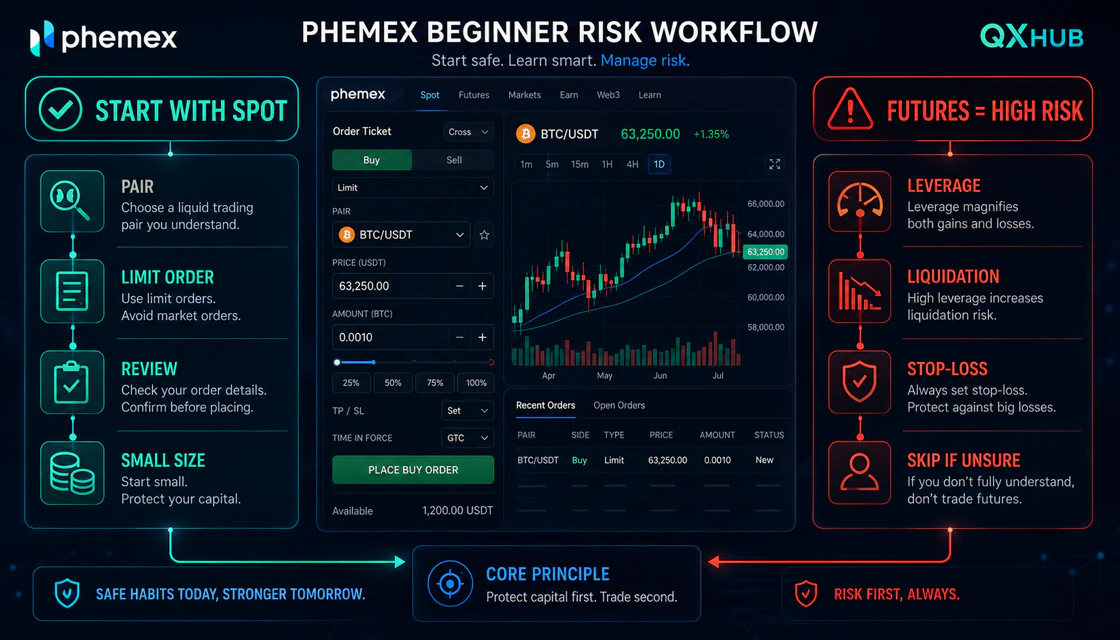
Start with spot, simulate first and treat leverage as a high-risk tool.
- Confirm your country is supported for the exact product and payment route you need.
- Register on the official domain, complete KYC and enable passkey or 2FA plus withdrawal-address protection.
- Open simulated trading. Practise a limit order, market order, cancellation, stop and account transfer without real money.
- Deposit a small amount using a matched network. Save the transaction hash and confirm crediting.
- Buy a liquid major asset on spot with an amount small enough that a large price decline would not affect essential finances.
- Record the quote, spread, fill, maker/taker status, trading fee and final average price.
- Make a small test withdrawal to a wallet you control. Verify the asset, network, address and memo independently.
- Review the full round-trip cost. Only then decide whether the platform solves a real need.
Risk management rules
- Keep emergency money, taxes, debt payments and living expenses outside crypto trading.
- Cap total exchange exposure; do not store more online than the active plan requires.
- For spot, size the position for a severe drawdown. Crypto can fall rapidly and remain below the purchase price for long periods.
- For futures, define maximum account risk before entry, use isolated margin when appropriate, set a hard stop and assume slippage.
- Never average down solely to avoid admitting a mistake. Never use martingale sizing.
- Treat Earn yield as compensation for additional risk, not as guaranteed interest.
- Keep a transaction and tax record. Rules differ by country; consult a qualified local professional when needed.
Beginner mistakes to avoid
- Registering before checking restricted-country and product-level rules.
- Depositing on the wrong network or omitting a memo or destination tag.
- Assuming a limit order always earns the maker rate.
- Comparing only headline trading fees while ignoring spread, slippage, funding and withdrawal costs.
- Moving directly from a demo win to 25x or 100x leverage.
- Treating copy trading, bots or Earn as passive and low risk.
- Leaving long-term holdings on the exchange without a reason.
- Believing proof of reserves or security certifications make loss impossible.
When to avoid Phemex
- Your country, province or intended product is restricted.
- KYC or source-of-funds requirements cannot be completed honestly.
- You need deposit insurance, capital guarantees or a locally regulated bank account.
- You feel pressure to recover losses with leverage, copy trading or a larger deposit.
- The asset or network has weak liquidity, suspended withdrawals or unclear custody.
- You are being guided by an unofficial “manager,” recovery agent or social-media support account.
- The fee, final quote, liquidation mechanics or withdrawal route is not understood.
Comparison context
Phemex competes most directly with global crypto exchanges that combine spot, derivatives and automated tools. Compared with a spot-focused beginner app, it offers more execution control but more opportunities for costly mistakes. Compared with the largest exchanges, its market depth can be competitive on major pairs but less consistent across smaller assets. Compared with self-custody, Phemex is easier for active trading but requires trust in the operator and its security processes.
Choose by jurisdiction, withdrawal reliability, liquidity on the exact pair, total cost, custody model and the product you will actually use. Brand size or a long feature list should not decide the account. Later QXHUB comparisons should use the same framework for Binance, Bybit, BingX and OKX rather than declaring one universal winner.
Summary
Phemex is a capable, broad crypto trading platform with spot, futures, margin, Earn, automation and on-chain access. Its standard 0.10% spot and 0.01%/0.06% futures maker/taker rates are competitive, and its reserve-verification and account-security tools are useful. The platform also carries material caveats: significant regional restrictions, complex leveraged products, changing payment routes and a real hot-wallet breach in January 2025.
A disciplined beginner should verify eligibility, complete KYC, lock down the account, practise in simulation, start with a small spot order and test a withdrawal. The correct question is not whether Phemex is “safe” in the abstract. It is whether the platform is legal and available for you, whether its controls and costs fit your task, and whether you can limit custody and trading risk when something goes wrong.
FAQ
Is Phemex available in the United States?
No. Phemex’s official KYC guide lists the United States among restricted jurisdictions. Do not attempt to bypass the restriction.
Is Phemex available in the United Kingdom?
The United Kingdom is listed as restricted for the main platform in the current KYC guide.
Does Phemex require KYC?
Identity verification is required for full platform access and may be necessary for fiat routes, higher limits and specific products. Requirements depend on region and account type.
What are Phemex spot fees?
The published Standard rate is 0.10% maker and 0.10% taker, verified 17 August 2026. VIP tiers, PT deductions and special pairs can change the actual rate.
What are Phemex futures fees?
The published Standard rate is 0.01% maker and 0.06% taker. Funding, liquidation charges where applicable, slippage and the closing trade add to total cost.
Does Phemex charge crypto deposit fees?
Phemex states that on-chain deposits and internal sends have no platform deposit fee, but the sending wallet or network may charge.
How much does a Phemex withdrawal cost?
The fee and minimum depend on the asset and selected network and are displayed before confirmation. Check the live screen.
Was Phemex hacked?
Yes. Phemex disclosed a hot-wallet attack on 23 January 2025. Withdrawals were suspended and restored in stages; Phemex says user losses were covered from company reserves.
Does proof of reserves make Phemex safe?
No single control makes an exchange safe. PoR helps verify included assets and liabilities but is not the same as a complete financial audit or deposit insurance.
Is Phemex good for beginners?
It can be used carefully through simulated trading and spot, but the interface and derivatives catalogue are complex. Beginners should avoid leverage and test deposits and withdrawals with small amounts.
Can I use a VPN to access a restricted Phemex product?
Do not bypass geoblocking or provide false residency information. It can violate terms and create KYC or withdrawal problems.
Should I keep long-term crypto on Phemex?
Only assets needed for active use should normally remain on an exchange. Consider self-custody for longer-term holdings if you understand key management and recovery.
Crypto exchanges
Crypto assets are volatile. Exchange access, products and fees vary by country and can change. Verify the live terms before registration or funding.


