
Crypto exchange review
WhiteBIT Review 2026: Fees, KYC, Security and Beginner Guide
An evidence-led WhiteBIT review covering current fees, KYC, country restrictions, security controls, deposits, withdrawals, app usability and a cautious beginner workflow.

Crypto trading and custody involve loss, operational and counterparty risk. This review is educational, not personal investment advice.
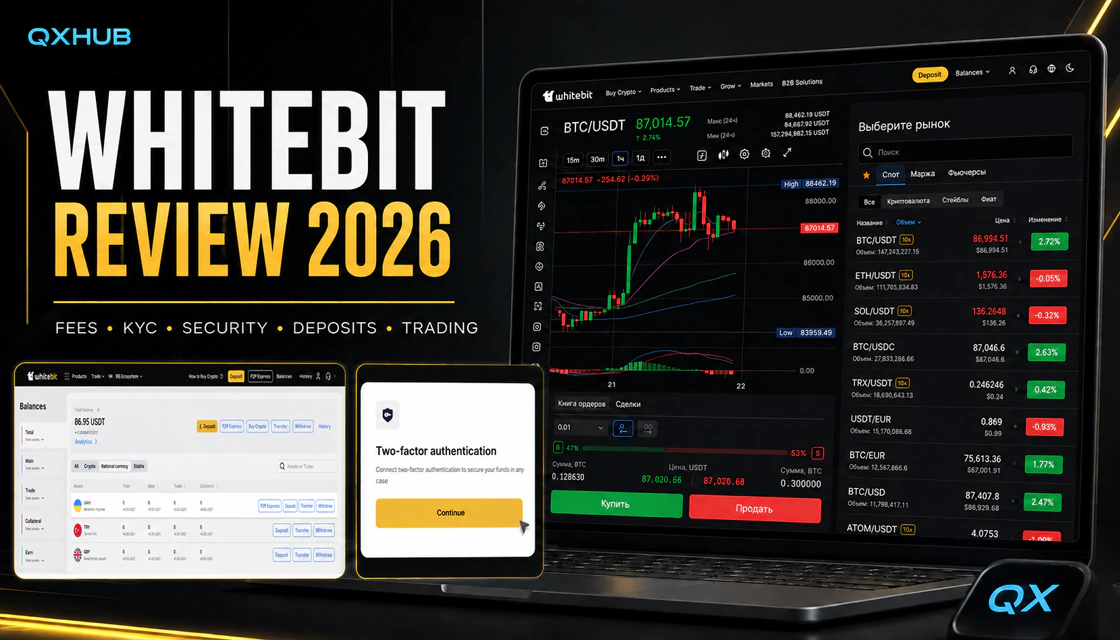
Quick verdict
- WhiteBIT combines spot, futures, margin and fiat routes, but product access depends on verification level, country and current platform rules.
- The standard published spot maker and taker fee is 0.1%; futures and withdrawal costs follow separate live schedules that should be checked before each transaction.
- A careful first route is KYC, 2FA or passkey, anti-phishing, a small spot order and a test transfer on the exact supported network.
What WhiteBIT is — and what it is not
WhiteBIT is a centralized cryptocurrency exchange. A user opens an account, completes the required identity checks, deposits fiat or crypto through available routes, and trades against an order book or other exchange services. The website currently presents spot, margin, futures, WhiteBIT Earn, Crypto Borrow, Convert and other ecosystem products, while warning that regulated or leveraged products may be supplied through eligible third parties and may be limited by country. [3]
The key word is centralized. Assets held on the exchange sit in custodial wallets: the platform controls the private keys while the user has contractual account access. That is convenient for trading and recovery, but it differs from self-custody. A healthy workflow therefore separates a trading balance from long-term savings and avoids treating any exchange balance like an insured bank deposit.
Who WhiteBIT suits
- A beginner who wants to practise interface navigation with demo tokens before depositing, then move to small spot orders after KYC.
- A supported-region user who values web and iOS/Android access and wants a conventional order book rather than only a simple swap button.
- A trader who understands maker/taker execution and wants transparent standard trading fees, while checking pair-specific exceptions.
- An experienced user who needs margin, perpetual futures or API tools and already has strict leverage, liquidation and collateral rules.
Who should avoid it
- Residents or citizens of restricted jurisdictions, or users whose local law prohibits the service or product.
- Anyone unwilling or unable to complete KYC, source-of-funds or Travel Rule checks when requested.
- Long-term holders who want exclusive control of private keys and do not need active exchange liquidity.
- Beginners who interpret high leverage, yield products or bonuses as a shortcut to profit.
Availability, countries and material restrictions
WhiteBIT’s availability is not a simple global yes/no. Its official KYC article lists jurisdictions whose citizens or residents are not accepted, including the United States, United Kingdom, Canada, Russia, Belarus, Iran, Syria, North Korea and several territories. The list also includes the temporarily occupied territories of Ukraine. Because sanctions, licensing routes and product permissions change, readers should use the current KYC article and the registration screen as the final check rather than copying an old country list. [1]
The EEA needs separate attention. WhiteBIT’s signup guide states that new registration on whitebit.com is currently unavailable for EEA residents during a transition to the EU MiCA framework and directs them to whitebit.eu and a waitlist. Existing access, future onboarding and the precise services on whitebit.eu can change. Do not use a VPN or false residence information to bypass this route. [2]
Regional rule. Confirm three things before sharing documents or depositing: your country is accepted, the exact product is enabled for your account, and the legal entity/terms displayed during onboarding match your jurisdiction.
Registration and KYC
Account creation
- Open the official WhiteBIT domain or verified mobile-store listing. Check the spelling before entering an email address.
- Create a unique password and confirm the email code. Mobile signup may also offer Apple or Google account routes.
- Read the User Agreement, Privacy Policy and prohibited-country confirmation. Do not register with inaccurate citizenship or residence data.
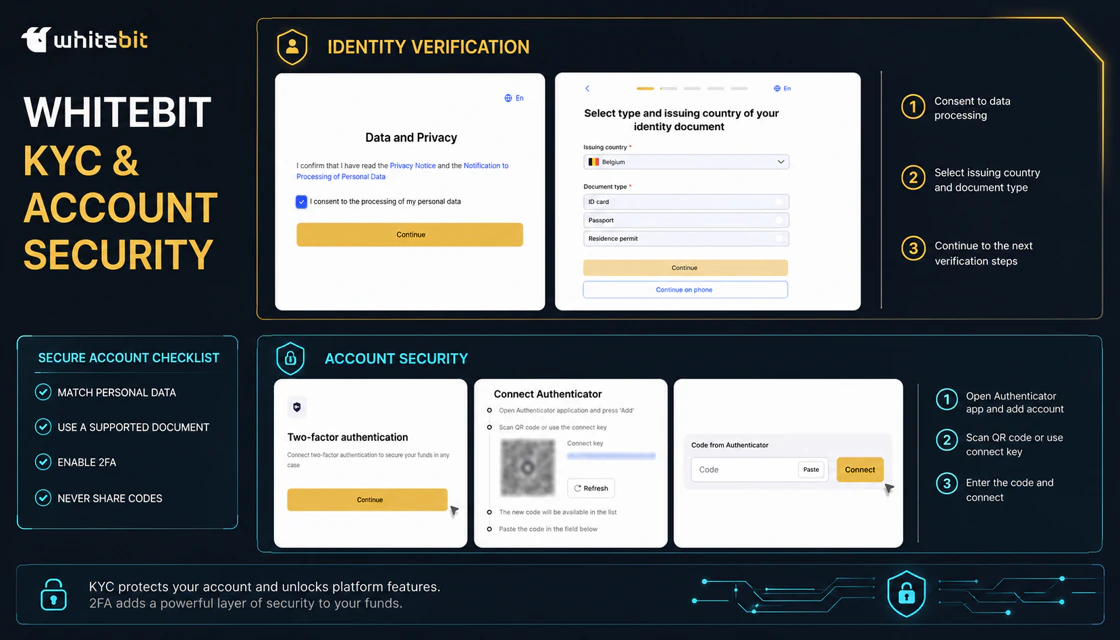
- Before funding, enable an authenticator-based 2FA or passkey and anti-phishing protection, then secure the email account itself.
- Start KYC from the account verification page and upload only current, clear documents through the official interface.
What KYC changes
WhiteBIT says an unverified user can use only demo tokens. KYC is required for deposits, withdrawals, Buy Crypto and WhiteBIT Codes. The exchange now describes verification levels: available services depend on the level, country and documents supplied; higher levels may require proof of address or additional checks. The help page says a level review can take from a few minutes to 24 hours depending on load, but that is not a guarantee for unusual or enhanced-due-diligence cases. [1][4]
Expect further questions when a payment or transaction triggers compliance review. The User Agreement and AML materials allow WhiteBIT to request source-of-funds, proof-of-transaction-origin and Travel Rule information. Keep bank statements, wallet transaction hashes and purchase records, but submit them only inside the official support or verification route. [5]
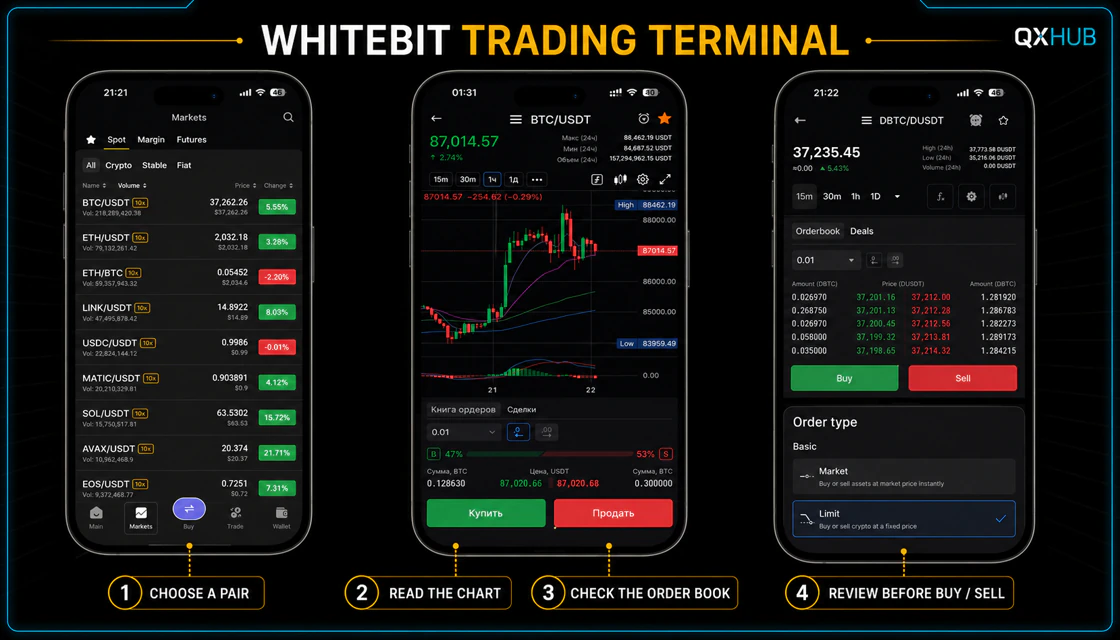
Markets and products
Asset counts, pairs, leverage caps and product availability are intentionally not frozen in this review because they change. Use the live Markets page for pairs and the account interface for products actually available to your verified profile.
| Product | Practical meaning |
|---|---|
| Spot | Buy or sell an asset against another asset through the order book. This is the cleanest learning route because there is no liquidation from leverage. |
| Convert / Buy Crypto | Simplified exchange or card/payment purchase routes. Convenience can include a spread or provider cost, so compare the final received amount. |
| Margin | Borrowed funds increase market exposure. WhiteBIT publishes a daily funding fee for margin/borrow, but discounts and eligibility can vary. |
| Futures | Perpetual-style leveraged products may be available through eligible providers and only in certain regions. Liquidation, funding and rapid losses are central risks. |
| Earn / Borrow / ecosystem | Additional products can add lock-up, counterparty, smart-contract, collateral or rate risk. Read the current product terms separately. |
WhiteBIT fees explained
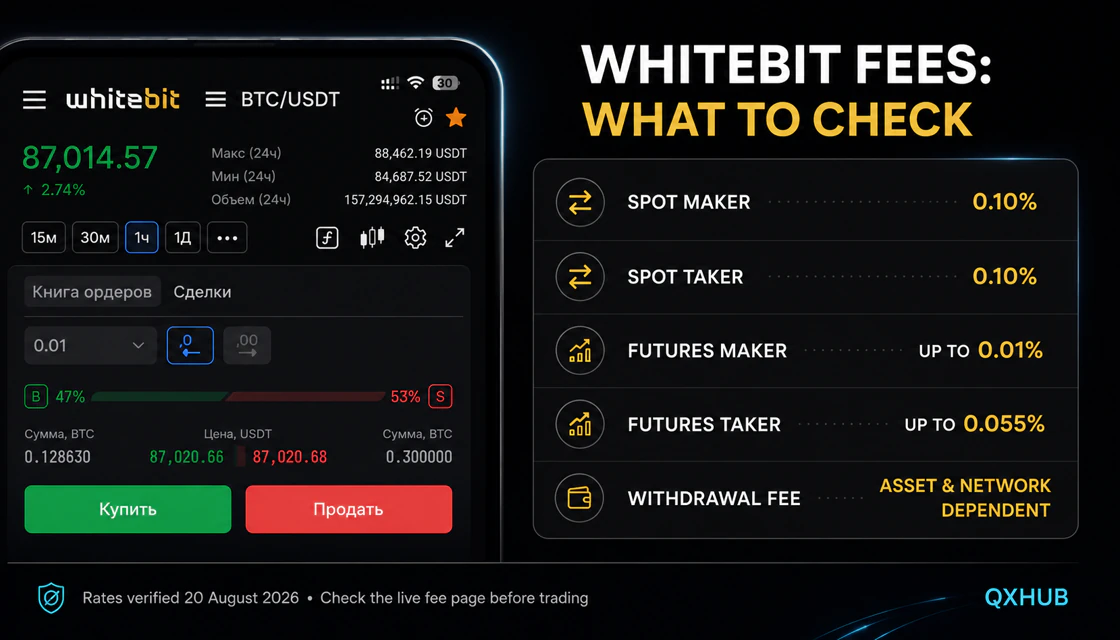
Fee verification date: 16 August 2026. The official trading-fee page showed standard spot maker and taker fees of 0.1% each. Futures fees were listed as 0.01% maker and up to 0.055% taker. The daily fee for margin trading and borrowing was listed as 0.0585%. Some pairs, programs and WBT/VIP discounts can differ; check the live page immediately before trading. [6]
| Action | Cost logic |
|---|---|
| Spot limit order that rests | Usually a maker execution; standard published fee 0.1%, unless the pair or discount program changes it. |
| Spot market order | Usually taker execution; standard published fee 0.1%, plus possible slippage when the book is thin. |
| Futures | Published maker 0.01% and taker no more than 0.055%; funding, liquidation and leverage risk are separate from trade fees. |
| Margin / borrow | Published daily use-of-funds fee 0.0585%; compounding holding cost matters even when price barely moves. |
| Crypto withdrawal | Asset- and network-specific; WhiteBIT says fees can change without notice. The live withdrawal form is authoritative. |
| Fiat payment | Method, currency, bank, provider, limits and region can change the cost. Review the final quote and received amount. |
A simple fee example
Suppose a beginner buys 500 USDT worth of BTC on spot at the standard 0.1% fee. The trading fee is 0.50 USDT equivalent (500 × 0.001), before any spread or slippage. Selling another 500 USDT equivalent later at the same fee adds another 0.50 USDT equivalent. The round-trip trading fee is therefore about 1.00 USDT equivalent, excluding price movement and withdrawal cost. The calculation is simple; the difficult part is remembering that market orders can also cross a wider spread or fill at several prices.
Maker/taker status is determined by how the order executes, not by whether the trader intends to buy or sell.
Deposits and withdrawals
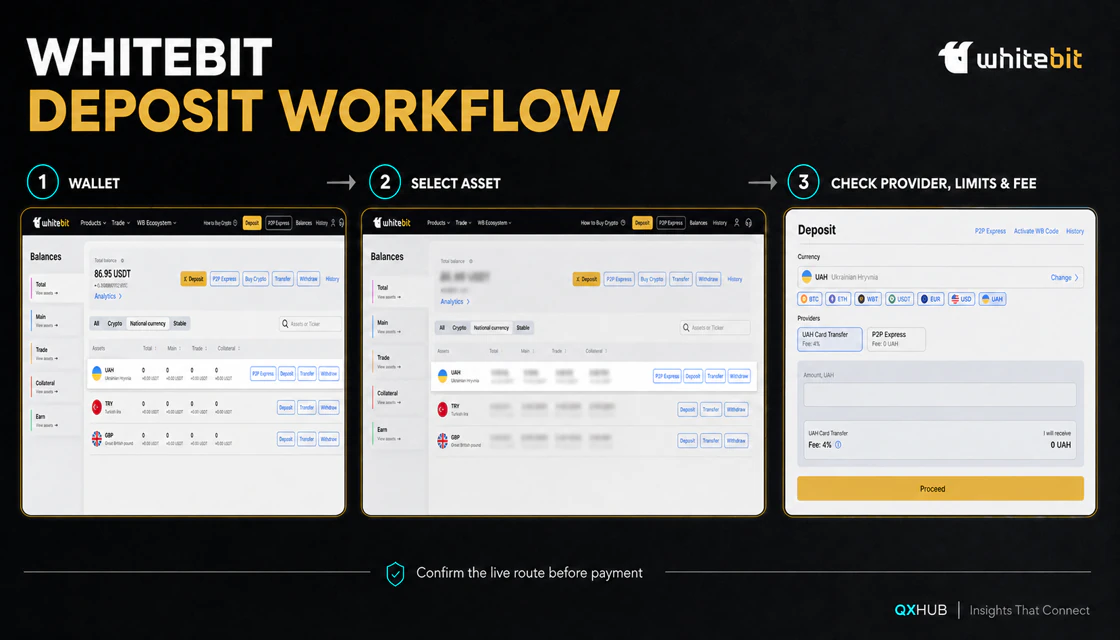
Crypto deposit workflow
- Select Deposit, choose the exact asset and read any status notice before generating or copying an address.
- Choose a network supported by both the sending platform and WhiteBIT. Token names alone are not enough: USDT on Ethereum, Tron and other networks are different routes.
- Copy the address and, when shown, the memo/tag. Compare the first and last characters on both screens.
- Send a small test amount above the displayed minimum, wait for credit, then send the remainder only if every field matches.
- Save the transaction hash and the deposit-page details until the balance is credited.
Crypto withdrawal workflow
Move the asset to the Main balance if required, choose Withdrawal, select the network, enter the recipient address and memo/tag, then review the minimum and fee. WhiteBIT’s guide says withdrawals require email confirmation and 2FA when enabled; a passkey can replace the email code in the described flow. The same guide says withdrawals usually take from one minute to one hour but may take longer when a network or provider is overloaded. Treat that as an operational estimate, not a promise. [7]
WhiteBIT’s fee table explicitly warns that withdrawal fees depend on blockchain fees and asset prices and may change without notice. The displayed fee and minimum inside the current withdrawal form win over any number in an article. [8]
A small test transfer is cheap insurance against the two hardest-to-reverse errors: the wrong network and the wrong destination data.
Fiat deposits and withdrawals
Fiat rails can include cards, bank transfers or regional payment providers, but availability and limits vary by currency, residence, verification level and bank. Provider charges and currency conversion can matter more than the headline exchange fee. Before paying, compare the amount charged, the rate, the amount credited and the expected withdrawal route. Use a payment method in the verified account holder’s own name and retain the receipt.
Security: strong controls, still not zero risk
WhiteBIT documents 2FA, passkeys and anti-phishing protection and recommends enabling these after signup. Its materials also state ISO 27001 certification and independent penetration testing; the API documentation lists additional certification and a 2024 proof-of-reserves audit. WhiteBIT stated in January 2025 that it had not experienced a hacking incident up to that date. These are positive signals, but they are claims and point-in-time assessments—not a guarantee against a future breach, insolvency, frozen withdrawals, account takeover or user error. [4][9][10]
Proof of reserves, where provided, is not the same as a full financial audit. A useful assessment also asks about liabilities, legal segregation, custody architecture and whether a user can independently verify inclusion. Even a technically secure exchange can create risk through phishing, weak email security or an incorrect on-chain transfer.
Security works in layers: protect the email, harden the account, verify withdrawals and limit the balance kept on an exchange.
Ten-minute security setup
- Use a password manager to create a unique exchange password and protect the registered email with a separate strong password.
- Enable a passkey or authenticator-based 2FA. Store recovery information offline; never send it to support.
- Set an anti-phishing code if available so authentic exchange emails are easier to recognize.
- Bookmark the official domain and obtain the mobile app only from the official WhiteBIT download page or verified app store listing.
- Review active sessions, API keys and connected devices. Delete anything you do not recognize.
- Before each withdrawal, recheck address, network and memo/tag and use a small test for a new route.
Platform and app usability
The web platform follows the familiar centralized-exchange model: separate Main, Trade and Collateral balances; order-book trading; history; funding and withdrawal pages; and additional product areas. The separation is useful but can confuse a beginner who sees assets in one balance and cannot withdraw or trade them from another. Learn the internal Transfer action before assuming funds are missing.
WhiteBIT provides iOS and Android applications and describes smartwatch compatibility. Mobile access is convenient for confirmations and monitoring, but a small screen increases the chance of order-size and address mistakes. For a first limit order or a new blockchain route, use the device that makes every field easiest to verify. [11]
Customer support
WhiteBIT’s help article says technical support is available 24/7 through support@whitebit.com, and the site also provides a request form and chat. For payment cases, send a concise timeline: account email (never password), asset, network, amount, timestamp, transaction hash or bank reference, current status and screenshots with sensitive data masked. Never provide a seed phrase, private key, password or one-time code. [12]
Practical beginner walkthrough
Phase 1 — learn without funding
- Confirm country access and age eligibility, then create the account only through the official route.
- Use demo tokens to locate Markets, Spot, order book, order ticket, open orders, history and balances.
- Choose one liquid spot pair. Write down base asset, quote asset, current bid, current ask and spread.
- Practise a limit order away from the market, observe that it remains open, then cancel it. No fee should be charged for an unexecuted cancellation according to WhiteBIT’s spot guide. [13]
Phase 2 — verify and secure
- Complete the KYC level needed for the intended service. Use matching residence information and current documents.
- Enable passkey or 2FA, anti-phishing and email security before any deposit.
- Read the live trading, fiat and withdrawal fee pages. Screenshot the relevant values with the date for your own records.
Phase 3 — small spot transaction
- Deposit a small amount through one supported personal payment route. If using crypto, test the network first.
- Transfer funds to the Trade balance if the interface requires it.
- Place a small spot limit order with no leverage. Record price, quantity, maker/taker status and fee after execution.
- Set an exit rule before buying: maximum acceptable loss or a long-term allocation rule. Do not improvise after a fast candle.
- Test a small withdrawal to a wallet or account you control and archive the transaction record.
Beginner default. For the first 20 sessions, keep futures and margin off. Your goal is not profit maximization; it is error-free execution, consistent records and a complete deposit-to-withdrawal loop.
Risk management
- Market risk: crypto prices can move sharply and continuously. Define position size before the order; do not average down automatically.
- Leverage risk: futures and margin magnify small price moves and can trigger liquidation. A stop order is not guaranteed to fill at the trigger price during gaps or thin liquidity.
- Custody risk: an exchange controls the keys. Keep only the operational balance needed for trading and withdrawals.
- Liquidity and execution risk: thin pairs can have wider spreads, slippage and difficult exits. Prefer liquid pairs while learning.
- Stablecoin risk: a stablecoin can depeg, be frozen by an issuer or face network-specific constraints. It is not identical to cash.
- Compliance risk: deposits or withdrawals may require extra documents. Keep clean records and never route third-party money through a personal account.
- Operational risk: wrong network, address or memo errors can be irreversible. Use a test transfer and a two-screen check.
Common beginner mistakes
| Mistake | Better rule |
|---|---|
| Choosing by fee alone | A 0.1% fee does not compensate for missing country access, fiat rails or withdrawal support. |
| Using market orders blindly | The fee may be clear while slippage is not. Read spread and book depth before size. |
| Sending on the wrong network | Match asset, network, address format and memo/tag on both platforms. |
| Skipping a test withdrawal | A small withdrawal reveals account, KYC and route issues before the balance grows. |
| Keeping everything on-exchange | Separate trading liquidity from long-term holdings and maintain a recovery plan. |
| Starting with futures | Leverage hides process mistakes behind fast P&L. Learn spot execution first. |
| Trusting support impostors | Initiate contact from the official site and never reveal secrets or remote-control access. |
Demo practice task
Complete this exercise before the first deposit. It should take 30–45 minutes and produce a one-page record.
- Open demo mode and select one liquid spot pair. Record bid, ask and spread at the start.
- Place one limit buy below the current ask. Observe whether it rests in open orders; cancel it if it does not fill.
- Place a second limit order near the market and record whether the final execution is classified as maker or taker.
- Calculate the expected 0.1% fee on 100, 500 and 1,000 USDT notionals: 0.10, 0.50 and 1.00 USDT equivalent per executed side at the standard rate.
- Locate the crypto deposit page, identify two available networks for one asset, and write why they are not interchangeable.
- Locate security settings, support and withdrawal history. Do not submit documents or a withdrawal for this exercise.
- Write a skip rule: ‘I will not fund the account until country access, KYC, fees, network and a small withdrawal route are clear.’
WhiteBIT versus common alternatives
A comparison should follow the user’s job, not a universal ranking. WhiteBIT is worth shortlisting when supported fiat access, a conventional order book and its security controls match the user’s region. Binance or OKX may be compared for market breadth and ecosystem depth; Bybit, Phemex and BingX often enter the conversation for derivatives-focused workflows. Those differences are volatile and region-specific, so a future comparison should verify the exact legal entity, product permissions, current fees, liquidity on the intended pair and withdrawal route on the same date.
For a beginner, the best alternative may also be a simpler exchange or broker with fewer products, because fewer buttons can reduce mistakes. For long-term storage, a self-custody wallet can reduce exchange custody exposure but introduces seed-phrase and transaction responsibility. The right comparison is therefore exchange versus exchange for trading, and exchange versus wallet for custody—two different decisions.
When to skip WhiteBIT
- Your citizenship or residence appears on the current restricted list, or the signup flow does not accept your legal location.
- You are an EEA resident and the current whitebit.com route does not permit new registration; wait for the official whitebit.eu route rather than bypassing it.
- The asset/network you need is suspended, unavailable or has a withdrawal minimum that makes your transfer uneconomic.
- The fiat provider, conversion quote or withdrawal route is unclear before payment.
- You cannot secure the email and account with passkey or authenticator 2FA.
- You are opening the account primarily for high leverage, a bonus or a yield headline rather than a documented plan.
Advantages and disadvantages
| Advantages | Disadvantages / risks |
|---|---|
| • Standard 0.1% spot maker/taker fee is easy to understand. | • KYC is required for deposits, withdrawals and core funding functions. |
| • Demo-token access can support interface practice before funding. | • Country, entity and product restrictions create uneven availability. |
| • Spot, mobile apps and advanced tools cover several user levels. | • Dynamic network and provider fees require a fresh check every transfer. |
| • 2FA, passkey and anti-phishing options support layered account security. | • Margin and futures introduce liquidation and funding risk. |
| • Official fee, help and status pages provide operational references. | • Custodial balances remain exposed to exchange and account-access risk. |
Summary
WhiteBIT can be a practical exchange for a verified user in a supported region who wants spot trading, mobile access and a broader product menu. Its standard spot fee is transparent, and its security toolkit is more useful when the user actually activates it. The main caution is variability: registration routes, KYC levels, countries, products, fiat methods and network costs can change. A strong decision therefore uses current official pages, not a static review alone.
The beginner workflow is deliberately boring: confirm access, secure the account, complete KYC, practise with demo tokens, check live fees, deposit a small amount, trade one liquid spot pair without leverage and test a withdrawal. If any step is unclear, pausing is the correct operational decision.
FAQ
Is WhiteBIT safe?
WhiteBIT documents security controls and certifications and said in January 2025 that it had not experienced a hack up to that point. No centralized exchange is risk-free. Use 2FA or passkey, anti-phishing, a small exchange balance and tested withdrawals.
Is WhiteBIT available in the United States?
No according to the official KYC restricted-country list reviewed on 16 August 2026. United States citizens and residents are not accepted.
Can UK residents use WhiteBIT?
The current KYC page lists the United Kingdom among forbidden countries and territories. Recheck the live page because legal routes can change.
Can EEA residents register?
WhiteBIT’s signup guide says new registration on whitebit.com is currently unavailable for EEA residents and directs them to whitebit.eu and a waitlist during the MiCA transition.
Does WhiteBIT require KYC?
Yes for deposits, withdrawals, Buy Crypto and WhiteBIT Codes. An unverified user can use demo tokens only according to the official help center.
What are WhiteBIT spot fees?
At the 16 August 2026 verification, the standard published spot maker and taker fees were 0.1% each, with a warning that some pairs or discount programs can differ.
What are WhiteBIT futures fees?
The official fee page showed 0.01% maker and a taker fee not exceeding 0.055%. Funding, liquidation and leverage risks are additional.
How much does a crypto withdrawal cost?
It depends on the asset and network and can change without notice. Use the live withdrawal form and fee table immediately before confirming.
How long does a WhiteBIT withdrawal take?
WhiteBIT’s crypto withdrawal guide says usually one minute to one hour, with exceptions during network or provider congestion. Verification or compliance review can also affect timing.
Does WhiteBIT have an app?
Yes. WhiteBIT provides iOS and Android apps through its official download page.
Does WhiteBIT have a demo account?
WhiteBIT describes demo tokens for learning the platform before KYC and funding. Use them to practise orders and navigation, not to model real slippage perfectly.
Is WhiteBIT good for beginners?
It can be if the user stays with spot, uses demo first, secures the account and tests a small withdrawal. The advanced product menu can be distracting, so leverage should remain off while learning.
Can I use WhiteBIT without keeping coins there?
Yes. A user can fund for a trade and withdraw to self-custody, but every transfer needs a correct network, address and memo/tag. Self-custody shifts responsibility to the wallet owner.
Crypto exchanges
Crypto assets are volatile. Exchange access, products and fees vary by country and can change. Verify the live terms before registration or funding.


