binary options demo account
Binary Options Demo Account: A 30-Trade Practice Plan for Beginners
Learn how to use a binary options demo account with a structured 30-trade practice plan, realistic risk units, payout-aware math, a trading journal, and four safety gates.

Key points
- Use a demo account to test one observable setup and a repeatable decision process—not to chase a large virtual balance.
- Complete 30 comparable trades in three blocks, record every payout and skip, then judge rule compliance before win rate or virtual profit.
- Demo evidence cannot prove live profitability, platform legitimacy, or legal access; verify the provider and your jurisdiction independently before any real-money decision.
Binary Options Demo Account: 30-Trade Practice Plan
A binary options demo account can teach platform control, setup recognition, timing, and review—but only if the practice resembles the decisions you would make with real money. A large virtual balance and a lucky winning streak are not evidence of readiness. This guide gives you a broker-neutral, 30-trade protocol built around repeatable rules, payout-aware math, realistic stake sizing, and honest review.
Quick answer: what should a demo account prove?
A demo account should prove that you can follow a defined process under changing market conditions. It should not prove that you can turn virtual money into a large number. Complete at least 30 comparable trades in three blocks of ten, use the same setup and stake rule, record the payout shown before each trade, and judge rule compliance before win rate.
- You can explain the setup in one sentence before entry.
- You can skip a trade when one required condition is missing.
- You use a fixed, realistic risk unit instead of oversized virtual bets.
- Your journal separates execution quality from outcome.
- Your result remains viable after applying the actual payout and break-even win rate.
- You have checked whether the product and platform are permitted in your location.
What demo trading can—and cannot—teach
The most dangerous demo lesson is false certainty. Simulation reduces emotional pressure and may simplify execution. Treat the result as a first filter: useful enough to reject a weak process, but not strong enough to promise future performance.
| Demo can test | Demo cannot fully reproduce |
|---|---|
| Platform navigation, asset selection, chart tools, expiry controls, and order confirmation. | Fear of losing money, hesitation after losses, greed after wins, and pressure from an actual balance. |
| Whether your entry rules are objective enough to repeat and audit. | The reliability of deposits, withdrawals, KYC, customer support, or legal protection. |
| How a setup behaves across a small sample of real market conditions. | A guarantee that future market conditions, price feeds, execution, or displayed payouts will match. |
| Journal discipline, no-trade decisions, session limits, and review habits. | Proof that a strategy has a durable edge; thirty trades are only an initial evidence sample. |
Set up the practice environment before trade one
The quality of the sample depends on what you hold constant. Before opening the chart, write a one-page test specification. If the rules change halfway through, you no longer have one 30-trade test; you have several smaller, incomparable experiments.
Choose one market and one session
Start with one liquid market available on the platform and practise during the same 60- to 90-minute window. Switching among forex, crypto, stocks, and OTC instruments creates different volatility and data conditions. If regular-market and OTC pricing are both available, test them as separate samples rather than mixing them.
Define one setup in observable language
A setup should state context, trigger, expiry logic, and cancellation. Example: “Trade only with the short-term trend, after a pullback into a pre-marked support or resistance zone, when a completed candle confirms rejection; skip if high-impact news is close or the payout falls below the test floor.” Every phrase must be visible or measurable before entry.
Make the virtual stake realistic
Ignore the size of the virtual balance. Choose the amount you would be able to risk without affecting essential expenses, then reduce it further for initial practice. For learning purposes, many traders model a small fixed fraction such as 0.5%–1% of a hypothetical risk budget per trade. This is an educational convention, not a recommendation to fund an account.
Record the displayed payout
Binary options usually return less than the amount lost on an unsuccessful trade. At an 80% profit payout, risking 1 unit wins 0.8 units but loses 1 unit. The break-even win rate is 1 ÷ (1 + payout), so an 80% payout requires about 55.6% wins before costs and execution differences. A strategy tested without payout data is incomplete.

The five-step demo workflow
- Plan: write the asset, session, setup, payout floor, maximum trades, and stop conditions.
- Observe: mark context before the trigger appears. If you open the platform searching for action, you are already vulnerable to forced trades.
- Execute: act only after the entry candle or required signal is complete. Confirm direction, amount, and expiry before the click.
- Record: capture the chart and log the conditions immediately. Memory becomes generous after the result is known.
- Review: score the decision before looking at the daily balance. One well-executed loss is more useful than an accidental win.
The 30-trade practice plan
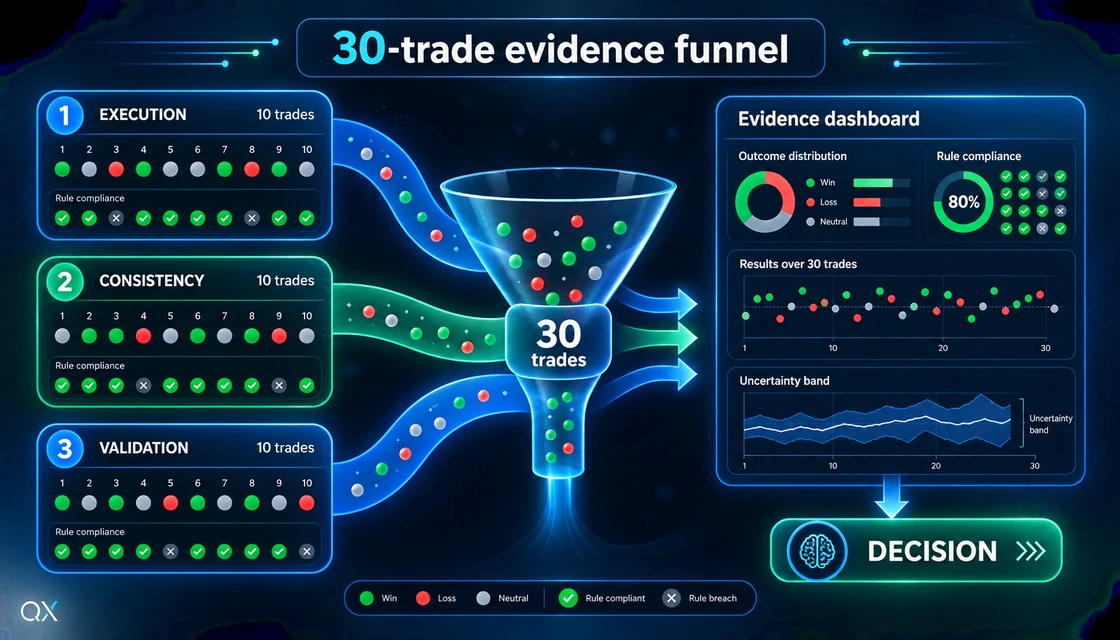
Thirty trades are not statistically conclusive, but they are long enough to expose obvious inconsistency and short enough for a beginner to complete without months of drift. Divide the sample into three blocks. Keep the core setup unchanged inside the full sample; use notes to propose changes for the next test rather than editing rules midstream.
Block 1 — Trades 1–10: execution
The first block tests whether the rule is usable. Ignore the balance. Your target is accurate platform control and a complete record for every decision.
- Use one asset and one expiry framework.
- Take no more than three trades in one session.
- Screenshot the chart before entry and after expiry.
- Mark every rule as yes, no, or not applicable.
- Write one sentence explaining each skip as well as each trade.
Block 2 — Trades 11–20: consistency
Repeat without widening the rules to create more opportunities. Begin tracking whether errors cluster after a loss, after a win, late in the session, or when the market is quiet.
- Keep the same fixed risk unit.
- Add a five-minute pause after every trade.
- Stop after two rule violations, regardless of outcome.
- Compare the payout and chart quality with Block 1.
- Count valid skipped setups as disciplined decisions, not missed profits.
Block 3 — Trades 21–30: validation
Use the final block to see whether the routine survives a different day or normal change in volatility. Do not deliberately seek extreme news or abnormal conditions. The goal is ordinary variation, not a stress stunt.
- Schedule sessions in advance instead of trading from boredom.
- Require the same pre-entry checklist.
- Do not increase stake after wins or losses.
- Write the result only after scoring compliance.
- At trade 30, freeze the sample and review it as a whole.
The journal fields that matter
| Field | What to record | Why it matters |
|---|---|---|
| Context | Date, time, asset, regular/OTC market, timeframe, session, relevant news. | Shows whether performance depends on one environment. |
| Contract | Direction, entry time, expiry, amount risked, displayed payout. | Makes break-even and expectancy calculations possible. |
| Setup | Trend/structure, level, trigger, confirmation, cancellation rule. | Separates a real setup from a story written after entry. |
| Process score | Checklist items met, screenshot saved, emotional state, rule violation code. | Measures controllable behaviour before outcome. |
| Outcome | Win, loss, tie/refund, net units, notes after expiry. | Completes the record without letting outcome redefine quality. |
How to evaluate the 30 trades
1. Rule compliance first
Calculate compliant trades ÷ total trades. A reasonable first target is not perfection but visibility: you should know exactly why each breach occurred. If compliance is below 80%, do not tune indicators yet. Repeat the practice block with simpler rules.
2. Win rate against the actual payout
Calculate wins ÷ resolved trades, excluding genuine ties or refunds. Then compare it with the weighted break-even rate from the payouts you recorded. Do not use the platform’s highest advertised payout or one convenient screenshot. If payouts varied, calculate each trade in risk units or use the average only as a clearly labelled approximation.
3. Expectancy in risk units
For fixed one-unit risk, expectancy per trade is (win rate × average profit payout) − (loss rate × 1). Example: 18 wins and 12 losses at an average 80% payout produce 18 × 0.8 − 12 = +2.4 units across 30 trades, or +0.08 unit per trade. That small positive result is not a promise; a few outcomes can reverse it in such a limited sample.
4. Error cost
Recalculate the sample without rule-breaking trades. If the compliant subset is materially better, behaviour—not the setup—may be the immediate problem. If compliant trades are still clearly below break-even, retire or redesign the setup rather than increasing frequency.
Worked example: a useful result that still says “wait”
A beginner completes 30 trades with an average payout of 75%: 17 wins, 13 losses, and 24 fully compliant decisions. The break-even win rate at 75% is about 57.1%. The observed win rate is 56.7%, and expectancy is 17 × 0.75 − 13 = −0.25 unit. The result is close to break-even but still negative, while compliance is 80%.
The correct conclusion is not “deposit and hope the next trade wins.” It is: the process is becoming consistent, but the evidence does not yet support real-money risk. Review the six non-compliant trades, simplify the rule if necessary, and run a new 30-trade sample without changing the historical record.
When to skip a demo trade
- The setup is visible only before the candle has completed.
- The asset, market type, or session is outside the test specification.
- The displayed payout is below your recorded test floor.
- High-impact news overlaps the setup or expiry window.
- The chart feed is frozen, delayed, or visibly inconsistent.
- You already reached the session trade limit or stop condition.
- You feel an urge to recover the previous virtual loss immediately.
- You cannot capture the entry reason in one clear sentence.
A skipped trade is data when the reason is recorded. It trains the most transferable trading skill: refusing an incomplete setup.

Demo versus live: the transfer problem
Real money changes attention. Traders may enter early, hesitate, raise the amount, cancel a rule after two losses, or stare at the balance instead of the chart. Platform conditions may also differ: available assets, payout, price feed, order acceptance, and payment operations can change. This is why the move from demo should be treated as a new test, not a graduation ceremony.
A conservative transfer test
- First verify the platform’s legal entity, registration or authorisation where applicable, country availability, risk disclosure, and withdrawal rules.
- Use the smallest practical funding level and trade amount only if the product is lawful and suitable for you.
- Reduce session frequency; do not copy the demo account’s virtual balance or stake scale.
- Use the identical checklist and record the first live decisions as a separate sample.
- Stop immediately if behaviour changes, fees or payouts differ materially, or any deposit/withdrawal process is unclear.
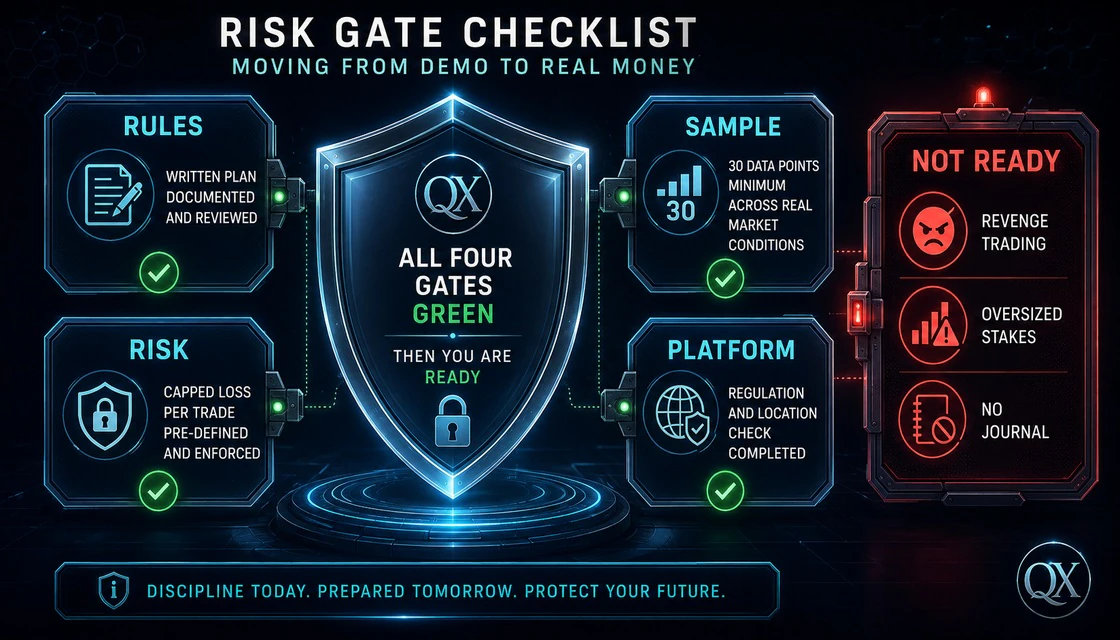
Four gates before any real-money decision
- Rules gate: the setup, expiry logic, skip rules, and session stop are written and stable.
- Sample gate: at least 30 comparable trades are complete, with no missing payout or outcome data.
- Risk gate: the hypothetical stake, daily cap, and maximum platform balance are small enough to lose without harming essential finances.
- Platform gate: official domain, legal entity, local access, registration status, data handling, payments, KYC, and support routes have been checked independently.
Common beginner mistakes
- Trying several strategies inside one sample and reporting one combined win rate.
- Refilling the demo balance and increasing stake until the chart looks exciting.
- Ignoring payout changes and comparing raw wins with raw losses.
- Taking many trades in one session, making the sample a fatigue test.
- Deleting rule-breaking wins because they make the journal look untidy—or keeping them as proof the rule works.
- Optimising the strategy after every loss, a form of overfitting.
- Practising only on OTC instruments and assuming the result applies to regular markets.
- Moving live because of a high virtual balance instead of documented process quality.
- Treating demo access as evidence that the broker is regulated, safe, or appropriate.
Risk management checklist
- No borrowed money, rent, emergency savings, or essential funds are ever assigned to trading.
- One predefined risk unit per trade; no martingale or loss-chasing progression.
- A daily limit for trades, losses, and rule violations.
- A platform-balance cap and a documented withdrawal test before any scaling.
- No acceptance of bonuses or promotions without reading withdrawal and turnover conditions.
- No sharing of passwords, one-time codes, or full payment credentials.
- Immediate stop if the platform, product, or solicitation appears unregistered or unlawful in your jurisdiction.
Demo practice task
Complete this 45-minute drill before starting the 30-trade sample. It tests whether your setup is objective enough to record.
- Write a four-line setup: context, trigger, expiry, cancellation.
- Open one chart and observe for 15 minutes without trading. Mark two situations that look tempting but fail the rules.
- Select one historical or live demo setup and complete the pre-entry checklist. If it qualifies, place one virtual trade at the fixed unit; otherwise record a skip.
- Save before-and-after screenshots and score compliance before reading the outcome.
- Explain in two sentences what would make the same decision invalid on another day.
Final checklist
- One asset or clearly separated market sample.
- One setup, unchanged across all 30 trades.
- Fixed, realistic risk unit.
- Payout recorded before every entry.
- Screenshots and rule score for every trade.
- Three blocks of ten completed on planned sessions.
- Win rate compared with the correct break-even rate.
- Expectancy and error cost reviewed.
- Platform legality and identity checked independently.
- A written decision: repeat demo, redesign, stay demo-only, stop, or cautiously run a separate live transfer test.
Summary
The best binary options demo account is not the one with the largest virtual balance. It is the environment in which you can repeat one process, measure actual payouts, document skips, expose rule violations, and reach a decision without financial pressure. Thirty trades provide a useful first screen—not statistical certainty. If the sample is incomplete, below break-even, emotionally unstable, or tied to an unchecked platform, the professional choice is to remain on demo or stop.
Quick answers
Is a binary options demo account free?
Many platforms advertise free virtual practice, but access conditions, registration requirements, assets, and data may vary. Check the official site and do not treat “free” as proof of legitimacy.
How many demo trades do I need?
Thirty comparable trades are a practical first sample. More evidence across different normal conditions is better, provided the rules remain stable and the records are complete.
What is a good demo win rate?
There is no universal number. The required rate depends on the actual payout. At 80%, the mathematical break-even rate is about 55.6%; a margin above break-even is still uncertain in a small sample.
Should I use the full virtual balance?
No. The displayed virtual balance is a platform feature, not a risk plan. Practise with a small fixed amount that models conservative real-world behaviour.
Can demo trading prove a strategy is profitable?
No. It can reject unclear rules and reveal early evidence, but it cannot guarantee future results or fully reproduce live emotion and execution.
Should I practise OTC and regular markets together?
No. Their pricing and trading conditions may differ. Keep them as separate samples and label them clearly.
When should I move from demo to live?
Only after documented consistency, payout-aware evidence, conservative risk limits, and an independent platform and jurisdiction check. You never have to move live.
Are binary options legal everywhere?
No. Rules vary widely. For example, the FCA’s permanent UK ban on sale to retail consumers took effect in 2019, while U.S. binary options must meet specific exchange and regulatory requirements. Verify current local rules.
What if the demo result is negative?
That is useful information obtained without financial loss. Review compliance, simplify or retire the setup, and begin a new sample only after defining the change in writing.
Next step
Choose a topic by task: brokers for platform selection, guides for access, strategies for setups, risk for discipline and investing for longer market logic.