Deriv demo account
Deriv Demo Account 2026: Complete Practice Guide
Learn how the Deriv demo account works, compare Deriv Trader, MT5 and TradingView practice routes, follow a realistic 7-day plan and avoid common demo mistakes.

Key points
- Choose the platform route first: Deriv Trader options, MT5 CFDs and TradingView-connected trading use different tickets, risks and performance measures.
- Make demo practice realistic with one working balance, fixed percentage risk, written stop rules, one setup and a journal that records skipped trades.
- Move toward real money only after a meaningful sample shows strong rule adherence; demo results cannot reproduce live financial pressure or guarantee future performance.
Deriv Demo Account: Quick Answer
A good demo account is not the one with the largest virtual balance. It is the one you use with enough realism that your decisions can be reviewed. Deriv is more complex than a single quick-trading screen: its ecosystem can include options-style contracts, CFD platforms and chart-first routes. That flexibility is useful, but it also creates the first beginner trap—testing three different products as if they were the same strategy.
This guide shows how to open and structure a Deriv practice account, choose the correct platform for your objective, create rules that survive outside demo and decide whether your sample is ready for a cautious next step. It does not promise profit. Options and leveraged CFDs can cause rapid losses, and availability varies by jurisdiction.
What is a Deriv demo account?
A Deriv demo account uses virtual funds instead of deposited money. Deriv's own education material states that demo accounts are available across its trading platforms, commonly loaded with USD 10,000 in virtual funds and refillable. Treat that figure as a platform feature to recheck in your dashboard rather than as a target balance. The useful part is not the number; it is the ability to repeat a process without financial loss while you learn the controls.
Your main Deriv login can contain more than one trading account or platform route. Deriv says each person should have one client account, while multiple trading accounts—such as real and demo MT5 accounts—can sit under it. Do not create extra identities simply to reset results. If a demo record is poor, preserving it is more educational than erasing it.
- Virtual funds replace real deposits during practice.
- You can learn navigation, order tickets, chart tools and account-specific terminology.
- You can test one defined setup over a meaningful sample.
- You can practise stopping after a loss limit even though no money was lost.
- You cannot reproduce the full emotional pressure of real capital.
Choose the platform before you practise
The phrase “Deriv demo account” can describe different trading experiences. An options contract, a leveraged CFD position and a chart-linked TradingView order are not interchangeable. They use different inputs, risk mechanics and exit logic. Your first decision is therefore not which asset to trade. It is which product model you are trying to learn.
| Platform route | Product model | What to practise | Best use |
|---|---|---|---|
| Deriv Trader | Options-style contract tickets in a browser | Stake, duration, barrier/contract rules, potential payout | Learning the ticket and expiry discipline |
| Deriv MT5 | CFDs in MetaTrader 5 | Spread, margin, leverage, stop loss, take profit | Practising order mechanics and chart-based plans |
| TradingView with Deriv | CFDs through a chart-first workspace | Chart layout, alerts, order panel, execution | Traders who already analyse in TradingView |
| Other dashboard platforms | Availability varies by region and account | Exact product, fees, leverage and account rules | Only after checking the live dashboard and terms |
Deriv Trader demo: practise the contract ticket
Deriv Trader is Deriv's browser-based options platform. On an options-style ticket, the result depends on the contract definition—not only on whether the chart generally moved in your preferred direction. Depending on the product, the ticket may involve a stake, duration, barrier or prediction condition, and a displayed potential payout. Read every field before clicking. A one-second or ultra-short duration may be available, but availability is not a reason to use it. Very short contracts leave little room to distinguish analysis from noise.
A useful Deriv Trader demo session should train ticket accuracy. Before each practice contract, say the contract type, the exact condition required for a positive result, the duration, the maximum amount at risk and the reason the chart context supports the idea. If you cannot explain those fields in one sentence, skip the trade.
Deriv MT5 demo: practise CFD mechanics
Deriv MT5 is a MetaTrader 5 route for CFDs on markets such as forex, stocks, commodities, cryptocurrencies and synthetic indices, subject to availability. A CFD position behaves differently from a fixed-payout option. You must understand bid and ask prices, spread, volume, margin, leverage, stop loss, take profit and floating profit or loss. Deriv's help centre notes that a new MT5 position may initially show a small loss because of the spread.
Deriv's current MT5 demo page says the demo account does not expire. Treat that as the current platform statement, while still checking the dashboard and regional terms for any account-specific conditions.
TradingView and other routes
Deriv also supports TradingView connectivity for eligible CFD accounts. This can suit a trader who already builds analysis with TradingView charts, layouts and alerts. Deriv states that a demo account can be used with TradingView. Paper Trading inside TradingView is another simulation, but it is not identical to order execution through a connected Deriv account. Keep those datasets separate in your journal.
Other platform tiles may appear in your account, including automation or copy-trading routes. Do not assume a tutorial written for one tile applies to another. Confirm the product, legal entity, fees, leverage, contract rules and demo availability in the current dashboard and official terms for your country.
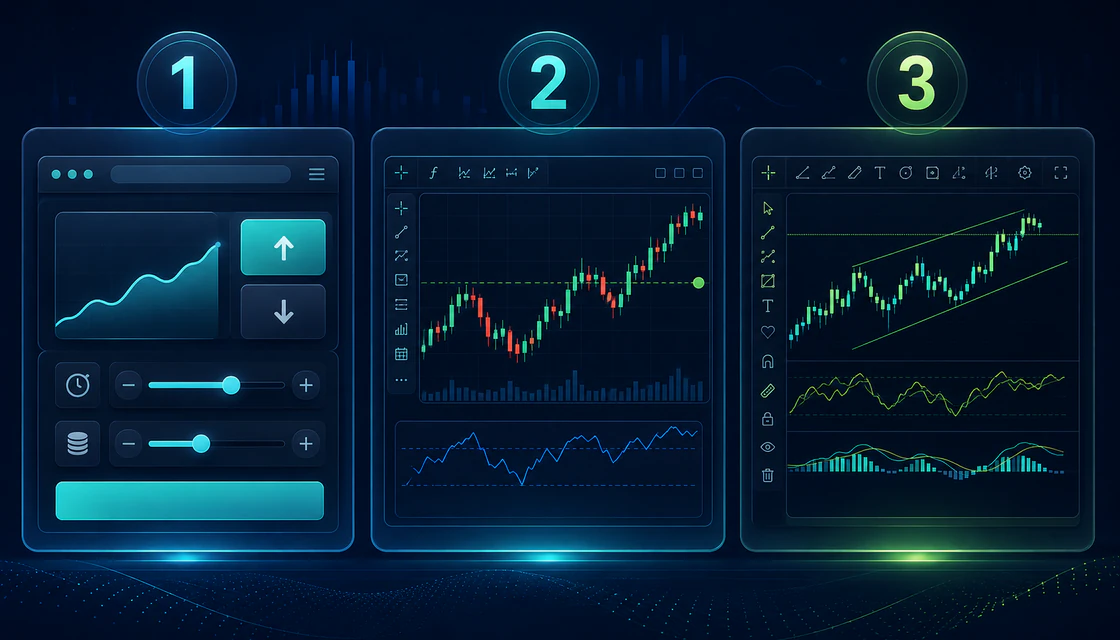
How to open and set up a Deriv demo account
- Go to the official Deriv website and confirm that services are available in your country. Avoid look-alike domains and links sent by unknown people.
- Create one client account with accurate personal information. Deriv states that one client should not operate multiple separate accounts.
- Switch to the demo or virtual-money environment in the dashboard. The wording can differ by platform and interface update.
- Choose one platform route based on the product you intend to learn: options-style contracts, MT5 CFDs or a supported chart-first connection.
- For MT5, create the dedicated demo trading account and MT5 password if prompted. MT5 credentials can be separate from the main Deriv login.
- Set the practice balance and risk rules before placing the first order. A refillable balance should not become permission to ignore losses.
- Take a screenshot of the clean starting state and begin a journal. Record the platform, product, asset, setup, risk, time and result.
What demo can teach—and what it cannot
Demo is excellent for procedural competence. You can learn where an order is placed, how to calculate exposure, how a contract expires, how spread affects a CFD entry and how to close or protect a position. You can also discover whether your written strategy is precise enough to produce the same decision twice.
Demo is weaker at reproducing behaviour under pressure. A virtual loss does not threaten rent, savings or a goal. That means a trader may wait patiently in demo and become impulsive with real funds, or accept drawdown that would be intolerable outside practice. The solution is not to dismiss demo. It is to make demo rules stricter and the transition slower.
| Factor | Demo | Real account |
|---|---|---|
| Capital | Virtual and refillable | Limited and exposed to loss |
| Emotion | Usually lower | Fear, greed and loss aversion are stronger |
| Execution | Useful approximation | Can feel different under live conditions and pressure |
| Objective | Learn rules and collect evidence | Protect capital while following a validated plan |
| Meaning of a win | One observation | Still only one observation, with real financial impact |
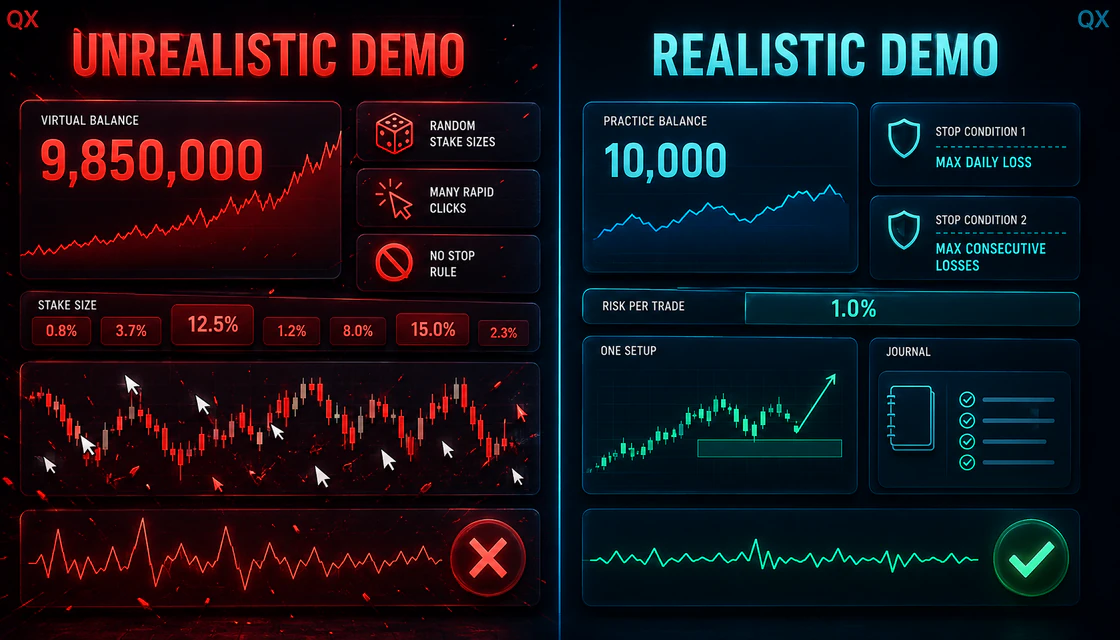
Build a realistic practice environment
Start by shrinking the virtual world. If you expect your eventual real deposit to be modest, do not evaluate decisions as if millions of virtual units were disposable. Choose a notional practice balance close enough to your likely real budget that percentage risk feels meaningful. If the platform balance cannot be reduced directly, maintain a separate “working balance” in your journal and ignore the rest.
Use percentage risk, not random stakes
Define the maximum amount at risk before the session. For an options contract, the stake may be the maximum loss if the contract finishes negatively, but check the ticket terms. For CFDs, calculate risk from entry to stop loss and account for volume, tick value and currency conversion. Do not use margin required as a substitute for risk; leverage can make exposure much larger than the cash margin.
A conservative training rule might use the same small percentage for every valid setup and a hard daily stop. The purpose is not to prescribe a universal percentage. It is to prevent the result of the previous trade from changing the size of the next one.
Keep one setup and one market context
A sample becomes difficult to interpret when every trade uses a different idea. For the first test, choose one setup—for example, a pullback in a defined trend after a completed confirmation candle—and one market context. Write the entry condition, invalidation, timing rule and skip conditions. On options, add a tested duration or expiry rule. On CFDs, add the stop-loss and exit model.
- Trade the setup only when all conditions are visible before entry.
- Use completed candles if your plan requires candle confirmation.
- Avoid high-impact news unless news trading is the strategy being tested.
- Do not switch to synthetic indices merely because the external market is closed.
- Record valid skipped trades as evidence of discipline, not missed profit.
Use stop conditions even on virtual funds
A demo session should end under the same rules you would want when money is real. Set a maximum number of trades, a maximum session loss and a maximum number of consecutive losses. Add a time stop: if the session lasts longer than planned, close the platform. The ability to refill virtual funds makes these rules more important, not less.
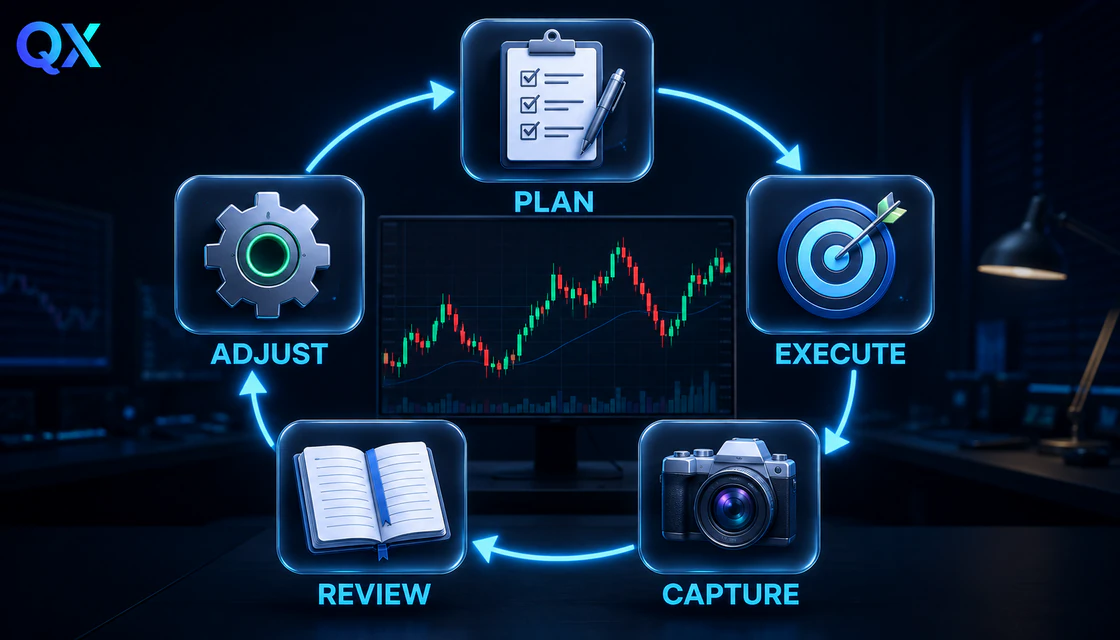
The five-step demo practice loop
Plan: define platform, product, asset, setup, risk, session window and stop rules before opening the chart.
Execute: act only when the written conditions are present; do not improve the story after clicking.
Capture: save a before-entry screenshot and an after-result screenshot with personal information hidden.
Review: score rule adherence separately from profit or loss. A losing trade can be well executed; a winning trade can be a process error.
Adjust: change only one variable after enough observations. Restart the sample when the setup definition materially changes.
A practical Deriv demo setup example
The following worked example is for education, not a trade recommendation. Assume a trader is testing a trend-pullback setup on one liquid forex pair during a consistent session. The chart timeframe is five minutes. Trend direction requires a sequence of higher highs and higher lows for bullish conditions or lower highs and lower lows for bearish conditions. The pullback must reach a previously marked zone, and entry requires a completed rejection candle in the trend direction.
Options version
On an options-style platform, the trader selects only a contract whose condition matches the hypothesis and uses one pre-tested duration rule. The exact expiry is not guessed from how fast the candle looks. The trader skips if the potential payout is below the threshold used in the test, the contract definition is unclear, or a high-impact economic release overlaps the contract window.
CFD version
On MT5, the same chart idea needs a different risk expression. Entry is placed only after confirmation, the stop goes beyond the invalidation point, and volume is calculated so the loss at the stop stays within the fixed risk limit. A take-profit or management rule is defined before entry. The trade is skipped if the spread is unusually large relative to the stop distance or the required volume cannot express the planned risk safely.
When to skip
- The dashboard shows a different product or legal route than the guide assumes.
- The contract condition, leverage, spread or fee is not understood.
- The chart is between levels and the setup location is weak.
- The entry would occur directly before major scheduled news.
- The daily limit, consecutive-loss limit or session time has been reached.
- You feel an urge to increase size to recover a virtual loss.
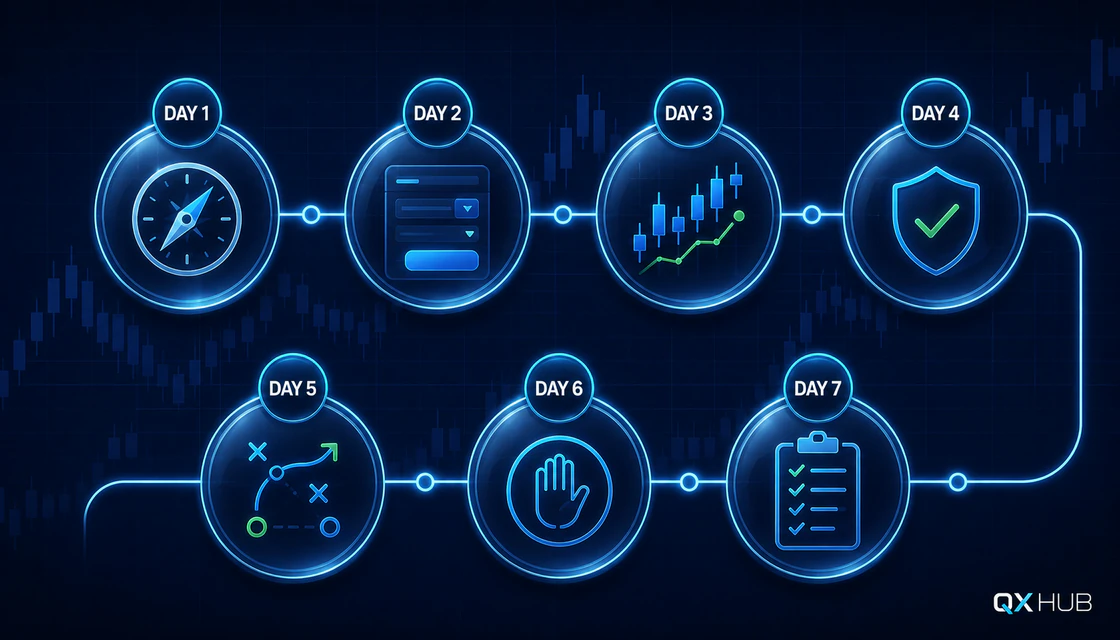
Seven-day Deriv demo practice plan
Day 1 — Navigation and account map
Open the dashboard without trading. Identify the demo switch, platform tiles, account currency, balance, history, support route and security settings. Write down which legal entity and products are shown for your region. Goal: zero accidental orders.
Day 2 — Order ticket mechanics
Use the chosen platform and place a small number of practice orders solely to learn the ticket. On Deriv Trader, explain contract type, stake, duration and payout condition. On MT5, explain symbol, bid/ask, volume, stop loss, take profit and margin. Goal: no field is clicked without a definition.
Day 3 — Chart setup
Choose one asset and create a clean chart. Mark trend structure, one or two important zones and the news window. Use only indicators that have a defined job. Goal: a chart another trader could understand without asking why five indicators disagree.
Day 4 — Risk and stop rules
Set a working balance, fixed risk, maximum trades, daily loss cap and consecutive-loss stop. Rehearse ending the session after the limit. Goal: stopping feels like completing the plan, not failing it.
Day 5 — One setup only
Trade or observe only the defined setup. Capture every valid signal, including signals you correctly skip because another filter fails. Goal: consistency, not activity.
Day 6 — No-trade discipline
Spend one full session looking for reasons not to trade. Record unclear structure, weak location, news conflict, poor payout, large spread or emotional urgency. Goal: prove that waiting is an active trading skill.
Day 7 — Review and decision
Review the week by process metrics: percentage of trades that met all rules, average risk, number of impulsive entries, stop-rule compliance and screenshot completeness. Choose one improvement for the next week. Do not move to real money because of a short winning streak.
How many demo trades are enough?
There is no magic number that guarantees readiness. Ten trades can reveal a mechanical problem but say little about robustness. A useful first validation commonly needs at least several dozen clean examples collected across relevant conditions, followed by a separate forward sample after the rules are frozen. The more selective the setup, the longer this takes.
Judge the sample with more than win rate. For options, compare win rate with the break-even rate implied by the actual payout. A lower payout requires a higher win rate to break even. For CFDs, examine average gain, average loss, risk-reward distribution, maximum drawdown, spread impact and whether results depend on one unusually large trade. In both cases, separate strategy performance from rule adherence.
- Rule-adherence rate: how often every entry condition was met.
- Risk consistency: whether stake or position risk stayed within the plan.
- Skip quality: whether forbidden conditions were avoided.
- Drawdown: the worst peak-to-trough decline in the practice sample.
- Expected value: average outcome per unit of risk across the sample.
- Stability: whether results survive different days and reasonable market conditions.
Common Deriv demo account mistakes
Treating the virtual balance like arcade credit
Refilling a large balance after every bad session removes the feedback loop. Maintain a fixed working balance and record drawdown before any reset.
Mixing options and CFDs in one dataset
A fixed-payout contract and a leveraged CFD have different outcome distributions, costs and management rules. Keep separate journals and performance metrics.
Changing duration, stop or stake after a loss
This is revenge trading even when the money is virtual. The demo should expose the behaviour before it becomes expensive.
Testing on a market you will not trade
Synthetic indices can be available around the clock, while external markets follow sessions and news. Evidence from one environment does not automatically transfer to another.
Optimising until the past looks perfect
If you change rules after every losing trade, the strategy may fit the sample rather than a repeatable market behaviour. Freeze the rules, validate on new data and keep an untouched forward test.
Moving to real money because demo feels boring
Boredom often means the trader expects stimulation rather than evidence. A disciplined process should feel repetitive. That is a feature.
When should you move from demo to real trading?
Moving to a real account should be a risk decision, not a graduation ceremony. Consider a cautious transition only when you can operate the platform without mechanical errors, your rules are written, a meaningful sample shows positive expectancy after realistic costs or payouts, and your rule-adherence rate is consistently high. You should also be able to stop after losses without negotiating with yourself.
If you choose to continue, use an amount you can afford to lose and reduce the financial scale. Keep the same setup and session limits. Expect performance to change because emotion changes. A real-money result that diverges from demo is a reason to step back, not increase size.
Deriv demo account troubleshooting
The demo platform or product is missing
First confirm that you are in the demo environment and that the platform is available in your country. Product tiles can differ by jurisdiction, account entity and interface update. Use the official help centre or live chat rather than a third-party workaround.
The Deriv MT5 demo is unavailable
Deriv's current MT5 demo page says the demo account does not expire. If an MT5 demo is missing or inaccessible, confirm the selected account type, server, password, regional availability and current dashboard, then use official support instead of assuming an inactivity timeout.
MT5 login fails
Check the MT5 login number, dedicated MT5 password and the server shown in account details. The main Deriv password may not be the MT5 trading password. Avoid repeated password guessing and use the official reset flow.
A position starts negative
On MT5, the difference between bid and ask creates the spread. That cost can make a new position appear slightly negative immediately. If the spread is too large relative to your planned stop, skip the trade.
The virtual balance is too large
Create a smaller working balance in the journal and calculate every trade from it. Ignore the remaining virtual funds. Refill only according to a written reset rule after review.
Final advice
The strongest use of a Deriv demo account is not learning how fast you can place a trade. It is learning how often you can refuse a trade that does not meet the plan. Choose one product route, make the balance realistic, freeze the rules, capture the evidence and review behaviour separately from results.
When demo practice is structured this way, it becomes a laboratory for platform competence and decision discipline. It still cannot make a risky product safe, and it cannot guarantee live performance. But it can prevent many avoidable mistakes before real capital is exposed.
Quick answers
Is the Deriv demo account free?
Deriv describes its demo accounts as free practice environments with virtual funds. Recheck the current dashboard and terms for your region.
How much virtual money does Deriv provide?
Deriv's education material states that practice accounts are commonly loaded with USD 10,000 in virtual funds and can be topped up. The displayed amount can change, so treat the dashboard as the current source.
Does the Deriv demo account expire?
Deriv's current MT5 demo page says an MT5 demo account does not expire. Other platforms, account types and regional routes may have different conditions, so confirm the current dashboard and terms.
Can I use Deriv MT5 without depositing?
Yes, Deriv offers an MT5 demo with virtual funds for practice. A real MT5 account requires funding before live trading.
Is Deriv Trader the same as Deriv MT5?
No. Deriv Trader focuses on options-style contracts, while Deriv MT5 is a CFD platform. Their risk, costs, order controls and performance metrics differ.
Can I use TradingView with a Deriv demo account?
Deriv states that eligible users can connect a Deriv demo account to TradingView. Availability and instruments depend on the account and region.
Are synthetic indices available on demo?
They may be available on supported Deriv platforms and accounts. They are a distinct market environment and should not be mixed with forex or external-market results in one test.
Does success on demo mean I am ready for real money?
No. Demo can validate mechanics and process, but it cannot reproduce real-money emotion or guarantee future performance. Use a meaningful sample, strict rules and a much smaller real-money scale if you decide to proceed.
Can I have more than one Deriv account?
Deriv states that each client should have one main account, although multiple trading accounts such as real and demo MT5 accounts can exist under it.
What is the best Deriv demo strategy?
There is no universal best strategy. Start with one objective setup, a defined market context, fixed risk, explicit skip rules and a journal. Validate it before changing variables.
Next step
Choose a topic by task: brokers for platform selection, guides for access, strategies for setups, risk for discipline and investing for longer market logic.