economic calendar for binary options
Economic Calendar for Binary Options: News Risk, Timing and Trade Filters
Learn how to read an economic calendar, compare actual versus forecast, avoid expiry conflicts and build a practical news-risk filter for binary options.
Key points
- The calendar maps risk; it does not predict direction.
- Check both currencies, the exact time zone and the full expiry window before every entry.
- When scheduled news conflicts with the trading plan, skipping the trade is the disciplined decision.
Economic Calendar for Binary Options
The calendar maps risk; it does not predict direction.
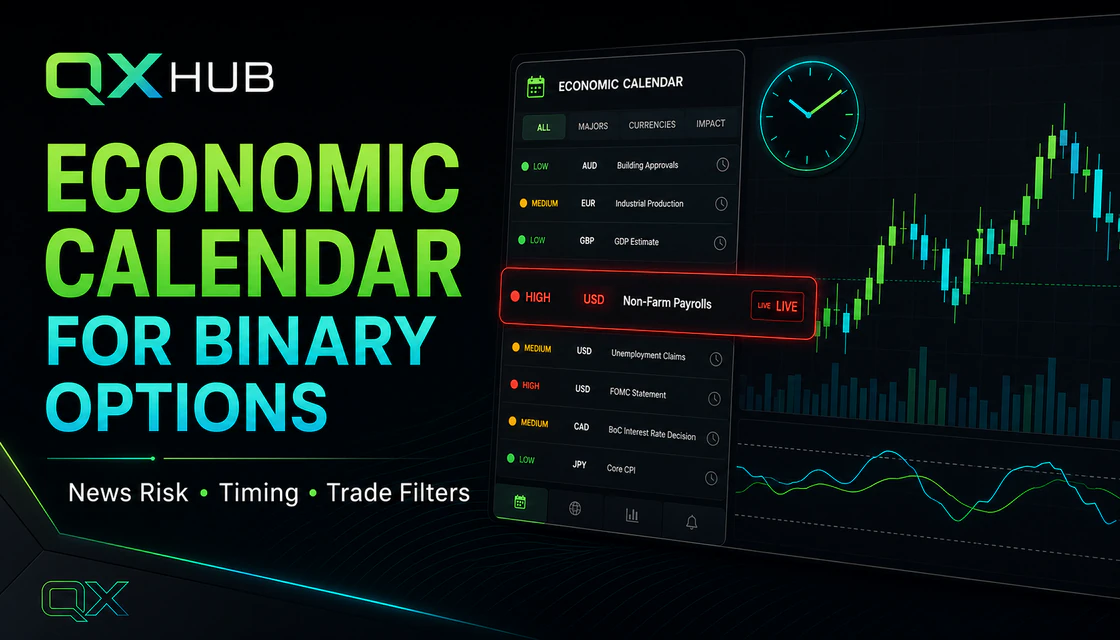
An economic calendar lists scheduled events that can change market prices: inflation reports, employment data, central-bank decisions, growth figures, speeches, and other releases. For binary options traders, the calendar is not a prediction tool. It is a map of moments when normal technical behavior can become unstable before a fixed expiry.
A chart pattern that looks clean can be invalidated within seconds when new information reaches the market. Price may spike above and below the strike, cross several technical levels, or reverse after an initial reaction. The practical purpose of a calendar is therefore to answer one question before entry: will this contract remain open during a restricted event window?
Risk warning: Binary options are high-risk, all-or-nothing products and may be restricted or prohibited in your jurisdiction. An economic calendar cannot remove news risk, predict direction, or guarantee profit. Check local regulations, read the contract terms, use only money you can afford to lose, and test any process on a demo account before considering real funds.
What Is an Economic Calendar?
An economic calendar is a schedule of macroeconomic announcements and policy events. Most calendars show the release time, related country or currency, event name, expected impact, previous result, market forecast, and actual value after publication.
Common entries include:
- central-bank interest-rate decisions;
- inflation indicators such as CPI or PCE;
- employment data, including payrolls and unemployment;
- gross domestic product;
- retail sales and industrial production;
- purchasing managers' indexes;
- trade balances and consumer confidence;
- speeches, meeting minutes, and policy testimony.
The calendar tells traders when information is scheduled. It does not show how price must react.
Why News Matters for Binary Options
Binary options settle at a fixed moment. A news release can change price faster than a normal technical setup was designed to handle. The contract can be correct in direction initially and still lose after a reversal before expiry.
News can affect:
- volatility: candle ranges may expand sharply;
- liquidity: price updates can become irregular;
- technical levels: support and resistance may be crossed repeatedly;
- entry quality: clicks made after a spike produce a late strike;
- expiry: the contract may span the release and its aftermath;
- payout and availability: platform terms may change around active periods.
These effects are not limited to the named currency. A major US release can influence EUR/USD, gold, equity indexes, bond yields, and other correlated markets.
How to Read an Economic Calendar
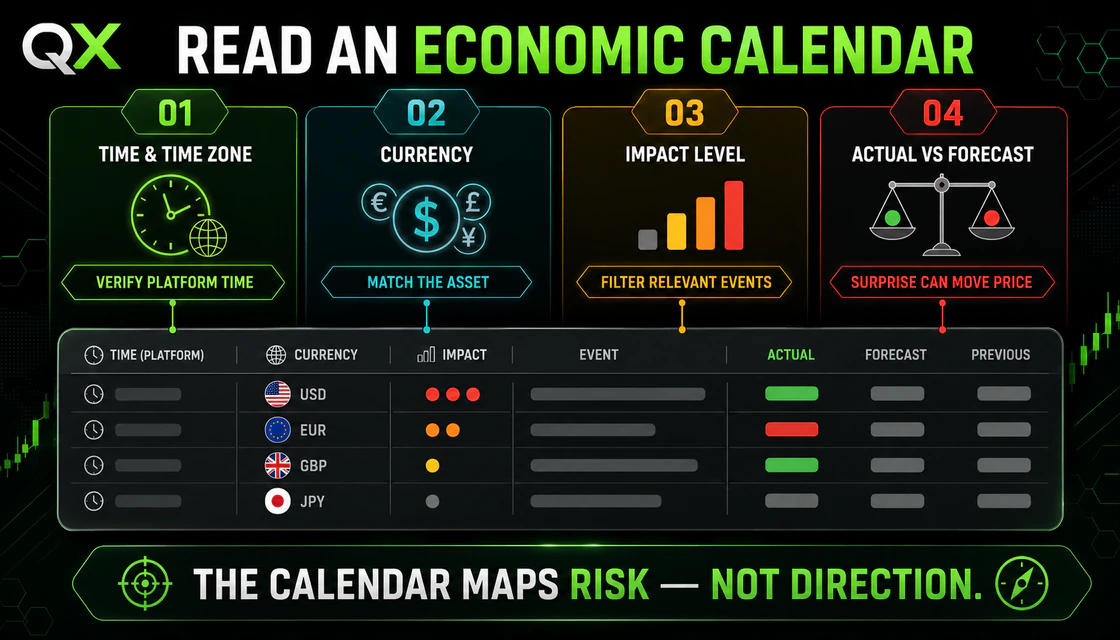
Four fields matter most before every trading session.
1. Time and Time Zone
Verify whether the calendar displays UTC, local time, or an automatically detected zone. Then compare it with the broker's platform clock. A one-hour mistake can place expiry directly across the event.
Daylight-saving rules can shift London and New York relative to UTC. Do not rely on a conversion saved months earlier.
2. Currency or Country
Match the event to the asset. EUR events are directly relevant to EUR pairs; USD events can influence every major USD pair and many global assets. Cross-currency pairs can be affected by events from either side.
3. Impact Level
Calendars often label events low, medium, or high impact. This is a screening aid, not a guarantee. A “high-impact” release may produce little movement if the result is expected, while an overlooked event can surprise the market.
4. Previous, Forecast and Actual
- Previous: the last reported value, sometimes revised.
- Forecast: a consensus estimate before publication.
- Actual: the newly released number.
Markets often react to the difference between actual and expected values, not simply whether the number looks positive or negative. Even then, direction is not guaranteed because positioning, revisions, details, and policy expectations matter.
Impact Ratings Are Filters, Not Facts
Impact labels are created by the calendar provider. Different calendars may classify the same event differently. A robust trading plan therefore defines event categories rather than trusting a color alone.
The table describes risk categories, not recommendations to trade them.
| Event category | Typical concern | Planning response |
|---|---|---|
| Central-bank decision | Sudden repricing and statement risk | Prohibit entries across the decision and related briefing |
| Inflation | Rate expectations can change quickly | Apply a fixed restricted window |
| Employment | Headline, revisions, wages, and unemployment may conflict | Avoid treating one number as directional |
| GDP / activity | Surprise can affect growth expectations | Check the relevant currency and expiry |
| Speech / testimony | Timing and content may be less precise | Use a broader or manual restriction |
Forecast, Actual and Market Reaction
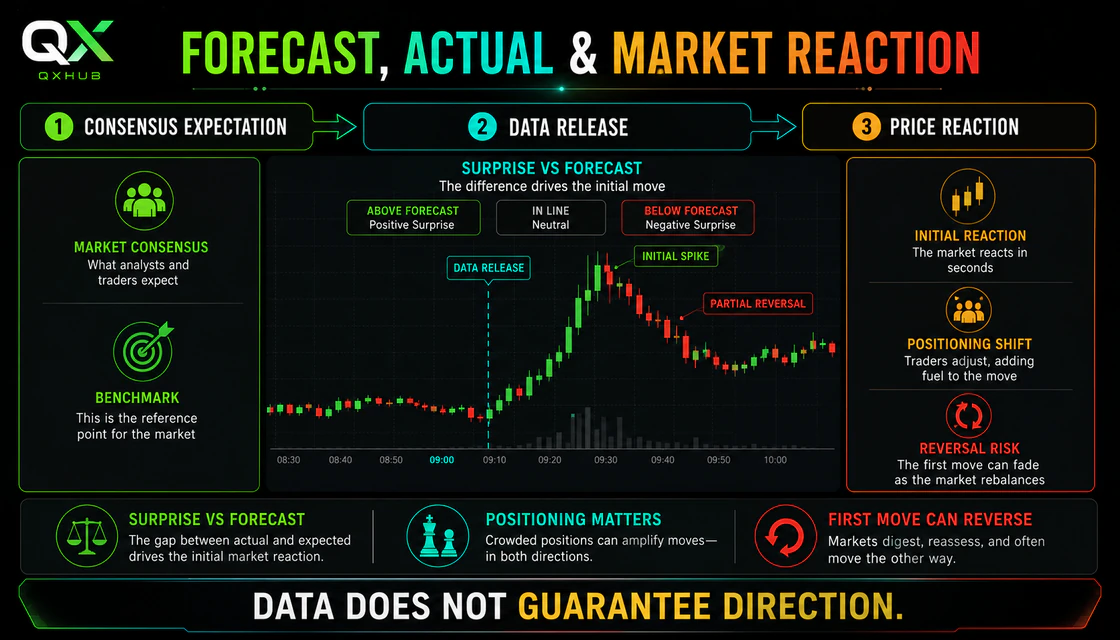
A common mistake is to assume “better data means currency up.” Market reaction is more complex.
The Consensus Baseline
Prices may reflect expectations before publication. If a result matches consensus, there may be little new information. If it differs significantly, repricing can be rapid.
Revisions Matter
Previous values are sometimes revised. A strong headline paired with a weak revision can create a mixed reaction.
Details Matter
Employment reports can include wages, participation, and unemployment. Inflation can contain headline and core measures. Central-bank decisions include the rate, statement, projections, and press conference.
Positioning Matters
If traders are already heavily positioned for one outcome, even supportive data can trigger profit-taking. A crowded market can reverse after the first move.
The First Move Can Fail
Algorithms and fast participants react in milliseconds. The initial spike may reverse as the full release is assessed. Chasing it produces poor entry location and unpredictable expiry risk.
The economic number explains what was published. It does not guarantee where price will settle.
The News Risk Window
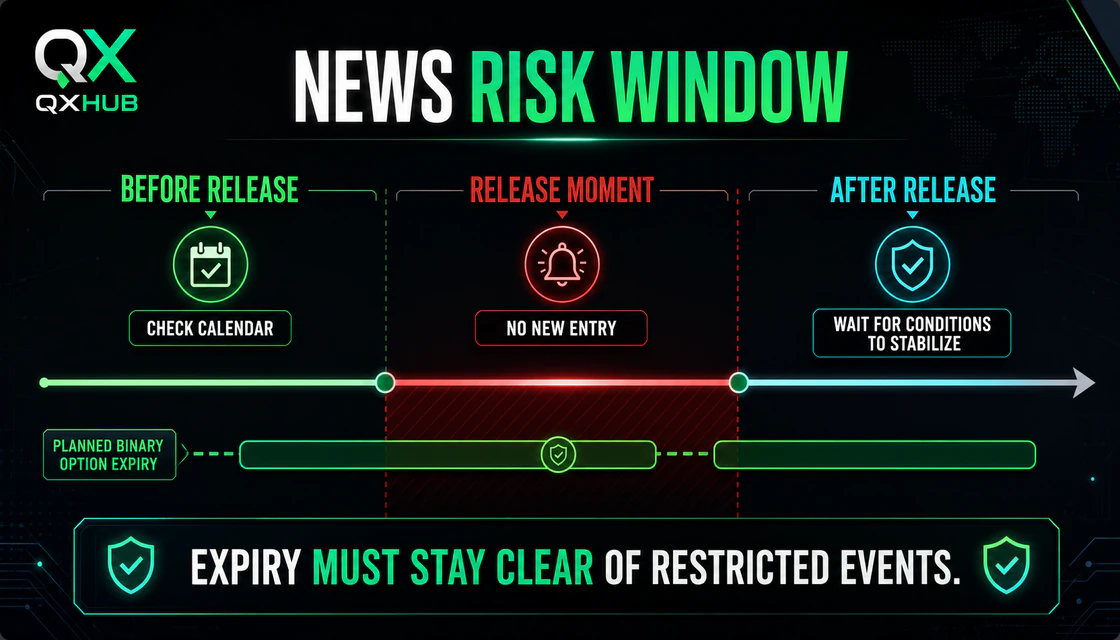
A news filter needs a defined period before and after the release. “Avoid news” is too vague to audit.
Before the Release
Liquidity and positioning can change before publication. Price may compress, drift, or become erratic. A contract entered before the event can still be open when the release arrives.
At the Release Moment
Spikes, rapid reversals, gaps between updates, and multiple strike crossings can occur. No new entry should be allowed when the plan classifies the moment as restricted.
After the Release
The market may need time to process revisions, details, and commentary. Waiting one candle is not universally sufficient. The plan should define how stabilization is recognized.
Expiry Must Be Clear
The key check is not only entry time. If a five-minute option is opened three minutes before a prohibited release, the expiry crosses the event. The trade violates the filter even though entry occurred outside the red zone.
How Long Should Traders Wait Around News?
There is no universal safe interval. A suitable restriction depends on:
- event type;
- asset and currency;
- chart timeframe;
- strategy logic;
- normal session volatility;
- contract expiry;
- whether a press conference follows the headline.
A testable rule could prohibit new entries for a specified period before and after selected event categories and require candle ranges to return within a recent baseline. The exact values must come from evidence, not a copied rule.
Some events, such as policy speeches, do not have a single precise “actual” release. In such cases, the plan may prohibit the entire scheduled window.
Economic News by Currency
USD
US inflation, payrolls, Federal Reserve decisions, retail sales, and growth data can affect USD pairs and global risk assets. Because USD is widely used, spillovers can be broad.
EUR
European Central Bank decisions and euro-area inflation or activity data can influence EUR pairs. National releases from major euro-area economies may also matter.
GBP
Bank of England decisions, UK inflation, labor data, GDP, and retail sales can produce movement in GBP pairs.
JPY
Bank of Japan decisions, inflation, wage data, and policy comments can affect JPY pairs. Intervention-related headlines can be unscheduled.
AUD, NZD and CAD
Domestic central-bank decisions and local employment or inflation data matter. Commodity-market developments can also influence these currencies outside the calendar.
This mapping is a starting point. Always check both currencies in a pair and the broader market context.
News Risk by Asset Type
If a binary options platform offers a derivative or OTC version, its price source and contract rules must also be understood.
| Asset | Common event exposure | Additional consideration |
|---|---|---|
| Currency pair | Events from both currencies | Session overlap can amplify movement |
| Gold | USD, yields, inflation, central banks | Safe-haven flows can conflict with rate logic |
| Equity index | Rates, inflation, growth, earnings themes | Cash-market opens add volatility |
| Oil | Inventories, supply policy, geopolitics | Unscheduled headlines are common |
| Crypto | Macro data plus crypto-specific news | Weekend and 24/7 behavior differ |
News, Volatility and False Breakouts
News can push price through support or resistance, attract late breakout entries, and reverse. A large candle is proof that movement occurred—not confirmation that direction will continue.
Warning signs include:
- long wicks beyond a level;
- immediate return inside a range;
- several rapid level crossings;
- unusually wide candle ranges;
- a retest that fails before expiry;
- price behavior unlike the strategy's historical sample.
Technical confirmation rules do not become stronger merely because news caused the break. If the strategy excludes event-driven volatility, skip the setup.
Scheduled vs Unscheduled News
An economic calendar covers scheduled events. It cannot list every geopolitical headline, emergency announcement, company shock, intervention rumor, or technical outage.
This is why a calendar is only one layer of risk control. Fixed stake, daily loss limits, maximum trade count, and stop conditions remain necessary. A clear calendar does not make a trade safe.
A Practical Pre-Session Calendar Routine
Step 1: Set the Correct Time Zone
Confirm the calendar, local clock, and platform time. Record any daylight-saving difference.
Step 2: List Planned Assets
Check both currencies in each pair and any macro exposure of non-FX assets.
Step 3: Filter Relevant Events
Apply the strategy's event categories and impact rules. Do not remove an event only because the headline seems unimportant.
Step 4: Mark Restricted Windows
Add the prohibited period before and after each event to the trading plan or session notes.
Step 5: Check Every Expiry
Before entry, confirm that settlement occurs outside all restricted windows.
Step 6: Recheck During the Session
Calendars can update, speeches can run late, and times can change. Recheck before a trade if the session is long.
Step 7: Record the Decision
Log skipped trades caused by news. A correct “no trade” decision is useful data.
Complete Educational Example
Suppose a trader tests a support-retest setup on EUR/USD during a defined London-session window. The setup requires a five-minute candle rejection at a previously marked level, a fixed expiry, a minimum payout, and no high-impact EUR or USD event inside the restricted window.
At the start of the session, the calendar shows a USD inflation report later in the morning. A setup appears six minutes before publication. Although entry is technically outside the no-entry period, the planned expiry would settle after the release. The trader skips.
After publication, price spikes above resistance, reverses, and crosses the level several times. One candle later, a familiar rejection pattern appears. The candle range is still far above the strategy's tested baseline, so the trader skips again.
Later, movement stabilizes and all rules pass. The trader takes a demo trade at the fixed stake. It loses. The process can still be correct: the calendar filter reduces untested exposure but cannot guarantee a winning settlement.
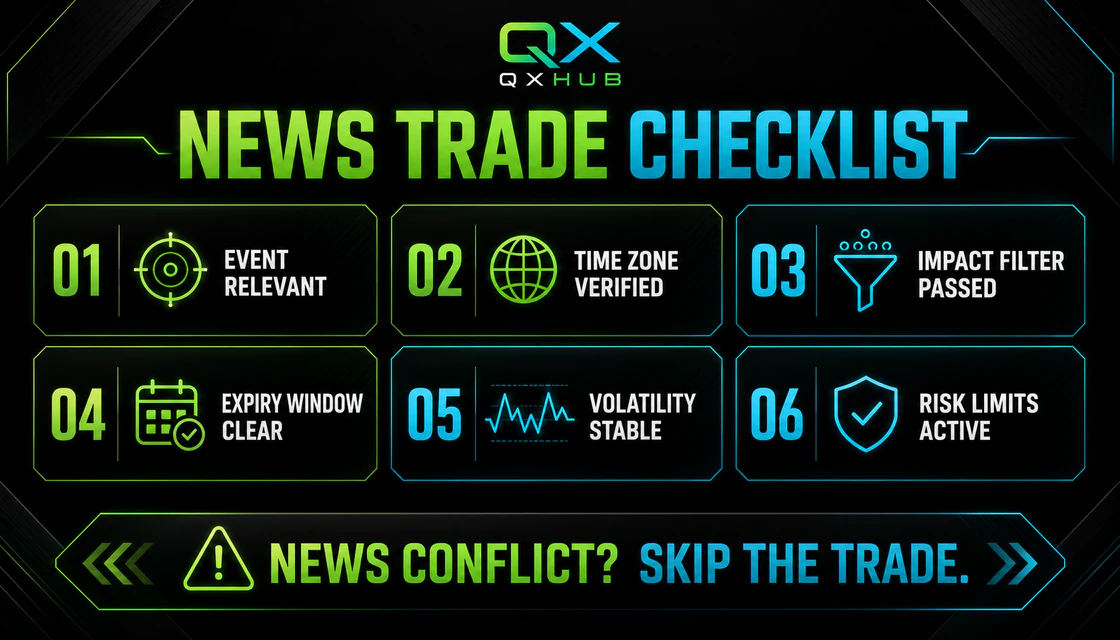
News Trade Checklist
- Event relevant: both currencies and the asset's macro exposure were checked.
- Time zone verified: calendar time matches the platform clock.
- Impact filter passed: the event category is allowed by the plan.
- Expiry window clear: settlement will not cross a restricted event.
- Volatility stable: current candle behavior resembles the tested regime.
- Technical setup complete: context, trigger, and invalidation are present.
- Payout acceptable: the displayed return matches the test assumptions.
- Risk limits active: stake, trade count, and daily loss limits remain available.
- No emotional override: the entry is not a chase after the first move.
If news conflicts with the plan, skip the trade.
How to Backtest a News Filter
- Define event categories and relevant currencies.
- Choose a fixed pre-event and post-event restriction as a test hypothesis.
- Record every valid setup, including skipped event-window signals.
- Note actual candle range, session, payout, expiry, and rule adherence.
- Compare results inside and outside the proposed filter.
- Keep scheduled news separate from unscheduled shocks.
- Validate the final rule on later, unseen data.
- Forward-test on demo without changing the filter mid-sample.
Avoid scanning many waiting periods until one produces the best historical result. That can overfit the sample. A useful filter needs a logical explanation and later validation.
Journal Fields for News-Aware Trades
Review the filter after a predefined sample, not after one surprising chart.
| Field | Example entry | Purpose |
|---|---|---|
| Event | Inflation release | Groups similar risks |
| Currency | USD | Links event to asset |
| Scheduled time | Platform time | Audits conversion |
| Impact category | High | Applies the filter |
| Minutes to event | Recorded at entry | Checks expiry overlap |
| Volatility state | Stable / elevated / erratic | Identifies regime |
| Expiry clear? | Yes / no | Audits compliance |
| Rule adherence | Yes / no | Separates process from outcome |
Common Economic Calendar Mistakes
Using the Wrong Time Zone
An incorrect conversion can place a contract directly across the release.
Checking Only One Currency
EUR/USD is exposed to both EUR and USD events. Cross pairs require the same two-sided check.
Treating Impact Color as Certainty
Provider labels are estimates. Event category and strategy rules matter more than a color alone.
Predicting Direction From the Headline
Markets react to expectations, revisions, details, and positioning. “Better” data does not guarantee a currency rise.
Entering Immediately After Release
The first move can reverse as participants process the full report.
Ignoring Expiry Overlap
Entry can occur before the restricted window while settlement still crosses the event.
Forgetting Speeches and Press Conferences
Policy communication can continue after a rate decision and produce additional volatility.
Increasing Stake on a “Certain” Release
No economic event makes direction certain. Higher stake compounds risk.
Assuming a Clear Calendar Means No News
Unscheduled headlines remain possible. Risk limits always apply.
Final Thoughts
An economic calendar is a risk-management tool, not a directional signal. It helps traders identify moments when a normal setup may be exposed to abnormal movement before settlement.
The essential process is simple: verify the time zone, match the event to the asset, define restricted windows, keep expiry clear, wait for conditions to stabilize, and apply fixed risk. If the calendar conflicts with the trade, the correct decision is no trade.
Quick answers
What is an economic calendar in trading?
It is a schedule of planned economic releases and policy events, usually showing time, currency, impact, forecast, previous value, and actual result.
How does news affect binary options?
News can expand volatility, trigger rapid reversals, cross technical levels, change payout or availability, and move price around the strike before expiry.
Should binary options traders avoid high-impact news?
Many plans restrict it because behavior can become unstable. The exact rule should be defined and tested; there is no universally safe interval.
How long should I wait after a news release?
There is no fixed answer. It depends on event type, asset, timeframe, strategy, expiry, and whether conditions have returned to the tested regime.
Does better-than-forecast data mean the currency will rise?
Not necessarily. Expectations, revisions, positioning, policy implications, and report details can produce a different or reversing reaction.
Can I trade the first candle after news?
Only if the strategy was specifically tested for that environment. The first candle can contain erratic movement and does not guarantee continuation.
What if the calendar time differs from my platform?
Identify each time zone and convert carefully. Recheck daylight-saving changes and use the platform clock in the final trade checklist.
Are medium-impact events safe?
No label makes an event safe. A medium-rated release can surprise, while a high-rated event can be quiet. Use the plan's category rules and current conditions.
Can an economic calendar improve win rate?
It may help exclude untested event windows, but it cannot guarantee a win rate or profit. Any benefit must be tested and validated.
Next step
Choose a topic by task: brokers for platform selection, guides for access, strategies for setups, risk for discipline and investing for longer market logic.