how to stop overtrading
How to Stop Overtrading: Practical Rules for Binary Options Traders
Learn how to stop overtrading with hard trade limits, daily loss caps, a pre-trade checklist, cooling-off rules and a weekly review routine.
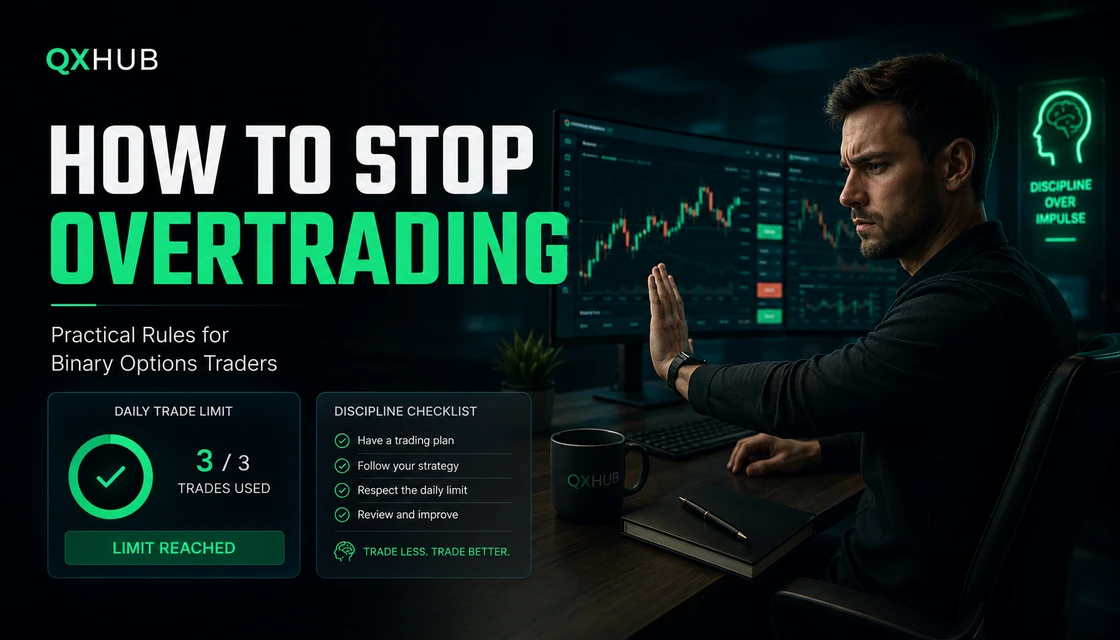
Quick answer
Overtrading stops when the next click is governed by rules written before the session. Define a valid setup, a maximum number of trades, a daily loss cap and a mandatory pause. When any limit is reached, the session is over; a new candle, a recent loss or a winning streak does not reopen it.
- Overtrading is any trading that exceeds your tested setup, risk plan or current ability to make clear decisions.
- A trade-count cap and a loss cap must work together: reaching either one ends the session.
- A short checklist and a cooling-off delay create useful friction before an impulsive entry.
- Weekly review should measure rule adherence before profit, win rate or account growth.
What overtrading really means
Overtrading is not defined by one universal number. Five planned entries may fit a tested method, while one emotional entry can already be too much. The useful question is not only how many trades you took, but how many met the rules that existed before the session. Frequency becomes dangerous when setup quality, timing or stake discipline declines.
Why binary options make the cycle faster
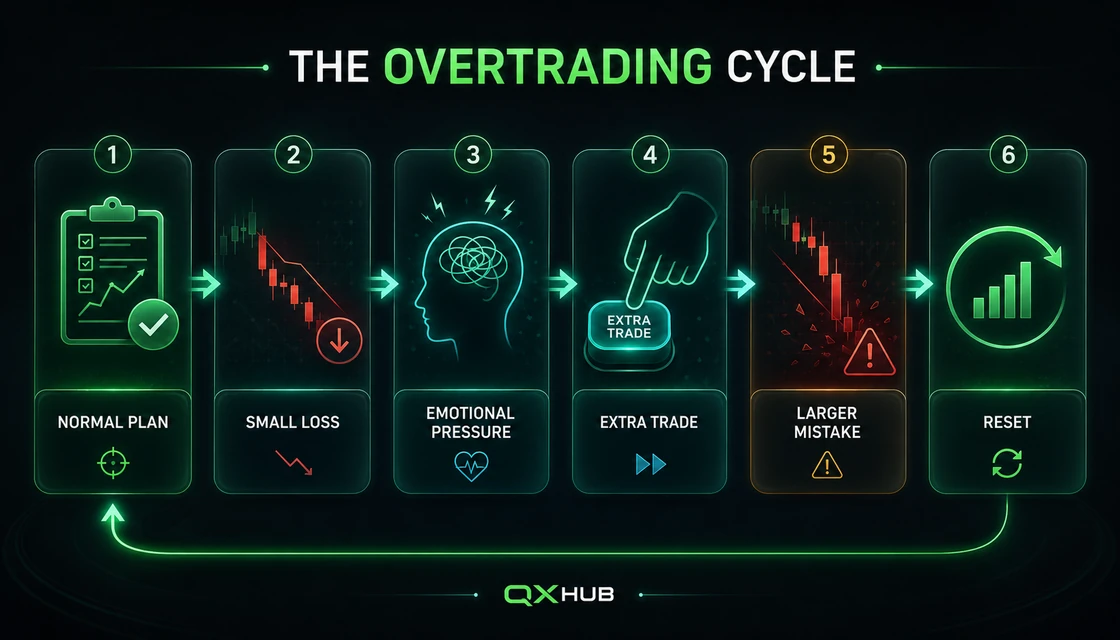
Short expiries provide rapid emotional feedback, interfaces make another direction click look simple, and every moving candle can be mistaken for an opportunity. A small loss or a missed move creates pressure; pressure lowers the entry standard; the extra trade produces another result and the loop accelerates. The best place to interrupt that cycle is before the unplanned click.
Ten warning signs
Treat these as alarms: you cannot describe the setup in one sentence; criteria become flexible after a loss; you leave the chosen session; correlated positions express the same idea; stake rises; screenshots become chaotic; waiting feels uncomfortable; journaling stops; each result changes the next decision; or you continue after a written limit. One sign deserves attention; several signs mean the session should end.
Set a hard trade limit and daily loss cap
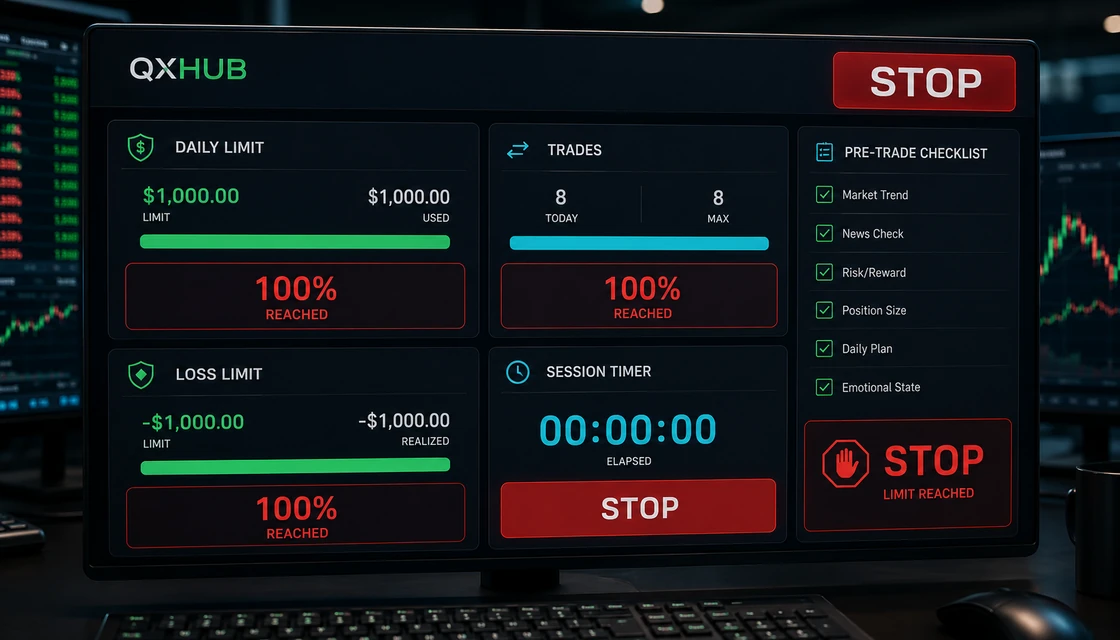
Choose the maximum number of valid attempts before opening the platform. Add a money limit and express it in risk units. For example, a demo plan risking 1% per trade with a 3% daily cap ends after three full losses, even if the trade-count allowance is not used. The limits are safety boundaries, not targets that must be reached.
Use a pre-trade checklist
Before every entry confirm the asset and session, market context, named setup, trigger, expiry logic, payout threshold, fixed stake, scheduled-news check and emotional state. If one required item is missing, the result is no trade. Keep the checklist short enough to use, but precise enough that a vague feeling cannot pass as confirmation.
Separate planned trades from impulsive trades
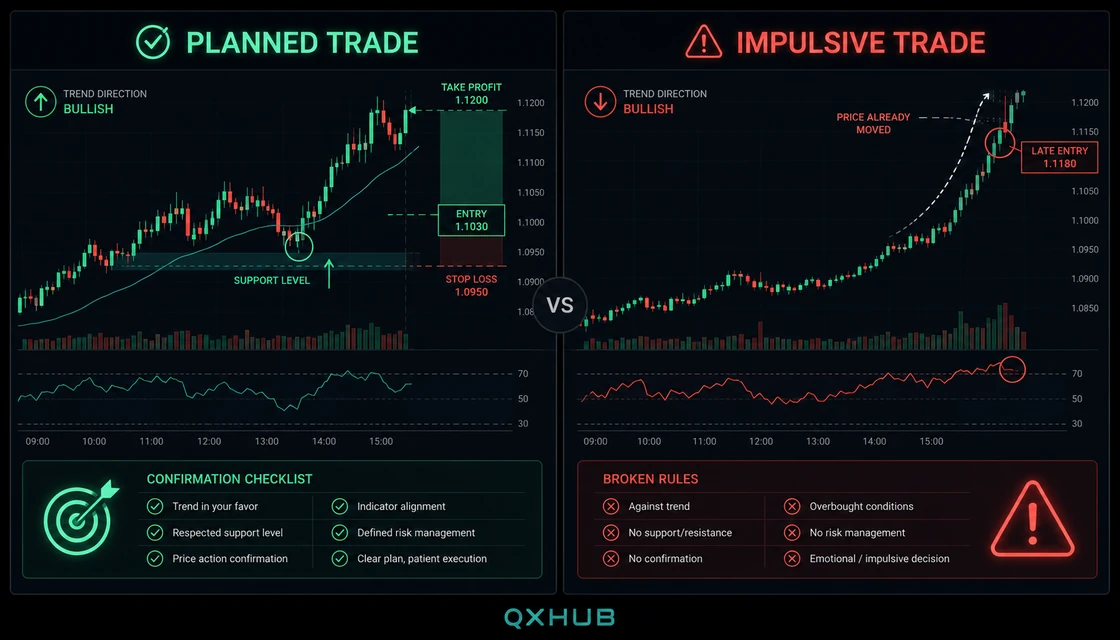
A planned trade begins with a rule and waits for price. An impulsive trade begins with movement and invents the reason afterward. Create friction: write the setup in one sentence, save a screenshot, wait through a cooling-off timer and disable one-click habits where possible. A missed move costs nothing; a late emotional entry creates real exposure.
Do not repair a session with Martingale
Increasing the stake after a loss does not improve the next setup. It only makes later outcomes carry the burden of earlier ones. The same discipline is needed after wins: confidence can loosen criteria and turn a good session into a long, careless one. Keep the standard stake unchanged and stop at the original limit regardless of recent results.
What to do after breaking a rule
End the session immediately instead of trying to recover the violation. Record what happened, capture the chart and identify the trigger: loss chasing, boredom, fear of missing out, a winning streak or fatigue. Return to demo only after a reset, and make the next barrier concrete—for example a longer pause, fewer available assets or a lower session cap.
Run a weekly overtrading review
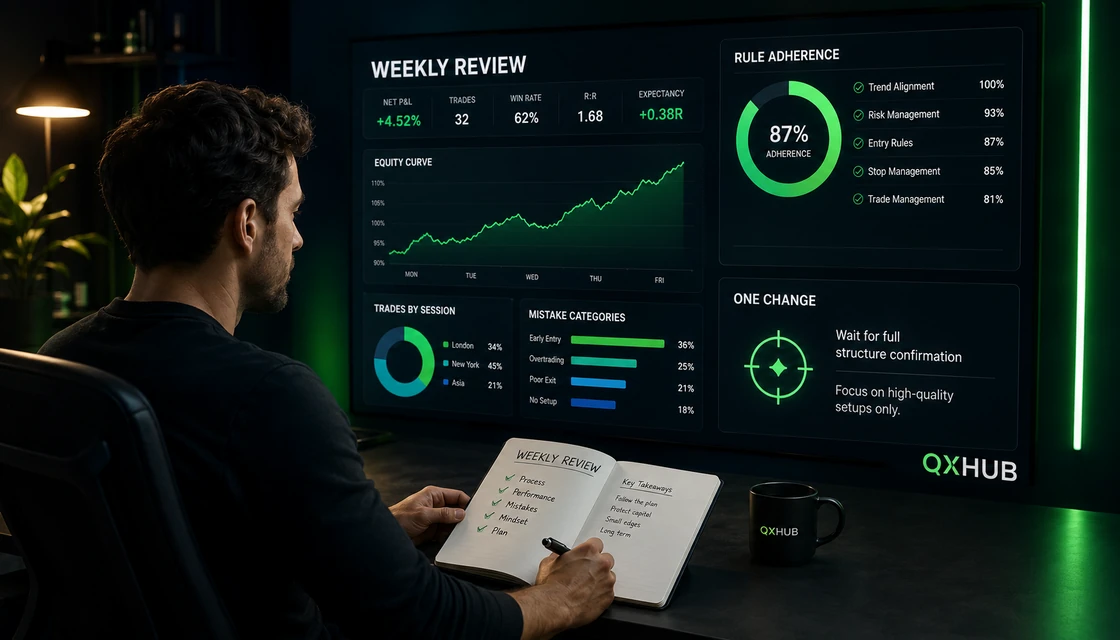
Review trade count, stake sequence, screenshots, skipped setups and rule breaches. Calculate process measures such as the percentage of trades that met every condition and the number taken after the first violation. Pick one improvement for the next week. Profit can be positive during a poorly controlled week, so rule adherence must be reviewed before P&L.
A practical anti-overtrading rule set
Trade only named setups in selected sessions. Use one fixed stake, a maximum trade count and a daily loss cap. Pause after every result, stop after any limit and never increase size to recover. Record every entry and every breach. These rules cannot guarantee a profit, but they can stop one emotional decision from becoming a chain of avoidable risks.
Practical route for how to stop overtrading
Use this route after reading the guide. It turns how to stop overtrading into a repeatable routine: one idea, one chart check, one risk limit and one clear Quotex action instead of impulsive entries.
- Learn how to stop overtrading with hard trade limits, daily loss caps, a pre-trade checklist, cooling-off rules and a weekly review routine.
- A trade-count cap and a loss cap must work together: reaching either one ends the session.
- Why binary options make the cycle faster
- Ten warning signs
Write the reason you opened this page in one sentence. Compare it with the guide's core point: Overtrading is any trading that exceeds your tested setup, risk plan or current ability to make clear decisions. If the reason is still vague, stay on demo and sharpen the rule before touching a live balance.
Open one asset and connect the idea with the section "What overtrading really means". Do not jump between markets. A clean rehearsal means the same timeframe, the same expiration logic and the same condition for skipping the trade.
Before any real click, set the amount, the daily stop and the maximum number of attempts. Keep this filter beside the chart: Trading involves risk. Compare the platform, read the rules and never trade funds you cannot afford to lose. A strong trader protects attention first, capital second and ego never.
If the checklist still holds, use the most relevant path: Registration. If the context changes, compare it with Fast entry or Android app. The best route is the one that matches the reader's goal, not the loudest button.
Use the guide like a trading plan
A visitor searching for how to stop overtrading usually needs a direct answer, not hype. This guide connects that question with Learn how to stop overtrading with hard trade limits, daily loss caps, a pre-trade checklist, cooling-off rules and a weekly review routine. and keeps the focus on the decision a beginner actually has to make next.
A calm trader does not turn one paragraph into a signal. Read the key points, compare them with the chart, then ask whether timing, amount and risk still agree. The strongest idea in this page is simple: Overtrading is any trading that exceeds your tested setup, risk plan or current ability to make clear decisions.
When the idea is clear, move in order: open the right Quotex route, practise the workflow on demo and only then decide whether Registration, Fast entry or Android app fits the session. If the rule feels rushed, the better decision is patience.
- A trade-count cap and a loss cap must work together: reaching either one ends the session.
- A short checklist and a cooling-off delay create useful friction before an impulsive entry.
- Weekly review should measure rule adherence before profit, win rate or account growth.
- Trading involves risk. Compare the platform, read the rules and never trade funds you cannot afford to lose.
Quick answers
How many trades per day is overtrading?
There is no universal number. It becomes overtrading when the count exceeds the tested plan or decision quality falls.
Can one trade be overtrading?
Yes. One entry is excessive if it is outside the setup, session, stake or risk rules.
Why do I keep trading after a loss?
A loss creates urgency and a desire for emotional relief. A prewritten stop and mandatory pause remove the decision from that moment.
Should I stop after two losses?
Use the limit defined by your tested plan. If two losses equal that limit or your judgment changes, stop.
Can a journal prevent overtrading?
A journal cannot enforce discipline by itself, but it makes extra trades and emotional triggers visible enough to correct.
Does a higher payout justify an extra trade?
No. Payout is only one filter; it does not replace setup quality, timing or session limits.
What if I repeatedly break my limits?
Stop real-money trading, return to demo and add stronger friction such as shorter sessions, blocked access after the cap or accountability.
How should a beginner use how to stop overtrading?
Treat how to stop overtrading as a decision filter, not as a signal by itself. Start with the page's main idea: Overtrading is any trading that exceeds your tested setup, risk plan or current ability to make clear decisions. Then check one chart, one timeframe and one amount on demo before any real-money step.
What should I check before applying What overtrading really means?
Check whether the market still matches the section "What overtrading really means", whether A trade-count cap and a loss cap must work together: reaching either one ends the session. is true on the chart and whether your amount fits the planned risk. If one part is missing, skipping is the professional choice.
Is how to stop overtrading enough to open a trade?
No. The topic can help you read the situation, but a trade still needs timing, expiry logic, risk limit and a reason to stay out. The useful line from this guide is: A short checklist and a cooling-off delay create useful friction before an impulsive entry.
Next step
Choose a topic by task: brokers for platform selection, guides for access, strategies for setups, risk for discipline and investing for longer market logic.