binary options money management
Binary Options Money Management: Risk Rules and Examples for Beginners
Learn binary options money management with fixed-risk rules, payout and break-even math, daily loss limits, drawdown examples and a practical worksheet.

Key points
- Define risk per trade, a daily loss limit and a maximum trade count before opening the platform.
- Evaluate payout and break-even math together; win rate alone does not describe the result.
- Ban stake escalation, plan for losing streaks and review compliance every week.
Binary Options Money Management
High-risk products require strict limits. Money management cannot guarantee returns.
Binary options money management is not a method for predicting the next candle. It is the set of rules that decides how much capital is exposed, when a session must end, and which losses are acceptable before a trade is opened. A strategy may define the market setup, but money management determines whether one bad session remains manageable or becomes an account-threatening event.
This distinction matters because binary options have a fixed outcome structure. A winning trade normally returns the stake plus a quoted payout, while a losing trade normally loses the stake. The potential loss can therefore be larger than the potential profit on a single trade. If the payout is 80%, a $10 win earns $8, but a $10 loss costs $10. The trader must understand both position size and break-even math instead of looking only at win rate.
This guide explains fixed risk, daily limits, payout-adjusted expectations, losing streaks, drawdown, and review rules. All numbers are educational examples, not recommendations for a particular account.
Risk warning: Binary options are high-risk instruments and may be restricted or unavailable in some jurisdictions. Money-management rules cannot remove market risk or guarantee a profit. Never trade money you cannot afford to lose.
| FORMAT Actionable guide | FOCUS Capital & risk | UPDATED July 2026 |
|---|
What Is Binary Options Money Management?
Binary options money management is a written framework for controlling exposure before, during, and after a trading session. It answers practical questions:
- What percentage or fixed amount may be risked on one trade?
- What is the maximum total loss allowed in one day?
- How many positions may be open or taken in one session?
- Does the current payout justify the setup under the tested plan?
- What happens after several consecutive losses?
- When must live trading stop and return to review or demo practice?
The purpose is not to make every trade safe. No trade is safe simply because its stake is small. The purpose is to keep individual outcomes from controlling the account and to make risk decisions consistent enough to review.
Money Management vs Risk Management vs Strategy
These terms overlap, but they are not identical.
A trader can have a reasonable setup and still fail through uncontrolled staking. The reverse is also true: careful stake sizing cannot turn a weak or untested setup into a profitable one. Strategy quality and risk control must be evaluated separately.
| Concept | Main Question | Typical Rules |
|---|---|---|
| Trading strategy | When is there a valid setup? | Trend, level, signal, confirmation, expiry |
| Money management | How much capital is exposed? | Stake size, daily loss cap, session limit |
| Risk management | What can go wrong, and how is it contained? | Market filters, news avoidance, exposure limits, stop conditions |
| Trading discipline | Will the written rules actually be followed? | Checklist, journal, cooling-off period, review |
Why Money Management Is Different for Binary Options
In traditional spot trading, a trader may use a stop-loss and take-profit with a chosen reward-to-risk ratio. In a standard binary option, the outcome is usually determined at expiry. The trade either finishes in the money, producing the quoted payout, or out of the money, losing the stake, subject to the platform's exact terms.
This creates four important consequences.
The full stake is normally the amount at risk. A $10 position should be treated as a possible $10 loss, not as a temporary margin allocation.
The payout affects the required win rate. An 80% payout and a 95% payout do not have the same break-even point.
There is limited ability to repair a poor entry. Extending expiry or adding another position may create new risk rather than fix the original decision.
Fast expiries can multiply decisions. A trader can take many positions in a short period, making daily and session limits essential.
Money management must therefore account for payout, frequency, and the all-or-nothing nature of each outcome.
Build a Risk Budget Before Choosing the Stake
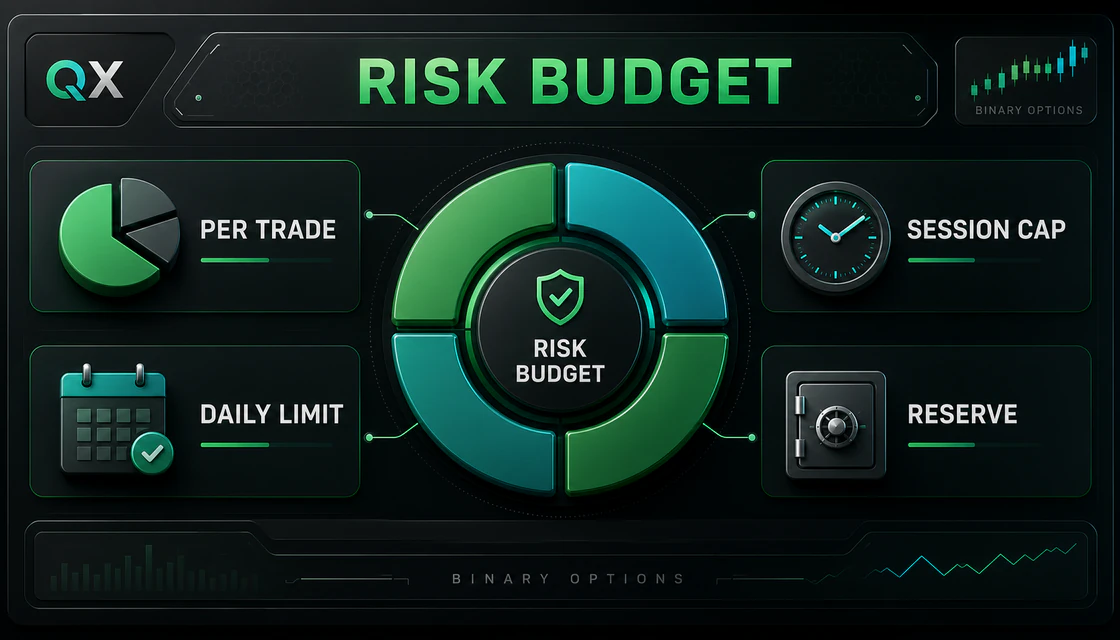
A useful starting point is a risk budget: the maximum amount of capital the plan permits to be exposed over several layers. It should be defined before the trading platform is opened.
Layer 1: Risk Per Trade
Risk per trade is the amount that can be lost on one position. It may be defined as a small percentage of the current account balance or as a conservative fixed amount. Percentage-based sizing automatically adjusts downward after losses and upward only as the account grows. Fixed-amount sizing is simpler but must be reviewed when the balance changes materially.
The calculation is:
Stake = Current account balance × Risk percentage
For an educational $500 balance:
The table is not a recommendation. It shows how quickly exposure changes as the percentage rises. The appropriate ceiling depends on experience, tested results, personal circumstances, platform minimums, and the possibility of a long losing sequence.
| Risk per Trade | Stake | Loss After One Losing Trade |
|---|---|---|
| 0.5% | $2.50 | $2.50 |
| 1.0% | $5.00 | $5.00 |
| 2.0% | $10.00 | $10.00 |
| 5.0% | $25.00 | $25.00 |
Layer 2: Daily Loss Limit
A daily loss limit defines the point at which trading ends for the day. It protects the account from a session in which normal variance, poor market conditions, fatigue, or emotional decisions begin to compound.
The limit should be expressed in money and in risk units. If one standard stake is defined as 1R, a daily cap might be written as “stop after losing 3R” rather than as a vague promise to stop when the session feels bad. The actual number must match the tested strategy and the trader's tolerance; it is not universal.
The stop must be final. Reducing the next stake while continuing to trade is not the same as respecting a daily loss limit.
Layer 3: Maximum Number of Trades
A trade-count limit controls decision frequency. It is particularly useful with short expiries, where the platform makes it easy to keep clicking.
The limit should reflect the realistic number of high-quality setups available in the selected session. If a strategy usually produces two or three valid setups, allowing twenty trades creates room for entries that were never part of the research.
The daily loss cap and trade-count cap should work together. Trading stops when either limit is reached.
Layer 4: Capital Reserve
Not all deposited capital should automatically be treated as today's trading budget. A reserve is the part of the account that is not available for routine session exposure. Conceptually separating reserve capital helps prevent a trader from increasing stakes merely because funds remain visible on the platform.
The safest capital is capital that does not need to be traded. If losing the account would affect rent, debt payments, food, medical needs, or emergency savings, that money does not belong in a high-risk trading account.
Fixed Percentage or Fixed Stake?
Both methods can be structured, but each has trade-offs.
A fixed percentage is mathematically consistent, but rounding matters. If the calculated stake is below the platform's minimum, the trader should not automatically round up without checking the resulting percentage. A minimum stake can make a small account riskier than the written plan allows.
A fixed stake can be acceptable for testing when the balance is stable and the amount is deliberately conservative. It becomes dangerous when the trader treats “fixed” as permanent while the account declines.
| Method | How It Works | Advantage | Main Limitation |
|---|---|---|---|
| Fixed percentage | Recalculate stake from current balance | Exposure scales down after drawdown | Requires recalculation; may conflict with platform minimums |
| Fixed stake | Use the same monetary amount for a defined review period | Simple and consistent | Percentage risk rises if balance falls |
| Risk band | Use one fixed stake within a narrow balance range | Practical compromise | Needs clear thresholds and scheduled review |
Never Use Martingale as Money Management
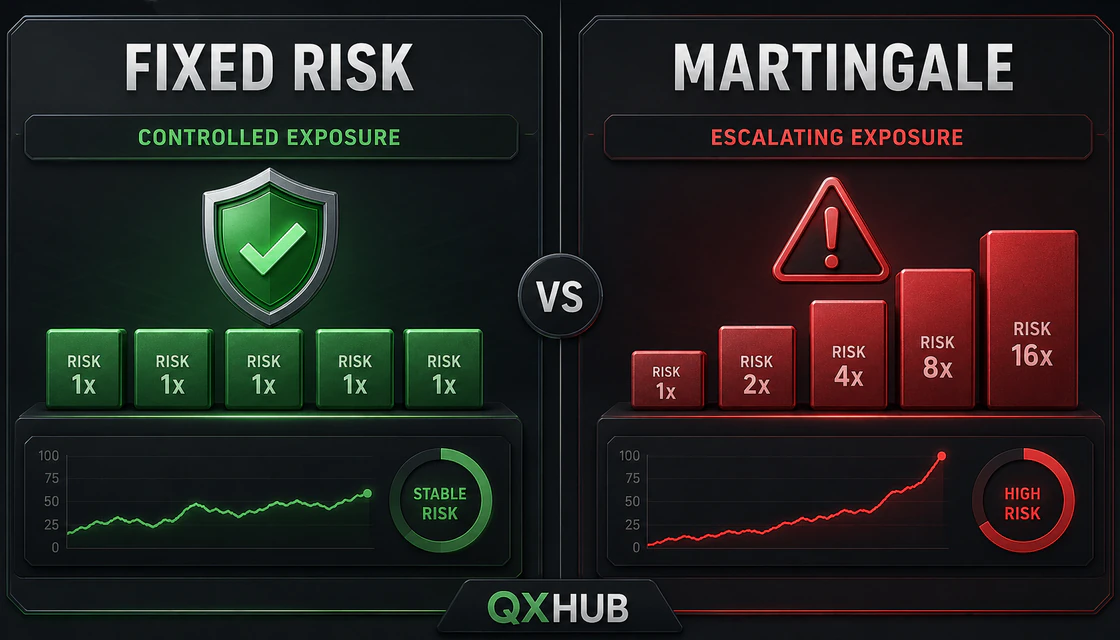
Martingale increases the stake after a loss, often with the aim of recovering previous losses in one winning trade. It is commonly presented as a money-management system, but it is an exposure-escalation system.
Consider a simplified sequence beginning with $5 and doubling after every loss:
Six consecutive losses are not impossible. The sequence can also be interrupted by stake limits, insufficient balance, changing payout, execution errors, or a market regime that remains unfavorable longer than expected. A later win does not make the earlier escalation safe; it only hides the tail risk until a sufficiently long losing sequence occurs.
Fixed risk keeps the next decision independent from the emotional need to repair the previous outcome. That is a central principle of sound money management.
| Trade | Stake | Cumulative Amount Lost if Trade Loses |
|---|---|---|
| 1 | $5 | $5 |
| 2 | $10 | $15 |
| 3 | $20 | $35 |
| 4 | $40 | $75 |
| 5 | $80 | $155 |
| 6 | $160 | $315 |
Understand Payout and Break-Even Win Rate
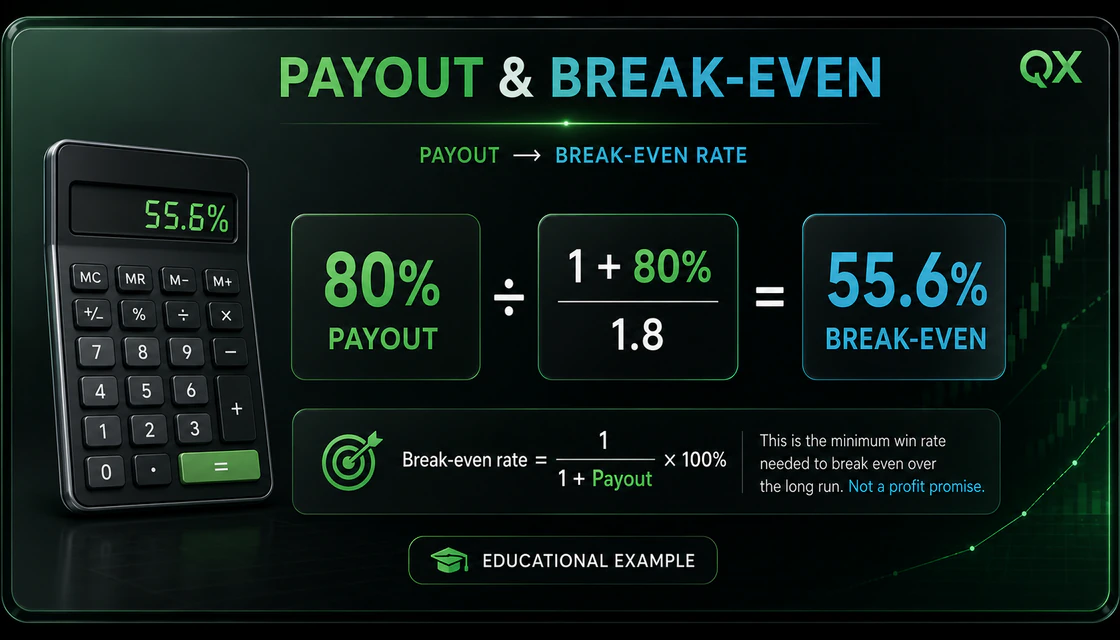
A raw win rate has little meaning without the average payout. When the loss on an unsuccessful trade is 100% of the stake and the profit on a successful trade is less than 100%, more than half of trades must win just to break even before other costs or execution differences.
For a payout expressed as a decimal, the simplified break-even formula is:
Break-even win rate = 1 ÷ (1 + payout)
At an 80% payout, ten $10 trades with six wins and four losses produce $48 in gross profit from wins and $40 in losses, for a net result of $8. Five wins and five losses would produce $40 in profit and $50 in losses, for a net loss of $10.
This example assumes a uniform payout, full stake loss on losing trades, and no refunds or special platform terms. Real results should use the actual payout recorded for each trade.
| Quoted Payout | Profit on a $10 Winning Trade | Simplified Break-Even Win Rate |
|---|---|---|
| 70% | $7.00 | 58.82% |
| 80% | $8.00 | 55.56% |
| 85% | $8.50 | 54.05% |
| 90% | $9.00 | 52.63% |
Set a Minimum Payout Rule Carefully
A minimum payout filter can prevent a trader from taking a setup when the reward has fallen below the level used in testing. It should not be invented after a losing session. The threshold belongs in the strategy and journal because payout availability can vary by asset and time.
If a setup was tested mainly at 85% payout, trading it at 65% changes its expected economics. The signal has not changed, but the required win rate has. A lower stake does not correct an unfavorable payout; it only reduces the size of the exposure.
Plan for Losing Streaks Before They Happen
Even a strategy with a positive historical result can experience consecutive losses. Outcomes are not guaranteed to alternate. A trader who assumes that a win is “due” after three losses is committing the gambler's fallacy.
With fixed percentage risk, the approximate balance after a losing sequence is:
Remaining balance = Starting balance × (1 − risk percentage)^number of losses
For a $1,000 educational balance:
The difference is not cosmetic. Higher risk makes recovery mathematically harder. After a 10% drawdown, an 11.11% gain is needed to return to the starting balance. After a 40% drawdown, the required gain is 66.67%.
| Consecutive Losses | Balance at 1% Risk | Drawdown | Balance at 5% Risk | Drawdown |
|---|---|---|---|---|
| 3 | $970.30 | 2.97% | $857.38 | 14.26% |
| 5 | $950.99 | 4.90% | $773.78 | 22.62% |
| 10 | $904.38 | 9.56% | $598.74 | 40.13% |
Use a Losing-Streak Protocol
A written protocol removes improvisation. It can include:
- stop the session after the daily loss cap;
- save before-and-after screenshots;
- mark whether every losing trade followed the setup;
- separate normal strategy losses from rule violations;
- do not increase the next stake;
- resume only after the planned review or cooling-off period;
- return to demo if the setup or execution cannot be explained clearly.
The protocol is not designed to predict when the streak will end. It is designed to prevent normal variance from turning into emotional overexposure.
Avoid Correlated Exposure
Several trades can represent one underlying idea. Positions on EUR/USD, GBP/USD, and gold may all be influenced by a sudden US dollar move. Taking the same directional exposure across related assets does not necessarily create diversification.
Binary options traders should define whether simultaneous positions are allowed and whether correlated trades count as separate risk units. If three positions can lose for the same reason, the combined stake should be evaluated as one exposure cluster.
Correlation can change and is never perfect. The practical rule is to identify common drivers—currency, session, scheduled news, and market sentiment—before assuming that multiple assets reduce risk.
Match Expiry and Stake Rules to the Tested Setup
Money management cannot be separated completely from expiry. A trader may be tempted to use a larger stake on a “stronger” signal or to change expiry after a loss. Both actions introduce discretion that may not exist in the tested plan.
A consistent framework defines:
- permitted chart timeframes;
- permitted expiry range for each setup;
- whether trading is paused around scheduled high-impact news;
- minimum payout;
- standard risk unit;
- conditions that invalidate the trade before entry.
The stake should not rise because a chart looks especially convincing. Unless different setup grades have been separately defined and tested, “high confidence” is an emotion, not a sizing model.
A Practical Pre-Trade Money-Management Checklist
Before every position, confirm:
- the account balance used for sizing is current;
- the calculated stake does not exceed the permitted risk percentage;
- the platform minimum does not force risk above the plan;
- today's cumulative loss remains below the daily cap;
- the maximum number of trades has not been reached;
- combined exposure across open or correlated positions is acceptable;
- the payout meets the tested minimum;
- the setup, timeframe, and expiry match the strategy;
- no scheduled news filter is being violated;
- the stake is not being increased to recover a loss;
- the trade can be skipped without emotional pressure.
If one mandatory item fails, the correct stake is zero. A checklist is valuable only when it can block a trade.
Complete Beginner Money-Management Example
The following example shows how rules can fit together. It is not a recommendation and does not imply profitability.
Suppose the current balance is $500 and the risk rule is 1%. The standard stake is $5. If the first trade wins at an 80% payout, the account increases by $4 to $504. Recalculating 1% gives $5.04, but the trader may round down according to the platform increment and plan.
If the next three trades lose at $5 each, cumulative loss from those trades is $15. The session ends under the three-loss protocol. The earlier win does not authorize another trade, and the trader does not increase the stake to recover the net session loss.
This is what rule-based management looks like: the process responds to predefined limits, not to hope, frustration, or a feeling that the next signal must work.
| Rule | Educational Example |
|---|---|
| Starting balance for calculation | $500 |
| Standard risk per trade | 1% of current balance, rounded down to an allowed stake |
| Maximum simultaneous exposure | 1R |
| Daily loss limit | 3R |
| Maximum trades per session | 5 |
| Consecutive-loss action | End session after 3 losses, even if 3R has not been reached exactly |
| Minimum payout | Use only the threshold supported by the strategy's test data |
| Martingale | Prohibited |
| News filter | No new trades around scheduled high-impact events under the plan |
| Review | Record every trade and complete a weekly risk review |
Common Money-Management Mistakes
Risking a Percentage of the Initial Deposit Forever
If the balance falls, a stake based on the old balance becomes a larger current percentage. Recalculate from the current balance or use clearly defined risk bands.
Measuring Only Win Rate
A 60% win rate can be positive, flat, or negative depending on payout, stake consistency, and rule violations. Track monetary result, payout, and average risk alongside win rate.
Raising Stakes After Wins
A winning streak can create overconfidence. If the written rule is fixed percentage, follow it. Do not add an emotional “house money” exception.
Treating a Deposit Bonus as Risk-Free Capital
Bonus funds may have turnover, withdrawal, or eligibility conditions. Read the applicable terms. A bonus does not change the market risk of a position or make aggressive staking safe.
Ignoring Platform Minimum Stakes
If the minimum stake exceeds the planned risk percentage, the account may be too small for that rule on that platform. Do not hide the mismatch by rounding upward.
Resetting the Daily Limit After a Break
A lunch break, device change, or new trading session does not erase the day's cumulative risk unless the written plan defines a genuinely separate period. Limits must use one consistent clock and timezone.
Changing the Risk Rule After Several Trades
Changing from 1% to 3% because the setup “looks better” destroys consistency. Any new sizing model should be researched and tested outside an active session.
How to Review Money Management Weekly
Money management improves through records, not memory. A weekly review should separate market outcomes from rule compliance.
Use the review to choose one specific correction. Examples include lowering the number of permitted trades, adding a mandatory pause after two losses, or returning to demo until a recurring execution error is resolved. Do not change several variables at once; otherwise, the effect of each change cannot be evaluated.
| Metric | What to Calculate | Warning Sign |
|---|---|---|
| Rule-adherence rate | Trades following every sizing and limit rule ÷ total trades | Repeated exceptions or missing records |
| Average stake | Total staked ÷ number of trades | Stake increases after losses or wins |
| Maximum daily loss | Largest one-day decline under the chosen method | Daily cap exceeded |
| Maximum drawdown | Largest peak-to-trough balance decline | Risk is emotionally or financially intolerable |
| Average payout | Mean actual payout across recorded trades | Trading below tested assumptions |
| Limit violations | Count of trades after a stop condition | The plan does not block behavior |
| Correlated exposure | Combined stake on positions with a common driver | Several losses from one market event |

QX Hub worksheet
A Copyable Binary Options Money-Management Worksheet
Use the following fields to create a written plan:
Every blank should be completed before live trading. “Use judgment” is not a measurable risk rule.
Final Thoughts
Binary options money management is a system of constraints. It does not predict direction, improve a weak signal, or guarantee recovery. Its job is to make the cost of being wrong known before the trade and to prevent one emotional sequence from controlling the account.
Define a small standard risk unit, combine it with daily and frequency limits, account for payout, ban stake escalation, and review compliance every week. The strongest rule is the one that still applies after a loss, after a win, and when the next trade feels impossible to miss.
Quick answers
What is the best money-management strategy for binary options?
There is no universal best rule. A defensible framework uses conservative fixed exposure, a daily loss cap, a trade-count limit, payout awareness, and a written review process. The numbers must fit the trader's tested strategy, platform constraints, finances, and ability to tolerate loss.
How much should a beginner risk per trade?
No percentage is safe or suitable for everyone. Beginners should understand that even small percentages can produce meaningful drawdowns across repeated trades. Use educational calculations, consider platform minimums, practice on demo, and never risk essential money.
Is 1% risk per trade safe?
No fixed percentage makes binary options safe. A 1% rule limits the size of one loss relative to the account, but repeated losses, correlated positions, poor payout, or rule violations can still produce a substantial drawdown.
Should the stake change after every trade?
With fixed-percentage sizing, it can be recalculated from the current balance. Some traders use conservative risk bands to avoid impractical tiny changes. Whichever method is used should be written, rounded consistently, and never altered to chase a loss.
Why does payout matter to money management?
The payout determines how much a winning trade earns relative to a losing trade. Lower payout raises the break-even win rate. Stake size alone cannot compensate for poor trade economics.
Can Martingale guarantee recovery after losses?
No. Martingale rapidly increases exposure and can fail because of losing streaks, account limits, platform maximums, payout changes, or insufficient balance. It can concentrate many ordinary losses into one severe account loss.
What should I do after reaching the daily loss limit?
Stop live trading for the period defined in the plan. Save the records, review whether the trades followed the strategy, and do not reset the limit by switching assets, devices, or sessions.
How often should money-management rules be reviewed?
Compliance can be reviewed weekly, while major rule changes should use a meaningful sample and be tested outside an active session. Avoid changing risk because of one unusually good or bad day.
Next step
Choose a topic by task: brokers for platform selection, guides for access, strategies for setups, risk for discipline and investing for longer market logic.