IQ Broker demo account
IQ Broker Demo Account 2026: Setup, Practice Plan, and Risk Rules
Learn how to use the IQ Broker demo account with $10,000 in virtual funds, sensible leverage controls, a 20-trade practice plan, and clear live-account checks.
Key points
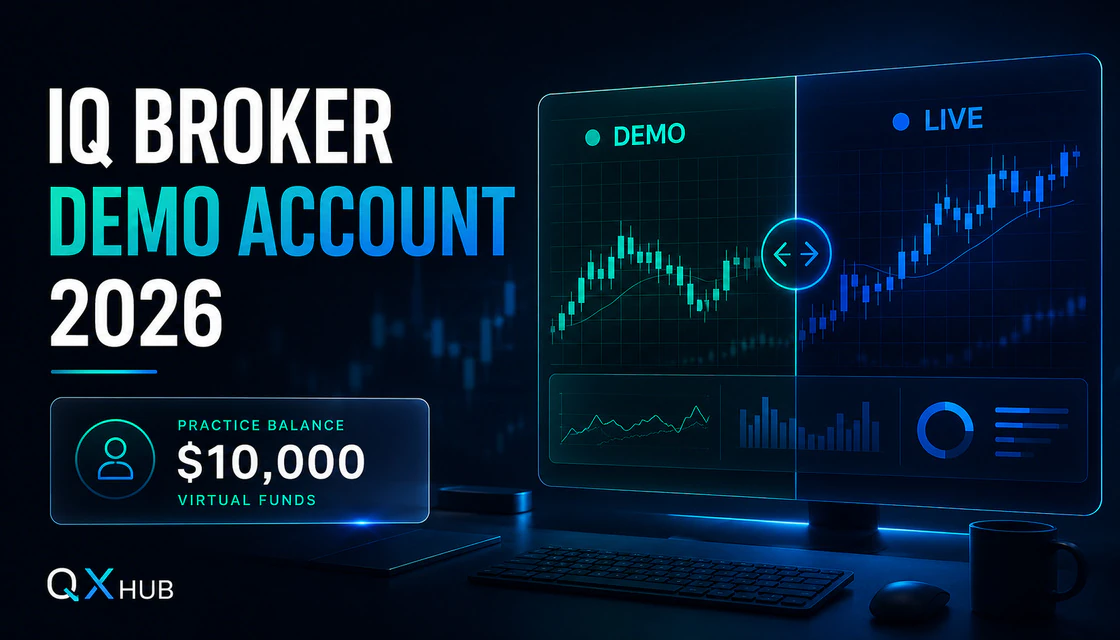
- IQ Broker currently advertises unlimited free practice with $10,000 in virtual funds, but its demo terms say those trades are not executed in the market and virtual funds have no cash value.
- Turn practice into evidence: choose one market and setup, define risk before entry, document 20 valid trades, and score rule adherence rather than virtual profit alone.
- Treat leverage as a risk control, not a target. Stay on demo or skip the platform whenever country access, legal entity, product terms, fees, or maximum loss remain unclear.
IQ Broker Demo Account: Quick Answer
A demo account is valuable only when it changes how you make decisions. Random clicks can teach the interface, but they do not prove that a strategy, position size, or leverage choice is robust. IQ Broker currently promotes a free practice account with $10,000 in virtual funds. This guide turns that sandbox into a controlled 20-trade experiment.
What the IQ Broker demo account includes
On the official IQ Broker homepage checked on 14 August 2026, the platform describes an “Unlimited Practice” account with a free $10,000 virtual balance. The same page markets Forex and CFD access, simple and advanced modes, mobile-first use, market insights, in-app lessons, and leverage up to 1:3000. That leverage figure is marketing-level information: the maximum available to a specific user may be lower, restricted, instrument-dependent, or unavailable under local rules.
- Virtual funds are not withdrawable and have no cash value.
- A demo order can help you learn controls, margin, P&L, and order management without putting money at risk.
- IQ Broker's current demo terms say demo trades are not executed in the market. The practice environment may therefore not reproduce all liquidity, slippage, rejection, financing, and execution effects of a real account.
- Availability of instruments, platform modes, and leverage must be checked inside your account.
- Registration, verification, deposits, withdrawals, and legal protections are separate from demo practice.
How to open and configure the practice account
- Navigate to the official IQ Broker domain directly and confirm the browser address before entering details.
- Choose Create a free account. Use accurate information and a unique password; do not register through an unsolicited private link.
- Read the country and risk notices shown during onboarding. If your jurisdiction is not supported, stop rather than using a workaround.
- Enter the trading room and select Practice or Demo before placing any order. Confirm that the balance is virtual.
- Open settings and choose one consistent chart theme, time zone, and price display. Avoid changing the workspace during the test.
- Choose one liquid market that is actually available to your account and note its trading hours, spread, contract size, and margin behavior.
- Before the first order, write a maximum risk per trade and maximum daily loss for the simulation.
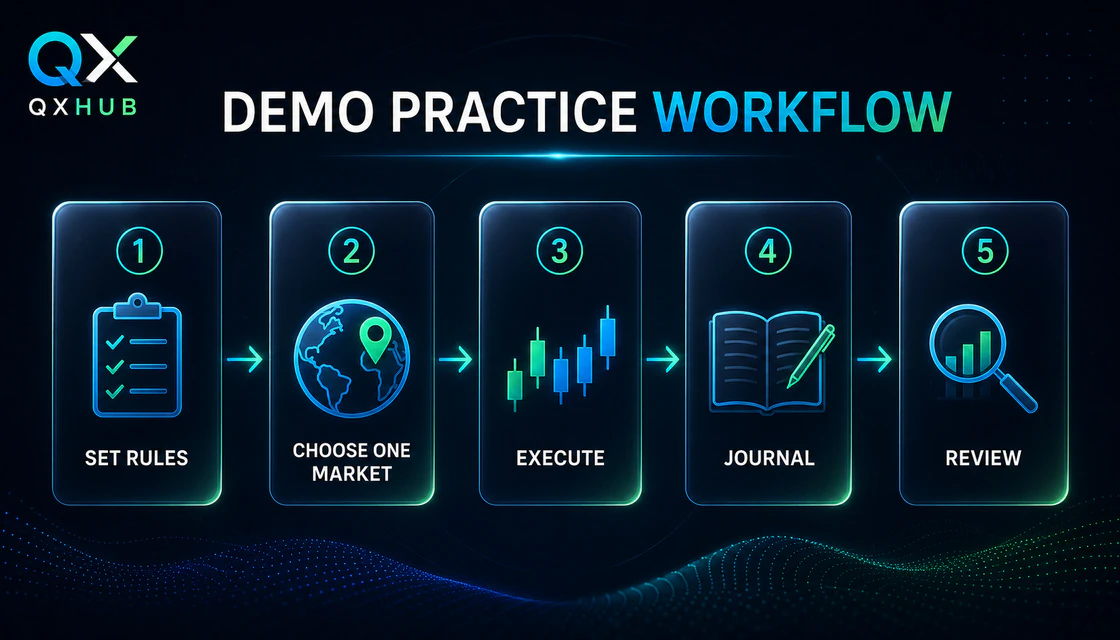
The five-step demo practice workflow
1. Set rules before opening the chart
Define the market, session, direction criteria, entry trigger, invalidation point, stop-loss method, profit-taking logic, position-size formula, and conditions that cancel the trade. A rule must be observable. “Buy when it feels bullish” cannot be reviewed; “buy only after a completed higher low above the marked level” can.
2. Choose one market and one setup
A narrow test protects you from selection bias. If every loss causes a switch to a new asset or indicator, the sample tells you nothing. Use the same instrument and setup for the first 20 valid opportunities unless the market becomes unavailable or the spread violates your written filter.
3. Execute without moving the goalposts
Record the planned entry, stop, target or exit rule, position size, leverage, and maximum loss before submitting. If the platform shows margin or liquidation information, read it before confirming. Do not widen a stop simply to avoid a losing result.
4. Journal the decision
Capture a before screenshot and an after screenshot. Record whether every rule was followed, not just whether the trade made virtual money. Add spread, session, news context, planned risk, actual exit, and one short lesson.
5. Review a batch, not a mood
Evaluate after 20 valid trades or at a scheduled weekly checkpoint. A three-trade winning run is not validation. Look for rule adherence, average planned loss, execution errors, adverse excursion, and the proportion of setups you correctly skipped.
Demo versus live: what does not transfer automatically
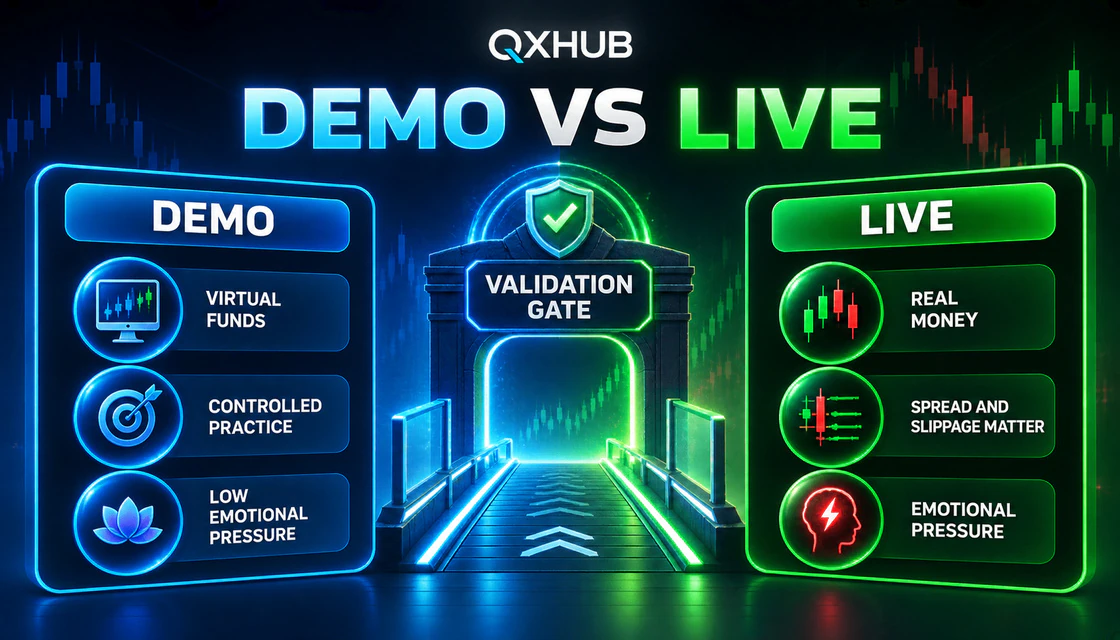
The goal is not to make demo feel emotionally identical to live trading—it cannot. The goal is to prove that the mechanics and rules are clear enough to deserve a small, separate live validation. If behavior changes when money is involved, return to demo and redesign the process.
| Dimension | Demo environment | Live environment |
|---|---|---|
| Capital | Virtual and replaceable | Real and limited |
| Execution | Can be cleaner than live conditions | Spread, slippage, liquidity, and rejection can matter |
| Psychology | Low consequence; easy to reset | Loss aversion, urgency, and revenge trading appear |
| Position size | Often inflated because the balance feels abstract | Must be tied to affordable loss and contract value |
| Evidence | Useful for rule testing | Needed again with very small risk because conditions change |
Leverage: use demo as a risk laboratory
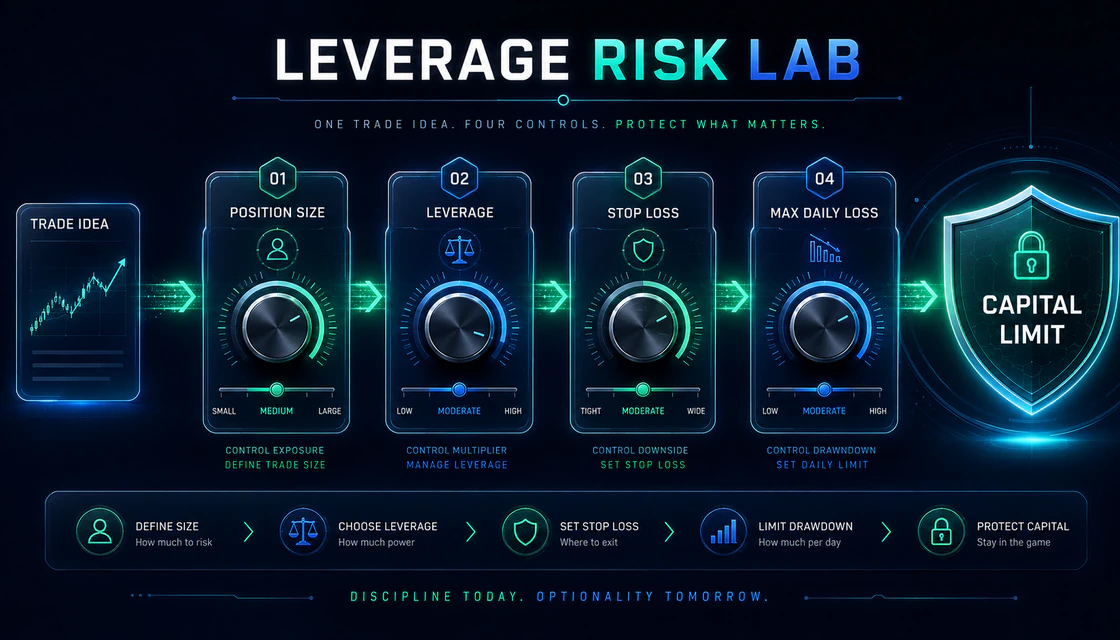
High leverage reduces the margin required to open a position; it does not make the underlying price move more predictable. It can also bring liquidation or stop-out risk closer. A platform maximum is not a recommendation. In the demo account, your job is to learn how contract size, leverage, margin, stop distance, and account equity interact.
A practical sizing workflow
- Choose a fixed hypothetical account equity that resembles the amount you could genuinely afford to risk—not the full $10,000 virtual balance.
- Set planned trade risk. For training, many beginners start with a small fraction such as 0.25%–0.5%; this is an educational example, not personalized advice.
- Identify the price level that invalidates the setup. The stop belongs at the invalidation point, not at a convenient dollar amount.
- Calculate the position size that makes the stop-out loss fit the risk limit. Include spread and a slippage allowance.
- Select the lowest leverage that still allows the calculated position within margin constraints.
- Reject the trade if the platform minimum size makes the planned loss too large.
A 20-trade demo practice task
Use four sessions of five valid trades, with at least one review day between sessions. A “valid trade” means the setup met every prewritten condition; a skipped low-quality setup is recorded separately and counts as good discipline, not a missed opportunity.
| Stage | Trades | Focus | Pass condition |
|---|---|---|---|
| Orientation | 1–5 | Order types, margin display, stop and close mechanics | No accidental orders; every trade has a before screenshot |
| Consistency | 6–10 | Same setup, fixed risk, no rule changes | At least 8 of 10 cumulative trades follow all rules |
| Stress test | 11–15 | Different session or modest volatility change | Risk remains within limit; spread filter is respected |
| Validation | 16–20 | Execute without prompts, then audit | No major safety breach and a complete journal |
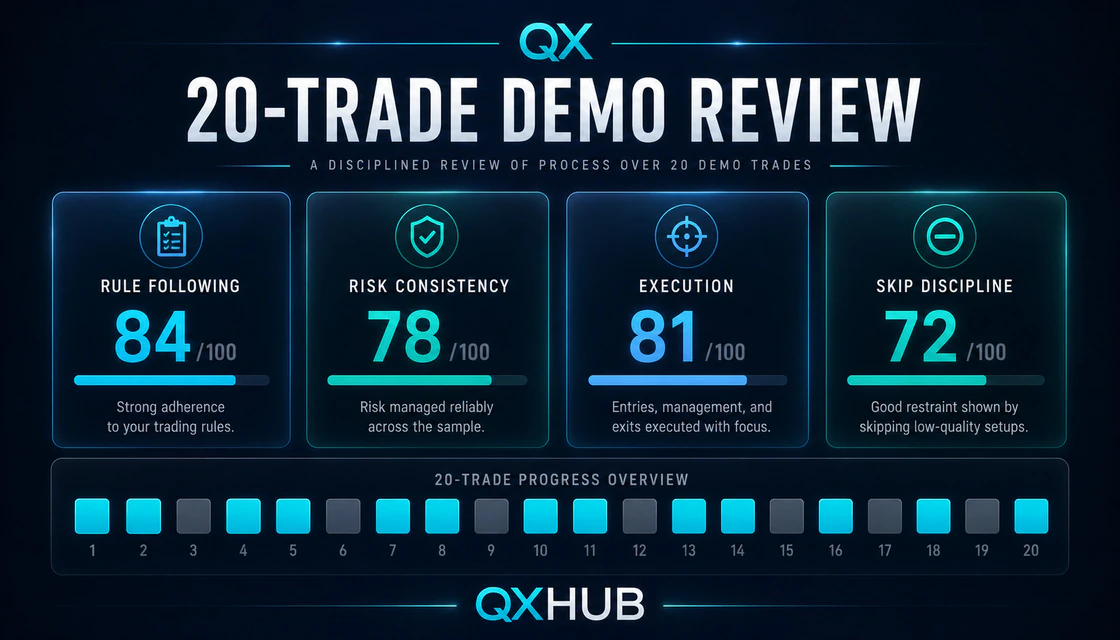
The scorecard
- Rule following: percentage of valid trades that met every entry and exit rule.
- Risk consistency: percentage that stayed within planned risk after spread and sizing.
- Execution: accidental orders, wrong direction, missing stop, late entry, or manual interference.
- Skip discipline: low-quality setups avoided because of news, spread, uncertainty, or rule conflict.
- Journal completeness: before/after screenshots and all required fields recorded.
A seven-day operating schedule
Do not force 20 trades into seven days. The schedule below organizes the work; it does not require a trade when no valid setup appears. If your market produces fewer opportunities, extend the test until the sample is complete. The ability to finish a session with zero trades is part of the assessment.
Day 1: platform and contract orientation
Explore the order ticket without submitting. Find the practice-account label, contract size, spread, leverage selector, margin estimate, stop-loss and take-profit controls, open-position panel, trade history, and support route. Write down anything you cannot explain. Submit only one or two minimum-risk demo orders to confirm mechanics, then close the platform.
Day 2: observation before execution
Mark the session high and low, a primary level, and the scheduled high-impact news. Watch at least ten potential moments and label each valid, invalid, or unclear under your rules. The objective is to prove that the setup can be recognized before money or P&L creates urgency.
Days 3–5: controlled sample
Run short, time-boxed sessions. Use the same market, reference equity, risk cap, and setup. Stop after the written daily loss, two execution errors, or the session time limit—whichever happens first. Record skipped trades as carefully as submitted trades. Do not increase size after wins or attempt recovery after losses.
Day 6: no-trade audit
Do not trade. Compare screenshots with the written rules, calculate adherence, list execution errors, and identify whether spread, news, or market regime invalidated some entries. Any rule that required hindsight should be rewritten in observable language, but do not retroactively rescore old trades under the new rule.
Day 7: decision memo
Write one page answering four questions: Is the platform mechanically clear? Can the setup be executed without improvisation? Does risk remain inside the cap under the platform minimum size? Are legal access, entity, fees, and payment rules acceptable? The permitted conclusions are continue demo, redesign the setup, investigate account terms, or stop. “Deposit because the week was profitable” is not a valid conclusion.
When to remain on demo
- You cannot explain how position size and leverage affect maximum loss.
- You change the setup after every losing trade.
- Stops are widened, removed, or added only after entry.
- The sample is under 20 valid trades or contains several undocumented trades.
- Profit comes from one oversized winner while rule adherence is weak.
- You keep trading after the simulated daily loss limit.
- You have not checked the legal entity, product availability, fees, withdrawal policy, and protections for your country.
- Real-money losses would affect essential expenses or trigger debt.
When to skip IQ Broker entirely
- The platform or promoted instrument is restricted where you live.
- You cannot identify the contracting company or understand the current legal documents.
- The account displays leverage or loss exposure you cannot explain.
- A representative pressures you to deposit, borrow, install remote-access software, or send money outside the cashier.
- Payment methods are in another person’s name or withdrawal terms are unclear.
- You want guaranteed returns, signals without verification, or a fast way to recover prior losses.
Common beginner mistakes
- Treating the $10,000 virtual balance as a realistic position-sizing budget.
- Using the highest available leverage because margin looks smaller.
- Optimizing indicators until past demo trades look perfect.
- Testing many markets and setups in one small sample.
- Ignoring spread, overnight financing, contract size, and stop-out rules.
- Resetting the balance to erase evidence instead of preserving the journal.
- Judging readiness from win rate alone without payoff, costs, and rule adherence.
- Moving directly to normal live size instead of running a very small real-execution test.
Risk-management checklist
- Country and legal entity checked.
- Instrument type and trading hours understood.
- Position size derived from maximum loss.
- Leverage chosen after size, not before it.
- Stop level defined before entry.
- Spread and financing costs recorded.
- Daily and weekly loss limits written.
- No averaging down or recovery trade.
- All 20 trades documented.
- Live funding remains optional, not an expected next step.
Troubleshooting
The practice account is not visible
Confirm you are signed in through the official domain and look for the account selector or Practice label. Availability or naming can vary. If it still does not appear, use the official support route and ask whether demo access is offered under your country and account entity. Do not create multiple profiles to bypass a restriction.
The virtual balance or instrument list differs
Promotional pages show general conditions, while the logged-in platform may be localized. Record what your account actually displays. A different balance does not affect the method: define a realistic reference equity and size every position from the loss cap.
Orders close unexpectedly
Review margin level, stop-out rules, financing, order type, and any guaranteed or non-guaranteed stop behavior. Reduce position size and leverage, then reproduce the issue once on demo. If the explanation remains unclear, stop and send support the time, instrument, order ID, and screenshots without credentials.
Demo results look much better than live results
Compare spread, slippage, timing, market hours, position size, and rule adherence. Then compare behavior: late entries, early exits, moved stops, and extra trades often appear only with real money. Return to demo, but also keep a separate tiny live-execution dataset if the product is suitable and legally available.
Summary
The IQ Broker demo account can be a useful platform and risk-control laboratory. The official homepage currently advertises free unlimited practice with $10,000 in virtual funds, but the meaningful work is independent of the number: choose realistic reference equity, test one market and setup, control leverage, document 20 valid trades, and score the process. Remain on demo—or skip the platform—whenever legal access, contract terms, costs, or loss exposure are unclear.
Quick answers
Is the IQ Broker demo account free?
The official homepage checked on 14 August 2026 describes a free practice account. Confirm the current offer and access inside your account.
How much virtual money does the demo provide?
IQ Broker currently advertises $10,000 in virtual funds. Treat it as a platform sandbox, not as a suggested real deposit or trading budget.
Can demo funds be withdrawn?
No. Virtual funds have no cash value and cannot be withdrawn.
Does the demo use real market prices?
IQ Broker's current demo terms say demo trades are not executed in the market, so practice execution may not reproduce every live spread, slippage, liquidity, rejection, financing, or emotional effect.
What can I trade on demo?
IQ Broker markets Forex and CFD access across major markets, but the exact instruments depend on country, account, and current availability. Use the list shown in your own practice account.
What leverage should a beginner use?
There is no universal safe figure. Calculate position size from an affordable maximum loss and choose the lowest leverage that supports it. Never treat the advertised maximum as a target.
When am I ready for a live account?
Not after a winning streak. Require at least 20 documented valid trades, strong rule adherence, consistent risk, no major execution errors, and a separate legal, fee, and withdrawal review.
Does successful demo trading guarantee profit?
No. Market conditions, execution, costs, and psychology change with real money, and losses remain possible.
Next step
Choose a topic by task: brokers for platform selection, guides for access, strategies for setups, risk for discipline and investing for longer market logic.