
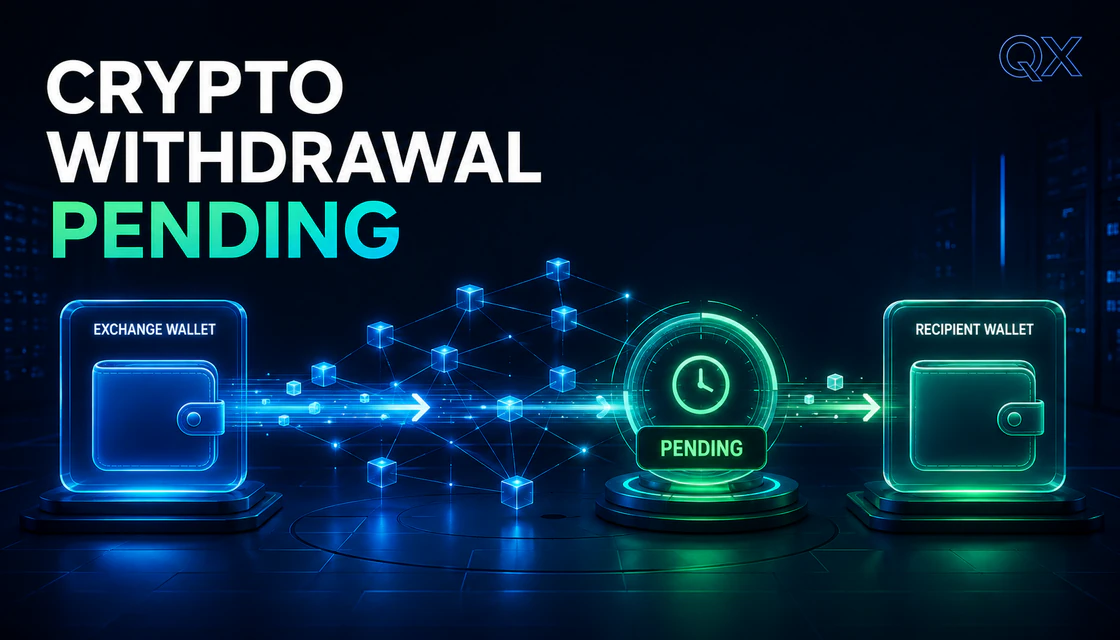
SHORT ANSWER
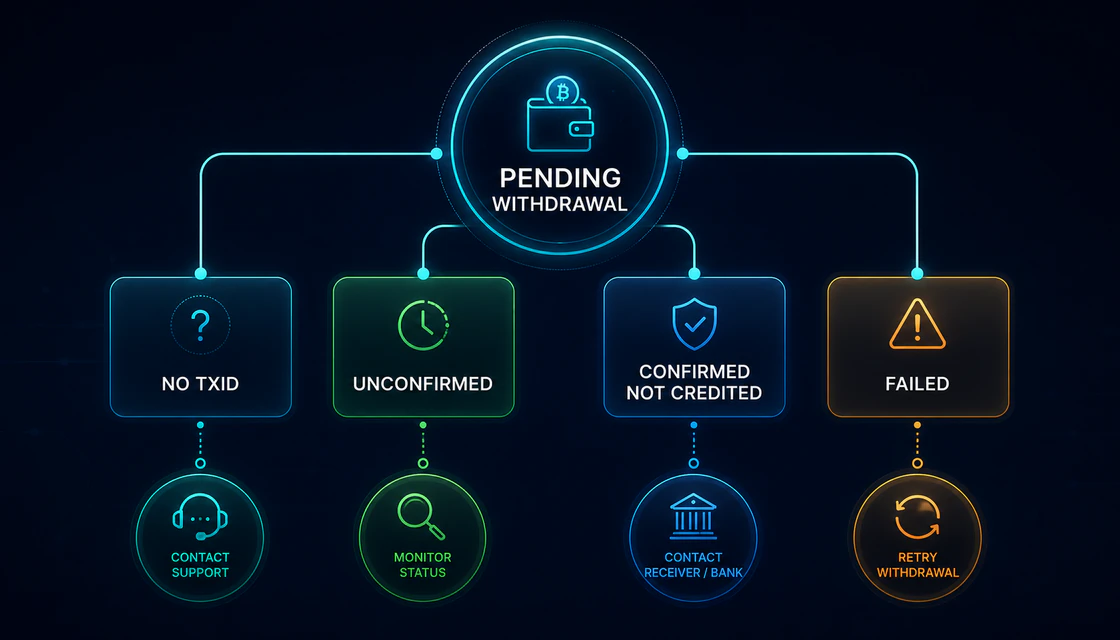
A pending crypto withdrawal is not one single problem. It may still be inside the sending exchange, be visible on-chain but lack confirmations, or already be confirmed while the destination has not credited it. First identify the exact stage. No TxID usually points to the sender; an unconfirmed TxID points to the network; a confirmed transfer with enough confirmations usually points to the receiving platform.
Four statuses that decide the next action
- 1
No TxID or transaction hash: check the sending platform’s status, security review, maintenance notice and official support.
- 2
TxID exists but the explorer shows unconfirmed: the transaction was broadcast and is waiting for inclusion or more confirmations.
- 3
Explorer shows confirmed but the balance is missing: verify the destination, network, memo or tag and its confirmation policy.
- 4
Status is failed, rejected or cancelled: read the stated reason, confirm that the balance reconciled and fix only that issue.
How a crypto withdrawal actually moves
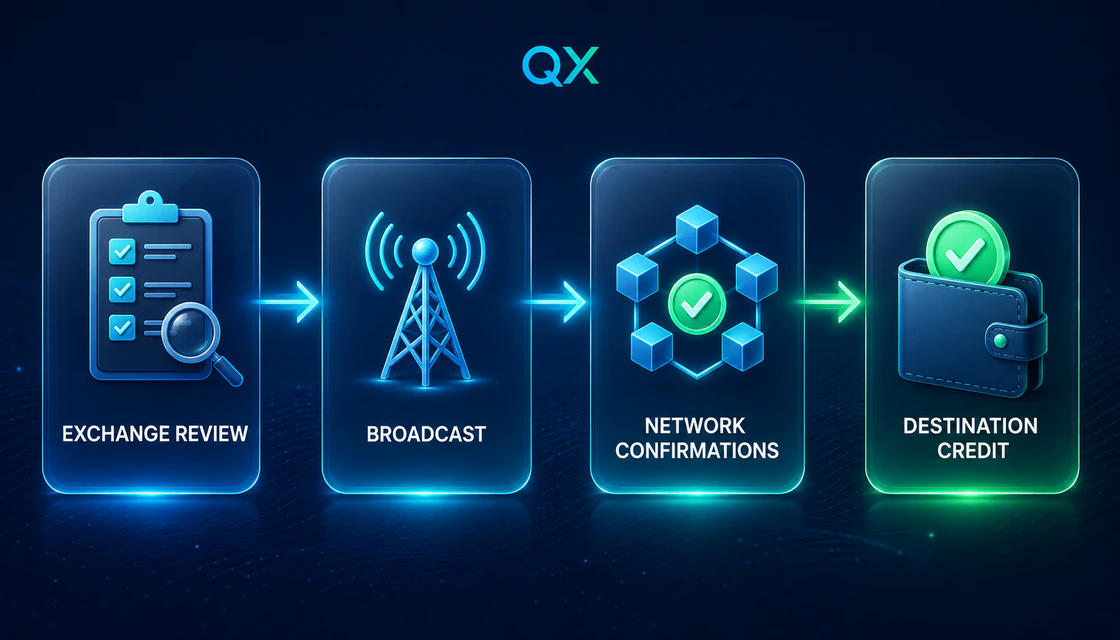
Exchange withdrawals cross two different systems. First, the sending platform performs its own checks: account security, withdrawal permissions, KYC or Travel Rule information, available balance, address controls, risk review and hot-wallet operations. Only after the platform signs and broadcasts the transaction does the blockchain network see it. The receiving wallet or exchange then decides when to display and credit the deposit.
This distinction explains why ‘pending’ can last for very different reasons. Binance separates a withdrawal that is still Processing from one marked Completed with a clickable TxID. Coinbase likewise explains that a transaction can remain pending until it receives the required number of network confirmations. The block explorer is therefore the boundary between a platform-side delay and a network or destination delay.
Stage 1: exchange review—no TxID yet
The request exists in account history, but the exchange has not published a transaction hash. Common explanations include a security review, withdrawal-address whitelist delay, unfinished email or two-factor confirmation, wallet maintenance, insufficient available balance after fees, an account restriction or extra compliance information. Processing at this stage is not proof of blockchain congestion because there may be no on-chain transaction yet.
Stage 2: broadcast—TxID exists
A TxID means the sending system created and broadcast an on-chain transaction. Open it from the platform’s history or in a reputable explorer for the selected network. Confirm that the explorer matches the chain: the same token ticker can exist on several networks. Depending on the network and wallet behavior, the transaction can be pending, confirmed, failed, dropped or replaced.
Stage 3: network confirmations
A confirmed transaction has been included in a block. Additional blocks add confirmations, but the number required for credit is a policy choice made by the destination and can vary by asset, network, deposit size and current risk controls. Do not assume one confirmation is enough everywhere. The destination’s live deposit screen or official support documentation is authoritative.
Stage 4: destination credit
Even after the explorer shows success, an exchange may still be indexing the deposit, waiting for more confirmations, checking a memo or tag, handling maintenance or reviewing the transaction. At this stage the sending exchange usually cannot credit the destination account. Contact the receiver with the TxID and exact deposit details, without disclosing authentication secrets.
Do not make it worse: do not send a second transfer over the same route while the first is unresolved. Never share a seed phrase, private key, remote-access code or screen-control permission with anyone claiming to recover the transaction.
The 10-minute diagnostic workflow
| Explorer or platform state | What it usually means | Next safe action |
|---|---|---|
| No TxID; exchange says Processing | The transaction has not been broadcast, or the platform has not exposed the hash yet. | Check security confirmations, maintenance and the sender’s official support or status page. |
| TxID not found on the correct explorer | It may not have propagated, the hash or network may be wrong, or the transaction was dropped or replaced. | Re-copy it from official history, confirm the chain and ask the sending side if it remains absent. |
| Unconfirmed or 0 confirmations | The transaction is in a network queue or waiting for block inclusion. | Monitor the explorer. For self-custody, use only wallet-supported speed-up or cancel tools; an exchange withdrawal usually cannot be edited by the user. |
| Confirmed, confirmations increasing | The transfer is on-chain; the destination may require more confirmations or internal processing. | Check the receiver’s live confirmation threshold and maintenance notices. |
| Confirmed, enough confirmations, no credit | Destination indexing, memo or tag, unsupported network or compliance review may be involved. | Contact destination support with the evidence package. |
| Failed or reverted | The network execution did not complete successfully; fee treatment depends on the chain. | Contact the sending service if its balance did not reconcile, and do not resend until the cause is clear. |
1. Freeze the situation
Do not repeat the withdrawal, change account security settings or trust unsolicited recovery messages. Save the withdrawal record and note the time, asset, amount, network, destination and current status. If the request is unauthorized, use the exchange’s official security route immediately rather than ordinary troubleshooting.
2. Read the sending platform’s status literally
Open transaction or withdrawal history—not only the portfolio balance. Look for Processing, Pending, Awaiting approval, Completed, Failed, Rejected or Cancelled. Labels differ between exchanges, so use the help link attached to the record. Confirm that email approval, two-factor authentication, passkey or withdrawal-whitelist steps were completed.
3. Find the TxID
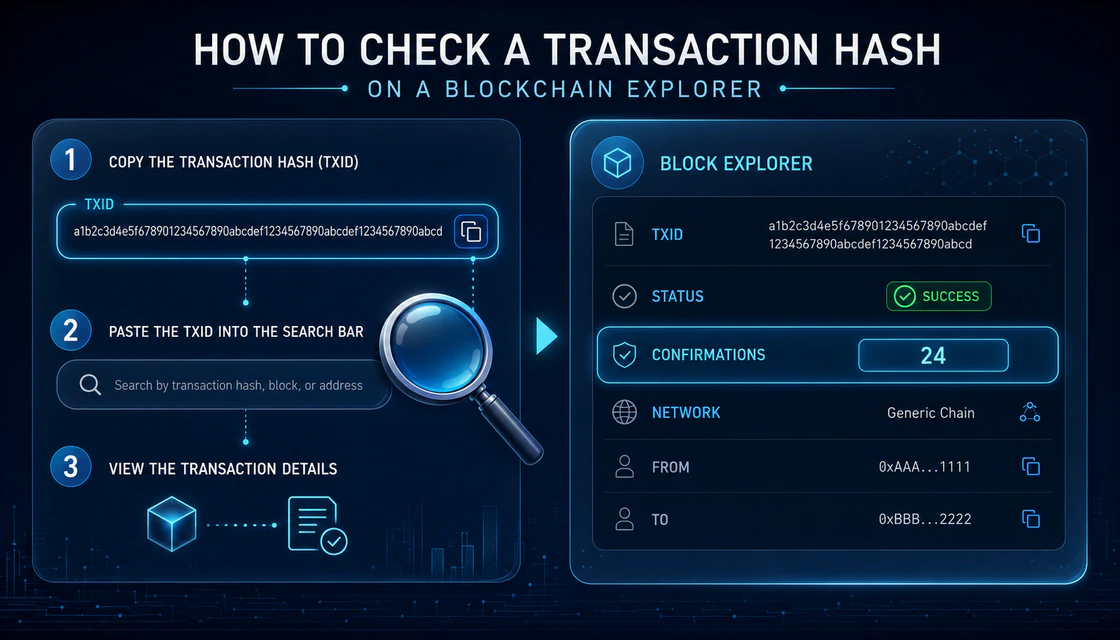
A transaction hash is a public identifier for the on-chain transfer. It is safe to give a legitimate support team the TxID, but it does not authorize spending. If no TxID exists, an explorer cannot diagnose the withdrawal: the sending platform still owns the next action. If a TxID exists, copy it from the official history page and open the linked explorer.
4. Verify the chain before interpreting the result
Check the asset and network selected in the withdrawal form. USDT on Ethereum, Tron, BNB Smart Chain and other networks are separate routes even when the ticker is the same. A TxID searched on the wrong explorer may appear not found. Compare the destination address and memo or tag with the deposit instructions that were active when you sent the funds.
5. Match the explorer state to the correct action
Use the status table below to decide who controls the next step. Do not escalate to the receiver before broadcast, and do not keep asking the sender to credit a transaction that already reached the correct destination.
Why crypto withdrawals stay pending
Exchange security or compliance review
A centralized exchange may pause a withdrawal after a new login, password reset, two-factor change, device change, unusual location, newly added address, large amount or compliance trigger. Exact rules are platform- and region-specific and are often intentionally not published in full. A review is not proof of wrongdoing and does not guarantee a short timeline. Supply only the documents requested through the authenticated app or official support portal.
Wallet maintenance or unavailable network
Exchanges periodically pause deposits or withdrawals for upgrades, node synchronization, liquidity management, chain incidents or internal wallet work. A token can remain tradable while withdrawals on one network are disabled. Check the live withdrawal form and official status page. Do not select a different network merely because it is open unless the destination explicitly supports that exact asset and network pair.
Network congestion or fee competition
On networks with fee markets, transactions offering less competitive fees can wait longer for inclusion. Coinbase lists insufficient network confirmations, insufficient fees and high network volume among reasons a transfer can remain pending. A Bitcoin transaction normally sits in a node’s mempool before a miner includes it in a block; conditions change continuously. For Ethereum-family transactions, fee settings and nonce order can affect inclusion.
Nonce gap on account-based chains
Ethereum transactions from one address use sequential nonces. A later transaction may wait behind an earlier transaction with a lower nonce. This mainly matters for self-custody wallets and advanced troubleshooting. Do not manually replace nonces unless your wallet explicitly supports Speed Up or Cancel and you understand the result. An exchange-created withdrawal is controlled by the exchange’s wallet system, not by your personal wallet settings.
Destination confirmation policy
A blockchain can show success before a receiving exchange credits the deposit. Destinations choose confirmation thresholds based on chain characteristics and risk. Coinbase says incoming transactions remain Pending until they receive the required number of confirmations. Thresholds can change, so the destination’s current live requirement is authoritative.
Wrong network, missing memo or unsupported token contract
A transfer may be valid on-chain yet fail to map automatically to the intended account. Common causes include an unsupported network, an omitted destination tag or memo, or an unsupported token contract. These are recovery cases, not ordinary pending confirmations. Stop, preserve the TxID and contact the destination. Recovery may be impossible, delayed or charged a fee; never assume support can reverse an irreversible transfer.
Minimum deposit or internal credit rules
Some platforms set minimum deposit amounts or credit only supported asset contracts. A transfer below the minimum can remain uncredited even when confirmed. Do not top up until the platform’s official policy confirms whether deposits aggregate and whether the same network, address and memo must be used.
What you can—and cannot—speed up
Exchange withdrawal
If a centralized exchange created the transaction, the user generally cannot change the network fee, nonce or raw transaction after submission. Use the platform’s cancellation option only if it is visibly offered and the transaction has not been processed. Avoid third parties promising to push an exchange withdrawal for payment.
Self-custody Bitcoin transaction
Some Bitcoin wallets support Replace-by-Fee (RBF), allowing a compatible unconfirmed transaction to be replaced with a higher-fee version. Child Pays for Parent (CPFP) can use a spend of an unconfirmed output with enough combined fee to encourage miners to include both transactions. Availability depends on the original transaction and wallet. Use only the wallet’s documented feature; never paste a seed phrase into a transaction accelerator.
Self-custody Ethereum transaction
Wallets may offer Speed Up or Cancel by submitting a replacement with the same nonce and a more competitive fee. A cancellation is normally another transaction intended to replace the pending one; it is not a guaranteed blockchain reversal. If the original confirms first, the intended transfer can still complete. Use the wallet’s built-in workflow and verify the network, nonce and fee estimate.
When to wait: waiting is appropriate when the TxID is valid, the transaction is unconfirmed or below the destination’s required confirmation count, the address and network are correct, and official status pages show normal or acknowledged delays. Monitoring is safer than improvising.
Worked example: from ‘Completed’ to credited
A beginner withdraws 250 USDT from Exchange A to Exchange B using a network supported by both. Exchange A changes the status to Completed and provides a TxID, but Exchange B still shows no balance. A screenshot of the empty balance alone is not enough evidence.
- Open Exchange A’s withdrawal history and copy the TxID, network, amount and completion time.
- Open the explorer linked from Exchange A. Confirm Success, the destination address and an increasing confirmation count.
- Open Exchange B’s current USDT deposit page. Confirm the same network, address and any memo or tag requirement.
- Check Exchange B’s required confirmations and deposit-maintenance notice. If the threshold has not been met, monitor.
- If the threshold is met and the deposit remains absent, contact Exchange B—not Exchange A—with the evidence package.
The key logic is ownership of the next action. Before broadcast, the sender controls the process. After a confirmed transaction reaches the correct destination, the receiver controls crediting. This boundary prevents hours of being redirected between support teams.
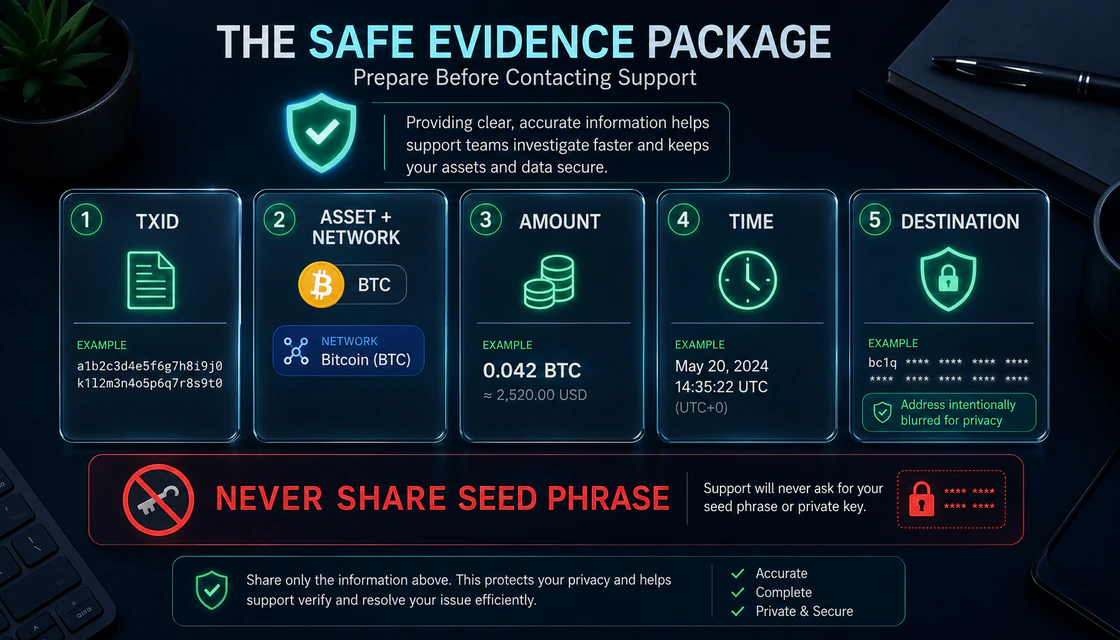
Prepare a safe support evidence package
Good evidence shortens the first support exchange. Provide public transaction and account-specific operational details, but never authentication secrets. Redact unrelated balances, full identity documents and other addresses unless the official case form specifically requests them.
| Evidence | What to include | What not to expose |
|---|---|---|
| TxID | Full public transaction hash copied from official history. | Seed phrase, private key, API secret or two-factor code. |
| Asset and network | Exact token symbol or contract where relevant and selected chain. | A guess based only on the ticker. |
| Amount and fee | Requested amount, displayed fee and net sent or received if shown. | Unrelated portfolio balances. |
| Time and status | Timestamp with timezone and current platform status. | Edited screenshots that hide the relevant status. |
| Destination | Address and memo or tag used; identify the receiving platform. | Passwords or remote access to your device. |
| Explorer result | Status, confirmations, block number and link to the correct explorer. | Links sent by strangers in direct messages. |
Security risks during a delayed withdrawal
- Fake support: scammers search social media for people posting ‘withdrawal pending’ and reply with look-alike accounts. Start support only from the authenticated app or official domain.
- Seed-phrase theft: no exchange or explorer needs your wallet recovery words to inspect a public TxID.
- Remote-access fraud: do not install screen-control software or let a stranger configure your wallet.
- Address poisoning: do not copy a destination from recent transaction history without rechecking the full address from the receiving wallet.
- Recovery-fee scams: a legitimate platform may publish a recovery fee, but unsolicited agents demanding crypto upfront are a red flag.
- Impatience errors: sending again, switching networks or changing a memo can create a second problem while the first is unresolved.
Beginner mistakes
- Treating Completed on the sending exchange as identical to credited at the destination.
- Searching the TxID on the wrong blockchain explorer.
- Checking only the first and last address characters when a memo or tag is also required.
- Assuming every exchange uses the same confirmation threshold.
- Trying self-custody nonce or fee-replacement techniques on an exchange-controlled withdrawal.
- Posting the entire account screen publicly, including email, balances and support case number.
- Sending a second large transfer instead of a small test on a new route.
Practice task: diagnose five simulated cases
Use a demo worksheet—do not send real funds. For each case, write the stage, owner of the next action, evidence required and one action to avoid.
| Case | Observation | Correct diagnosis target |
|---|---|---|
| A | Exchange status Processing; no TxID after a security change. | Platform-side review; sender support or status page. |
| B | TxID found; correct chain; 0 confirmations. | Broadcast but unconfirmed; monitor the network. |
| C | Explorer Success; confirmations below destination requirement. | Wait for the destination threshold. |
| D | Explorer Success; enough confirmations; memo was omitted. | Destination recovery case; contact the receiver. |
| E | TxID searched on Ethereum, but the withdrawal used Tron. | Wrong explorer; recheck the network before escalation. |
Pass condition: you can identify which system controls the next step without guessing and prepare the evidence package without revealing a secret. If not, repeat the exercise before making another live withdrawal.
When to escalate immediately
Use the platform’s authenticated security or support flow. Preserve emails, timestamps and case numbers. If the amount is material, consider independent legal or financial guidance appropriate to your jurisdiction. Crypto recovery rules and reporting duties vary by country.
Exchange availability, recovery procedures, compliance reviews, tax treatment and reporting duties vary by country and legal entity. Use the support and security route shown inside your own verified account and seek local professional advice when the amount is material.
- The withdrawal was not authorized by you or followed an unexpected login or security alert.
- The address shown in history differs from the one you confirmed.
- The exchange marks the withdrawal Completed but provides an invalid or unrelated TxID.
- The transaction is confirmed to the correct destination with enough confirmations, but the receiver has no record after its published processing window.
- An official status page reports a security incident, chain halt or prolonged wallet outage.
Summary
A pending crypto withdrawal becomes manageable when you locate it in the four-stage chain: exchange review, broadcast, network confirmations and destination credit. No TxID points to the sender. An unconfirmed TxID points to the network. A confirmed transaction with sufficient confirmations points to the destination. Wrong-network and missing-memo cases require a recovery assessment, not another transfer. Throughout the process, protect authentication secrets and contact support only through official routes.
SAFE TROUBLESHOOTING
Before you contact support
- I saved the withdrawal status, time, asset, amount and selected network.
- I copied the TxID only from authenticated transaction history.
- I opened the block explorer for the correct network.
- I checked the destination address and every required memo or tag.
- I compared the confirmation count with the receiver’s current requirement.
- I checked official maintenance and status notices.
- I prepared evidence without passwords, private keys, seed phrases or two-factor codes.
- I will not resend until the cause and owner of the next action are clear.
FAQ
How long can a crypto withdrawal stay pending?
There is no universal time. Platform review, wallet maintenance, network congestion, confirmation policy and destination processing all matter. Use the live status, TxID and official service notices rather than a generic promise.
What if there is no TxID?
The transaction may not have been broadcast. Complete any required approval, check maintenance and contact the sending platform if the status remains unresolved.
Is a TxID safe to share with support?
Yes. A TxID is public blockchain data. Share it only through a verified support channel and never include seed phrases, private keys, passwords or two-factor codes.
Why does the explorer say confirmed but the exchange balance is empty?
The receiver may require more confirmations, be under maintenance, need a memo or tag, reject the network or token contract, or hold the deposit for review. Contact the receiving side after checking its live requirements.
Can I cancel an exchange withdrawal?
Only if the platform visibly offers cancellation before processing. Once broadcast and confirmed, ordinary blockchain transfers are generally irreversible.
Can I speed up a pending transaction?
A self-custody wallet may support RBF, CPFP or same-nonce replacement depending on the network. Users usually cannot edit an exchange-controlled withdrawal.
What if I used the wrong network?
Stop and contact the destination with the TxID, asset, network, address and memo or tag. Recovery depends on whether the destination controls the relevant keys and supports a recovery process; it may be impossible.
Should I send another small amount to make the first appear?
Not unless the platform’s official policy specifically says deposits aggregate. A second transfer can create another fee or routing problem.
Who should I contact first?
No TxID or rejected request: the sender. Confirmed transfer to the correct destination: the receiver. Unconfirmed on-chain transfer: monitor the network and use only wallet-supported tools if it came from self-custody.
Does KYC guarantee a fast withdrawal?
No. KYC can be required, but security review, network conditions, product rules and compliance checks can still affect processing. Requirements vary by exchange and jurisdiction.
QX HUB / CRYPTO
Built for decisions, not hype
Each guide starts with the action a reader needs to complete, separates changing platform details from durable safety rules, and keeps the final check inside the live account interface.


