
EMA RSI strategy on Quotex
EMA + RSI Strategy on Quotex: Practical Rules
Learn a clean EMA + RSI strategy on Quotex: trend filter, RSI confirmation, pullback entries, skip rules, risk limits and demo practice.

Quick answer
EMA + RSI is useful on Quotex when EMA defines the trend and RSI confirms momentum. The setup is not a magic signal: wait for a pullback, check RSI around the 50 line, confirm with a candle close, keep the stake fixed and skip flat or emotional markets.
- EMA 20 and EMA 50 give the strategy its trend map.
- RSI 14 works best as a momentum filter, not as a buy or sell button.
- The clean entry usually appears after a pullback, not after a stretched candle.
- The strongest rule in this setup is often the decision to skip.
What EMA + RSI tries to solve
Most beginners do not lose structure because they lack indicators. They lose it because every fast candle feels like an invitation. EMA + RSI gives the chart a decision order: first trend, then pullback, then momentum, then candle trigger. That order keeps the trader from buying every green candle or selling every red candle. The strategy does not remove uncertainty, but it makes the uncertainty easier to review.
How EMA 20 and EMA 50 build the trend filter
EMA stands for Exponential Moving Average. In this setup EMA 20 reads the short-term rhythm, while EMA 50 gives the broader direction. When EMA 20 is above EMA 50 and both lines slope upward, bullish ideas are cleaner. When EMA 20 is below EMA 50 and both lines lean lower, bearish ideas deserve more attention. If price keeps chopping through both averages, the setup is not ready.
Why RSI 14 is the momentum filter
RSI measures momentum from 0 to 100, but beginners often focus too much on 30 and 70. For this strategy the 50 area is more useful. In an uptrend, RSI holding above or recovering above 50 shows that momentum still supports the buyer side. In a downtrend, RSI staying under or returning below 50 keeps the seller side in control. A single overbought or oversold touch is not enough.
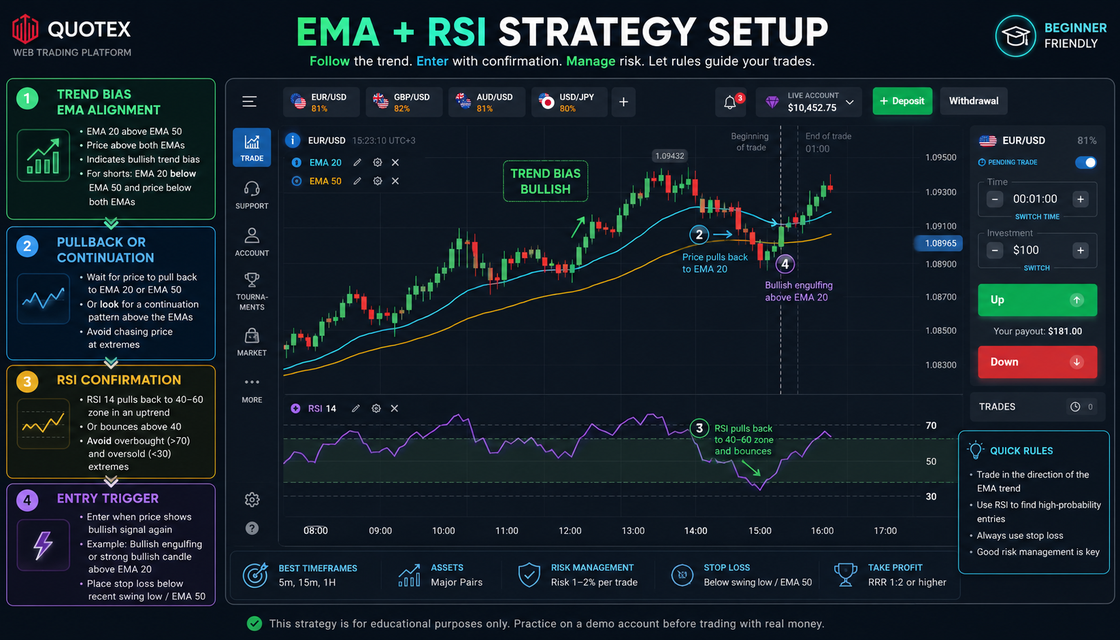
Best Quotex chart setup
A practical starting setup is simple: candlestick chart, EMA 20, EMA 50 and RSI 14. The 5-minute chart is usually calmer for beginners than very short noise, while still giving enough examples for practice. Keep the settings stable for a full demo cycle. Changing the values after one loss destroys the sample and turns learning into guessing.
CALL setup: continuation after a pullback
A CALL idea starts with bullish structure: EMA 20 above EMA 50, price pulling back toward the EMA area and RSI holding above or recovering above 50. The trigger is a bullish candle that closes back with the trend, ideally after rejecting the pullback zone. Avoid entering after several long green candles far above EMA 20. That is not confidence; that is usually late timing.
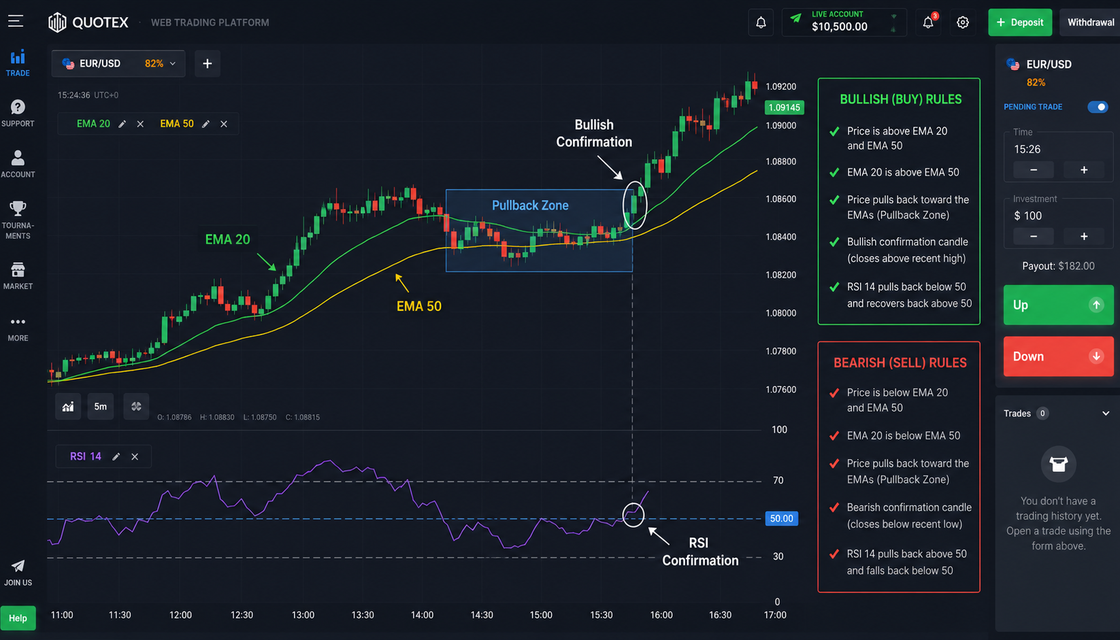
PUT setup: failed bounce in a downtrend
A PUT idea needs the opposite structure: EMA 20 below EMA 50, price bouncing toward the EMA area and RSI staying below or returning below 50. The trigger is a bearish candle that closes back with the trend after the bounce fails. If price breaks above EMA 50 and holds there, the bearish read is weaker. Do not force the trade because RSI looks high.
When a good trader skips the signal
Skip the setup when the EMAs are flat, tangled or crossing repeatedly. Skip when price is already far from the averages, RSI is stuck around 50, the candles have long wicks on both sides or a news spike has changed the rhythm. Also skip when you feel the need to win back a loss. The market does not owe you a setup; protecting attention is part of the edge.
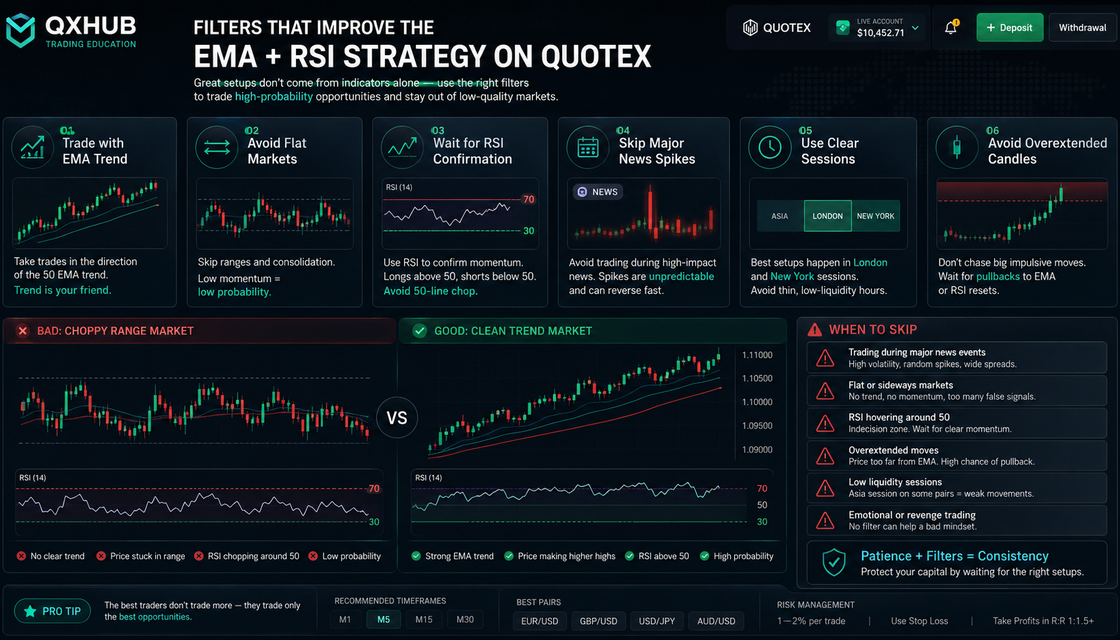
Risk rules before the click
Use a fixed small stake while testing. Set a daily loss limit and a maximum number of trades before the session starts. Do not increase the amount after a losing trade and do not continue after repeated rule breaks. A simple EMA + RSI strategy can still lose, so the account must survive normal mistakes. Broken discipline is more dangerous than one losing trade.
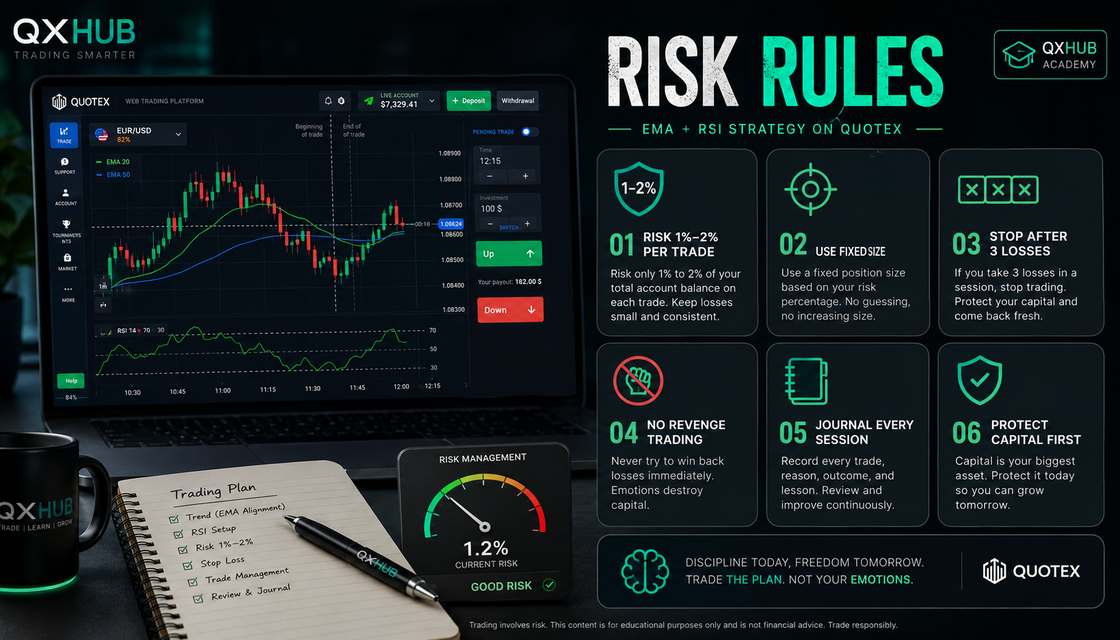
7-day demo practice plan
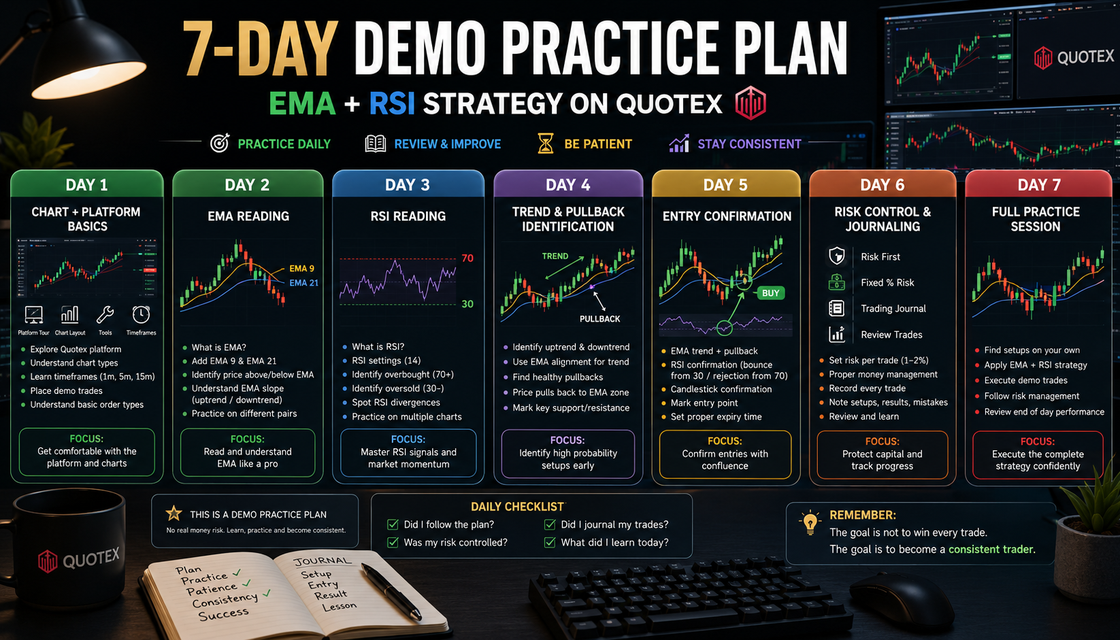
Day one is chart setup and screenshots. Day two is reading EMA structure without trading. Day three adds RSI confirmation. Day four allows only pullback entries. Day five is a skip drill: record weak setups you refused. Day six is review and grading. Day seven is a clean 10-trade demo test where discipline is judged before result.
Final advice
EMA + RSI works best as a discipline framework. Trend first, pullback second, momentum third, candle trigger last. If you start with the trigger and then look for reasons, you will eventually justify poor trades. Use the strategy to slow the decision down, keep risk fixed and make every result reviewable.
Practical route for EMA RSI strategy on Quotex
Use this route after reading the guide. It turns EMA RSI strategy on Quotex into a repeatable routine: one idea, one chart check, one risk limit and one clear Quotex action instead of impulsive entries.
- Learn a clean EMA + RSI strategy on Quotex: trend filter, RSI confirmation, pullback entries, skip rules, risk limits and demo practice.
- RSI 14 works best as a momentum filter, not as a buy or sell button.
- How EMA 20 and EMA 50 build the trend filter
- Why RSI 14 is the momentum filter
Write the reason you opened this page in one sentence. Compare it with the guide's core point: EMA 20 and EMA 50 give the strategy its trend map. If the reason is still vague, stay on demo and sharpen the rule before touching a live balance.
Open one asset and connect the idea with the section "What EMA + RSI tries to solve". Do not jump between markets. A clean rehearsal means the same timeframe, the same expiration logic and the same condition for skipping the trade.
Before any real click, set the amount, the daily stop and the maximum number of attempts. Keep this filter beside the chart: Trading involves risk. Compare the platform, read the rules and never trade funds you cannot afford to lose. A strong trader protects attention first, capital second and ego never.
If the checklist still holds, use the most relevant path: Registration. If the context changes, compare it with Fast entry or Android app. The best route is the one that matches the reader's goal, not the loudest button.
Use the guide like a trading plan
A visitor searching for EMA RSI strategy on Quotex usually needs a direct answer, not hype. This guide connects that question with Learn a clean EMA + RSI strategy on Quotex: trend filter, RSI confirmation, pullback entries, skip rules, risk limits and demo practice. and keeps the focus on the decision a beginner actually has to make next.
A calm trader does not turn one paragraph into a signal. Read the key points, compare them with the chart, then ask whether timing, amount and risk still agree. The strongest idea in this page is simple: EMA 20 and EMA 50 give the strategy its trend map.
When the idea is clear, move in order: open the right Quotex route, practise the workflow on demo and only then decide whether Registration, Fast entry or Android app fits the session. If the rule feels rushed, the better decision is patience.
- RSI 14 works best as a momentum filter, not as a buy or sell button.
- The clean entry usually appears after a pullback, not after a stretched candle.
- The strongest rule in this setup is often the decision to skip.
- Trading involves risk. Compare the platform, read the rules and never trade funds you cannot afford to lose.
Quick answers
Is EMA + RSI good for Quotex beginners?
It can be useful because it combines a trend filter and a momentum filter, but it must be tested on demo and used with strict risk limits.
Which EMA settings should I start with?
EMA 20 and EMA 50 are a practical starting pair. Keep them stable during practice so the review means something.
Which RSI setting fits the setup?
RSI 14 is a sensible default. The 50 area is usually more important here than blindly reacting to 30 or 70.
Can I use EMA + RSI on a 1-minute chart?
You can test it, but the 1-minute chart is noisier. Many beginners learn the process more clearly on a 5-minute chart.
When should I skip the strategy?
Skip flat EMAs, tangled averages, price far from structure, unclear RSI, news spikes and any trade taken to recover a loss.
Does EMA + RSI guarantee profit?
No. It is a structure for better decisions, not a guarantee. Risk control and review still decide whether the method is useful.
How many demo trades should I test?
Start with at least 20 to 30 screenshots or demo examples before changing settings or increasing pressure.
What should I write in the journal?
Record asset, timeframe, EMA structure, RSI condition, entry reason, expiry logic, result and whether the trade followed the rules.
How should a beginner use EMA RSI strategy on Quotex?
Treat EMA RSI strategy on Quotex as a decision filter, not as a signal by itself. Start with the page's main idea: EMA 20 and EMA 50 give the strategy its trend map. Then check one chart, one timeframe and one amount on demo before any real-money step.
What should I check before applying What EMA + RSI tries to solve?
Check whether the market still matches the section "What EMA + RSI tries to solve", whether RSI 14 works best as a momentum filter, not as a buy or sell button. is true on the chart and whether your amount fits the planned risk. If one part is missing, skipping is the professional choice.
Next step
Choose a topic by task: brokers for platform selection, guides for access, strategies for setups, risk for discipline and investing for longer market logic.