FIFA World Cup forex volatility
World Cup Forex Volatility: Quotex Trading Guide
A practical guide to FIFA World Cup forex volatility, liquidity, trading volumes, match-day filters and safer Quotex planning.
Quick answer
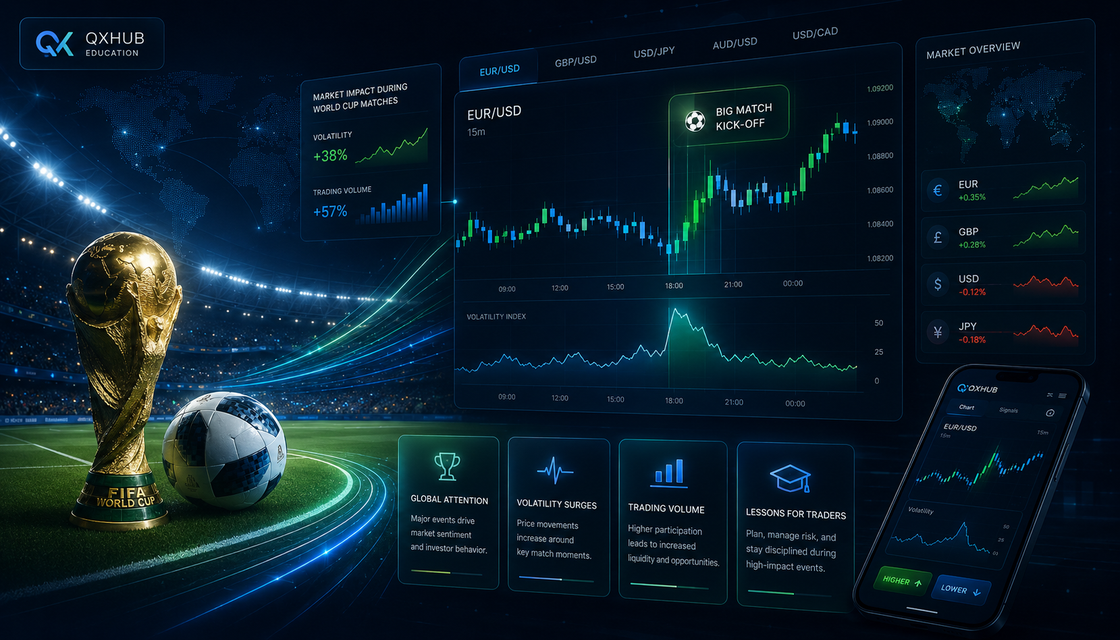
The World Cup can affect forex conditions indirectly, mostly through attention. Big matches can reduce participation, thin liquidity and make short-term candles less reliable, especially when they overlap with active sessions. Treat the match schedule as a filter for when to trade, not as a prediction tool.
- A football match is not a buy or sell signal; it is a market-quality filter.
- The strongest evidence comes from stock-market studies, so forex conclusions must stay careful.
- The riskiest window is football attention plus a real macro catalyst like CPI, jobs data or a central-bank speech.
- For Quotex, the practical edge is defensive: skip messy windows, use demo and protect stake size.
Why the World Cup matters to a trader
Interest rates, inflation and central banks still drive the market. But markets are also made of people, and people have limited attention. During a major World Cup match, some traders reduce activity, some delay decisions and some simply stop watching the chart. That does not create a guaranteed direction in EUR/USD or GBP/USD. It can create a different trading environment: thinner participation, slower price discovery and candles that look cleaner than they really are.
What research actually supports
The serious evidence is not a magic football-to-forex formula. Academic work on major football matches found that trading activity and volume can fall when a national team is playing, while market quality can weaken around the event. That evidence is strongest for stock exchanges, not retail fixed-time trading. The smart conclusion is conservative: a high-attention match can distract market participants, but it does not override rates, inflation, employment data or geopolitical shocks.
How attention becomes market noise
When participation drops, liquidity can become less balanced. A smaller order flow can move price farther, and one sharp candle can look like a breakout even when the market has not accepted the level. Price discovery may also slow down. The chart can sit flat during the match, then reprice quickly after attention returns. For a short-term trader, that is dangerous because expiry timing turns small execution differences into real account pressure.
Before, during and after kickoff
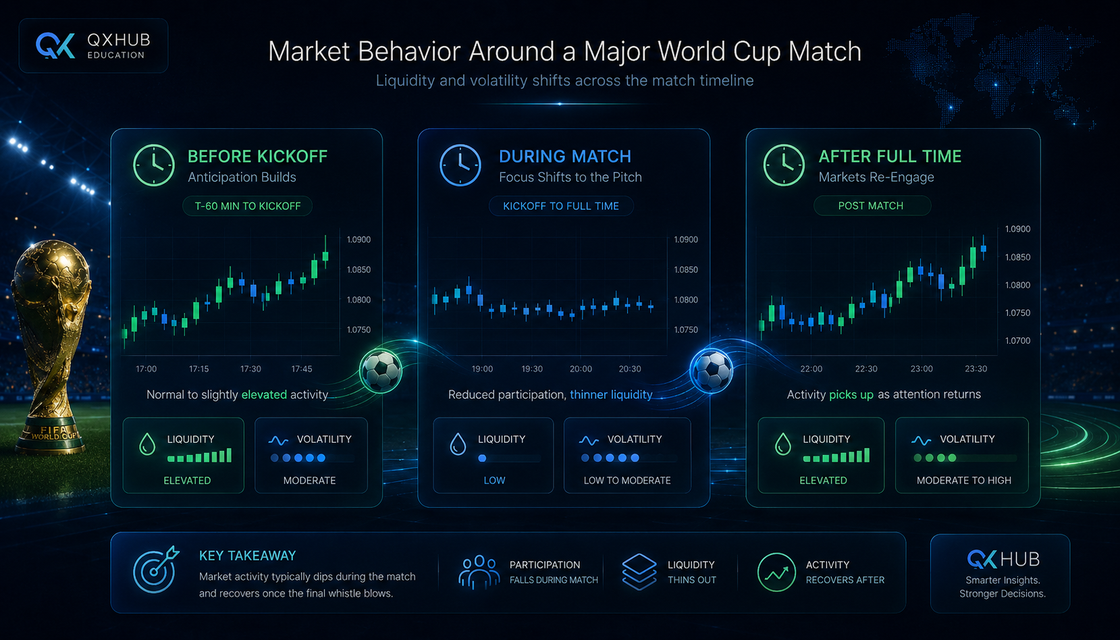
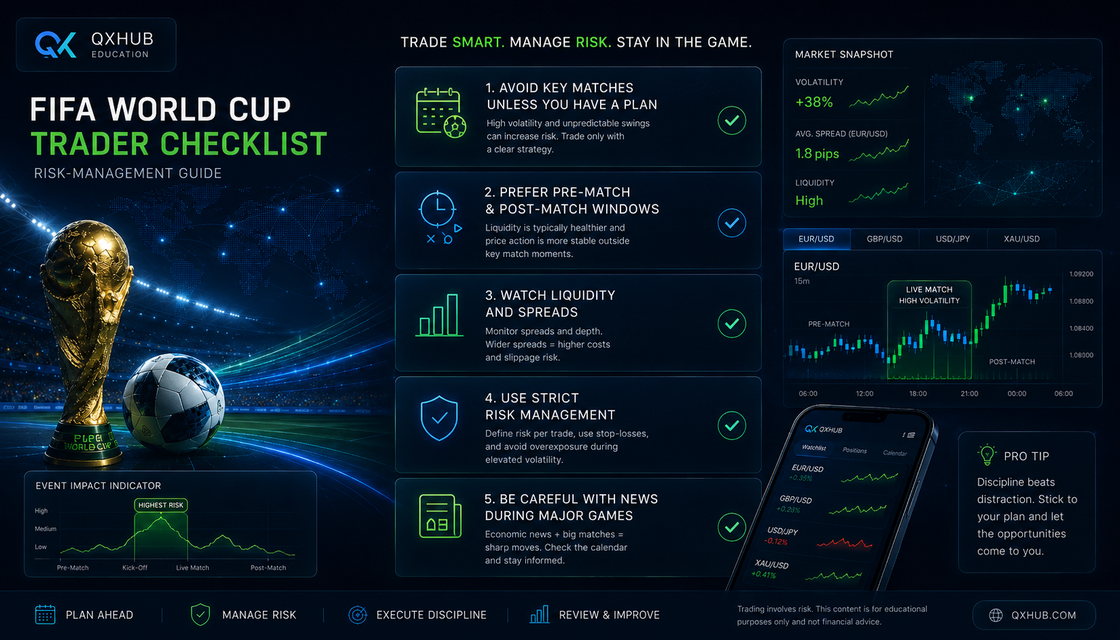
The cleanest routine is to split the match into windows. Sixty to one hundred twenty minutes before kickoff, normal rules may still work if the economic calendar is quiet. In the final thirty minutes, attention can already fade. During the match, observation or demo practice is usually stronger than live entries. At half-time, do not assume liquidity is back for good. After full time, wait until candle size, pullbacks and reactions feel normal again before judging a setup.
Currency pairs to watch without forcing a story
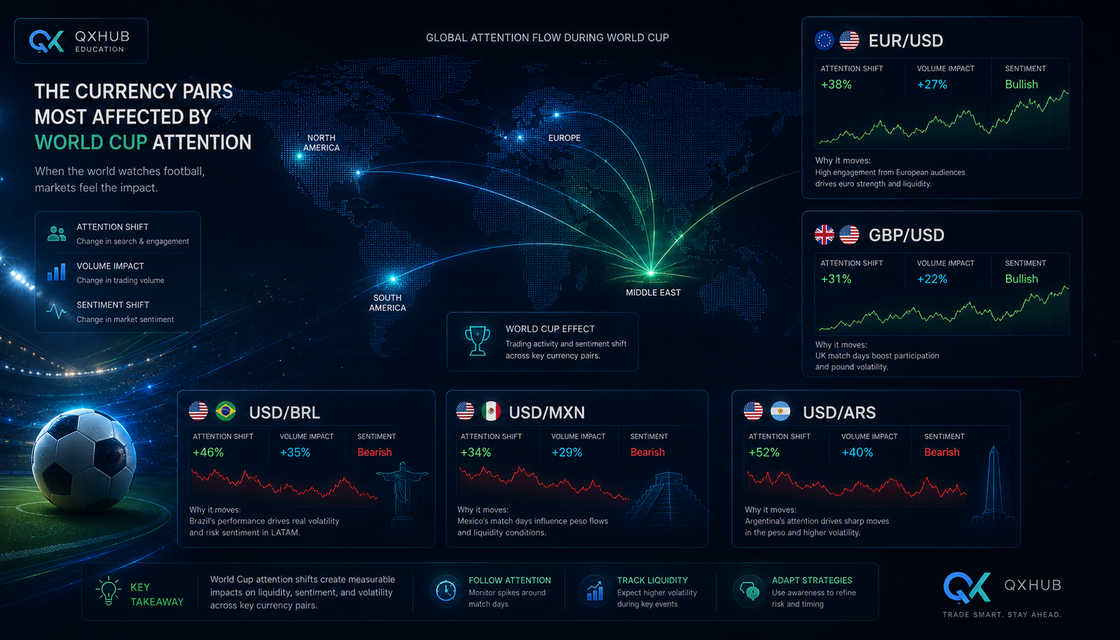
Pair selection should follow session overlap and liquidity. EUR/USD and GBP/USD matter because European matches can overlap with London and early New York trading. USD/MXN and USD/CAD deserve attention during North American windows because the 2026 tournament is hosted across the United States, Canada and Mexico. USD/BRL can be interesting when Brazil plays, but platform availability and liquidity differ from major pairs. The point is a watchlist, not an automatic trade.
A practical Quotex match-day plan
Use two calendars: the economic calendar first, the match schedule second. If a high-impact release lands near kickoff or full time, step back. For important matches, create a no-trade zone from about fifteen minutes before kickoff until at least fifteen to thirty minutes after full time. Then check three things: higher-timeframe direction, location at a known level and confirmation through candle reaction. If one part is missing, the professional trade is no trade.
Risk rules when market quality is unclear
Fixed-time trading gives little room to manage the position after entry, so stake control becomes the main defense. Keep the amount fixed, avoid Martingale, limit the number of attempts and stop after abnormal execution. If candles jump without follow-through or payout and asset availability change during the session, the market has already answered you. The setup is not good enough for real money. A strong trader protects decision quality before chasing a result.
Demo task for serious traders
Do not believe the idea blindly. Test it. Pick one liquid pair and one setup you already understand. For five important matches, save screenshots sixty minutes before kickoff, during the match and thirty minutes after full time. Record candle range, false breaks, valid setups, economic news and whether your normal confirmation still worked. After the sample, decide whether the match-day filter improves your trading. If the data says no, remove the filter.
Final verdict
The World Cup is useful to traders because it reminds us that markets are human systems. A match does not predict price direction, but it can change attention, liquidity and short-term reliability. For Quotex users, the safest interpretation is simple: check the calendar, avoid emotional windows, trade only clean structure and let demo data prove the idea before real money is involved. Missing one low-quality trade is never a problem. Forcing one usually is.
Quick answers
Does the FIFA World Cup always increase forex volatility?
No. Some matches can reduce activity instead of creating clean volatility. The effect depends on session overlap, match importance, liquidity and the economic calendar.
Can a national team win strengthen its currency?
Not reliably. Sporting mood can influence sentiment in some markets, but exchange rates are still dominated by rates, inflation, capital flows and global risk appetite.
Which pairs are most relevant during the World Cup?
EUR/USD, GBP/USD, USD/MXN, USD/CAD and sometimes USD/BRL are useful watchlist pairs, but only when the match overlaps with an active session and normal market drivers are quiet.
Should I trade one-minute expiry during a match?
Usually no. Thin or distracted conditions make very short expiries more sensitive to noise and execution differences.
How long should I wait after full time?
Start with fifteen to thirty minutes, then read the chart. If candle structure is still abnormal, keep waiting or stay on demo.
Is this a Quotex World Cup strategy?
It is better described as a market-condition filter. You still need a separate setup, risk rule and expiry plan.
Can I trade OTC assets while football distracts the market?
OTC instruments should be treated as a separate environment. Test them independently on demo because their pricing may not mirror interbank forex conditions.
What is the biggest beginner mistake?
Trading the match result instead of the chart. The result on the pitch is not a trading signal.
Next step
Choose a topic by task: brokers for platform selection, guides for access, strategies for setups, risk for discipline and investing for longer market logic.