
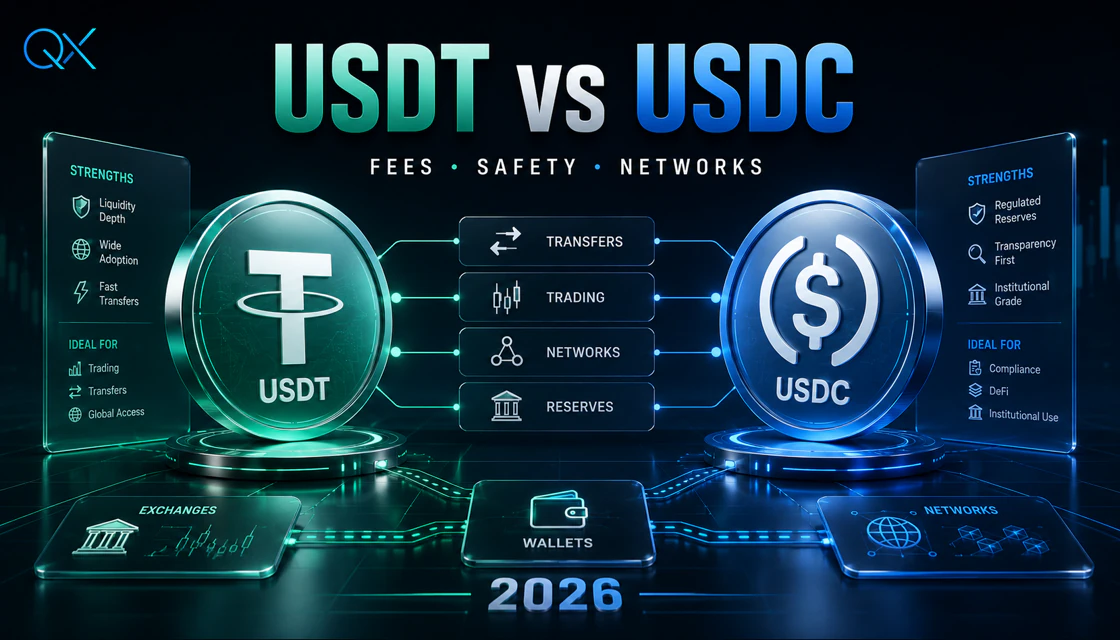
QUICK ANSWER
USDT is often the practical choice when a specific exchange, trading pair, counterparty, or low-cost route supports it more broadly. USDC can be the better fit when you prioritize Circle’s reserve-disclosure model, native USDC infrastructure, or a service that settles directly in USDC. Neither token is risk-free, and neither is automatically cheaper: the blockchain and platform set most transfer costs. Choose the destination first, then the exact token and network.
Five decisions before choosing a stablecoin
- 1
Define the job: transfer, trading balance, short hold or DeFi.
- 2
Start with the receiving platform and its supported routes.
- 3
Verify the exact token contract, network and native or bridged status.
- 4
Compare total net cost rather than one headline fee.
- 5
Use a valid test transfer before moving the remainder.
USDT and USDC are similar—not interchangeable
USDT and USDC are fiat-backed stablecoins designed to track the U.S. dollar. That similarity makes them look interchangeable. Operationally, they are not. They have different issuers, reserve-reporting systems, supported blockchains, exchange coverage, redemption routes, regulatory exposures, and smart-contract histories. A good decision is therefore not ‘Which ticker is best?’ but ‘Which complete route has the fewest weak links for this job?’
This guide is for beginners choosing a stablecoin for a transfer, trading balance, short operational hold, or decentralized application. It does not treat a stablecoin as a savings account, bank deposit, or guaranteed dollar. Availability, account eligibility, token contracts, withdrawal fees, deposit minimums, and local rules change. Verify every live screen before acting.
What USDT and USDC actually are
USDT is issued by Tether. Tether states that its tokens are pegged one-to-one with matching fiat currency and backed by its reserves; circulation information is typically updated daily and reserve reports are published quarterly. Direct access to Tether’s primary-market service is not the normal route for small retail users: its official transaction page says direct transactions are supported for amounts of 100,000 or more. Most beginners obtain and use USDT through exchanges or wallets.
USDC is issued by Circle. Circle describes USDC as redeemable one-to-one for U.S. dollars and backed by highly liquid cash and cash-equivalent assets. Circle publishes weekly reserve holdings and mint/burn flows, with monthly third-party assurance reports. Retail users still commonly acquire USDC through an exchange or wallet rather than dealing directly with the issuer.
Important distinction: the issuer’s redemption promise and the price available on your exchange are different layers. A token can trade slightly above or below one dollar during stress or local liquidity imbalance, even when issuer redemption remains available to eligible customers.
USDT vs USDC: the practical differences
This comparison intentionally avoids market-cap rankings and fixed fee numbers. Those figures change quickly and do not answer whether your intended destination supports the token and network today.
| Decision factor | USDT | USDC |
|---|---|---|
| Issuer | Tether entities; terms and eligible direct-service users are defined by Tether. | Circle entities; access and redemption depend on Circle terms and eligible accounts. |
| Reserve disclosure | Tether publishes circulation data and quarterly reserve reporting or assurance material. | Circle publishes weekly reserve holdings and monthly third-party assurance reports. |
| Network footprint | Available on multiple protocols; official supported-protocol pages must be checked for current status. | Native USDC is issued on multiple supported chains; Circle distinguishes native from bridged versions. |
| Typical retail route | Usually bought, sold, deposited, and withdrawn through exchanges or wallets. | Usually bought, sold, deposited, and withdrawn through exchanges or wallets. |
| Trading fit | Often useful where a venue lists deeper or more numerous USDT pairs. Verify the exact venue and region. | Useful where a venue uses USDC pairs or native USDC settlement. Pair depth varies by market. |
| Transfer cost | Depends mainly on the selected blockchain and sending platform fee. | Depends mainly on the selected blockchain and sending platform fee. |
| Core risks | Issuer, reserve, depeg, contract, blockchain, exchange, and legal-access risks. | Issuer, reserve, depeg, bank or custodian, contract, blockchain, exchange, and legal-access risks. |
Do not ask only ‘Which is safer?’
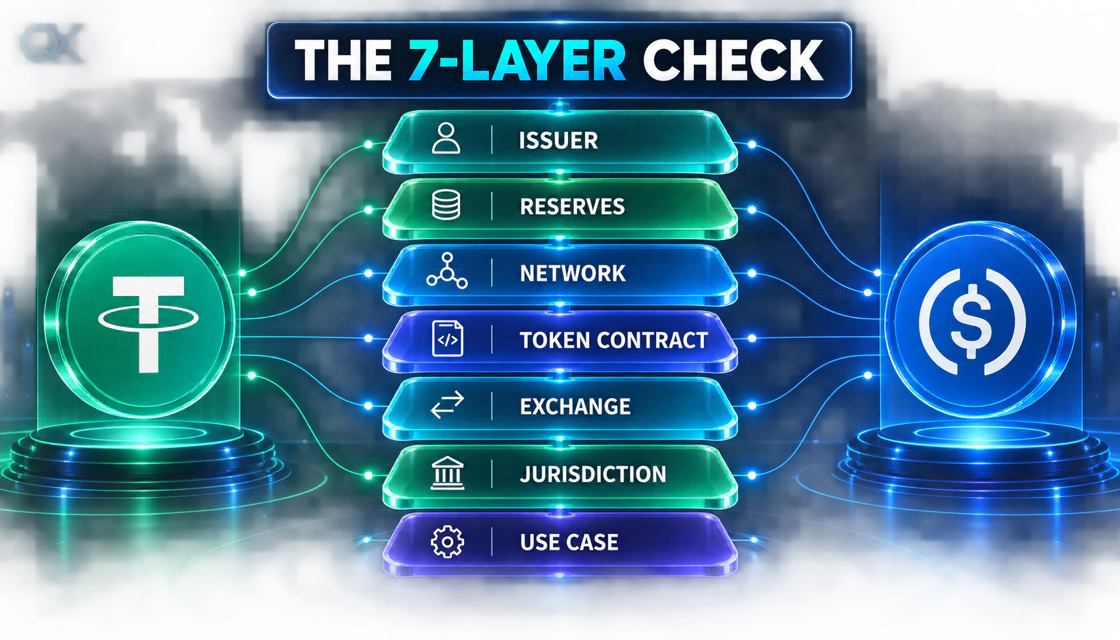
‘Safety’ is not one property. It is the combined result of at least seven layers: the issuer, reserve assets, blockchain, token contract, platform holding the balance, law applicable to the user, and purpose of the transaction. A transparent reserve report does not prevent a wrong-network transfer. A cheap chain does not eliminate exchange insolvency risk. Deep trading liquidity does not guarantee one-dollar execution in a stressed market.
Issuer and reserve layer
Read the issuer’s current transparency page, assurance material, terms, and risk disclosures. An assurance engagement is not the same as a full financial-statement audit, and public reserve information does not remove redemption, banking, custody, or operational risk. Focus on what is reported, how often it is reported, who performs the assurance, and what claims the report actually supports.
Platform and custody layer
If USDT or USDC sits on an exchange, you also depend on that exchange’s solvency, security, withdrawal operations, account controls, and local entity. The stablecoin may function perfectly while your platform account is frozen, unavailable in your country, or unable to withdraw through the route you need. Separate token risk from custodian risk.
Legal and access layer
Stablecoin availability and product treatment can differ by jurisdiction. Exchanges may limit pairs, deposits, withdrawals, rewards, or derivatives after regulatory changes. Check the service and entity shown in your own account. Do not rely on a global feature page as proof that a product is legal or available to you.
Stablecoin availability, exchange pairs, issuer access, tax treatment and consumer protections vary by country and legal entity. Verify the rules and routes shown for your own jurisdiction and verified account.
Networks matter more than the ticker
Both tokens operate across multiple blockchains, but support is not universal. Tether’s official integration page lists supported protocols and also identifies deprecated protocols. Circle’s official documentation lists supported chains for its products and warns that unsupported assets or bridged versions sent to certain addresses may be lost. Exchanges add another filter: a chain can be supported by the issuer but unavailable for deposits or withdrawals on your specific platform.
The receiving platform decides which version it can credit. Start there. If it lists USDT on TRON and Ethereum but only USDC on Ethereum and Solana, those are four distinct routes. A matching address format is not proof of compatibility, especially across EVM networks that share 0x-style addresses.
Network rule: match token, named network, destination support, address, and any memo or tag. Compare price and fee only after compatibility is confirmed. For a new route, send a small test above the deposit minimum and wait for account credit before sending the remainder.
Native USDC, bridged USDC, and wrapped versions
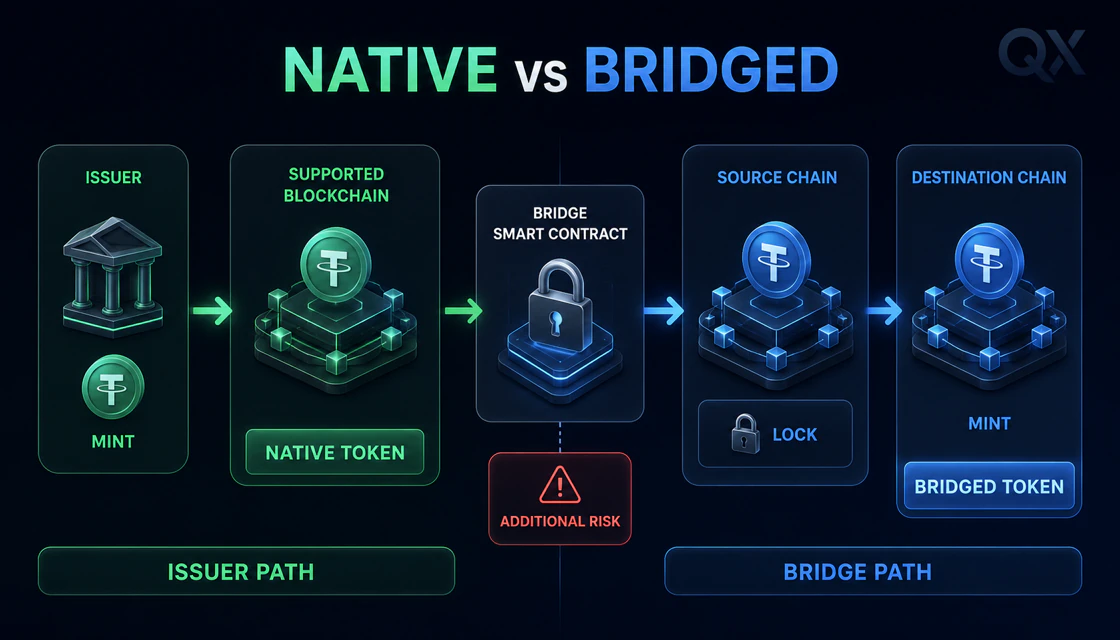
A native token is issued by the stablecoin issuer on a supported blockchain. A bridged token is generally created by locking or holding an asset on one chain and representing it on another. The bridged version may track the same value but relies on an additional mechanism. Its contract address and redemption path can differ from native USDC.
Circle’s documentation explicitly distinguishes native USDC and supported versions across its products. A wallet may display ‘USDC’ for more than one contract. Before using DeFi or withdrawing to an exchange, verify the contract address through the official issuer documentation and the receiving platform’s deposit page. Never choose by ticker or icon alone.
USDT also exists on multiple protocols, and the official Tether page provides protocol-specific integration details. The same discipline applies: identify the current supported token contract and destination route. Deprecated protocol support is a warning to check current status rather than reuse an old tutorial.
Fees: USDT is not inherently cheaper than USDC
Stablecoin issuers do not set the ordinary blockchain gas fee for a wallet-to-wallet transfer. The chosen chain’s fee market does. Exchanges may then charge their own fixed or dynamic withdrawal fee, impose a minimum withdrawal, and round the net amount. Therefore ‘USDT fees’ and ‘USDC fees’ are incomplete phrases unless the network and platform are named.
On the same blockchain, two token transfers can have similar on-chain mechanics, but contract design, transaction demand, and platform policy can still make the displayed fee differ. Across different chains, costs can vary much more. A low displayed fee is useful only when the destination supports that exact token and chain and the amount after fees exceeds its minimum deposit.
| Cost item | Where to verify it | What to compare |
|---|---|---|
| Trading fee | Live fee schedule and order ticket on your exchange. | Maker or taker tier, pair, account level, spread, and order type. |
| Withdrawal fee | Final withdrawal review screen. | Token, named network, fee, minimum, and net amount received. |
| Blockchain fee | Wallet estimate or network explorer. | Current gas or fee conditions and native gas token needed. |
| Conversion cost | Quoted trade or convert preview. | Spread, execution price, fee, and slippage—not only a ‘zero fee’ label. |
| Deposit minimum | Destination deposit screen. | Minimum amount after source withdrawal fees. |
| Bridge cost | Official bridge interface and route details. | Source fee, destination gas, bridge fee, time, and added contract risk. |
Trading liquidity and pair availability
USDT may be the more convenient quote asset on a venue where more markets are quoted in USDT or the relevant order book is deeper. USDC may be preferable when a venue offers an equally liquid USDC pair, when your funding or withdrawal rail settles in USDC, or when a protocol requires native USDC. The right answer can change from one exchange and region to another.
Before switching stablecoins for a trade, compare the actual order books and conversion preview. A lower headline trading fee can be outweighed by a wider spread or slippage. For a small market order, note the quoted received amount. For a larger order, inspect depth and consider limit orders. Do not assume one-dollar parity guarantees identical execution.
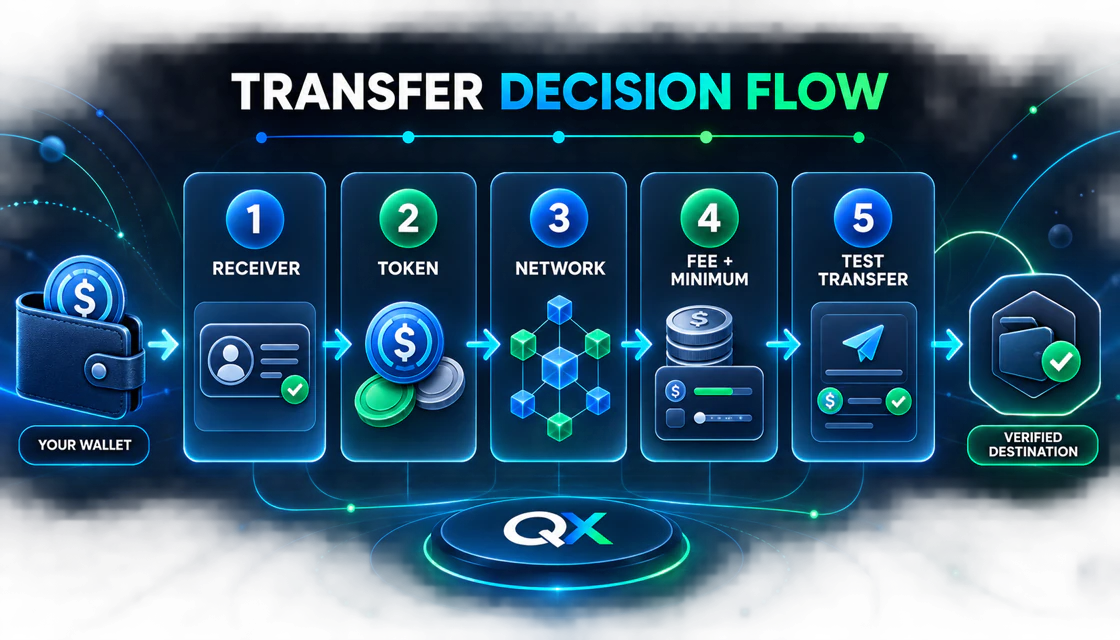
A five-step decision workflow
- Define the job. Is this a transfer, a trading quote balance, a short operational hold, or a DeFi interaction? A token that fits one job may be inefficient for another.
- Start with the destination. Confirm it accepts USDT, USDC, or both, then record the exact networks, deposit status, minimum, contract information, and account eligibility.
- Choose the complete route. Compare token plus network plus platform fee—not token alone. Exclude any route with uncertain support, a bridged token you cannot verify, or regional restrictions.
- Review the live economics. Check conversion spread, withdrawal fee, minimum, net amount, confirmation requirement, and whether you need a native gas token later.
- Test before scaling. Send a small amount above all minimums, wait for credit, save the transaction ID, and only then send the remainder.
Worked examples
Example 1: exchange-to-exchange transfer
A user holds USDT on Exchange A and wants to fund Exchange B. Exchange B accepts USDT and USDC, but only two of Exchange A’s USDT withdrawal networks overlap. The user should compare those overlapping USDT routes first. Converting to USDC adds a trade and possible spread; it is justified only if the USDC route has lower total cost, better destination support, or a downstream need. The final comparison is net units credited, not the cheapest headline fee.
Example 2: keeping a trading quote balance
A trader uses an exchange where the target markets have deeper USDT order books. USDT is operationally simpler there. If the same trader later moves funds to a platform that primarily uses native USDC, converting once and transferring USDC may reduce repeated conversions. Keep only the required operating balance on the exchange and separate trading convenience from long-term custody.
Example 3: using DeFi
A protocol accepts a token labeled USDC on an L2 network. The user confirms the official contract, whether it is native or bridged, the protocol’s supported version, and the route back to an exchange. They also acquire enough native gas token for approval and withdrawal transactions. If the contract or bridge path is unclear, the professional decision is to skip.
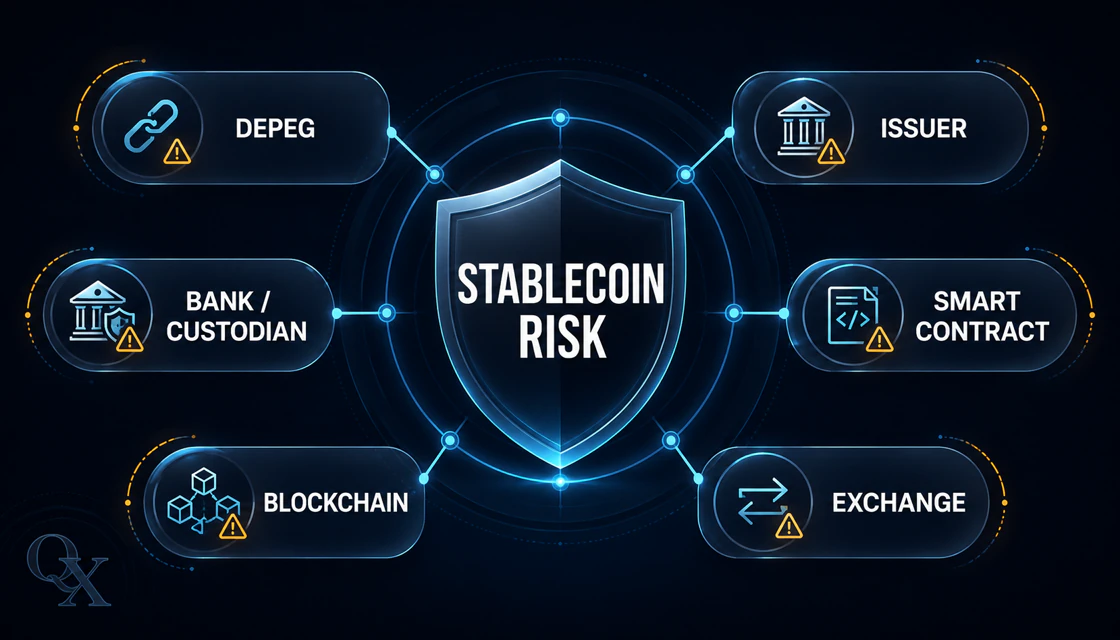
The risk map: what can go wrong
Depeg and market-liquidity risk
A stablecoin can trade away from one dollar during market stress, banking disruption, redemption friction, or an imbalance between buyers and sellers. The deviation may be temporary or persistent. A forced conversion during a depeg can lock in a loss. Use limit orders where appropriate and avoid assuming that every venue offers issuer-level redemption.
Issuer, reserve, and banking risk
You rely on the issuer to manage reserves, process eligible redemptions, maintain banking and custody relationships, comply with law, and operate its token systems. Circle disclosed that part of the USDC reserve was held at Silicon Valley Bank during the March 2023 banking failure; USDC temporarily traded below its target before the issue resolved. The episode shows that high-quality reserve assets do not eliminate banking access and market-confidence risk.
Smart-contract, blockchain, and bridge risk
Token contracts may include administrative controls such as freezing or upgrading, and a chain can experience congestion, outages, reorganizations, or high fees. Bridged versions add bridge contracts, validators, custodians, or messaging systems. These risks exist independently of the issuer’s reserve backing.
Exchange and account risk
Custodial platforms can pause withdrawals, change supported networks, restrict accounts, or fail. KYC and source-of-funds reviews can delay access. If a stablecoin is only a temporary transfer asset, minimize idle custodial time and verify the exit route before funding.
When to choose USDT, USDC—or neither
| Situation | Reasonable starting point | Check before acting |
|---|---|---|
| A venue has materially deeper USDT liquidity | USDT may reduce execution friction. | Live order book, spread, fee tier, and withdrawal route. |
| A service settles natively in USDC | USDC may avoid an extra conversion. | Exact chain, native contract, account eligibility, and exit route. |
| Both tokens share a supported route | Compare total net cost and downstream use. | Conversion spread + withdrawal fee + deposit minimum. |
| Only a bridged version is available | Pause and verify; native may be safer operationally. | Official contract, bridge operator, redemption and recovery path. |
| You need long-term cash-like storage | Consider whether any stablecoin is appropriate. | Issuer, custody, jurisdiction, diversification, and bank alternatives. |
| The route or legal access is unclear | Choose neither and wait. | Official platform support and local professional guidance. |
When to skip the transaction
- The receiver does not explicitly support the exact token and network shown on the sender.
- The contract address cannot be verified from the issuer, destination, or official protocol documentation.
- Deposits, withdrawals, minting, redemption, or the relevant bridge are paused.
- The conversion spread or withdrawal fee is hidden until after confirmation.
- The transfer amount cannot exceed the destination minimum after fees.
- A stranger, ‘support agent,’ investment group, or recovery service is rushing you.
- Your only reason is yield that you do not understand; stablecoin rewards add platform, lending, and counterparty risk.
- The balance is money you need for essential expenses or cannot afford to lose.
Beginner mistakes
- Choosing by ticker, brand familiarity, or market size without checking the complete route.
- Assuming USDT is always cheaper or USDC is always safer.
- Treating a 0x address as proof that any EVM network or token contract will work.
- Buying a bridged token because the wallet icon looks identical to native USDC.
- Comparing only the withdrawal fee and ignoring conversion spread, deposit minimum, and future gas needs.
- Holding a large stablecoin balance on one exchange because the price appears stable.
- Using a market order in a thin pair without checking depth and slippage.
- Skipping the test transfer on a new platform, chain, contract, or address.
Demo practice task: make the decision without sending money
Choose two exchanges you can legally access and one self-custody wallet. Do not deposit. Open each live receive screen and build a comparison sheet for USDT and USDC: supported networks, deposit status, minimum, contract link, required confirmations, withdrawal routes, displayed fee, and net amount for a hypothetical 100-unit transfer. Record the time because the data can change.
Next, identify the intersection of supported routes. Eliminate bridged or unclear versions. Estimate any conversion spread using a preview that you do not confirm. Select a test amount above all minimums and write the exact sequence you would follow. Your pass condition is not the cheapest route; it is a route you can explain from issuer to destination without guessing. Repeat on another day and note what changed.
Summary
USDT and USDC are both dollar-referenced stablecoins, but they are not interchangeable in every operational context. USDT can be convenient where exchange pairs and transfer routes support it more broadly. USDC can fit services built around Circle’s native infrastructure and disclosure model. Neither token is inherently the cheapest, and neither removes issuer, depeg, contract, chain, exchange, legal, or account risk.
The disciplined workflow is destination first, token second, network third, economics fourth, test transfer fifth. If any link is unclear, pause. Saving a small fee is never worth creating an unrecoverable route.
RISK CONTROL
Risk management checklist
- Verify the official domain, account entity, and country availability.
- Read the issuer transparency page and current risk disclosures; note the report date.
- Confirm the exact token contract and whether it is native or bridged.
- Confirm deposits and withdrawals are enabled on both sides now.
- Match token, named network, address, and memo or tag where required.
- Compare net received amount, not a single fee line.
- Use strong unique passwords, phishing-resistant two-factor authentication where available, and withdrawal allowlists.
- Send a test transfer and wait for credit before sending the remainder.
- Keep transaction IDs and screenshots until settlement.
- Avoid concentrating all operational cash in one token, chain, or custodian without understanding the trade-offs.
FAQ
Is USDT or USDC safer?
There is no universal answer. Compare issuer and reserve reporting, native token contract, chain, custodian, jurisdiction, and intended use. The weakest layer can dominate the result.
Is USDC fully backed?
Circle states that USDC is backed by highly liquid cash and cash-equivalent assets and publishes weekly reserve information plus monthly third-party assurance. Review the current official reports rather than relying on a summary.
Is USDT fully backed?
Tether states that its tokens are backed 100% by reserves and publishes circulation information and quarterly reserve reporting. Read the current official transparency and assurance material for scope and date.
Which has lower transfer fees?
Neither token is always cheaper. The blockchain and sending platform set most costs. Compare the same destination-compatible routes and the final net amount.
Can I send USDT to a USDC address?
No. They are different tokens. Even if an address format looks compatible, the receiver must support the exact token, contract, and network.
What is native USDC?
Native USDC is issued by Circle on a supported blockchain. A bridged representation relies on an additional bridge or wrapper and may use a different contract and redemption path.
Why did my exchange remove a stablecoin pair?
Pairs and products can change because of liquidity, platform policy, regulation, or regional entity rules. Check the notice and the live market in your own account.
Are stablecoins protected like bank deposits?
Do not assume so. Protections depend on the issuer, custodian, account structure, and jurisdiction. A token held in a wallet or exchange is not automatically an insured bank deposit.
Should I keep savings in USDT or USDC?
A stablecoin is not risk-free cash. For long-term reserves, consider issuer, custody, legal, concentration, and access risks and compare regulated banking alternatives available in your country.
Do I need gas to move a stablecoin?
A self-custody wallet normally needs the network’s native asset to pay transaction fees. An exchange may deduct a displayed withdrawal fee from the stablecoin instead. Check the live route.
Can a confirmed wrong-network transfer be reversed?
Usually not at the blockchain level. Recovery depends on who controls the destination address and whether the receiving platform supports a recovery procedure. Use official support only.
What should a beginner verify first?
Start at the receiver: exact token, native or bridged contract, named network, deposit status, minimum, address, and memo or tag. Only then compare fees and send a test.
QX HUB / CRYPTO
Built for decisions, not hype
Each guide starts with the action a reader needs to complete, separates changing platform details from durable safety rules, and keeps the final check inside the live account interface.


