best assets for binary options trading
Best Assets for Binary Options Trading: Complete Selection Guide
Compare forex pairs, indices, stocks, commodities, crypto and OTC instruments, then choose a binary-options asset by session, chart quality, payout, news risk and test evidence.

Key points
- Start with one or two liquid, familiar assets instead of scanning the entire broker list.
- Treat asset, session, timeframe, expiry and setup as one tested package.
- Use payout only as a final eligibility filter after identity, timing, news and readability checks.
Build a Watchlist, Not a Guess
Opening a broker’s asset list can feel like walking into a supermarket with no labels. EUR/USD, gold, an equity index, a technology stock, Bitcoin and an OTC instrument may all sit beside one another, sometimes with different payouts. They are not interchangeable. Each market has its own active hours, news drivers, volatility profile and data quality. A setup that is readable on one asset may become noisy or inactive on another.
The practical goal is not to find one universally “best” asset. It is to build a small, repeatable watchlist of markets that fit your schedule and your tested setup. This guide explains how to compare the main asset classes, how to reject unsuitable markets before looking for a signal, and how to run a structured demo test that works across brokers.
Quick Answer: What Is the Best Asset to Trade?
For many beginners, a major currency pair during an active weekday session is the easiest place to learn because the market is widely followed, economic drivers are visible and chart behavior can be observed repeatedly. That does not make EUR/USD or any other pair automatically profitable. It simply makes the learning environment more structured than jumping among unfamiliar assets.
- • Start with one or two liquid, familiar assets rather than the full broker list.
- • Trade only during the asset’s active underlying market hours.
- • Require a readable chart, an acceptable payout and no conflicting high-impact news.
- • Treat crypto, single stocks and commodities as separate specialties, not casual substitutes for forex.
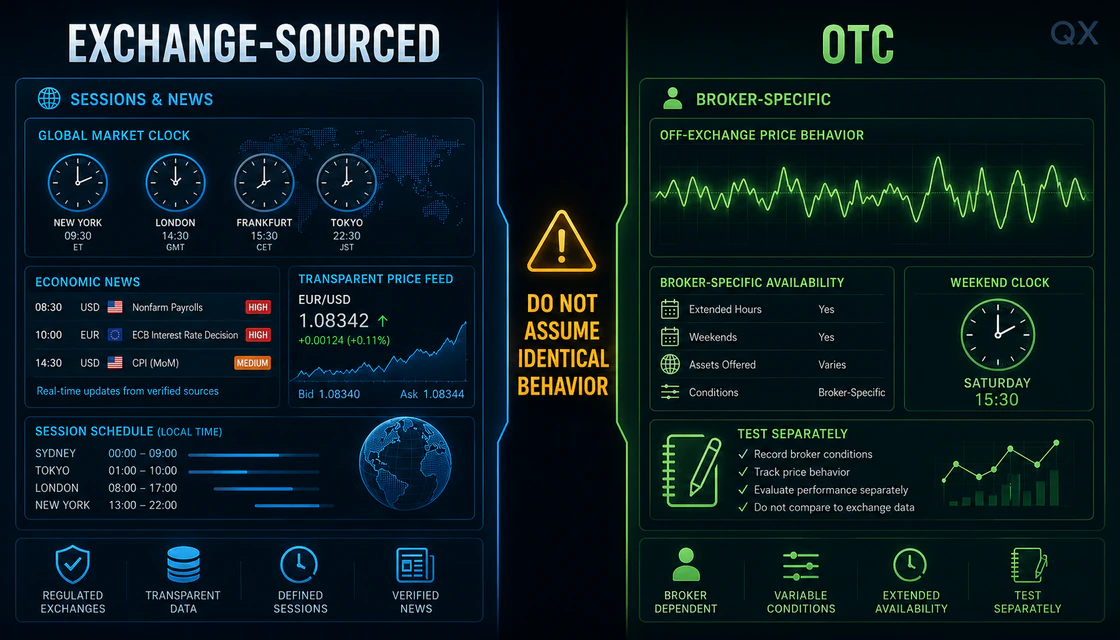
- • Treat broker-labelled OTC instruments as a separate dataset and never assume they behave like the corresponding live market.
What “Asset” Means in Binary Options
In a binary option, you usually do not buy the underlying currency, share, index or commodity. The contract settles according to a yes/no condition at expiry — commonly whether the quoted price is above or below an entry level. The asset name tells you what reference price the contract follows, while the broker’s contract terms determine the quotation, expiry and payout.
That distinction matters. Two brokers may display an asset with the same familiar name but offer different trading hours, payout percentages, expiry choices or OTC versions. Always inspect the instrument label and contract conditions inside the platform. Never assume that a chart is identical merely because the ticker looks familiar.
The Six Filters That Decide Whether an Asset Is Tradable
1. Availability and instrument identity
Confirm the exact symbol, whether it is live or OTC, and when the broker makes it available. An “OTC” suffix is not decorative. It may indicate that the displayed price is available outside the normal underlying-market schedule or is produced under different platform conditions. Record live and OTC versions separately in your journal.
2. Active market window
A market being open does not mean it is equally active all day. Currency pairs often become more active when the relevant financial centres are operating. Exchange-linked stocks and indices tend to respond most directly around their cash-session open, scheduled releases and company news. Match the asset to a window you can observe calmly and consistently.
3. Readability
Readability is more useful than raw speed. Look for candles with coherent structure, visible swing points and reactions that fit your setup. Reject charts with repeated gap-like jumps, erratic alternating candles, unusually long wicks in both directions or movement too flat to support the idea. “I cannot explain the market condition” is a valid reason to skip.
4. Payout and break-even requirement
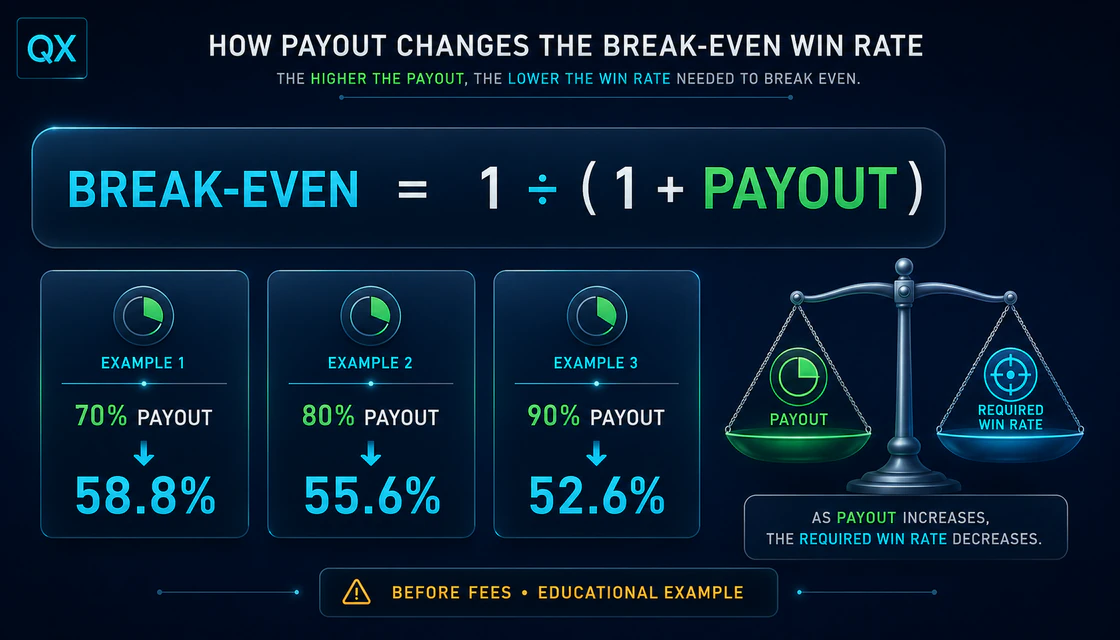
A higher payout lowers the win rate required to break even, but payout should be a filter — never the reason for entry. If a winning trade returns a profit equal to 80% of the amount risked, the simplified break-even win rate is 1 ÷ (1 + 0.80), or about 55.6%, before other frictions. At 70%, it rises to about 58.8%. A familiar setup with an unacceptable payout may be a no-trade.
| Profit payout | Simplified break-even win rate | Meaning |
|---|---|---|
| 90% | 52.6% | Lower mathematical hurdle, but no signal advantage by itself |
| 80% | 55.6% | Requires more wins than losses over a large sample |
| 70% | 58.8% | Less room for execution mistakes |
| 60% | 62.5% | A demanding hurdle; skipping may be rational |
5. News and event risk
Assets react to different catalysts. Currency pairs respond to central-bank decisions, inflation, employment and growth data. Stocks can gap or spike on earnings and corporate announcements. Oil reacts to inventory data and geopolitical supply risk. Crypto can move on regulatory, liquidity or platform-specific news. Check the economic and corporate calendar before choosing the chart, not after entering.
6. Strategy fit and test history
The final filter is evidence. If your pullback setup was tested on major currency pairs during London hours, that evidence does not automatically transfer to Bitcoin on a weekend or a stock around earnings. Asset, session, timeframe and expiry belong to one tested package. Change one element at a time and rebuild the sample.
Asset Classes Compared
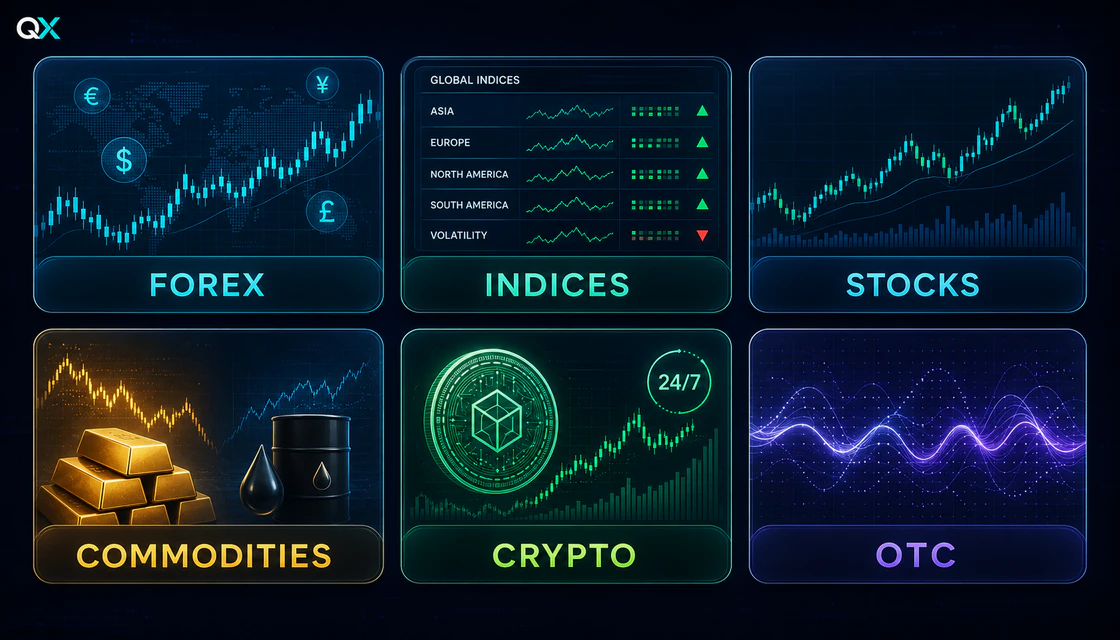
| Asset class | Typical strengths | Main risks | Beginner use |
|---|---|---|---|
| Major FX pairs | Frequent weekday activity; visible macro calendar; repeatable sessions | News spikes; session changes; false movement in quiet hours | Strong starting category when one pair and one session are studied |
| Minor/exotic FX | Different regional themes; occasional clear trends | Lower activity, sharper moves, less familiar drivers | Add only after testing; avoid choosing solely for payout |
| Stock indices | Broad market narrative; active around cash opens and macro news | Fast open, gaps, constituent-driven moves | Useful after learning session timing and news filters |
| Single stocks | Clear company identity and event calendar | Earnings gaps, headlines, limited exchange hours | Specialist category; avoid unknown companies and event windows |
| Commodities | Distinct drivers such as rates, inventories and supply | Headline sensitivity; fast reversals; contract-session complexity | Focus on one market such as gold only after learning its drivers |
| Crypto | Broad availability and 24/7 underlying market | Weekend liquidity changes, sharp volatility, headline risk | Use a separate tested plan; do not treat constant access as constant quality |
| Broker-labelled OTC | Availability beyond normal live-market hours | Different price process; limited external comparability; unknown rhythm | Separate journal and demo sample; never merge with live-market statistics |
Currency Pairs: Often the Cleanest Starting Point
Major currency pairs such as EUR/USD, GBP/USD, USD/JPY and AUD/USD are popular teaching markets because they connect to identifiable economies and recurring sessions. The global foreign-exchange market is very large, but size does not guarantee that every minute is readable. Liquidity and volatility still vary by hour, holiday and event.
A beginner can simplify the task by choosing one pair whose active window matches their schedule. EUR/USD may suit someone who can study London and New York activity. USD/JPY or AUD/USD may offer more relevant movement during parts of the Asian session. The pair should be chosen because its active period fits the trader — not because an influencer called it the easiest.
Indices: Strong Narrative, Faster Transitions
An index represents a basket of stocks, so it can reflect broad risk sentiment more cleanly than one company. Index-linked charts often become active near the underlying cash-market open and around major macro releases. That activity can produce clear directional movement, but it can also create violent first-minute reversals.
Do not treat every index as the same. A technology-heavy index may react differently from a broad-market or industrial index. Learn the region, cash-session schedule and major constituent exposure. If your expiry crosses the opening burst or scheduled news, the timing risk may dominate the chart pattern.
Single Stocks: Familiar Names, Concentrated Event Risk
Trading a well-known company may feel intuitive, but familiarity with a brand is not familiarity with its price behavior. Single stocks can react sharply to earnings, guidance, analyst changes, product announcements, legal issues and sector news. Outside the underlying exchange session, availability or price formation on a platform may differ from the live stock market.
Use a corporate calendar. Avoid treating a pre-earnings chart as an ordinary technical setup. If you cannot identify why the stock is moving, step back to a broader index or a familiar currency pair. The narrower the asset, the more important the specific-news filter becomes.
Commodities: Learn the Driver Before the Pattern
Gold, oil and other commodities can offer strong, recognizable themes. Gold often responds to real-yield expectations, the US dollar, risk sentiment and central-bank narratives. Oil reacts to supply, inventories, production policy, geopolitics and demand expectations. Those drivers can overwhelm a small technical pattern.
Choose one commodity and build a catalyst checklist around it. A clean support reaction is not enough if a major inventory report or policy announcement falls inside the trade window. Commodities reward preparation and punish generic “all assets behave the same” thinking.
Crypto: Always Open Does Not Mean Always Suitable
Crypto markets trade continuously, but activity, liquidity and volatility vary across the week. Weekend movement can differ from weekday behavior, and sudden headlines can produce sharp, continuous repricing. A binary-options contract referencing crypto may also use a quotation or availability schedule specific to the platform.
Keep crypto in its own test group. Do not combine Bitcoin weekend trades with weekday EUR/USD results. Use wider context, stricter volatility filters and a fixed no-trade rule after unusually large candles. Constant access is a temptation; the professional response is a narrower schedule.
OTC Assets: A Separate Market, Not an After-Hours Shortcut
On many retail platforms, OTC-labelled instruments are available when the corresponding regular market is closed. The label can mean different things across providers, so read the broker’s own explanation and contract terms. You may not be looking at the same price-discovery process as the live exchange or interbank market.
- • Never remove the OTC suffix from journal records.
- • Do not compare live and OTC win rates as one sample.
- • Test the exact instrument, day, hour, timeframe and expiry on demo.
- • Reject the assumption that a weekend version will respect weekday levels in the same way.
- • If the pricing method or rules are unclear, do not trade the instrument.
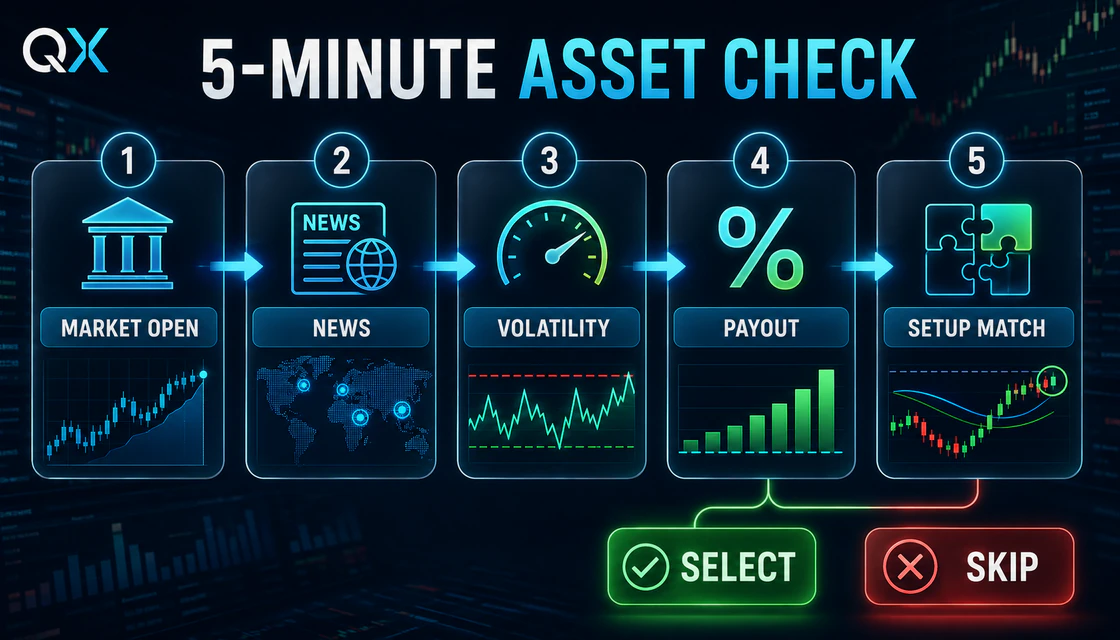
A Five-Minute Asset Selection Workflow
- Open the broker’s asset list and remove instruments outside your approved watchlist.
- Confirm the exact symbol, live/OTC status and current availability.
- Check whether the underlying market is in an active, normal session rather than a holiday or thin period.
- Check relevant economic, corporate or commodity events whose risk window overlaps the planned expiry.
- Inspect the chart without indicators: trend, range, volatility, candle quality and obvious abnormal movement.
- Confirm that the current payout meets the minimum written in your plan.
- Apply the strategy-specific setup, trigger and confirmation rules. If they are incomplete, skip.
- Record why the asset was selected in one sentence before entry.
Asset Selection Scorecard
Score each item from 0 to 2: 0 means unacceptable, 1 means uncertain, and 2 means clearly acceptable. This is a decision aid, not a prediction model.
A low score means no trade. A high score only allows you to look for a valid setup; it does not create one. Decide your minimum score before the session and keep it unchanged during the session.
| Criterion | 0 points | 1 point | 2 points |
|---|---|---|---|
| Instrument identity | Unclear or mismatched | Mostly clear | Exact live/OTC status confirmed |
| Market window | Closed, holiday or inactive | Moderate/uncertain | Normal active window |
| Chart readability | Chaotic or flat | Mixed | Structure fits the setup |
| Event risk | Major event conflicts | Minor uncertainty | Calendar checked; no conflict |
| Payout | Below plan minimum | Near threshold | Meets written rule |
| Test evidence | No relevant sample | Small sample | Tested asset/session package |
How Many Assets Should a Beginner Watch?
Two is usually enough for focused learning, and one may be better. A short watchlist reduces decision fatigue and creates comparable journal data. Watching ten assets often produces “chart shopping”: the trader keeps switching until something resembles a signal.
- • Stage 1: one asset, one session, one setup.
- • Stage 2: add a second asset only after the first has a clean demo sample and consistent rule adherence.
- • Stage 3: compare results by asset, but keep timeframe, expiry logic and risk constant.
- • Stage 4: remove the weaker asset if its chart remains less readable or triggers more rule violations.
Common Asset-Selection Mistakes
| Mistake | Why it fails | Better rule |
|---|---|---|
| Choosing the highest payout | Payout says nothing about signal quality | Use payout only after identity, timing, news and readability checks |
| Switching after every loss | Destroys the sample and encourages revenge trading | Keep the watchlist fixed for the test block |
| Trading every open market | Open does not mean active or readable | Define approved sessions for each asset |
| Ignoring the OTC label | Mixes different conditions and invalidates statistics | Separate live and OTC instruments completely |
| Using one expiry everywhere | Different volatility and structure may need different tested logic | Tie expiry to setup and tested asset/session package |
| Following news after it moves | Creates late entries into expanded volatility | Check the calendar before chart selection |
| Adding unfamiliar assets for excitement | Novelty replaces evidence | Require a demo sample before live consideration |
Risk Management Still Comes First
Asset selection improves the quality of the decision environment; it does not remove loss risk. Use a fixed amount or fixed percentage determined before the session, a daily loss limit, a maximum number of trades and a hard stop after rule violations. Never increase the next amount to recover a loss. Martingale changes the size of the risk, not the quality of the asset.
The mathematical asymmetry of binary payouts means a trader can win slightly more often than they lose and still fail to break even if the payout is too low. Review payout and results together over a sufficiently large sample. Never judge an asset from one streak.
When to Skip an Asset Completely
- • You cannot verify whether the instrument is live, OTC or exchange-linked.
- • The underlying market is closed, on holiday or in an abnormal low-activity period.
- • A major relevant event occurs before or near expiry.
- • The payout is below the minimum in your plan.
- • The chart shows abnormal jumps, extreme two-sided wicks or unreadable compression.
- • Your setup was never tested on that asset/session combination.
- • You are switching assets to recover a loss or relieve boredom.
- • The platform’s legal status, contract rules or withdrawal conditions are unclear.
Demo Practice Task: Build a Two-Asset Watchlist
Run this exercise for ten sessions without changing the rules. Its purpose is to compare decision quality, not to prove profitability.
- Choose two assets from the same broad category, such as EUR/USD and GBP/USD.
- Use the same 60–90 minute session window, chart timeframe, setup and expiry rule.
- Before every potential entry, complete the six-filter scorecard.
- Record valid setups even when you intentionally skip them because of payout or news.
- Save a screenshot before entry or at the moment of the skipped setup.
- After ten sessions, compare readability, rule-adherence rate, number of valid setups, payout availability and emotional mistakes.
- Keep one asset for the next test block. Change only one variable if you revise the plan.
| Journal field | What to record |
|---|---|
| Asset identity | Exact symbol and live/OTC label |
| Date and local time | Including time zone |
| Underlying session | Asia, London, New York, cash open or other |
| Market condition | Trend, range, expansion, compression or abnormal |
| Event check | Relevant event and time, or “none found” |
| Payout | Displayed profit payout before entry |
| Scorecard | Six criterion scores and total |
| Decision | Trade / skip and one-sentence reason |
| Rule adherence | Yes/no plus violation code |
| Screenshot | Before-entry chart and optional post-expiry view |
Complete Beginner Example
Assume a trader is available from 13:00 to 14:30 UTC and has tested a support-retest setup on major currency pairs. Their approved list contains EUR/USD and GBP/USD. On a particular day, GBP/USD has a higher payout, but a high-impact UK release falls inside the intended expiry window. EUR/USD has a slightly lower but acceptable payout, no conflicting event, and a cleaner retest structure.
The trader chooses EUR/USD because it passes the entire process. The decision is not “EUR/USD will win.” The decision is “EUR/USD is the only approved asset that currently fits identity, timing, news, payout, readability and test-history rules.” If the entry trigger never appears, the trader still does nothing. Good asset selection creates permission to wait for a setup — not permission to force a trade.
Final Advice
The strongest watchlist is usually boring: a few familiar instruments, specific active hours, a written payout floor, a news filter and enough demo records to understand the rhythm. Asset selection should reduce decisions, not multiply them. If you cannot explain why this exact market is suitable right now, the correct asset is none.
Quick answers
What are the best assets for binary options trading?
There is no universal best asset. Major currency pairs are often practical for beginners because they have recurring active sessions and visible macro drivers, but the best choice is the asset/session/setup package you have tested and can trade calmly.
Which currency pair is best for beginners?
Many beginners start with one major pair such as EUR/USD, but the correct pair depends on the hours you can observe, news awareness and chart readability. Start with one pair rather than ranking many pairs from a short result streak.
Are crypto assets better because they trade 24/7?
No. Continuous access does not guarantee stable liquidity or readable movement. Crypto needs its own schedule, volatility filter and test sample.
Should I choose the asset with the highest payout?
No. First confirm the instrument, active window, chart quality, event risk and strategy fit. Then use payout as a final eligibility filter.
Are OTC assets the same as live assets?
Do not assume so. The OTC label and pricing process may differ by platform. Track and test OTC instruments separately and read the broker’s contract terms.
How many assets should I trade?
For a beginner, one or two is usually enough. Expand only after you can follow the same rules consistently and compare meaningful journal samples.
Can I use the same strategy on forex, stocks and crypto?
The setup concept may transfer, but evidence does not transfer automatically. Re-test the exact asset class, session, timeframe and expiry combination.
How do I know an asset is too volatile?
Skip when movement is too fast to apply the setup consistently, candles show repeated extreme wicks, or a scheduled event creates an abnormal risk window. “Too volatile” is defined by rule execution, not excitement.
What should I do if no approved asset looks clean?
Do not trade. A watchlist is a filter, and “no suitable asset today” is a normal professional outcome.
Does choosing a better asset guarantee profit?
No. It can improve consistency and reduce avoidable mistakes, but every binary option can lose and no selection method guarantees a result.
Next step
Choose a topic by task: brokers for platform selection, guides for access, strategies for setups, risk for discipline and investing for longer market logic.