binary options expiry time
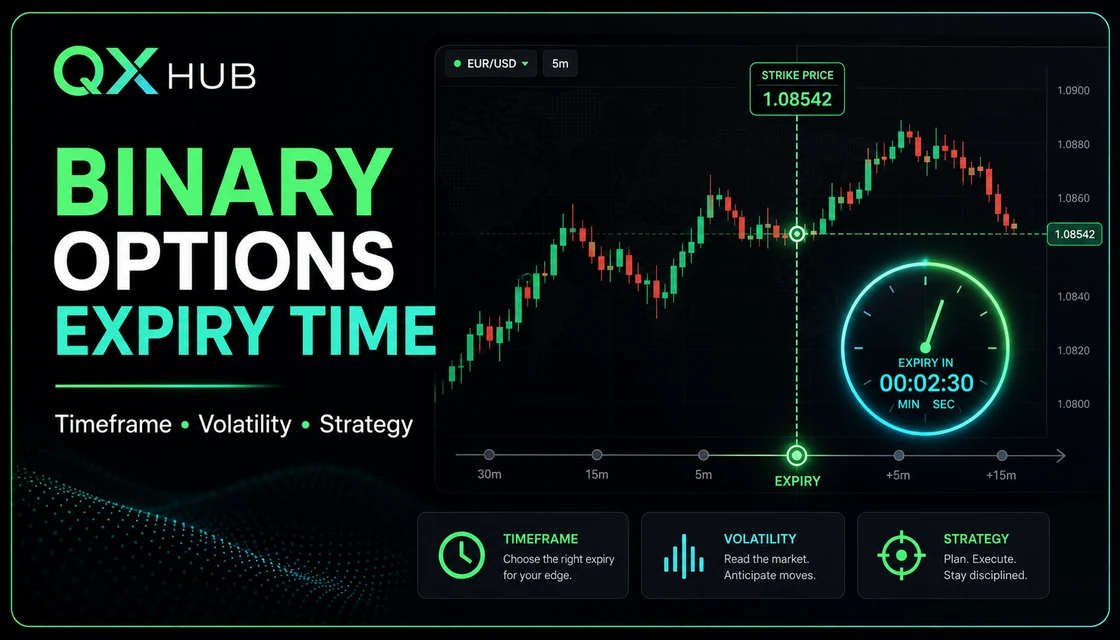
Binary Options Expiry Time
Timeframe, Volatility and Strategy
Key points
- Expiry defines settlement; it cannot guarantee outcomes.
- The binary options expiry time is the scheduled settlement moment of a contract. For a simple higher/lower contract, the platform typically compares the price at expiry with the strike recorded at entry. The exact settlement method, eligible price source, tie rule, and payout depend on the contract terms.
- Direction and timing are separate questions. A trader may correctly identify a bullish area, but price can dip below the strike before rising. A short expiry might settle during the dip. A longer expiry could capture the later rise—or remain open until another reversal. The path between entry and settlement therefore matters.
Binary Options Expiry Time
Expiry defines settlement; it cannot guarantee outcomes.
Expiry time is the moment when a binary option settles. The platform compares the final price with the strike and applies the contract rules. A move that looks correct on the chart can still settle on the wrong side if the expiry is too early, while a longer contract can remain open long enough for price to reverse.
This is why expiry is not a decorative setting added after an entry signal. It is part of the strategy. A useful expiry rule connects market context, chart timeframe, setup behavior, volatility, news risk, and the platform's available contracts. It must be defined before entry and tested with the rest of the method.
Risk warning: Binary options are high-risk, all-or-nothing products and may be restricted or prohibited in your jurisdiction. No expiry setting can make a trade safe or guarantee a profitable outcome. Check local rules, use only money you can afford to lose, and validate any process on a demo account before considering real funds.
What Is Binary Options Expiry Time?
The binary options expiry time is the scheduled settlement moment of a contract. For a simple higher/lower contract, the platform typically compares the price at expiry with the strike recorded at entry. The exact settlement method, eligible price source, tie rule, and payout depend on the contract terms.
Expiry can be displayed in two ways:
- Duration: the contract settles a fixed period after entry, such as five minutes.
- Clock time: the contract settles at a specific platform time, such as 10:30.
These formats can produce different remaining durations. If a platform offers fixed settlement points every five minutes, an entry at 10:27 may have only three minutes until a 10:30 expiry. Always read what the interface actually shows instead of assuming the label describes a full duration.
Three values should be recorded in the trading journal:
The example is illustrative. It is not a recommended duration.
Why Expiry Time Matters
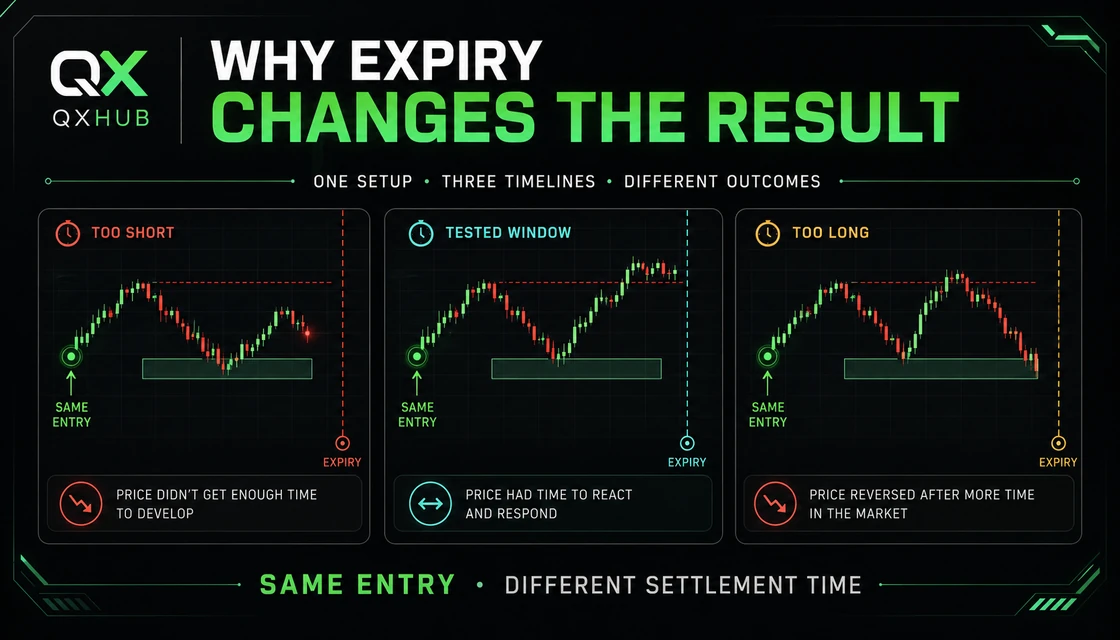
Direction and timing are separate questions. A trader may correctly identify a bullish area, but price can dip below the strike before rising. A short expiry might settle during the dip. A longer expiry could capture the later rise—or remain open until another reversal. The path between entry and settlement therefore matters.
One setup with different expiry windows and settlement outcomes
Expiry changes five practical elements:
- how much time a setup has to develop;
- how much market noise the contract must survive;
- how many new events can affect the price;
- whether a later pullback or reversal enters the settlement window;
- which historical sample is relevant when the strategy is tested.
There is no “correct” expiry in isolation. The only defensible choice is one that belongs to a defined setup and has been tested under comparable conditions.
Expiry Time Is Not the Same as Chart Timeframe
The chart timeframe controls how price data is grouped into candles. Expiry controls when the contract settles. A five-minute candle and a five-minute expiry are related units of time, but they are not interchangeable.
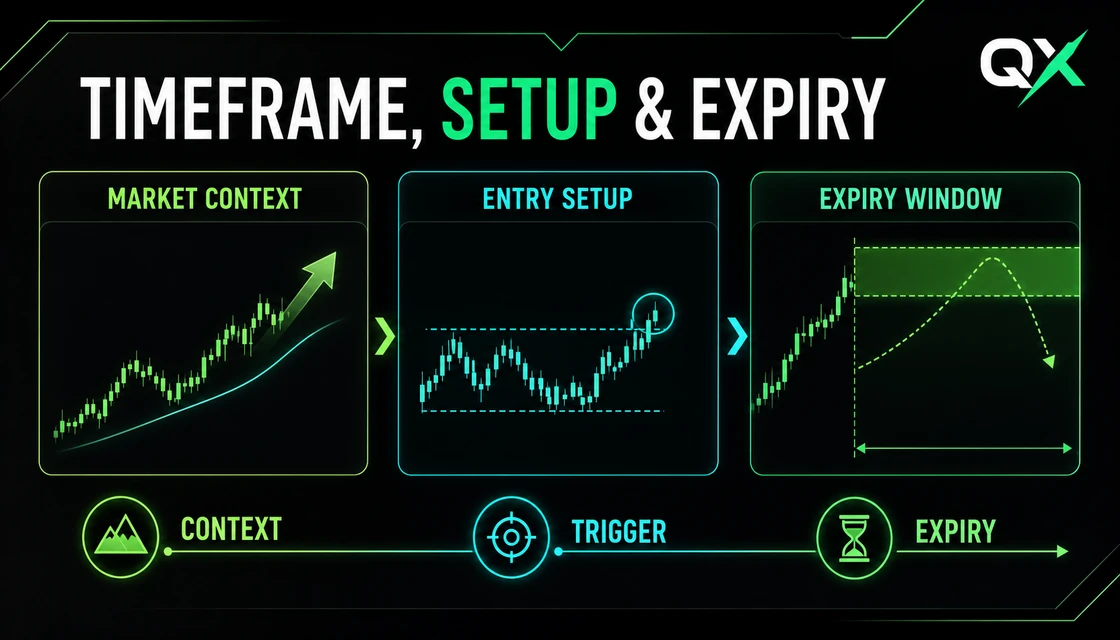
For example, a trader can analyze a 15-minute trend, identify a pullback on a five-minute chart, and execute using a separately tested settlement duration. The higher timeframe provides context; the lower timeframe provides the trigger; the expiry defines the outcome window.
Relationship between market context, entry setup and expiry window
Think in three layers:
Context: What market structure or regime is present?
Trigger: What exact event permits an entry?
Expiry: How long was this trigger tested to remain relevant?
Do not use a formula such as “expiry equals three candles” without evidence. Candle multiples can be a hypothesis for testing, but the result can differ by asset, timeframe, session, volatility, and setup type.
Is There a Best Expiry Time for Binary Options?
No universal best expiry exists. One-minute, five-minute, 15-minute, hourly, and end-of-day contracts expose the trader to different types of uncertainty. A shorter contract is not automatically easier because less time is involved. A longer contract is not automatically safer because the initial idea has more time to develop.
These are characteristics, not performance claims. The best expiry for a specific method is the one selected before testing, evaluated honestly, and confirmed on later data and demo trades.
The Main Factors That Should Define Expiry
1. Setup Logic
Start with what the setup is supposed to capture. A rejection from support, a range breakout, a trend pullback, and a news reaction do not evolve at the same speed.
Write a plain-language expectation: “After a confirmed rejection, price is expected to move away from the level within the tested window.” If the expectation cannot be described, the expiry rule will probably be arbitrary.
2. Chart Timeframe
The timeframe determines the scale of the pattern. A signal on a one-minute chart contains less aggregated information than a signal on an hourly chart. However, larger candles do not justify a mechanically longer expiry. The relationship must be tested.
Use consistent candle boundaries. A signal taken near the end of a candle may have different remaining development time from one taken just after a new candle opens.
3. Market Volatility
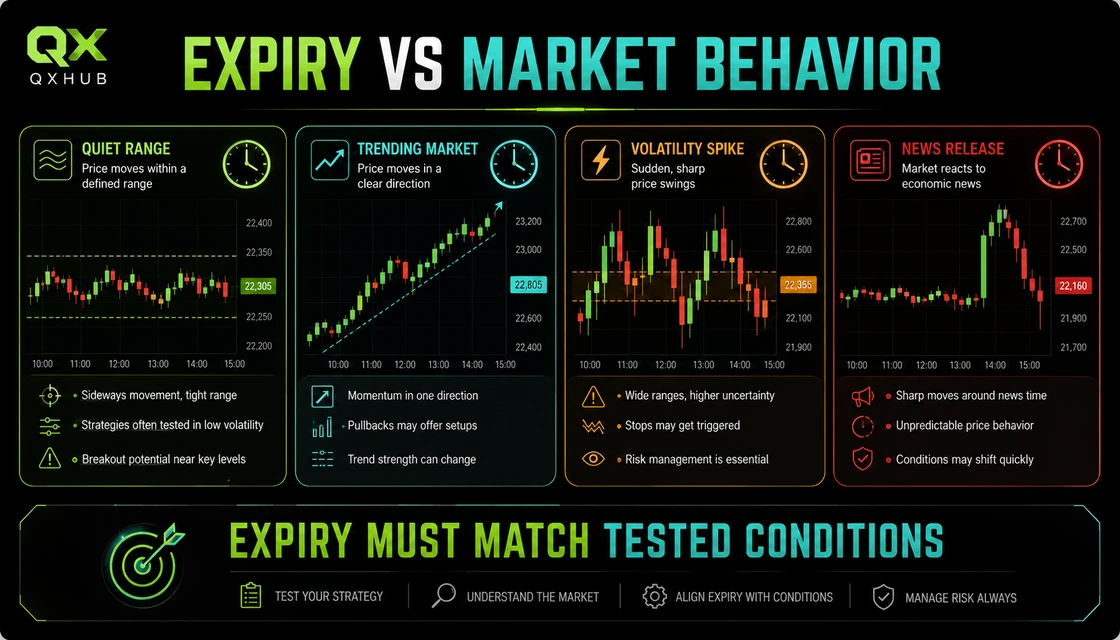
Volatility describes the magnitude and speed of price movement; it does not determine direction. In quiet conditions, price may need more time to travel, yet a narrow market can also remain indecisive. During a volatility spike, price may reach a target area quickly and reverse before settlement.
Expiry considerations across quiet, trending, volatile and news-driven markets
The safest response to unfamiliar volatility is not to improvise a new duration. Skip the trade or use the rule that was tested for that regime.
4. Market Structure
Distance to nearby support, resistance, swing highs, swing lows, and range boundaries affects how much room price has to move. A bullish entry directly below resistance may face a reversal long before a generous expiry ends.
An expiry rule should never replace structural analysis. Time cannot fix a poor entry location.
5. Trading Session
Market behavior can change between Asian, London, and New York hours and during overlaps. A duration tested in an active London window may behave differently late in the US session or during an OTC weekend feed.
Record the session with every result. If the session changes, treat it as a new testing segment rather than assuming the same expiry still works.
6. Scheduled News
An option that crosses an interest-rate decision, inflation report, employment release, or central-bank speech faces a different risk profile from the same chart pattern in a clear calendar window. Short-duration contracts are not protected: a release can move price within seconds.
Define a restricted period before and after relevant events. Reject any trade whose expiry would overlap that period. Unscheduled news remains possible, so fixed risk is still necessary.
7. Payout and Contract Availability
The platform may offer different payouts, settlement points, and assets at different times. A preferred duration may not be available, or its payout may fall below the minimum used in testing.
Do not select a nearby expiry merely because the preferred one disappeared. A different duration creates a different trade. If the available contract fails the plan, skip it.
Too Short, Tested Window, or Too Long?
“Too short” and “too long” can only be defined relative to the setup.
Expiry That Is Too Short
The contract may settle before the expected move has time to develop. Small price noise, a normal retest, or one unfinished candle can dominate the result. This is common when a trader shortens duration because the signal appears urgent.
A Tested Expiry Window
The duration matches the exact rule evaluated in historical and demo samples. It does not guarantee a win. It simply ensures that the live decision is comparable with the evidence used to build the method.
Expiry That Is Too Long
The original setup may finish, after which a new market phase begins. Price can reach the expected area and then reverse before settlement. Longer exposure also allows more news, session changes, and structural reactions to influence the result.
The lesson is not to aim for a middle duration. It is to stop changing expiry after seeing the current chart.
How to Build an Expiry Rule Step by Step
Step 1: Define One Setup
Specify the asset, session, context, trigger, invalidation condition, and prohibited situations. Do not test multiple unnamed patterns together.
Step 2: Choose a Starting Hypothesis
Select one or several candidate durations based on the setup's logic. A candidate is not a recommendation or proven edge; it is a variable to evaluate.
Step 3: Collect Every Valid Historical Signal
Record all signals that meet the rules, including losses, borderline cases, and periods that look unattractive. Cherry-picking perfect screenshots makes expiry analysis meaningless.
Step 4: Compare Fixed Durations Fairly
For each signal, measure the settlement result at the candidate expiries without changing the entry. Use the same price source and consistent assumptions. Keep ties, missing prices, and unavailable contracts visible.
This table illustrates process only. It does not suggest any duration.
Step 5: Include Payout Math
Win rate alone is insufficient. If a winning contract produces profit equal to 80% of the stake, the simple break-even win rate before other effects is:
Break-even win rate = 1 / (1 + 0.80) ≈ 55.6%
At a 70% payout, it is approximately 58.8%. A duration with a slightly higher historical win rate can still be worse if the available payout is lower. These calculations are mathematical examples, not expected returns.
Step 6: Validate on Unseen Data
Choose the rule using one historical segment, then test it on a later period that did not influence the choice. If the result collapses, the duration may be overfit or the setup may lack stability.
Step 7: Forward-Test on Demo
Demo testing reveals real-time problems that a historical review can hide: late clicks, platform clock confusion, changing payout, unavailable expiry, and emotional overrides.
Step 8: Freeze the Rule
Once a test begins, do not change duration after several losses. Review only after the predefined sample or review period is complete.
A Complete Educational Example
Consider a hypothetical trend-pullback setup on EUR/USD during a defined London-session window. The higher timeframe must show an established upward structure. On the entry chart, price pulls back to a previously marked support area and forms the required rejection trigger. High-impact EUR and USD events must be outside the restricted window, and the displayed payout must meet the plan.
Historical testing compares three fixed expiries. The trader records every valid trigger, the exact entry and settlement prices, payout, session, volatility notes, and rule adherence. One candidate performs best in the training sample, but the advantage disappears on later data. Another candidate has steadier results across both samples and is selected for a demo test.
During a live demo session, a valid-looking trigger appears. The preferred expiry is unavailable, while a shorter contract is offered. The trader skips the trade. Later, the correct expiry returns, but scheduled news would occur before settlement. The trader skips again.
Both decisions are correct even though no trade occurred. Expiry discipline is measured by whether the rule was followed, not by whether a missed chart later moved in the expected direction.
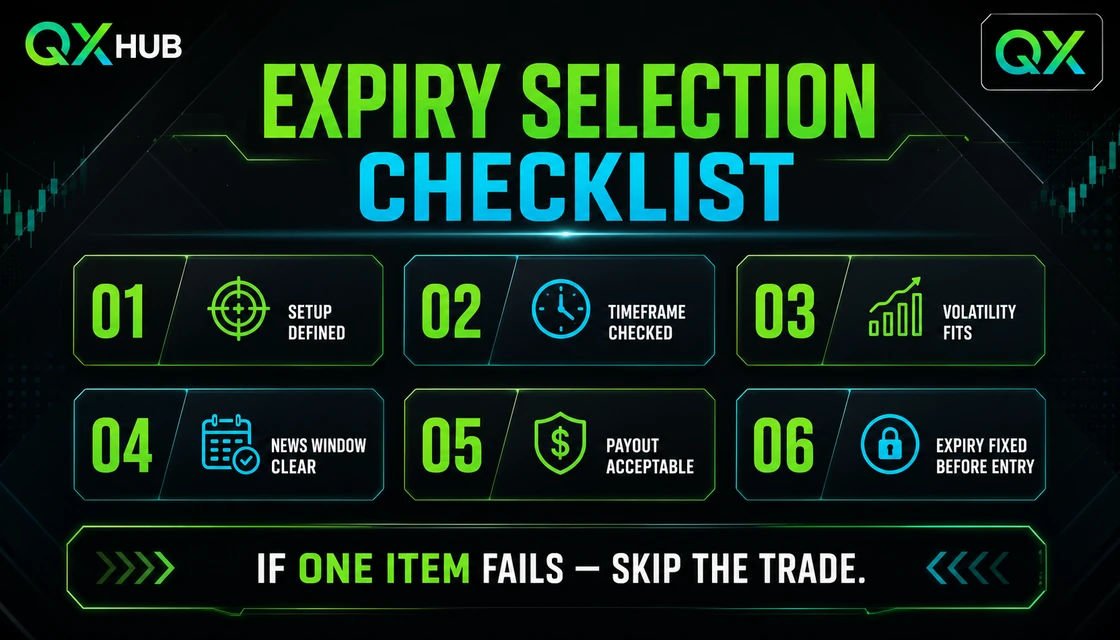
Expiry Selection Checklist
Use the checklist before entry, not while the contract is already open.
Binary options expiry selection checklist
- Setup defined: context, trigger, and invalidation match the plan.
- Timeframe checked: the chart and candle boundary are correct.
- Volatility fits: current behavior resembles the tested regime.
- Structure clear: nearby levels do not contradict the trade logic.
- Session allowed: the platform time is inside the tested window.
- News window clear: expiry does not overlap a prohibited event.
- Payout acceptable: the displayed return meets the test assumptions.
- Expiry fixed before entry: the selected settlement matches the rule.
- Risk available: stake and daily loss limits have not been reached.
If one item fails, skip the trade.
Common Expiry-Time Mistakes
Choosing Duration After the Signal
If the trader waits for the chart to “suggest” an expiry, the rule changes from trade to trade and cannot be evaluated consistently.
Using the Same Expiry for Every Strategy
A range rejection and a breakout continuation have different logic. One duration should not be copied across unrelated setups without testing.
Confusing Candle Length with Settlement Time
A five-minute chart does not automatically require a five-minute contract. The entry can occur anywhere inside the candle, and the setup may involve multiple timeframes.
Shortening Expiry After a Strong Candle
Fast movement creates fear of missing out. It does not prove that continuation will last until the new settlement time.
Extending Expiry After Losses
A longer duration can look like a solution when price moved correctly after a losing settlement. This hindsight ignores cases where additional time caused a winning position to reverse.
Ignoring Exact Platform Time
A clock-time expiry may provide less remaining duration than expected. Confirm the countdown or settlement timestamp before entry.
Crossing Scheduled News
Even a technically valid setup can face abrupt repricing if the contract remains open through a major release.
Comparing Win Rate Without Payout
Different contract durations may carry different returns. Evaluate break-even requirements and availability, not win rate alone.
Mixing Regular and OTC Data
OTC or synthetic instruments may use different price feeds and conditions. Keep their expiry tests separate from weekday market data.
Applying Martingale After Expiry Losses
Increasing the next stake does not repair an expiry rule. It compounds risk and can accelerate drawdown.
How to Review Expiry Performance
A weekly or sample-based review should answer:
- Was the planned expiry used on every trade?
- Were losses concentrated in a particular session or volatility regime?
- Did contracts settle near the strike unusually often?
- Did any trade cross a scheduled event or session transition?
- Was the offered payout consistent with test assumptions?
- How did rule-following trades compare with violations?
- Is the sample large enough to justify a change?
Do not optimize after a few trades. If a change is justified, alter one variable, document the reason, and start a new test version. Preserve the old results instead of rewriting them.
Frequently Asked Questions
What is the best expiry time for binary options?
There is no universal best expiry. The appropriate duration depends on the setup, timeframe, asset, session, volatility, news risk, payout, and contract availability. It must be tested as part of the complete strategy.
Is a longer expiry safer?
No. More time can allow a setup to develop, but it also permits reversals, news, and session changes to affect settlement. Longer duration changes risk; it does not remove it.
Are one-minute binary options harder?
Very short contracts are highly sensitive to small price fluctuations and entry timing. They provide rapid feedback but are not automatically easier or more predictable.
Should expiry match the chart timeframe?
Not automatically. Chart timeframe groups price data; expiry defines settlement. Their relationship should come from the setup logic and testing, not a fixed universal ratio.
Can I change expiry when volatility increases?
Only if the strategy contains a separately tested rule for that volatility regime. Improvising a different duration creates an untested trade. Skipping is usually the cleaner choice.
What happens if price equals the strike at expiry?
Tie treatment depends on the platform and contract. The stake may be returned, the result may be defined another way, or the price source may resolve a small difference. Read the current contract rules and record ties separately.
Should expiry cross an economic news release?
Not if the trading plan prohibits that event window. Scheduled releases can cause rapid, unpredictable movement. Define the filter in advance and reject overlapping contracts.
How many trades are needed to test an expiry?
There is no magic number that guarantees reliability. Use every valid signal, include different conditions, and validate on unseen data. Small samples support only cautious conclusions.
Can expiry selection guarantee a higher win rate?
No. A disciplined expiry rule can make testing and execution consistent, but it cannot guarantee a win rate or profit.
Final Thoughts
Expiry is a core strategy variable. It determines when the market stops having time to prove or disprove the trade. Choosing it by instinct, changing it after a loss, or matching it mechanically to a candle length produces inconsistent evidence.
The practical rule is simple: define the setup, test fixed expiry candidates honestly, include payout and news risk, validate the result, and freeze the chosen duration before entry. If the required contract is unavailable or current conditions do not match the test, skip the trade.
Suggested internal links: /glossary/expiry-time/, /glossary/volatility/, /glossary/economic-calendar/, /glossary/payout/, /glossary/risk-per-trade/, /glossary/support-and-resistance/, /glossary/false-breakout/, /glossary/otc-market/, /glossary/martingale/, /glossary/overtrading/
Quick answers
How should a beginner use binary options expiry time?
Treat binary options expiry time as a decision filter, not as a signal by itself. Start with the page's main idea: Expiry defines settlement; it cannot guarantee outcomes. Then check one chart, one timeframe and one amount on demo before any real-money step.
What should I check before applying Binary Options Expiry Time?
Check whether the market still matches the section "Binary Options Expiry Time", whether The binary options expiry time is the scheduled settlement moment of a contract. For a simple higher/lower contract, the platform typically compares the price at expiry with the strike recorded at entry. The exact settlement method, eligible price source, tie rule, and payout depend on the contract terms. is true on the chart and whether your amount fits the planned risk. If one part is missing, skipping is the professional choice.
Is binary options expiry time enough to open a trade?
No. The topic can help you read the situation, but a trade still needs timing, expiry logic, risk limit and a reason to stay out. The useful line from this guide is: Direction and timing are separate questions. A trader may correctly identify a bullish area, but price can dip below the strike before rising. A short expiry might settle during the dip. A longer expiry could capture the later rise—or remain open until another reversal. The path between entry and settlement therefore matters.
Which Quotex route fits after this guide?
The clean next route is Registration. If the task is only access or device setup, compare it with Fast entry and Android app. The route should match the reader's intent, not pressure the trade.
Next step
Choose a topic by task: brokers for platform selection, guides for access, strategies for setups, risk for discipline and investing for longer market logic.