best time to trade binary options
Best Time to Trade Binary Options: Sessions, Volatility and News Risk
Learn how Asian, London and New York sessions affect activity, volatility, payout and expiry, and build a practical timing rule for binary options.

Key points
- Timing changes market conditions, but it cannot guarantee an outcome.
- Choose a session only when asset activity, strategy, payout, expiry and news risk match the tested plan.
- Treat OTC, weekend and regular-market results as separate datasets.
Binary Options Trading Sessions
Timing changes conditions; it cannot guarantee outcomes.
The clock is part of every binary options setup. The same asset and chart pattern can behave very differently during a quiet Asian hour, the London open, the London–New York overlap, or a major economic release. Activity, spread-like price noise, payout availability, and the speed of a move can all change before an option expires.
That does not mean one session is automatically profitable. There is no universal best time to trade binary options. A useful trading window is one in which the chosen asset is active, the strategy has been tested, the payout meets the plan, and scheduled news does not introduce unacceptable uncertainty. This guide explains how to build that decision into a repeatable rule.
Risk warning: Binary options are high-risk products with an all-or-nothing payoff. They may be restricted or prohibited in your jurisdiction. A session filter cannot remove market risk or guarantee a profit. Check local rules, use only money you can afford to lose, and test any process on a demo account before considering real funds.
What Is a Trading Session?
A trading session is a recurring period when a major financial center is active. The global foreign-exchange market is often described through the Sydney, Tokyo, London, and New York sessions. These labels are practical time zones, not four separate centralized exchanges. Currency trading is decentralized, and activity moves across banks, institutions, liquidity providers, and regional participants during the day.
For a binary options trader, the session matters because the contract has a fixed expiry. A price move that develops slowly may not finish before a short option expires. A sudden burst of volatility can cross the strike several times. A quiet market can also produce weak follow-through or small, irregular candles. Timing therefore affects the conditions around the decision, even though it never determines the outcome.
Three clocks must be distinguished:
- Market time: the active global or regional session.
- Platform time: the clock displayed by the broker or trading interface.
- Local time: the trader's own time zone.
Write all three into the trading plan. Do not rely on memory, especially when daylight-saving rules change.
Is There a Best Time to Trade Binary Options?
The best time is not the hour with the largest candles. It is the window that matches a tested setup and a suitable asset while keeping avoidable risks under control. A trend-following method may need active conditions and clear continuation. A range strategy may be designed for quieter periods. A breakout approach may focus on a session open, but the same volatility can create false breaks and fast reversals.
Use four filters instead of searching for a universal clock time:
This definition is deliberately strict. It prevents a trader from calling an hour “good” merely because the market is moving quickly.
| Filter | Question | Reject the trade when… |
|---|---|---|
| Strategy fit | Was this setup tested in the current session? | The session is outside the tested rules |
| Asset activity | Is the asset normally active now? | Price is thin, erratic, or inactive |
| Contract quality | Are payout and expiry acceptable? | Payout is below the plan or expiry does not fit |
| Event risk | Is high-impact news clear of the trade window? | The option would remain open across a restricted release |
The Four Major Trading Sessions
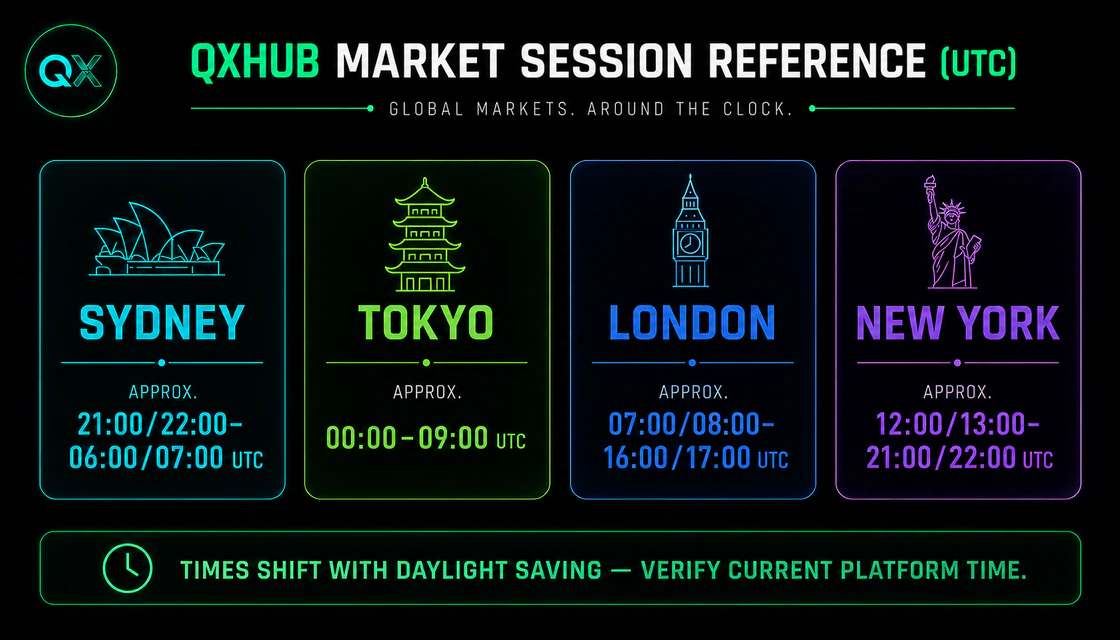
Session times are approximate because daylight saving can shift London, New York, and Sydney relative to UTC. Tokyo does not currently observe daylight saving. Broker clocks can also differ. Always confirm the current time on the platform before applying a schedule.
| Session | Approximate UTC window | Often associated assets | Typical consideration |
|---|---|---|---|
| Sydney | About 21:00/22:00–06:00/07:00 | AUD and NZD pairs | The global week begins here; activity can be limited outside regional assets |
| Tokyo / Asian | About 00:00–09:00 | JPY, AUD, and NZD pairs | Range-like behavior is common on some days, but news can produce sharp moves |
| London | About 07:00/08:00–16:00/17:00 | EUR, GBP, CHF and major pairs | Participation often increases near the European open |
| New York | About 12:00/13:00–21:00/22:00 | USD and CAD pairs, major pairs | US data and the London overlap can create rapid repricing |
Sydney Session
Sydney opens the trading week and bridges the late US period into Asia. AUD and NZD pairs can be more relevant than European crosses at this time, but “open” does not automatically mean liquid or clean. The first hours after a weekend may also reflect accumulated news and gaps in some price feeds.
Treat Sydney as its own dataset. A pattern validated during London should not be transferred simply because the candles look familiar. Record the hour, asset, payout, and behavior separately.
Tokyo and the Asian Session
The Asian session often concentrates activity in JPY, AUD, and NZD pairs. Some major pairs may form narrower ranges than they do during London or New York, but that is a tendency, not a rule. Central-bank communication, inflation figures, employment data, or an unexpected geopolitical event can change the character of the session immediately.
Range traders sometimes prefer quieter behavior, while momentum traders may find fewer valid signals. Neither conclusion should be assumed. Test the exact setup by asset and hour.
London Session
London is a major foreign-exchange center. European participation can increase activity in EUR and GBP pairs, and the opening period may bring breakouts from an earlier range. That activity also raises the risk of false breaks, fast pullbacks, and entries taken after a move is already extended.
The London open is not a signal by itself. Require the same setup, trigger, and confirmation that the trading plan demands at any other time.
New York Session
The New York session adds US and Canadian participation and overlaps with London for several hours. USD and CAD pairs can become especially responsive to North American economic releases. Later, activity may decline as European markets close, although equity-market events and US news can keep conditions active.
Do not treat the whole New York session as one block. A strategy may behave differently during the overlap, after the London close, and near the end of the day.
How Session Behavior Can Change
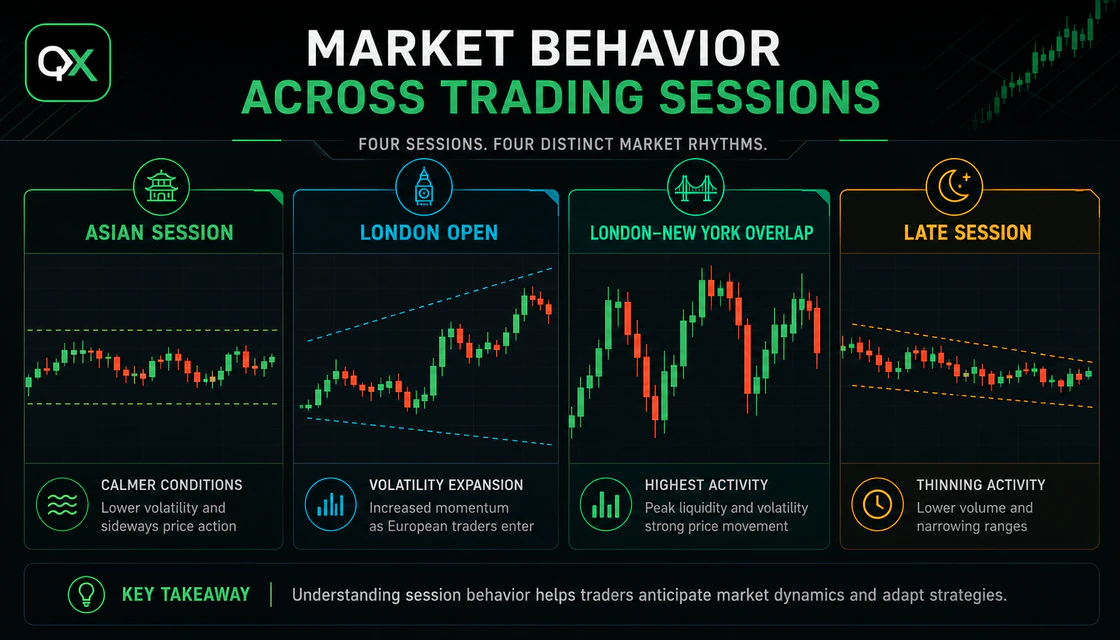
Terms such as “quiet,” “active,” and “volatile” describe tendencies, not promises. On one day, the Asian session may remain contained and London may expand the range. On another, an overnight announcement may produce the largest move before Europe opens.
The practical lesson is not to predict a session stereotype. It is to define observable conditions:
- candle range relative to the recent baseline;
- distance from meaningful support or resistance;
- frequency of false breaks;
- speed of price changes;
- scheduled event risk;
- whether the payout and expiry remain within the plan.
If the observed market no longer resembles the environment in which the setup was tested, skip the trade. A session label cannot rescue a mismatch.
Session Overlaps: More Activity, More Risk
An overlap occurs when two financial centers are active at the same time. More participants can mean stronger liquidity and larger price movement, but it can also mean more competition, noise, and abrupt repricing.
Sydney–Tokyo Overlap
This period can concentrate activity in Asia-Pacific currencies. It may be relevant for AUD/JPY, NZD/JPY, AUD/USD, and similar pairs, depending on availability. The session can still be quiet in other assets.
London–New York Overlap
The London–New York overlap is often the most active part of the currency day. Major EUR, GBP, and USD pairs may show stronger movement, while US releases can trigger sharp changes. For short-duration contracts, speed is a risk as much as an opportunity: the strike can be crossed repeatedly before expiry.
Use a tested overlap rule. Do not shorten expiry, increase the stake, or chase a candle because movement appears unusually strong.
Match the Asset to the Session
An asset-session match is a starting hypothesis, not a guarantee. Pairs involving currencies from active regions often receive more attention during those business hours:
- Asian/Pacific hours: AUD, NZD, and JPY pairs may be more active.
- London hours: EUR, GBP, and CHF pairs may receive more participation.
- New York hours: USD and CAD pairs may respond more strongly, especially around data.
- London–New York overlap: heavily traded major pairs may show the greatest activity.
The word “may” matters. Measure the actual chart. If EUR/USD is moving cleanly during Asia and the tested setup is valid, the session label alone does not invalidate it. Conversely, a GBP pair during London is not automatically suitable if the price is erratic or the payout is poor.
A compact journal table can expose whether the match is real:
The third trade is still a process failure even though it won. Session analysis must separate outcome from rule adherence.
| Trade ID | Asset | Session | Setup | Payout | Rules followed? | Result |
|---|---|---|---|---|---|---|
| 001 | EUR/USD | London | Pullback | 82% | Yes | Loss |
| 002 | USD/JPY | Asian | Range rejection | 78% | Yes | Win |
| 003 | GBP/USD | London–NY | Breakout | 85% | No — late entry | Win |
Volatility, Timeframe and Expiry
Volatility describes the magnitude and speed of price movement; it does not say where price will finish. In binary options, that distinction is critical because the contract settles at a fixed time.
Quiet Conditions
Small candles can make a short expiry sensitive to minor fluctuations. A range strategy may benefit from orderly boundaries, but a low-volatility chart can also produce weak signals and indecisive price action. Do not assume quiet means safe.
Expanding Volatility
Session opens and overlaps can expand candle ranges. Momentum strategies may find more qualifying setups, but late entries become more dangerous. A larger candle is not proof that the next candle will continue.
Extreme or Irregular Volatility
During a major release, gaps between price updates, spikes, and rapid reversals can make a normal setup unreliable. The correct decision may be to stand aside until the market stabilizes.
Expiry should be defined during testing. Changing from five minutes to one minute because a trade “looks urgent” creates a different method. If the selected expiry no longer suits current volatility, reject the trade rather than improvising.
Economic News and Expiry Risk
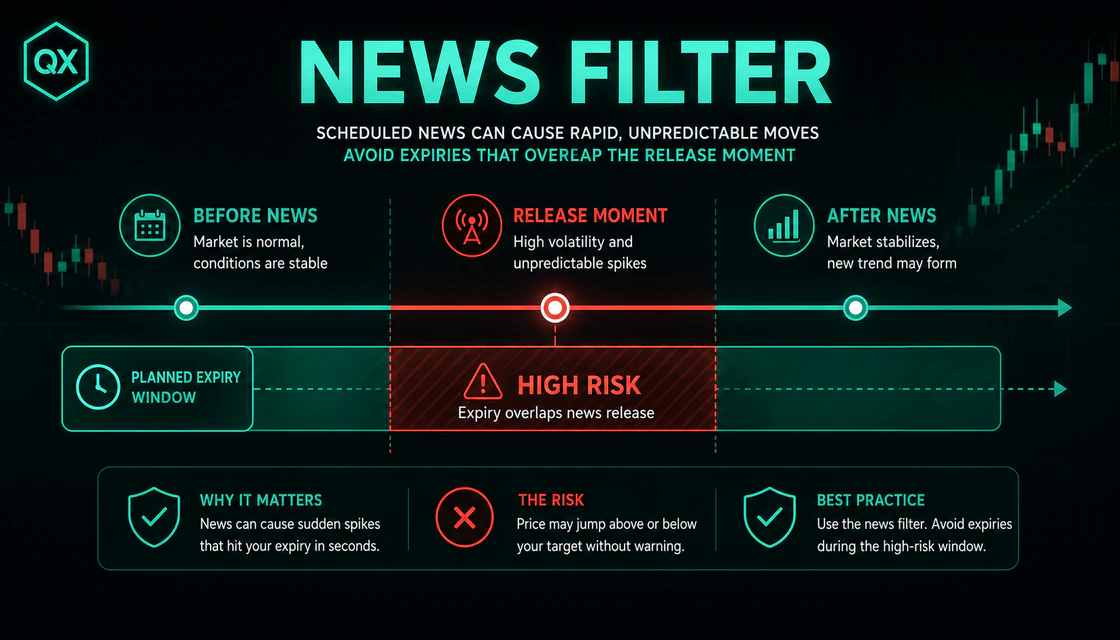
Scheduled economic releases can change prices within seconds. Interest-rate decisions, inflation data, employment reports, growth figures, and central-bank speeches are common examples. The effect is not limited to the named currency; repricing can spread across correlated assets.
A useful news filter has three elements:
Relevant event: define which impact levels and currencies matter for the asset.
Restricted window: define how long before and after the event new trades are prohibited.
Expiry check: reject any contract whose expiry would cross the release moment.
Do not assume that waiting one candle is always enough. Conditions can remain unstable after the headline, and the first move can reverse. The waiting period should be tested and written into the plan.
Unscheduled news cannot be filtered perfectly. This is one reason fixed risk per trade and daily loss limits remain necessary even when the calendar is clear.
Payout and Contract Availability
Market activity is only one part of a binary options decision. The platform may offer different payouts by asset and time. An attractive chart does not make a low payout acceptable if it falls below the tested threshold.
If a winning contract returns the stake plus a profit of 80% of the stake, the simple break-even win rate before other effects is:
Break-even win rate = 1 / (1 + payout rate) = 1 / 1.80 ≈ 55.6%
At a 70% payout, the same calculation is approximately 58.8%. Lower payouts require a higher win rate merely to reach mathematical break-even. These examples are not expected performance; they show why payout belongs in the session rule.
Record the offered payout at entry, not an ideal or later value. If the platform changes availability or payout during a session, the plan must still apply.
OTC and Weekend Markets Are Different
Some platforms offer over-the-counter or synthetic instruments when the underlying market is closed. Their price feed and trading conditions may not match the weekday interbank market. A label that resembles a currency pair does not guarantee the same source, liquidity, or session behavior.
Do not transfer a London-session strategy to an OTC weekend instrument without separate testing and clear knowledge of how that instrument is produced. Keep OTC results in a separate journal category. If the price source and contract rules are unclear, the safest choice is not to trade it.
A Practical Session-Selection Checklist
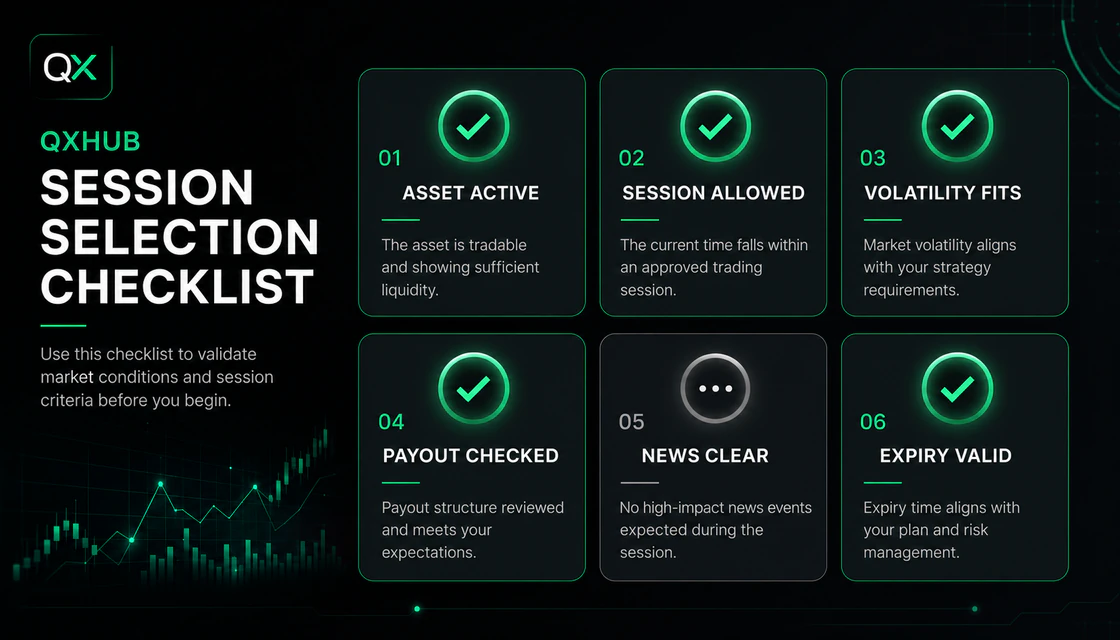
Use this check before every trade. Every item must pass; one failure means no trade.
- Asset active: the instrument is available and behaving normally.
- Session allowed: the current platform time is inside the written trading window.
- Volatility fits: present conditions resemble the tested setup environment.
- Setup complete: context, trigger, and confirmation are all present.
- Payout checked: the offered return meets the minimum rule.
- News clear: no restricted event affects the trade window.
- Expiry valid: the contract duration is the one defined for the setup.
- Risk available: the stake and daily limits have not been exceeded.
- No emotional override: the entry is not revenge trading, fear of missing out, or an attempt to recover a loss.
The checklist is designed to reduce discretionary exceptions. It cannot predict the settlement price.
Build a Session Rule for Your Trading Plan
A vague rule such as “trade when the market is active” cannot be audited. Convert it into fields that can be checked before entry.
The example is educational, not a recommendation. Values should come from testing, platform rules, and personal risk limits—not from copying another trader.
| Plan field | Weak rule | Testable rule example |
|---|---|---|
| Trading window | Trade London | 08:15–10:30 platform time, Monday–Thursday |
| Assets | Trade majors | EUR/USD and GBP/USD only |
| Setup | Trade breakouts | Close outside Asian range, then defined retest and confirmation |
| Expiry | Use short expiry | Fixed expiry tested for this setup; no changes after entry |
| Payout | Good payout | Minimum displayed payout defined in advance |
| News filter | Avoid news | No new entry inside the documented pre/post-event window |
| Stop condition | Stop if bad | Stop after the fixed trade or loss limit is reached |
How to Test a Trading Window
Treat session choice as a variable. A disciplined test is more useful than collecting only memorable wins.
Define one setup, one expiry rule, and a small list of assets.
Choose exact session windows in platform time and map them to UTC.
Record every valid historical signal, including losses and ambiguous cases.
Note payout assumptions and exclude contracts the platform would not have offered.
Separate results by asset, session, hour, weekday, and news proximity.
Keep rule-following trades separate from violations.
Validate the rules on later, unseen data and then on a demo account.
Recheck the clock when daylight saving changes.
Do not choose the best-performing hour after scanning dozens of combinations and then call it proven. That can be overfitting. A narrow window needs a logical reason, enough observations, and validation on data that did not create the rule.
Complete Educational Example
Suppose a trader is testing a London-session pullback setup on EUR/USD. The plan allows entries from 08:15 to 10:30 platform time. Price must be above a defined trend filter, pull back toward a previously marked support area, and produce a clear rejection trigger. The payout must meet the preset threshold, and no relevant high-impact event may fall inside the restricted window.
At 09:05, the market is within the allowed session. The asset is active and the payout passes. Price reaches support, but the rejection trigger has not appeared. The trader waits. At 09:12, a trigger forms, but an inflation release is scheduled before the planned expiry. The correct action is to skip the trade.
Later, another setup appears after the restricted news period. Volatility has not stabilized and candle ranges are far larger than the tested sample. The correct action is again to skip. The session is allowed, but the conditions are not.
This example shows why “London is the best time” is an incomplete rule. A session opens the decision process; it does not approve the trade.
Common Trading-Session Mistakes
Converting Time Zones from Memory
Daylight saving can shift a session relative to UTC or local time. Write the conversion down and verify it on the platform.
Treating an Open as a Signal
The London or New York open may increase activity, but time alone does not provide direction. Wait for the complete setup.
Chasing the First Large Candle
A large move can be nearly finished by the time it is noticed. Entering late changes the strike, context, and risk.
Changing Expiry to Fit the Moment
Shortening or extending expiry after seeing volatility means the trade no longer follows the tested method.
Ignoring Payout
A strong-looking chart does not compensate for contract terms that fail the plan.
Trading Through Scheduled News
A valid pattern before a release can be invalidated by rapid repricing. Check whether the expiry crosses the event.
Assuming More Volatility Is Better
Volatility increases movement, not predictability. It can improve opportunity for one method and destroy the conditions required by another.
Mixing OTC and Regular-Market Results
Separate price sources and contract conditions require separate testing. Combining them hides meaningful differences.
Extending the Session After Losses
An extra hour taken to recover money is overtrading. End the session at the planned time or earlier if a stop condition is reached.
Weekly Session Review
Review timing at the end of the week, not after every outcome. Ask:
- Which sessions and assets produced valid setups?
- How often did I trade outside the allowed window?
- Did payout fall below the threshold at particular hours?
- Were losses concentrated near news or session transitions?
- Did results change after a daylight-saving shift?
- Were rule-following trades different from impulsive trades?
- Is there enough data to justify a change?
Choose only one evidence-based adjustment for the next test. Changing the session, asset list, expiry, indicators, and risk at once makes the result impossible to interpret.
Final Thoughts
Time is a filter, not a forecast. The value of a trading session comes from making the environment measurable: which asset is active, which setup is allowed, what volatility fits, whether the payout is acceptable, and whether news conflicts with the expiry.
A strong rule sounds less exciting than “trade the busiest hour,” but it is more useful: trade only inside a tested window, when every condition passes, and stop when the plan says stop. That discipline cannot make binary options safe, but it can prevent the clock from becoming another excuse for an impulsive decision.
Quick answers
What is the best time to trade binary options?
There is no universal best time. A suitable window is one in which the asset is active, the strategy has been tested, payout and expiry meet the plan, and relevant news risk is acceptable. The answer can differ by setup and asset.
Is the London–New York overlap always best?
No. It often has high activity, but greater volatility can create rapid reversals and false breaks. A method should be tested specifically during the overlap before it is used there.
Which session is best for beginners?
No session removes the product's risk. Beginners benefit more from a consistent demo-account window, one or two assets, fixed rules, and a journal than from searching for the most active hour.
Which currency pairs are active during the Asian session?
Pairs containing JPY, AUD, and NZD often receive more regional attention, but behavior varies by day and event. Confirm actual market conditions and test the specific pair.
Why do session times change?
London, New York, and Sydney can shift relative to UTC because of daylight-saving schedules. Tokyo does not currently use daylight saving. Broker platform clocks may follow a separate convention.
Should I trade immediately when a session opens?
Not unless the written setup is complete. The open is a time marker, not an entry signal. Waiting can help reveal whether volatility and direction match the method.
How long should I avoid trading around news?
There is no single safe interval. Define which events matter and test a fixed restricted window before and after them. Never let a planned expiry cross a prohibited release moment.
Do weekend OTC instruments follow normal sessions?
Not necessarily. They may use different price sources and contract conditions. Do not assume weekday session behavior applies; test separately and avoid instruments whose construction is unclear.
Can a session filter improve win rate?
It may help remove trades taken in unsuitable conditions, but it cannot guarantee a particular win rate or future profit. Any claimed benefit must be supported by a sufficiently large, honest test and later validation.
Next step
Choose a topic by task: brokers for platform selection, guides for access, strategies for setups, risk for discipline and investing for longer market logic.