how to trade gold on Quotex
How to Trade Gold on Quotex in 2026: XAU/USD Strategy Guide
Learn how to trade gold on Quotex using XAU/USD market drivers, active sessions, chart structure, two complete setups, expiry rules, news filters and risk management.

Key points
- Treat gold as a macro-sensitive market and check high-impact US events before opening the entry chart.
- Read H1 structure first, then use M5 or M15 for a confirmed pullback or false-breakout retest.
- Avoid the first reaction to CPI, NFP or FOMC; wait for smaller candles, a visible level and a completed retest.
- Match demo expiry to several entry candles and record the live payout before every planned trade.
How to Trade Gold on Quotex
Gold can produce clean directional moves, sharp reversals and violent news spikes within the same session. That mixture attracts short-term traders and punishes anyone who enters without context. On Quotex, the decision is not how far gold will travel. It is whether the platform price will finish above or below the entry at a fixed expiry. Direction, timing and payout must therefore agree.
A practical process begins outside the entry chart. Check what can move the US dollar and interest-rate expectations, identify the higher-timeframe trend or range, mark levels, then wait for price to confirm a setup. Indicators can support the reading, but they cannot repair a late entry, an oversized news candle or an expiry that is shorter than the idea.
Risk warning: Digital options can lose the full amount committed. Platform availability, symbols, payouts and expiries can vary by country and time. Use demo first, verify current conditions and never risk money needed for essential expenses.
What XAU USD Represents
XAU/USD expresses the price of gold in US dollars. XAU is the market code for one troy ounce of gold, while USD is the quote currency. When the quoted price rises, gold is becoming more expensive in dollars. When it falls, gold is becoming cheaper in dollars. On a fixed-time platform, you are predicting direction by expiry rather than buying a physical bar or holding a futures contract.
| Instrument | What you trade | Main decision |
|---|---|---|
| Physical gold | Ownership of bars or coins | Storage, premium and long-term value |
| ETF or stock | A listed security linked to gold or miners | Market price and portfolio exposure |
| Futures or CFD | Leveraged price movement | Entry, exit, margin and risk |
| Quotex digital option | Direction over a fixed period | Above or below entry at expiry |
What Moves Gold
The World Gold Council groups gold performance around economic expansion, risk and uncertainty, opportunity cost and momentum. For short-term chart reading, translate those themes into observable catalysts rather than assuming one permanent relationship.
Important: Correlations are conditional. Gold and the dollar can occasionally rise together during stress. Read the actual chart and catalyst instead of treating an inverse relationship as a law.
| Driver | Typical gold response | Why the relationship can fail |
|---|---|---|
| US dollar | A weaker dollar can support gold; a stronger dollar can pressure it | Safe-haven demand or positioning may dominate |
| Real yields | Falling yields can reduce the opportunity cost of holding gold | Markets may already have priced the change |
| Inflation data | Surprises can change rate expectations and volatility | Gold may react first to yields or USD direction |
| Central banks | Policy shifts affect rates, currencies and risk sentiment | The press conference can reverse the first move |
| Geopolitical risk | Demand for perceived safety can increase | Relief or profit-taking can unwind the move |
| Positioning | Trend followers can amplify an established move | Crowded trades can reverse abruptly |
Best Time to Trade Gold
Gold trades globally, but participation and volatility change through the day. Activity often increases as London becomes active and again when New York joins, especially around US data. More movement is not automatically better: the best window is one in which your setup is visible, the payout is acceptable and no unplanned announcement sits inside the expiry.
| Session context | What to expect | Beginner decision |
|---|---|---|
| Asian hours | Can be active, but often reacts to regional flows and overnight news | Trade only if structure is clean |
| London open | Liquidity and range can expand | Wait for the first direction to settle |
| London New York overlap | Often the strongest participation and US catalyst risk | Best observation window; check calendar |
| Late New York | Momentum can fade or reverse | Avoid forcing a final trade |
| Weekend or OTC label | Different availability and price behavior may apply | Track in a separate demo sample |
Build the Gold Workspace
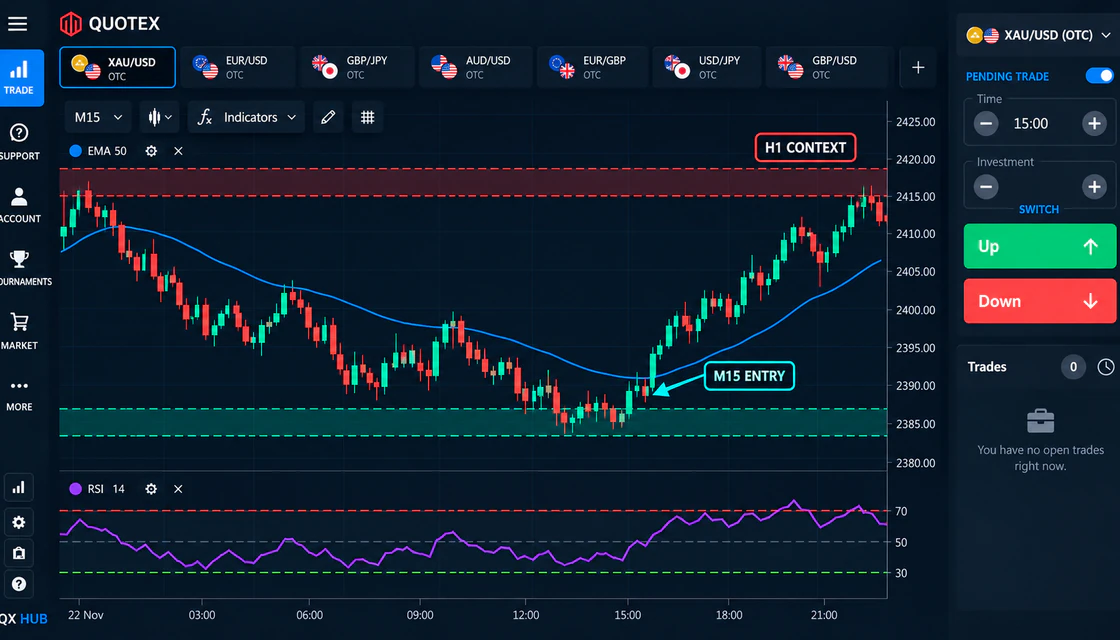
Keep the chart simple. A clean H1 plus M15 workflow is stronger than five indicators on one timeframe. Draw zones, not single-pixel lines, because gold often probes a level with a wick before the next directional move.
| Layer | Starting choice | Job |
|---|---|---|
| Context timeframe | H1 | Trend, range and major levels |
| Entry timeframe | M5 or M15 | Pullback, retest and candle close |
| EMA | 50 | Directional filter, not an entry signal |
| RSI | 14 | Momentum reset or divergence |
| Levels | Manual zones | Location for invalidation and confirmation |
| Expiry sample | 3–5 entry candles | Allows the reaction to develop |
The Gold Decision Sequence
- Check the calendar for CPI, PCE, NFP, FOMC decisions, central-bank speeches and other high-impact US events.
- Classify H1 as uptrend, downtrend, range or transition. If the swings are unclear, do not force a bias.
- Mark the nearest support, resistance and prior breakout zone before opening the entry timeframe.
- Move to M5 or M15 and wait for one tested setup: trend pullback or false-breakout retest.
- Require a completed confirmation candle. Do not enter on an unfinished wick.
- Choose expiry from the chart rhythm, confirm payout and stake, then decide whether the setup still offers a clean entry.
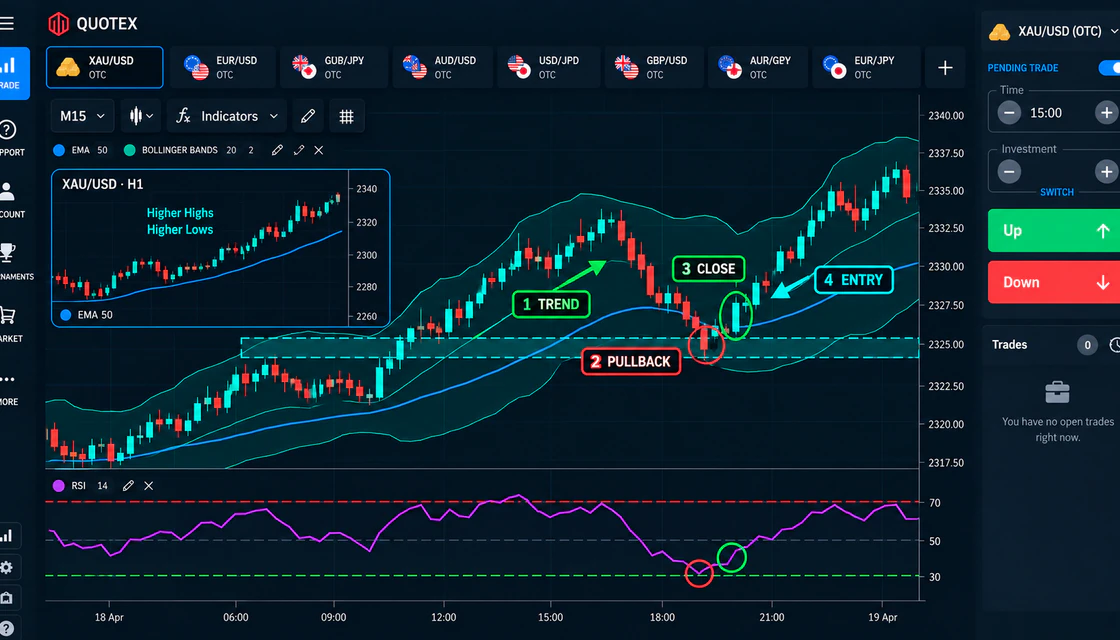
Setup One Trend Pullback
- H1 prints higher highs and higher lows, with price generally above a rising EMA 50.
- M15 pulls back toward prior support, a broken resistance zone or EMA 50 without destroying the H1 structure.
- RSI cools toward 40 or briefly below it; oversold is helpful but not required in a healthy trend.
- A bullish rejection or engulfing candle closes above the level.
- Enter only after the close and test an expiry of three to five M15 candles, or 45–75 minutes.
Reverse the logic: H1 lower highs and lower lows, price below a falling EMA 50, M15 rally into resistance, RSI reset and bearish confirmation. Avoid selling after a long red impulse; the purpose of the pullback is to improve location and reduce late-entry risk.
Skip when: the pullback becomes a structural reversal, the confirmation candle is abnormally large, the setup appears immediately before news or the entry is several candles away from the level.
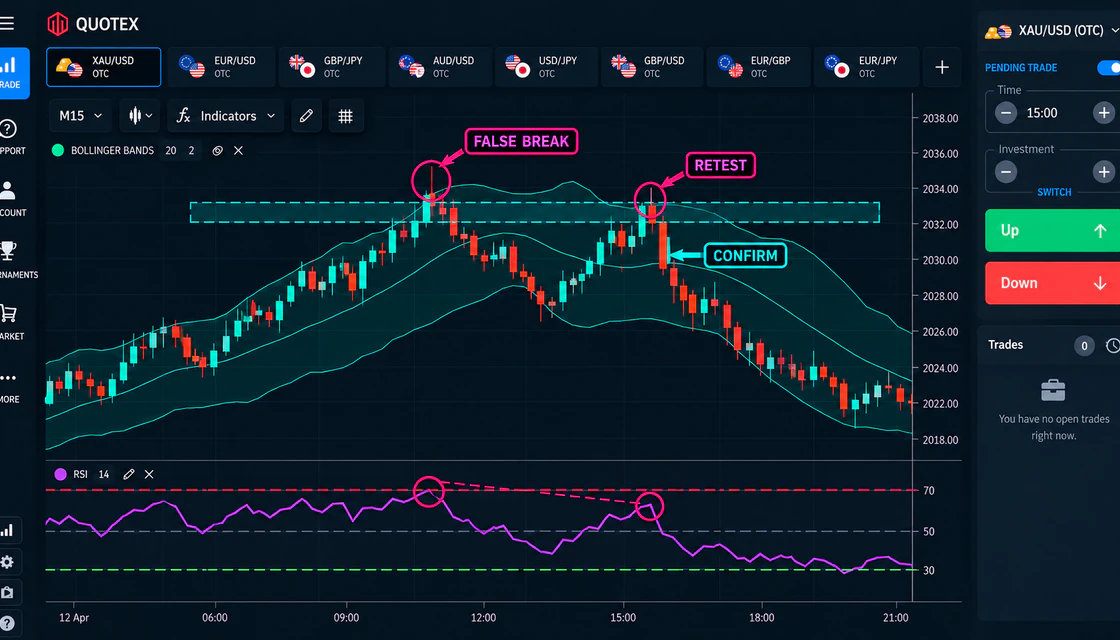
Setup Two False Breakout and Retest
Gold often tests obvious highs and lows before choosing direction. A wick through resistance is not enough. A stronger false-breakout setup requires price to close back inside the prior structure and then fail on the retest. This sequence shows rejection and gives a clearer invalidation point than reacting to the first spike.
- Mark a level that produced at least two visible reactions.
- Wait for price to trade beyond the zone and then close back inside it.
- Look for momentum disagreement, such as bearish RSI divergence above resistance or bullish divergence below support.
- Require a retest that fails to reclaim the broken side of the zone.
- Enter after the retest candle closes, provided price has not already accelerated away.
- Cancel if price closes decisively beyond the level or if the move was caused by an unreconciled news spike.
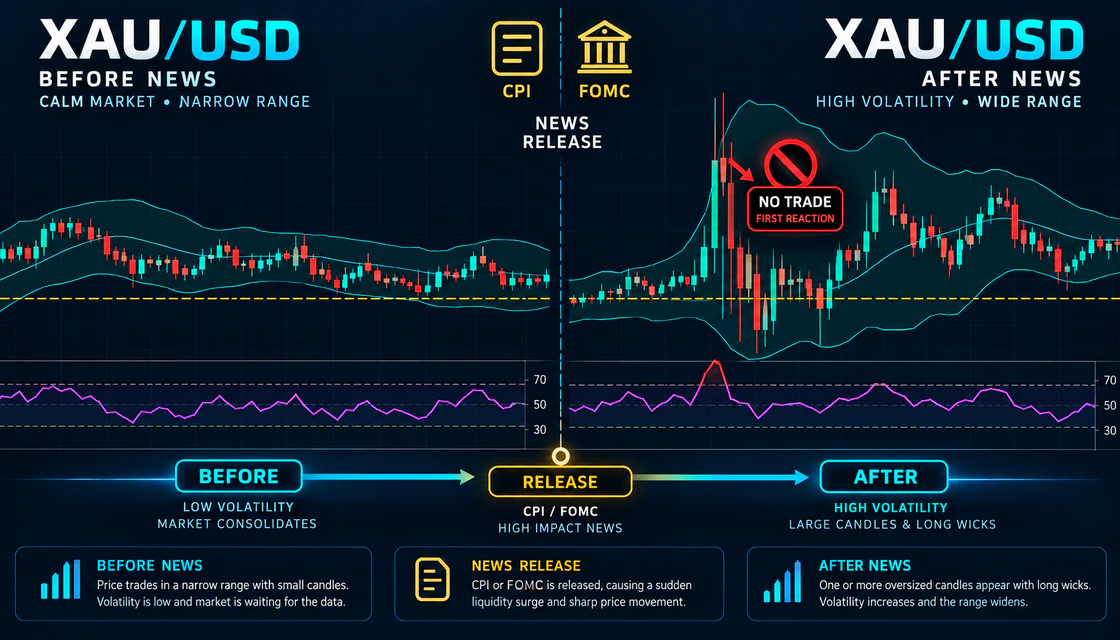
How News Changes the Setup
High-impact US data can change rate expectations within seconds. On gold, the first candle may overshoot both sides of a level, widen the bands and make RSI temporarily meaningless. A correct directional opinion can still lose when the entry and expiry fall inside this discovery phase.
Practical rule: A fixed five- or ten-minute waiting period is not universally safe. Wait for price structure to normalize: smaller candles, a visible level and a completed retest.
| Phase | Chart behavior | Default action |
|---|---|---|
| Before release | Compression, smaller candles or nervous positioning | Do not open a trade that expires through the event |
| First reaction | Oversized candle, gaps or long wicks | No trade |
| Price discovery | Fast reversals and repeated level breaks | Observe until structure reforms |
| Post-news setup | New range, pullback or retest becomes visible | Evaluate with fresh levels |
| Unclear market | No stable swing or payout deteriorates | End the session |
Expiry for Gold Setups
Gold can move quickly, but speed is not a reason to use the shortest expiry. Match duration to the setup and the entry timeframe. The confirmation candle already consumes time, so an expiry of several candles usually gives the next reaction a fairer test than a one-candle guess.
- Never shorten expiry because the entry was late. Skip the trade.
- Do not let expiry cross a scheduled high-impact event.
- Separate trend-pullback and false-breakout statistics.
- Keep regular XAU/USD and any OTC-labelled sample separate.
| Entry chart | Demo starting range | Use when |
|---|---|---|
| M1 | 3–5 minutes | Separate high-noise test only |
| M5 | 15–25 minutes | Structure and confirmation are clear |
| M15 | 45–75 minutes | Pullback or retest needs room |
| M30 | 90–150 minutes | Platform duration and session allow it |
Payout and Break Even
The same chart strategy has different economics at different payouts. If a losing trade loses the full stake, the break-even win rate equals 1 divided by 1 plus the payout as a decimal. Record the displayed payout before every entry.
A high payout cannot repair a weak signal, but a low payout can make a marginal strategy unworkable. Set a minimum payout threshold during testing and do not lower it after a loss simply to find another trade.
| Payout | Break-even rate | Minimum rounded wins per 100 |
|---|---|---|
| 60% | 62.5% | 63 |
| 70% | 58.8% | 59 |
| 80% | 55.6% | 56 |
| 85% | 54.1% | 55 |
| 90% | 52.6% | 53 |
Gold Risk Rules
- Use a fixed amount selected before the chart opens. A conservative demo benchmark is 0.5%–1% per attempt.
- Never use Martingale or add to a losing position. Gold volatility does not make recovery sizing safer.
- Stop after two or three full-risk losses or the maximum number of trades in the written plan.
- Avoid several positions based on the same gold move or the same US news event.
- Do not trade while a key data result is unknown or the first reaction is still unstable.
- Grade the process separately from the result. A valid setup can lose; an impulsive trade can win.
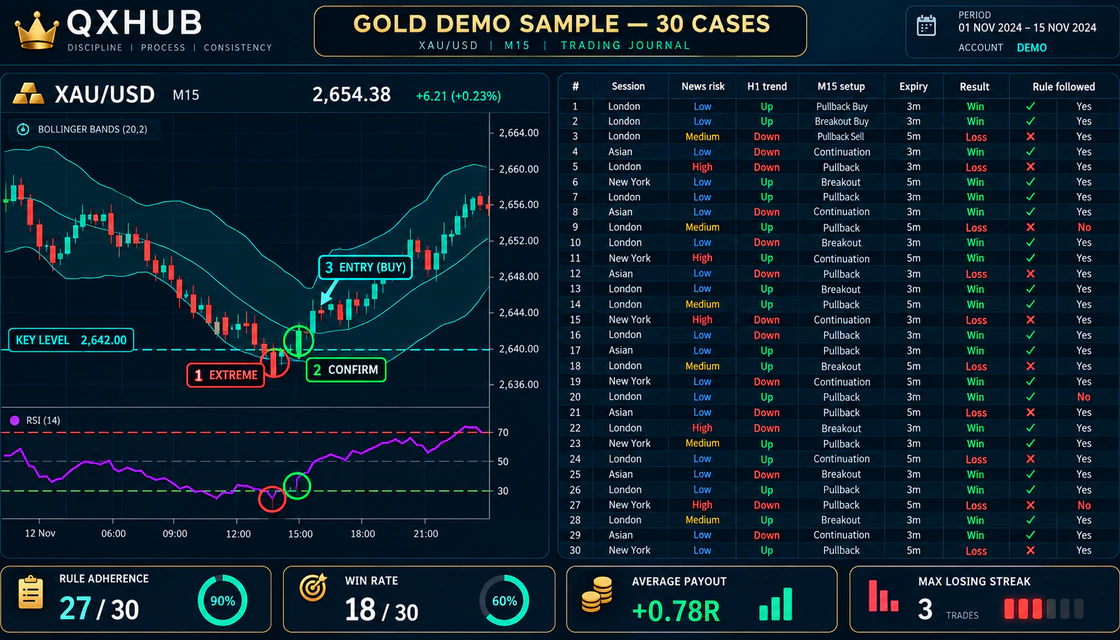
Thirty Case Gold Demo Test
- Choose one setup, one entry timeframe, one session window and one expiry rule.
- Capture the H1 context and the M15 entry screen before clicking.
- Record the session, news risk, market regime, level, candle confirmation, expiry, payout and result.
- Mark whether every rule was followed without changing the explanation after expiry.
- Save the chart at expiry and note whether direction or timing caused the failure.
- After 30 cases, calculate win rate, break-even margin, rule adherence and maximum losing streak.
- Compare valid trades with rule breaks and improve only a repeated weakness.
| Journal field | Example |
|---|---|
| Asset | XAU/USD regular market |
| Session | London–New York overlap |
| News risk | No high-impact release during expiry |
| H1 structure | Higher highs and rising EMA 50 |
| M15 setup | Pullback to broken resistance |
| Confirmation | Bullish engulfing close |
| Expiry | 4 candles or 60 minutes |
| Payout | 82% before entry |
| Process score | 7 of 7 rules followed |
| Review note | Correct direction; entry one candle late |
Common Gold Trading Mistakes
| Mistake | Why it fails | Better rule |
|---|---|---|
| Trading the first news candle | Price discovery creates extreme wicks | Wait for stable structure and retest |
| Assuming USD correlation is fixed | Risk flows can move both assets together | Use correlation as context only |
| Entering after a long impulse | Most of the move may be complete | Wait for pullback or skip |
| Using one timeframe | Entry chart hides broader structure | H1 context plus M5 or M15 trigger |
| Drawing levels after the move | Creates hindsight confirmation | Mark zones before the signal |
| Shortening expiry when late | Turns structure into a coin flip | Keep expiry fixed; skip late entries |
| Martingale after a loss | Exposure rises when uncertainty remains | Fixed stake and daily stop |
Pre Trade Checklist
| Question | Check |
|---|---|
| Is XAU/USD currently available and is the payout above my tested minimum? | □ |
| Did I check CPI, PCE, NFP, FOMC and central-bank events? | □ |
| Can I name the H1 regime and nearest level? | □ |
| Is this a tested pullback or false-breakout setup? | □ |
| Has the confirmation candle closed? | □ |
| Is the entry still near the level? | □ |
| Does expiry fit three to five entry candles? | □ |
| Will the trade finish before the next major event? | □ |
| Are the amount and daily stop fixed? | □ |
Conclusion
Trading gold on Quotex is a timing problem built on macro context. Gold responds to risk, the dollar, yields, inflation expectations, central-bank policy and positioning, but none of those drivers creates an automatic entry. The chart must still show a readable regime, a real level and a completed confirmation.
For a beginner, the strongest workflow is H1 context, M5 or M15 execution, one tested setup and an expiry of several entry candles. Avoid the first news reaction, keep the stake fixed and record thirty comparable cases before judging the method. The goal is not to predict every gold move. It is to participate only when the setup is clear enough to define before clicking.
Quick answers
Can you trade gold on Quotex
Gold or XAU/USD may be available depending on current platform conditions and region. Confirm the exact symbol, regular or OTC label, payout and expiry in demo mode before planning a trade.
What is the best time to trade gold on Quotex
The London session and London–New York overlap often provide stronger participation, but the best window is a clean setup without an unplanned high-impact event inside the expiry.
What timeframe is best for gold
H1 is useful for context and M5 or M15 for entries. Beginners should avoid judging the trend and timing from one ultra-short chart.
What indicators work for XAU USD
EMA 50 can filter direction and RSI 14 can show momentum reset or divergence. Support, resistance and a completed candle remain the core evidence.
Should I trade gold during CPI or FOMC
Beginners should normally avoid the first reaction. Wait until volatility settles and a new structure, level and retest become visible.
Is a gold strategy guaranteed to work
No. Every setup can lose. Results depend on market regime, execution, expiry, payout and risk control. Test on demo and use only money you can afford to lose.
Next step
Choose a topic by task: brokers for platform selection, guides for access, strategies for setups, risk for discipline and investing for longer market logic.