quotex 5-minute strategy
Quotex 5-Minute Strategy: Setup, Filters and Risk Rules
A practical Quotex 5-minute strategy guide with trend bias, support and resistance, pullback entries, confirmation filters, fixed risk rules and a 7-day demo practice plan.
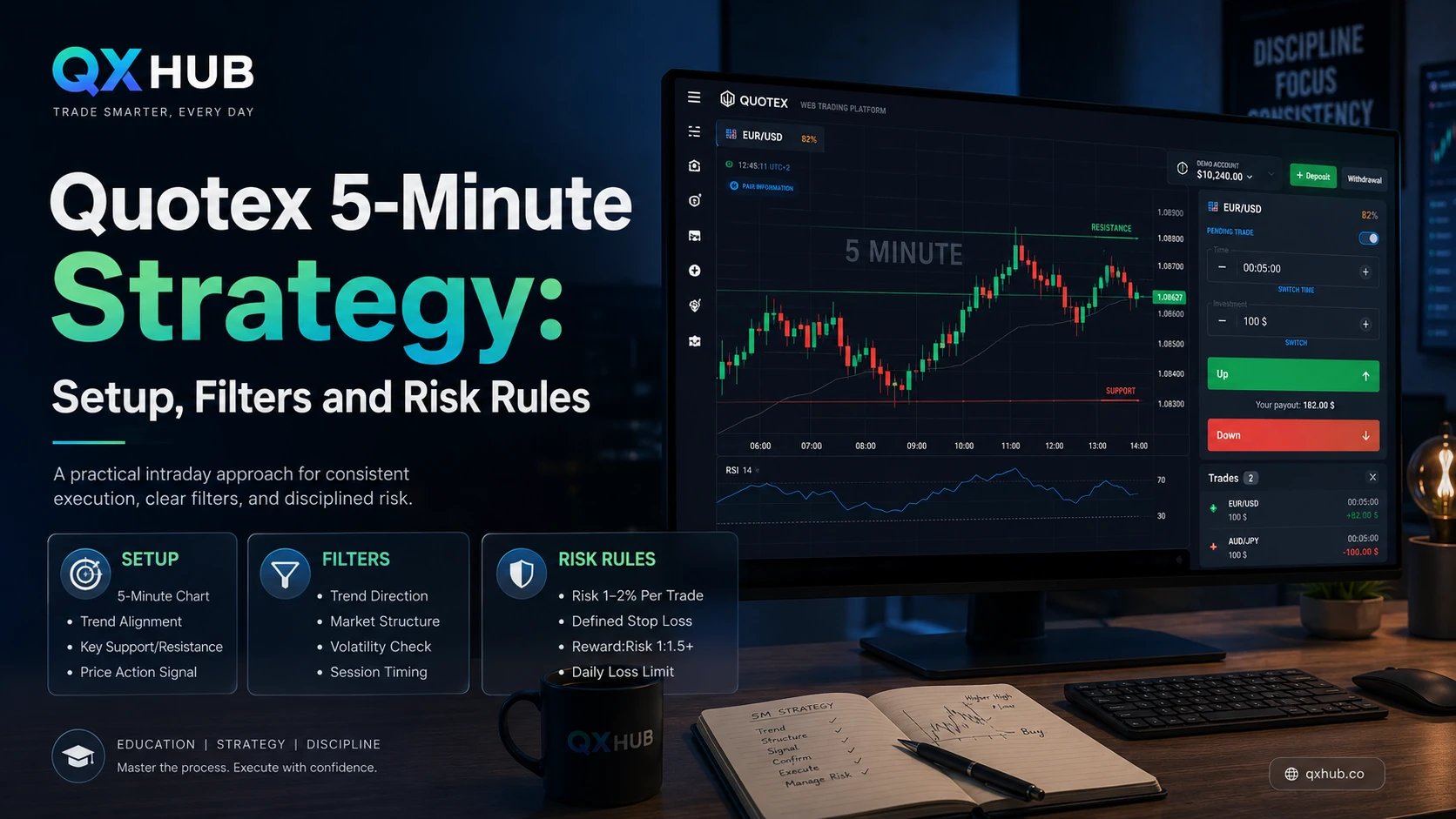
Quick answer
A serious Quotex 5-minute strategy is not a secret signal. It is a repeatable routine: define trend bias, mark one or two clean levels, wait for a pullback, enter only after candle confirmation, filter weak markets and protect every session with fixed risk.
- The 5-minute chart is fast enough for practice, but slow enough to read structure before clicking.
- The working setup is trend bias plus key level plus pullback plus confirmation. Missing one block weakens the trade.
- Filters are not decoration: they keep you away from chop, unfinished candles, news spikes and dead sessions.
- Risk rules complete the strategy. Fixed size, a daily stop and a journal prevent emotional escalation.
quotex 5-minute strategy
Choose the broker route
Open the account only after the comparison is clear: one platform for fast fixed-return practice, the other for a broader trading workspace.

5-minute setup
Quotex
The working setup is trend bias plus key level plus pullback plus confirmation. Missing one block weakens the trade.
1. Why the 5-minute chart fits structured practice
The 5-minute chart gives a trader a workable rhythm. It is quick enough to show several examples during one session, but slow enough to read price structure, mark a level and wait for the candle to close. One-minute charts often push beginners into reflex trading. Very slow charts can make practice feel endless. Five minutes sits in the middle: enough action, but still enough time to think.
2. The core idea behind the strategy
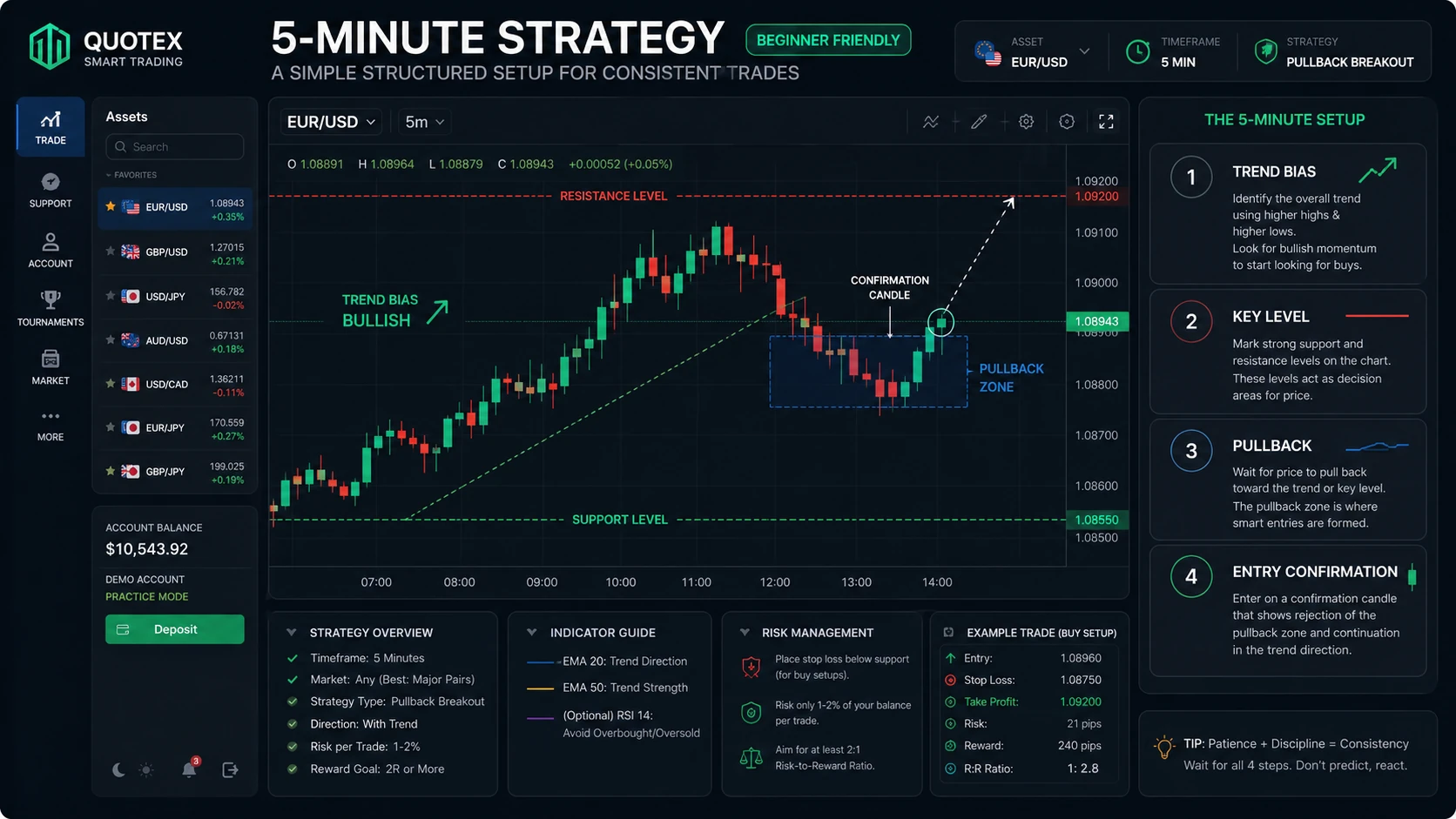
The strategy is built from four blocks: direction, location, timing and confirmation. Direction comes from trend bias. Location comes from support and resistance. Timing comes from a pullback. Confirmation comes from the candle that proves price still respects the idea. The goal is not to predict every candle. The goal is to stack simple conditions and reject everything that does not fit.
3. Step one: define trend bias
Before looking for an entry, decide whether the market has structure. In an uptrend, price tends to print higher highs and higher lows. In a downtrend, it prints lower highs and lower lows. If the structure is bullish, buy-side setups deserve more attention. If it is bearish, sell-side setups are cleaner. Trend bias is not a guarantee; it is a filter that keeps you from fighting the current for no reason.
4. Step two: mark one or two key levels
A good 5-minute setup needs a clean decision area. Mark support or resistance where price has already reacted. Beginners often draw too many lines and then lose the chart. Keep only the levels that matter now. A useful level answers one question: if price comes back here, is there a logical reason to watch for a reaction? If the answer is weak, the level is noise.
5. Step three: wait for the pullback
After price moves with the trend, do not chase it. In an uptrend, wait for price to pull back toward support, a trendline area or a previous reaction zone. In a downtrend, wait for price to return toward resistance. The pullback gives a better place to make a decision. It also exposes traders who are clicking because they are late, not because the setup is clean.
6. Step four: demand candle confirmation
Confirmation is the difference between a planned trade and a guess. It can be a closed rejection candle, an engulfing candle, a strong continuation candle or a clear failure to break the level. The important part is the close. An open candle can look perfect and then completely change shape. Let the chart finish speaking before you pay for the idea.
7. Filters that remove weak trades
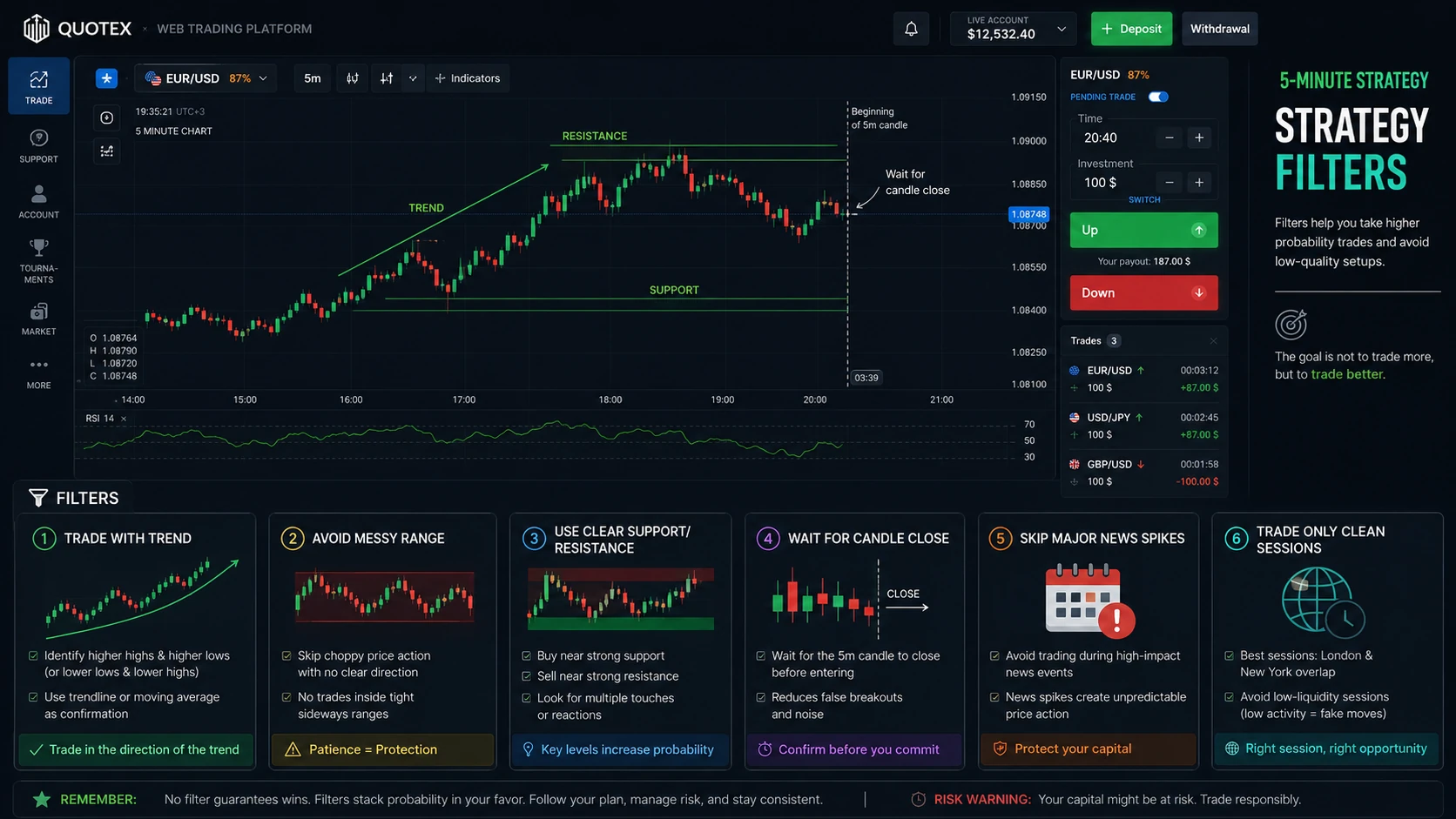
The best filter is often the word no. Do not trade a tight, messy range. Do not enter before the candle closes. Do not chase after a move is already stretched. Do not trade through major news if the chart becomes unreadable. Do not force a session when volatility is dead. A beginner improves faster by taking fewer clean setups than by clicking every small movement.
8. Valid setup versus skip this trade
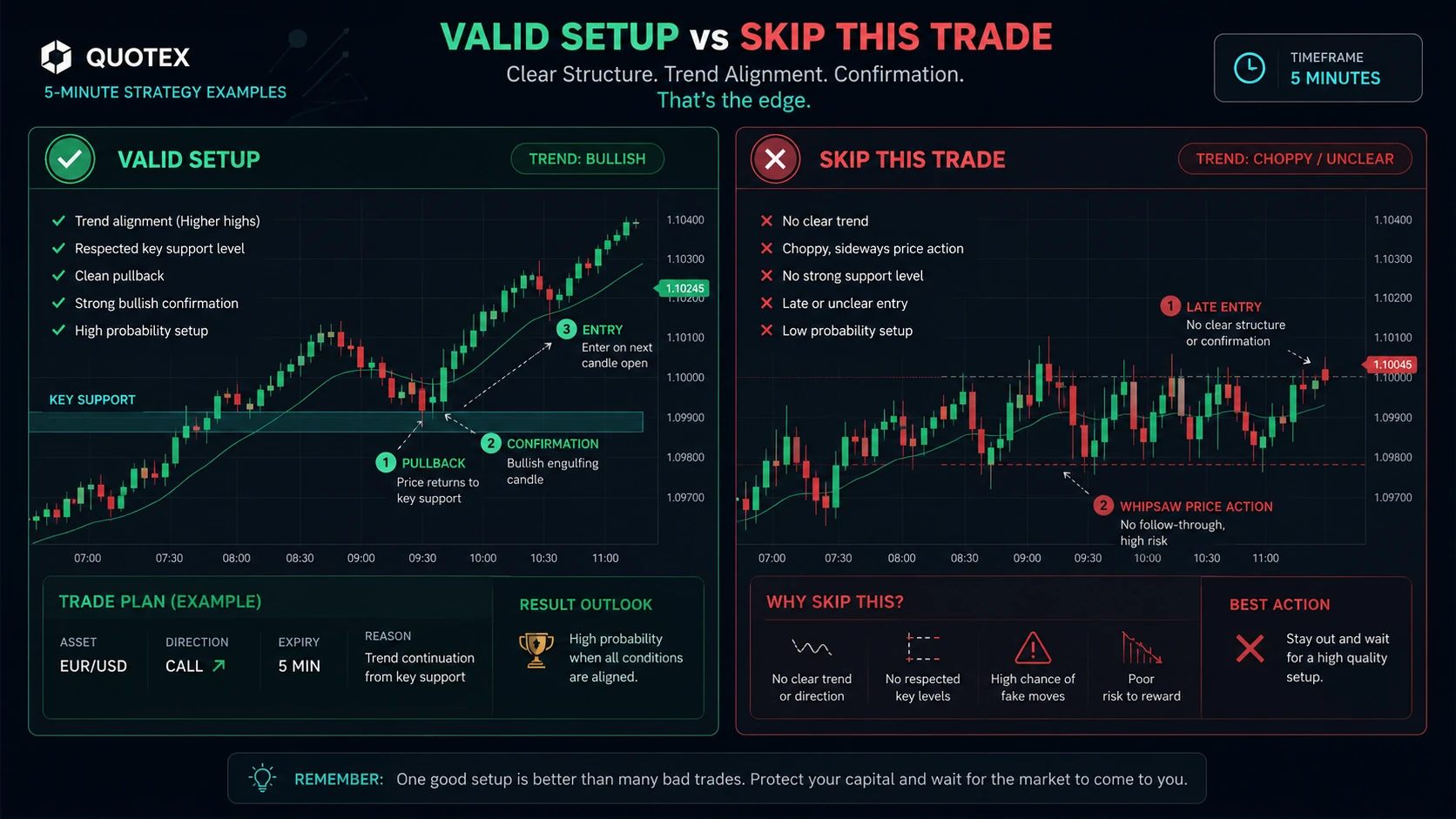
A valid setup has direction, a meaningful level, a pullback, confirmation and a risk plan. A skipped trade usually has the opposite: unclear trend, random level, late entry, no candle close or pressure to do something. Most beginner losses are not caused by lack of intelligence. They come from negotiating with a weak setup until it starts to look acceptable.
9. Risk rules for a 5-minute strategy
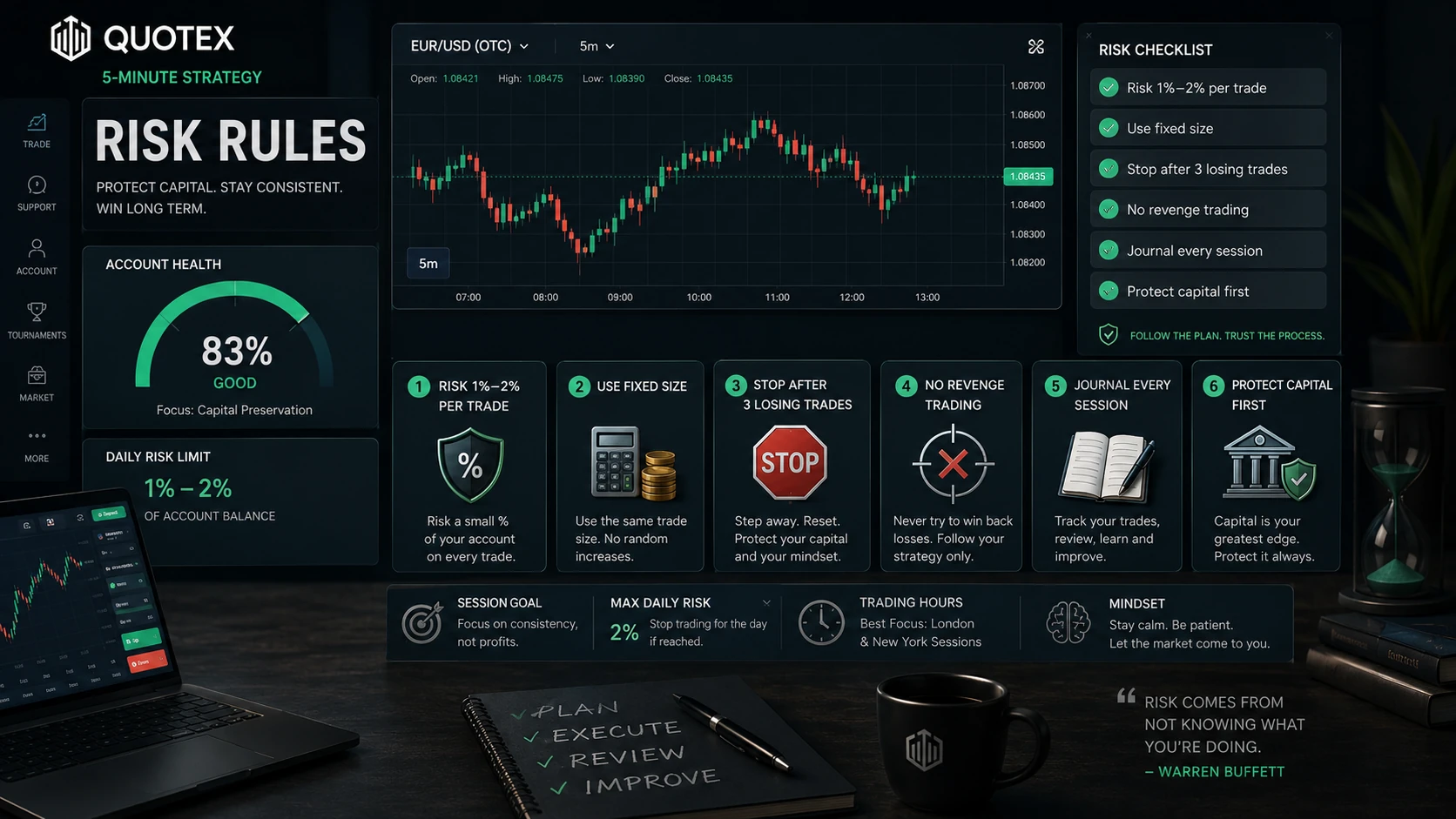
Use a fixed amount or a small percentage such as 1-2% per trade. Do not increase size because the last trade won, and do not double after a loss. Stop after three losses or when the daily loss limit is reached. Never revenge trade. Write the reason for every entry and every skip. A strategy is not complete until it tells you when to stop.
10. Seven-day demo practice plan
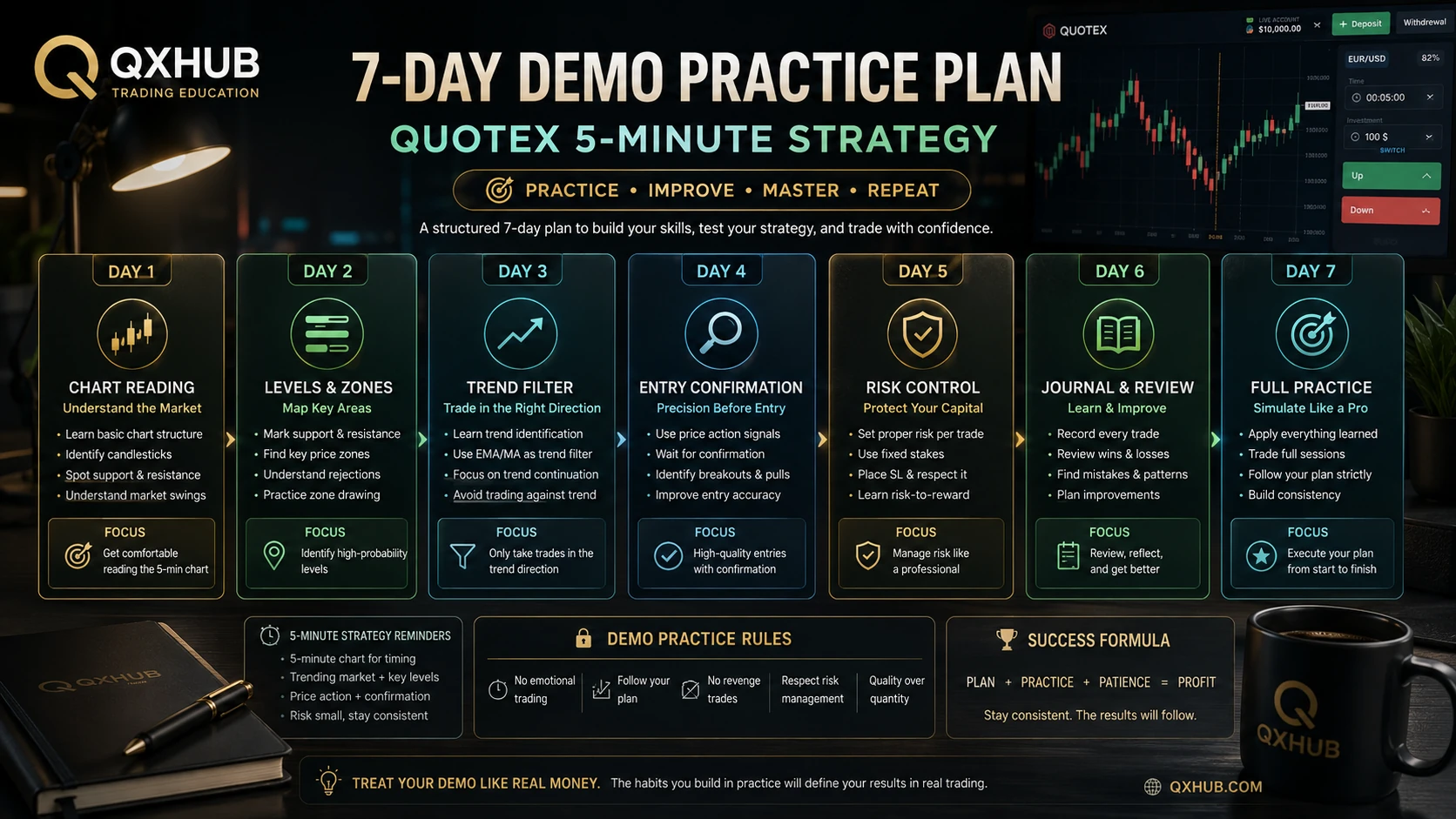
Day one: read candle structure. Day two: mark support and resistance without clutter. Day three: label trend or range. Day four: watch confirmation candles around levels. Day five: practice fixed risk and stopping rules. Day six: review the journal and label good versus weak trades. Day seven: run one full demo session from checklist to review. If execution is unstable, repeat the cycle before changing the method.
Quick answers
Is the Quotex 5-minute strategy good for beginners?
Yes, if it is practiced on demo first. The timeframe gives enough movement to learn while still leaving time to check trend, level and risk.
What is the core setup?
Trend bias, key level, pullback and candle confirmation. All four should align before the trade is considered.
Should I trade every pullback?
No. A pullback is only interesting when it returns to a meaningful level and confirmation appears.
Why wait for candle close?
Because open candles can change shape fast. The close gives cleaner evidence and reduces fake confirmation.
Which indicators can help?
A moving average, RSI or Bollinger Bands can help as filters, but they should not replace price structure and risk rules.
How much should I risk?
Keep it small and fixed. Many traders use 1-2% per idea on practice plans, plus a strict daily stop.
When should I skip a trade?
Skip unclear trend, messy range, late entry, major news spike, emotional pressure or any trade that cannot be explained in one sentence.
How long should I test the method?
At least seven focused demo sessions with a journal. If discipline breaks, repeat the cycle before trading real money.
Next step
If the comparison is clear, continue with the broker that fits your trading routine. Review the full broker page first, then open the account through the protected route.