false breakout in binary options
False Breakouts in Binary Options: Confirmation Guide
Learn how false breakouts form in binary options, which confirmation clues matter, and how volatility, news, expiry and risk filters help prevent late entries.
Key points
- Treat a level break as an event, not automatic confirmation; define the close, retest or structure rule before entry.
- Reject late entries, unstable news spikes and setups with poor room beyond the level.
- Match expiry and risk limits to the tested process, then record every qualifying setup rather than only attractive examples.
False Breakouts in Binary Options
A level break is an event — not automatic confirmation.
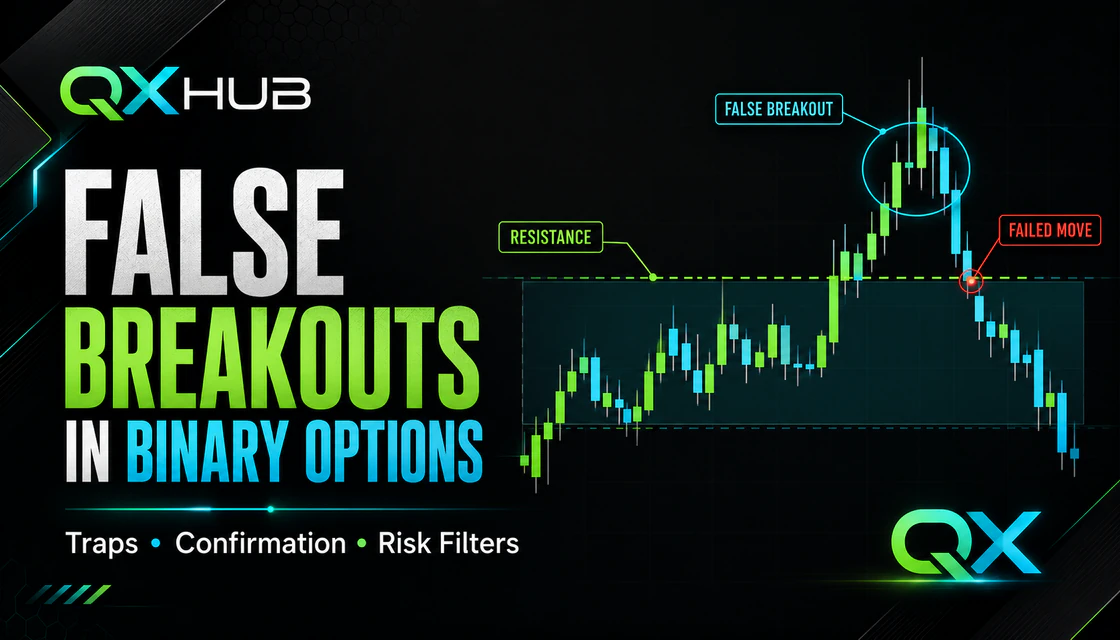
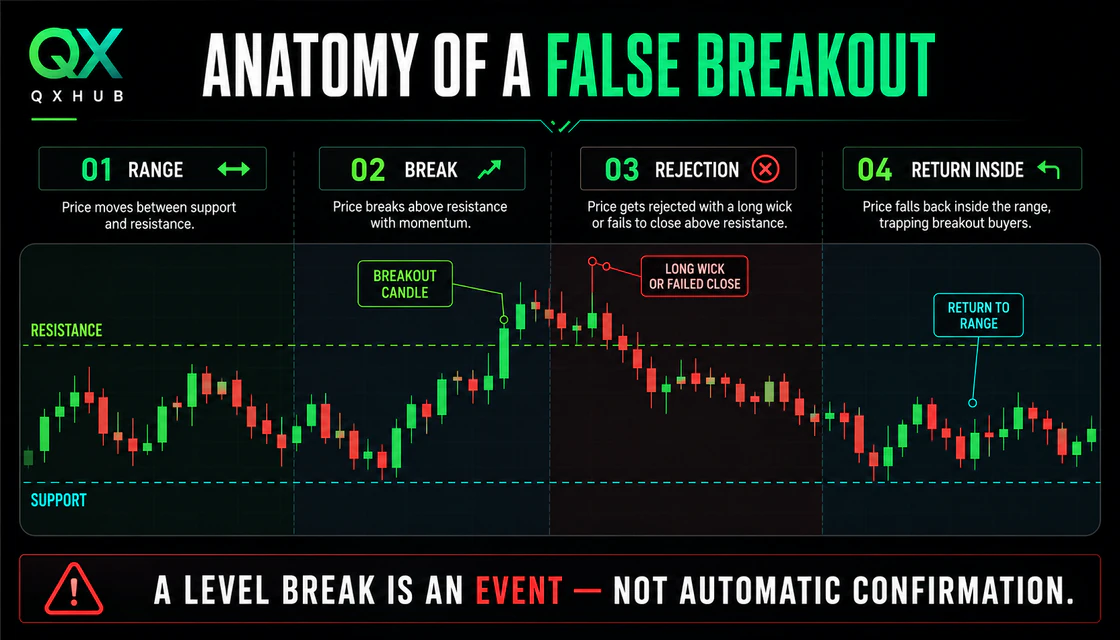
A breakout occurs when price moves beyond a support or resistance level. A false breakout occurs when that move fails: price rejects the new area and returns through the level, often trapping traders who entered late.
This matters in binary options because the contract settles at a fixed time. A breakout can look convincing for several candles, reverse before expiry, and settle on the opposite side of the strike. The goal is not to predict every trap. It is to define what counts as a valid level, what confirmation the strategy requires, and which conditions make a breakout trade unacceptable.
Risk warning: Binary options are high-risk, all-or-nothing products and may be restricted or prohibited in your jurisdiction. No confirmation method can eliminate false breakouts or guarantee profit. Check local regulations, read the contract terms, use only money you can afford to lose, and test any process on a demo account before considering real funds.
| FORMAT Guide & checklist | FOCUS Breakouts & traps | UPDATED July 2026 |
|---|
What Is a False Breakout?
A false breakout is a move beyond a technical boundary that does not establish acceptance outside it. Price may trade above resistance or below support briefly, then return inside the previous range. The failure can appear as a long wick, a candle that closes back inside, a failed retest, or a larger reversal.
The level can be:
- horizontal support or resistance;
- a range boundary;
- a previous swing high or low;
- a trend line;
- the high or low of a trading session;
- a pattern boundary such as a triangle or channel.
A break is an event, not automatic confirmation. The strategy must define what happens after the level is crossed.
Breakout, Fakeout, Failed Break and Liquidity Sweep
Traders often use several terms for similar chart behavior. They are not always exact synonyms.
It is safer to describe what price did than to claim why it happened. “Price traded above resistance, failed to close beyond it, and returned inside the range” is observable. “Market makers hunted everyone” is a story.
| Term | Practical meaning | Important caution |
|---|---|---|
| Breakout | Price moves beyond a defined level | The move may still fail later |
| False breakout / fakeout | Price breaks the level and returns | “False” is often known only after the return |
| Failed break | A breakout attempt cannot hold | The failure rule must be defined in advance |
| Liquidity sweep | Price trades beyond a visible high/low before reversing | Motive cannot be proven from a chart alone |
| Stop hunt | Informal claim that stops were deliberately targeted | Avoid presenting intent as fact without evidence |
Why False Breakouts Are Dangerous in Binary Options
Fixed expiry compresses the decision into a settlement window. A trader cannot simply wait indefinitely for the original idea to recover. The breakout may fail before the option settles, or a failed break may reverse again after expiry.
False breakouts create several risks:
- Late entry: the strike is obtained after a large candle has already moved.
- Poor location: entry occurs far from the broken level and close to the next obstacle.
- Volatility mismatch: a strategy tested in orderly movement is used during erratic spikes.
- Expiry mismatch: the contract settles before a retest or after a later reversal.
- Emotional urgency: a trader enters because the move appears to be leaving without them.
The solution is not to wait for endless confirmation. Too much delay can also create a late entry. The solution is to test one clear confirmation rule and use it consistently.
What Makes a Level Valid?
A false breakout cannot be assessed without a meaningful reference level. Lines drawn through random price noise produce random “breaks.”
Clear Reactions
A valid level should have visible evidence that price previously reacted there. More touches are not always better: repeated tests can weaken a boundary or show that it is imprecise. Focus on clear swings and reactions, not the highest possible count.
Appropriate Timeframe
A level from a higher timeframe may carry more context than a minor line on a one-minute chart. However, higher timeframe does not mean guaranteed. Record which timeframe created the level and which timeframe supplies the entry.
Zone Instead of Exact Pixel
Support and resistance often behave as zones. Different price feeds, spreads in underlying markets, and normal volatility can push candles slightly beyond a line. A strategy should define whether it uses a close, wick, percentage, or range-based tolerance.
Room Beyond the Level
A bullish breakout directly below another resistance level has limited room. A bearish break directly above major support faces the same problem. Time cannot fix poor structure.
Current Relevance
An old level may remain useful, but market context can change. Revalidate the line after major news, a session transition, or a large structural move.
Confirmed Breakout vs False Breakout
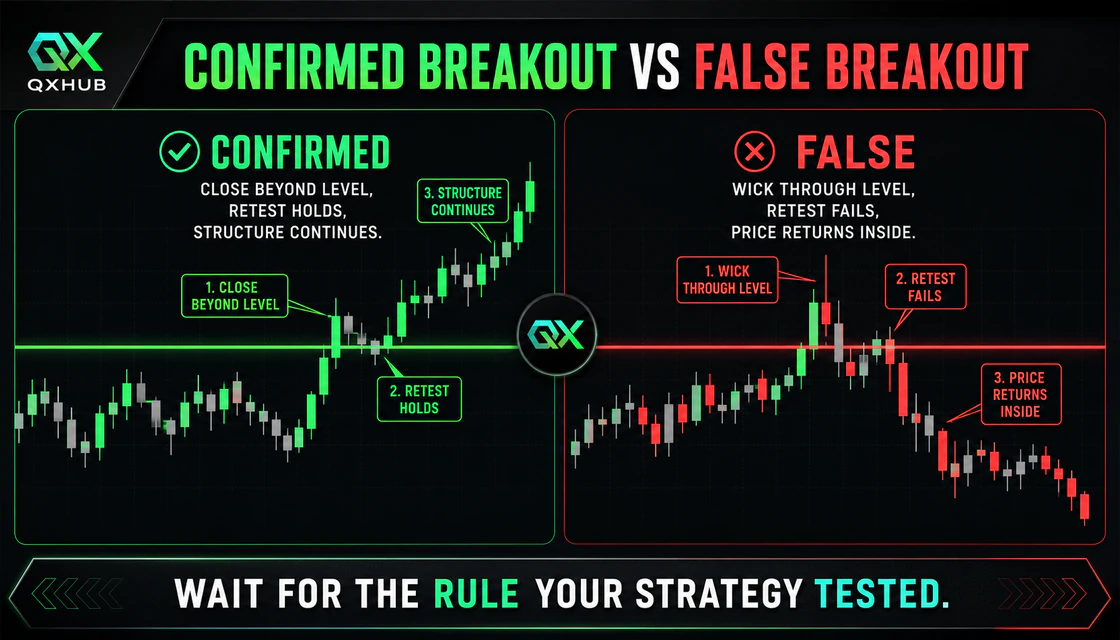
The difference is not the color of one candle. It is whether the market meets the strategy's acceptance rule.
Possible Confirmation Elements
- a candle closes beyond the level;
- the candle body, not only the wick, is outside;
- a retest holds on the new side;
- market structure continues with a new swing;
- volatility remains within the tested regime;
- the move is not inside a restricted news window.
These elements are examples, not universal requirements. Combining every item can make a rule too slow. Testing should identify the minimum evidence the setup actually uses.
Possible Failure Elements
- price only wicks through the level;
- the candle closes back inside the range;
- the retest cannot hold outside;
- price crosses the boundary repeatedly;
- the breakout candle is abnormally large and immediately rejected;
- the move occurs during unstable news volatility.
Failure clues reduce uncertainty; they do not create certainty. A chart can return inside, then break again later.
Five Common False-Breakout Clues
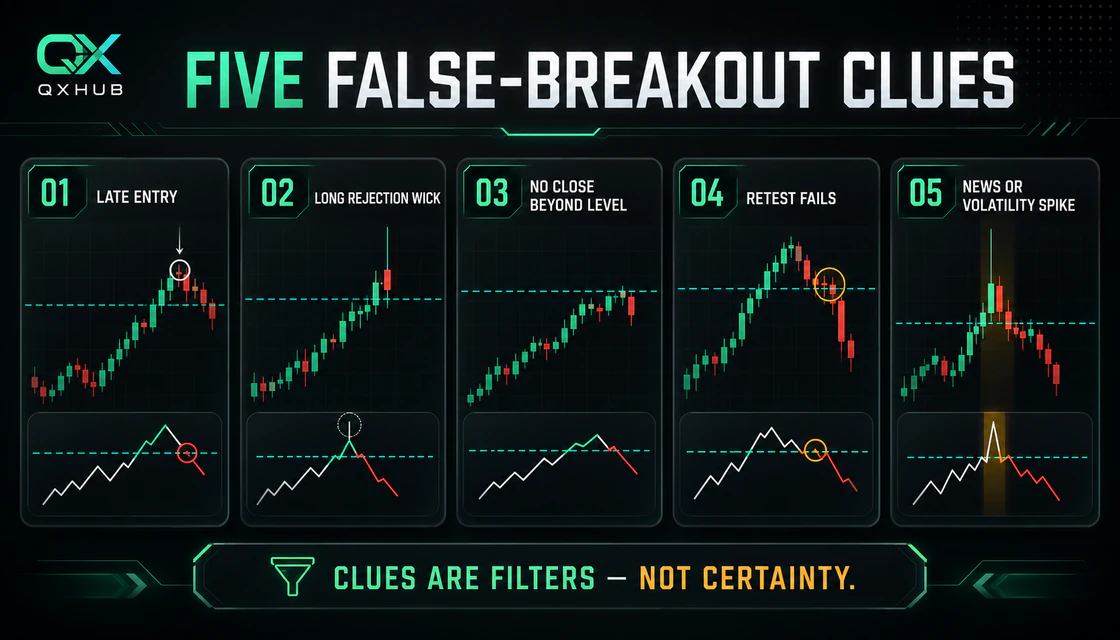
1. Late Entry After an Extended Candle
When a trader enters near the end of a large breakout candle, the strike is far from the level that defined the setup. The move may be extended, and even a normal retest can settle the contract unfavorably.
2. Long Rejection Wick
A long wick beyond resistance or support shows that price visited the area and moved back before the candle closed. It is evidence of rejection, but not proof of a full reversal. Compare the wick with recent candle ranges and the surrounding structure.
3. No Close Beyond the Level
If the strategy requires a close outside, a wick is not enough. Entering before the candle closes changes the rule and makes historical comparison unreliable.
4. Failed Retest
After a bullish breakout, the old resistance may be tested as support. If price closes back below it or crosses repeatedly, acceptance is weak. The exact failure definition must be written before entry.
5. News or Volatility Spike
A major release can force price through multiple levels in seconds. A large candle created by an event may have little relationship to the technical setup tested in normal conditions.
The Role of Candle Close
Waiting for a candle close is a common confirmation method because it distinguishes a temporary wick from a completed candle. It still has limitations.
The meaning of a close depends on timeframe. A one-minute close, a five-minute close, and an hourly close represent different amounts of information. Waiting for a higher-timeframe close can improve context but make the entry too late for a short expiry.
Define:
- the candle timeframe;
- whether the body must close completely outside;
- how far beyond the zone counts;
- whether a retest is required;
- how many candles can pass before the setup expires.
Without these details, “wait for confirmation” is not a testable rule.
Retests: Useful but Not Guaranteed
A retest occurs when price returns to the broken area. In a bullish breakout, previous resistance may act as support. In a bearish breakout, previous support may act as resistance.
A retest can help improve entry location and show acceptance, but:
- some valid breakouts never retest;
- some retests are deep and ambiguous;
- a retest can hold briefly and fail before expiry;
- repeated tests can turn the level into noise;
- event-driven moves may ignore normal structure.
Do not invent a retest after the fact. Specify the maximum depth, trigger, invalidation, and allowed time.
Volatility and False Breakouts
Volatility measures movement, not direction. Both low and high volatility can produce traps.
Use candle range, ATR context, session behavior, and structure to describe the regime. Do not treat a large candle as confirmation by itself.
| Regime | False-breakout risk | Planning question |
|---|---|---|
| Compression | First break may attract premature entries | Does the setup require a close or retest? |
| Orderly expansion | Movement can continue, but late entry worsens location | Is the entry still near the tested trigger? |
| Trending volatility | Countertrend breaks may fail quickly | Does higher-timeframe structure agree? |
| Erratic spikes | Multiple levels can be crossed and reversed | Is this regime prohibited? |
Trading Sessions and Breakout Quality
Session transitions often produce range breaks:
- London can break an Asian-session range;
- the London–New York overlap can expand activity in major pairs;
- late-session conditions can reduce follow-through;
- Asia-Pacific data can move JPY, AUD, or NZD pairs sharply.
These are tendencies, not signals. Test the exact asset and window. A method designed for the London open should not be transferred to a quiet late session or an OTC weekend feed without separate evidence.
Daylight-saving changes can shift London and New York relative to UTC and the platform clock. Record the platform time, not only the session name.
Economic News and Event-Driven Breaks
Scheduled news can create genuine repricing, false breaks, or both in rapid sequence. Interest-rate decisions, inflation, employment data, growth figures, and central-bank speeches are common sources.
A practical filter defines:
which currencies and event categories matter;
a restricted period before the release;
a restricted period after the release;
a rule preventing expiry from crossing the event;
a condition showing that normal market behavior has returned.
There is no universal safe waiting period. Unscheduled news remains possible, so a calendar does not replace fixed risk.
Expiry Time and Breakout Logic
Expiry should allow the tested sequence to occur. A setup requiring a close and retest needs a different timeline from an immediate momentum entry.
Too Short
The contract may settle during the retest before continuation develops. Normal movement around the level can dominate the result.
Too Long
The breakout may complete, then price can reach a new obstacle or reverse before settlement. More time introduces more events.
Tested Window
The fixed expiry matches the historical and demo process. It cannot guarantee a win; it makes the live trade comparable with the evidence.
Do not shorten expiry because the breakout looks fast or extend it after seeing a loss. That creates a different method.
A Step-by-Step Breakout Process
Step 1: Mark the Level Before the Move
Draw support, resistance, range boundaries, and nearby obstacles before price breaks. Moving the line afterward creates hindsight bias.
Step 2: Classify the Regime
Label compression, expansion, trend, or erratic volatility. Reject conditions outside the strategy.
Step 3: Wait for the Defined Trigger
Use the exact rule: candle close, retest, structure break, or another tested event. Time alone is not a trigger.
Step 4: Check Entry Location
If price is already far beyond the level, the trade may be late even though confirmation occurred.
Step 5: Confirm News, Payout and Expiry
Reject the trade if the contract crosses restricted news, payout falls below the plan, or the required expiry is unavailable.
Step 6: Apply Risk Limits
Use the fixed stake, maximum trade count, and daily stop conditions. A visually strong breakout is not a reason to increase risk.
Step 7: Record the Trade
Save screenshots before entry and after expiry. Note the level, trigger, regime, session, payout, expiry, and whether every rule was followed.
Complete Educational Example
Suppose a trader tests a London-session breakout of the Asian range on EUR/USD. The range must be clearly defined before London opens. A valid bullish setup requires a five-minute candle body to close above the range, followed by a retest that does not close back inside. The entry trigger, expiry, payout threshold, news filter, and risk limit are fixed.
Price moves above the range with a large candle, but the candle is still open. The trader waits. It forms a long upper wick and closes inside. No trade: the close rule failed.
Later, another candle closes outside. Price retests the level, holds briefly, but a high-impact EUR release falls inside the planned expiry. No trade: the news rule failed.
On a third day, the close, retest, volatility, payout, expiry, and news filters all pass. The trader takes the demo trade at the fixed stake. It loses after price returns inside the range. The process can still be correct: confirmation reduces uncertainty but cannot eliminate false breakouts.
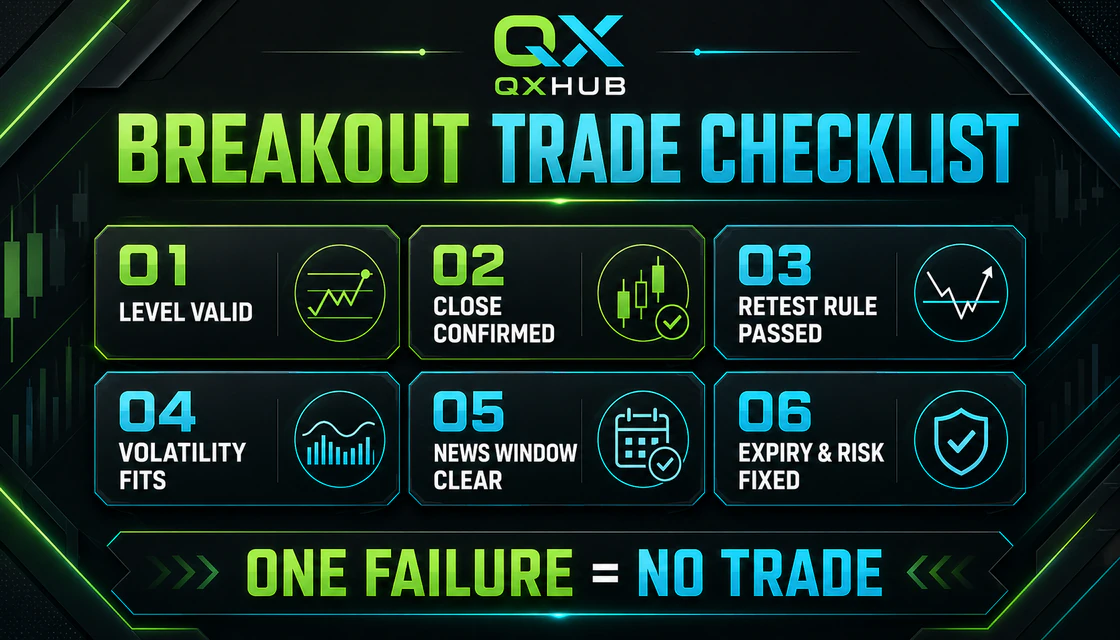
Breakout Trade Checklist
- Level valid: the boundary was marked before the break and has clear context.
- Room available: the next obstacle is not immediately beyond the entry.
- Close confirmed: the required candle completed outside the level.
- Retest rule passed: if required, the retest met the exact condition.
- Entry not late: price has not extended beyond the tested location.
- Volatility fits: the regime matches the sample.
- Session allowed: the platform time is inside the plan.
- News clear: expiry does not cross a restricted event.
- Payout acceptable: contract terms match the test assumptions.
- Expiry fixed: the selected settlement time is the tested one.
- Risk available: stake and daily limits have not been exceeded.
One failure means no trade.
How to Backtest False-Breakout Filters
Test the complete rule, not only attractive examples.
Define the level, trigger, retest, expiry, session, and exclusions.
Record every historical setup that qualifies.
Include breakouts that fail immediately and those that fail later.
Separate news-driven moves and OTC instruments.
Track payout assumptions and unavailable contracts.
Compare results with and without each filter.
Validate the final rule on later, unseen data.
Forward-test on demo without changing rules mid-sample.
Avoid trying dozens of wick ratios, candle periods, and retest depths until one result looks perfect. That is overfitting. A useful filter needs a logical reason and later validation.
Journal Fields for Breakout Trades
Review failures by category rather than changing the strategy after several losses.
| Field | Example value | Why it matters |
|---|---|---|
| Level type | Asian range high | Keeps setups comparable |
| Break method | Five-minute close | Defines confirmation |
| Retest | Passed / failed / not required | Separates entry models |
| Volatility regime | Orderly expansion | Identifies environment |
| Entry distance | Near / extended | Detects chasing |
| News clear? | Yes / no | Audits the calendar rule |
| Expiry and payout | Recorded at entry | Preserves contract context |
| Rule adherence | Yes / no | Separates process from outcome |
Common False-Breakout Mistakes
Entering Before the Candle Closes
If the plan requires a close, an open candle is incomplete evidence. A wick can reverse before the period ends.
Chasing a Large Candle
Late entry produces a worse strike and exposes the trade to a normal retest.
Redrawing the Level
Moving support or resistance to fit the outcome destroys the original test.
Treating Every Wick as Manipulation
A wick shows rejection or two-way movement. It does not prove deliberate targeting.
Ignoring the Next Level
A breakout can be valid but have little room before another structural obstacle.
Changing Expiry After a Failed Trade
Hindsight makes another duration look obvious. Test expiry changes on the full sample, not one chart.
Increasing Stake After a Trap
Martingale compounds risk and does not improve breakout quality.
Mixing Sessions and OTC Data
Different market conditions require separate analysis. Do not combine them into one result.
Final Thoughts
A breakout is not confirmed because price crossed a line. Confirmation comes from the exact behavior the strategy tested: a close, retest, structural continuation, acceptable volatility, clear news window, suitable expiry, and controlled risk.
False breakouts cannot be eliminated. They can only be handled with better definitions and consistent execution. Mark the level before the move, avoid late entries, and skip any trade that needs an exception to qualify.
Quick answers
What is a false breakout in binary options?
It is a move beyond support or resistance that fails to establish acceptance outside the level and returns through it before or after the contract settles.
How can I confirm a breakout?
Use a rule tested for the strategy, such as a candle close beyond the level, a retest that holds, or continued structure. No method guarantees continuation.
Is a long wick always a false breakout?
No. A long wick shows rejection during that candle, but price may still break later. It is a clue, not certainty.
Should I wait for a retest?
Only if the tested strategy requires one. Retests can improve context, but some valid moves do not retest and some retests fail.
What timeframe is best for confirming breakouts?
There is no universal best timeframe. The confirmation timeframe must match the level, setup, expiry, and testing process.
Why do breakouts fail around news?
News can produce rapid repricing, spikes, and reversals. Technical levels may be crossed repeatedly before conditions stabilize.
Can ATR identify false breakouts?
ATR measures movement, not direction or validity. It can show that a candle is large relative to recent ranges, but it cannot prove a breakout will fail.
Can false-breakout filters improve win rate?
They may remove trades that do not match the setup, but they cannot guarantee a win rate or profit. Any benefit must be tested and validated.
Are false breakouts tradable as reversal setups?
They can form a separate strategy, but the reversal needs its own trigger, expiry, risk rules, and evidence. A failed breakout is not an automatic opposite-direction entry.
Next step
Choose a topic by task: brokers for platform selection, guides for access, strategies for setups, risk for discipline and investing for longer market logic.