
QUICK ANSWER
A trade is a route, not a single event. Add the funding cost, trading fee, spread, slippage, conversion cost, withdrawal fee and blockchain cost. Divide the total by the starting amount and multiply by 100 to calculate the effective percentage. Use the live preview in your own verified account as the final quote.
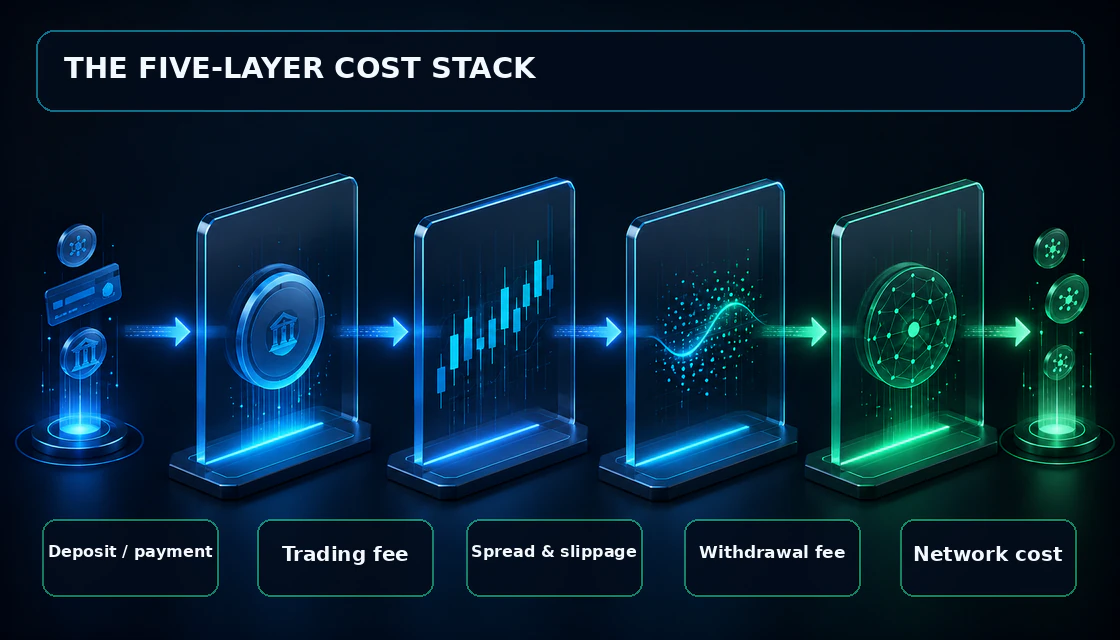
The five-layer crypto exchange fee stack
- 1
Deposit and payment-method costs
- 2
Maker or taker trading fees
- 3
Spread and slippage
- 4
Withdrawal platform fees
- 5
Blockchain network costs
How to calculate the real cost
A crypto exchange can advertise a low trading fee and still deliver an expensive transaction. You may pay to fund the account, cross the bid-ask spread, incur a maker or taker fee, lose value to slippage and pay again to withdraw. Some costs are explicit line items; others are embedded in the execution price.
Not every route contains every item. A free bank deposit may remove the first cost. A passive limit order may reduce the trading fee and avoid part of the spread, but it may not fill. An internal transfer may avoid a blockchain fee, but it keeps funds in platform custody and may not suit the recipient. Compare the exact route you intend to execute.
Effective cost = funding cost + trading fee + spread + slippage + conversion cost + withdrawal or platform fee + blockchain or network cost. Divide the total by the starting amount and multiply by 100 to express it as a percentage.
| Cost layer | When it appears | Where to verify | Best control |
|---|---|---|---|
| Deposit or payment | Card, bank transfer, processor or crypto funding | Funding screen and provider quote | Compare the net amount credited |
| Trading fee | When an order executes fully or partly | Fee tier page and order preview | Check pair, product, maker or taker status and fee currency |
| Spread and slippage | When execution differs from the reference price | Bid, ask, depth and fill report | Use liquid pairs, sensible size and limit controls |
| Withdrawal fee | When crypto or fiat leaves the exchange | Withdrawal confirmation for the selected asset and network | Compare supported routes and the net amount received |
| Network cost | When an on-chain transaction is broadcast | Exchange quote and current blockchain conditions | Delay during congestion only when waiting is acceptable |
Deposit and payment-method costs
Crypto deposits are often credited without a receiving-exchange deposit fee, but the sender still pays the blockchain cost. Fiat funding is more complicated. Bank transfer, open banking, card, mobile wallets, third-party processors and peer-to-peer routes can have different fees, exchange rates, limits, settlement times and chargeback rules. A convenient card purchase may include both a processor fee and a wider quoted price.
Measure what actually lands in the account. If a payment of $1,000 credits $970 of buying power, the funding cost is $30, or 3%, even when the interface splits that loss across several labels. When fiat conversion is involved, compare the provider's rate with an independent mid-market reference at the same time.
Maker, taker and fee-tier rules
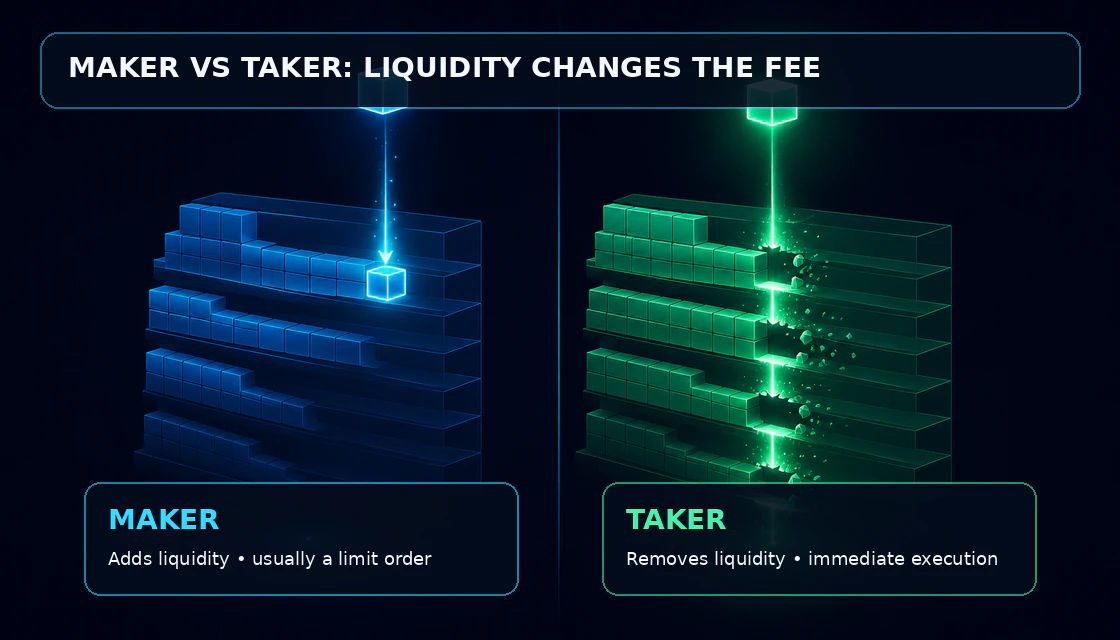
Order-book exchanges usually use a maker-taker model. A maker order adds liquidity because it rests on the book before execution. A taker order removes liquidity by matching immediately. Market orders are taker orders. A limit order is not automatically a maker order: if its price crosses an existing order, it can execute immediately and be charged as taker.
Official exchange documentation illustrates why execution labels matter. Kraken describes post-only orders that prevent taker execution. Binance explains that spot fees can be charged in the asset received. OKX publishes separate regular and VIP structures. The operational rule is the same everywhere: verify your current tier, exact product, pair and fee currency before submitting.
For a spot trade quoted in stablecoin, estimate the trading fee as executed notional multiplied by the fee rate. A $1,000 trade at 0.20% produces a $2 fee value. The deduction may come from the asset received, the quote currency or a designated fee token, changing the final quantity and sometimes creating a later conversion cost.
Volume tiers normally use a rolling period such as 30 days, not lifetime volume. Spot, instant buy, convert, margin, perpetual futures and options can use different schedules. Promotions can have dates and exclusions. Never copy a rate from a search result without checking the current logged-in fee page.
| Order behavior | Likely role | Main advantage | Main trade-off |
|---|---|---|---|
| Market order executes immediately | Taker | High execution certainty in liquid markets | Pays the taker rate and may sweep several price levels |
| Limit order rests on the book | Maker | Price control; maker rate may be lower | May fill partly, slowly or not at all |
| Marketable limit order crosses the book | Taker | Caps the worst acceptable price | Still removes liquidity and may pay the taker rate |
| Post-only limit order | Maker or cancelled | Prevents accidental taker execution | Can miss a fast-moving market |
Spread: the cost hidden inside the quoted price
The bid is the highest current buying price and the ask is the lowest selling price. Their difference is the spread. If an asset is quoted at a $100 bid and a $100.40 ask, a buyer crossing the market starts $0.40 behind before the explicit fee. The relative spread is the difference divided by the midpoint.
Wider spreads are common in less liquid pairs, during volatility or inside simplified buy and convert interfaces. A platform can advertise zero commission while earning through the quoted price. Compare the all-in quote: how much asset will you receive for the same input amount at the same moment?
Slippage and market impact
Slippage is the difference between the price you expected and the average price actually filled. It is not always an exchange charge. A market order consumes available quantities at successive price levels; when the first level is too small, the remainder fills at worse prices. Large orders, thin pairs and fast markets increase the risk.
Estimate buy-side slippage as (average fill price minus reference price) divided by reference price, multiplied by 100. For a sale, reverse the subtraction. Use the order-book midpoint or best quote immediately before submission, record the time and separate market movement from the explicit fee. A limit order controls the maximum buy price or minimum sale price, but cannot guarantee a fill.
Withdrawal fees and blockchain network costs
A crypto withdrawal can combine an exchange-set fee with the underlying network cost. The relationship is not always one-to-one: platforms may batch transactions, update a flat fee periodically or subsidize part of the on-chain cost. Use the live withdrawal page because the deduction depends on the asset and selected network.
The critical number is the amount received. The same token can exist on several networks, but matching the ticker is not enough. The sending network must be supported by the receiving wallet or exchange for that exact asset. Confirm the network, address, memo or tag, minimum and live status separately.
Safety beats a lower fee. Never choose a network only because it is cheaper. Start from the recipient's authenticated deposit page, copy the exact network and address, verify any memo or tag, compare address characters on both devices and send a small test when the fixed fee permits it.
Costs specific to derivatives, leverage and borrowing
Derivatives add costs that do not exist in a simple spot purchase. Perpetual contracts may exchange funding payments between long and short positions. Margin borrowing can accrue interest. Futures and options have their own execution and settlement rules. Liquidation can close a position at an unfavorable price and create losses beyond the planned stop level.
Beginners do not need derivatives to learn exchange mechanics. Spot practice with a small amount, or observation without funding, gives a clearer view of order types and costs without liquidation risk.
- Funding is not a fixed entry fee. Its sign and rate can change, and a position held across several intervals may pay repeatedly or receive payments.
- Leverage does not necessarily reduce the fee notional. A small margin can control a much larger position, so fees may be calculated on that larger exposure.
- Opening and closing are separate executions. A round trip can incur two trading fees plus spread and slippage on both sides.
- Convert borrowing interest and funding into the same currency and time horizon before comparing platforms.
Cryptoassets are volatile and may lose substantial value. Leverage and borrowing can magnify losses. A lower fee never makes an oversized or poorly understood trade safe.
Worked example: a $1,000 spot purchase and withdrawal
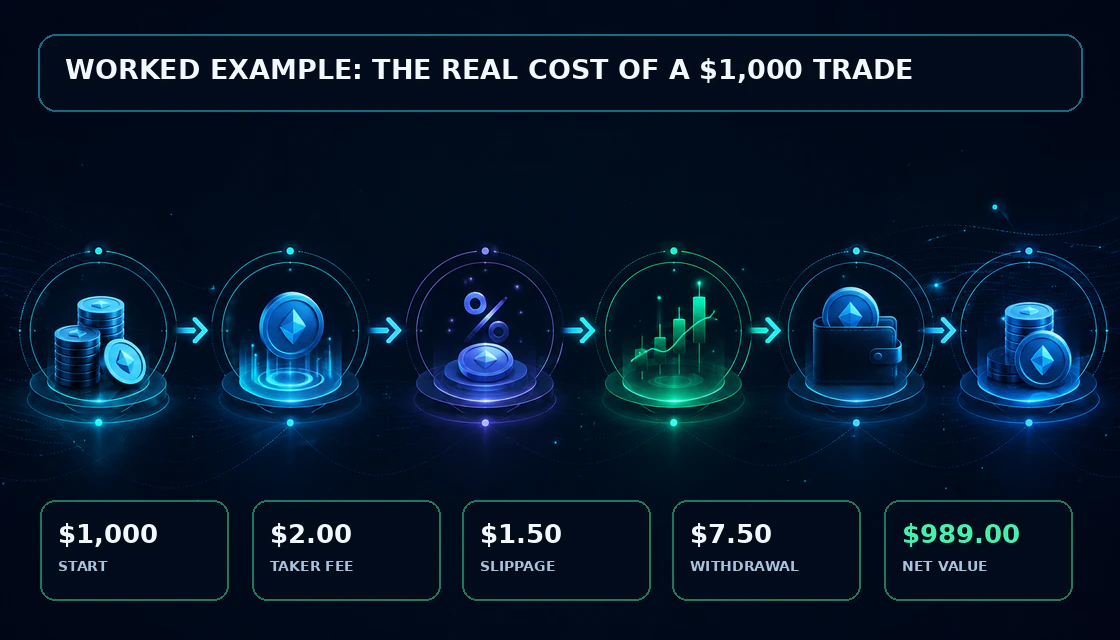
This educational calculation is not a quote from any exchange. Assume the user funds an account at no cost, buys $1,000 of BTC with a market order, pays a 0.20% taker fee, experiences 0.15% slippage relative to the pre-trade midpoint and sees a BTC withdrawal fee worth $7.50 at the same reference time.
The model excludes later BTC price movement, taxes and any receiving-wallet cost. If the fee is deducted in BTC, the user receives less BTC; the dollar conversion is only a comparison method. Repeat the calculation with the live fee and executable quote shown in your account.
| Item | Calculation | Cost |
|---|---|---|
| Starting buying power | - | $1,000.00 |
| Taker fee | $1,000 × 0.20% | $2.00 |
| Estimated slippage | $1,000 × 0.15% | $1.50 |
| Withdrawal fee | Quoted BTC amount × reference price | $7.50 |
| Total measured cost | $2.00 + $1.50 + $7.50 | $11.00 |
| Effective cost | $11.00 ÷ $1,000 × 100 | 1.10% |
| Illustrative net value | $1,000 - $11.00 | $989.00 |
A practical workflow for comparing exchange fees
Use the same asset, network, amount, order type and timestamp. Otherwise you are comparing different transactions. Do not rely on a homepage percentage or an affiliate table that may omit regional schedules.
Availability, fee schedules, payment rails and tax treatment vary by country and legal entity. Verify the provider entity, supported funding method and withdrawal route shown for your own jurisdiction.
- Define the route in one sentence: funding method, amount, asset, market, order type, destination and network.
- Confirm that the exchange entity, funding method, product, asset and withdrawal network are available in your jurisdiction and verified account type.
- Record the amount sent, provider fee, foreign-exchange rate, settlement time and exact amount credited.
- Open the current fee tier for the exact product and pair. Note maker and taker rates, fee currency, membership conditions and promotion limits.
- Inspect the best bid, best ask, spread, visible depth and expected maker or taker role. For instant buy, record the final quantity quoted.
- Preview the withdrawal without confirming. Record the network, fee, minimum, memo or tag and the net amount the recipient should receive.
- Convert every component into one reference currency at the same time and calculate the effective percentage.
- If you proceed, run a small valid test, verify the destination and preserve the records.
When to skip or delay the transaction
Delay is a legitimate risk-control decision. Fees can change, but irreversible transfers and leveraged losses matter more than saving a few basis points.
- The deposit, order or withdrawal preview does not show a clear total, rate or net amount.
- The spread is unusually wide or order-book depth is too thin for the planned size.
- Only a network unsupported by the receiving wallet is available.
- Withdrawals are suspended, the network is under maintenance or minimums are inconsistent.
- A stranger, account manager, recovery agent or social-media contact is rushing you.
- The route is attractive only with leverage, a product you do not understand or a locked promotion.
- You cannot verify identity requirements, regional restrictions, custody terms, two-factor authentication and withdrawal security first.
Common beginner mistakes
| Mistake | Why it matters | Better habit |
|---|---|---|
| Comparing only headline trading fees | Ignores spread, funding and exit costs | Compare the complete route and amount received |
| Assuming every limit order is maker | A crossing limit order can execute as taker | Use post-only where appropriate and understand cancellation risk |
| Using instant buy for frequent trading | Convenience pricing may differ from an order book | Compare the executable order-book quote |
| Choosing the cheapest network blindly | Matching tickers do not prove network compatibility | Start from the recipient's deposit page |
| Ignoring the fee currency | The received asset quantity may be reduced | Record gross fill, fee asset and net quantity |
| Chasing a higher VIP tier | Extra trading can cost more than the discount saves | Calculate break-even volume first |
| Forgetting the exit trade | A round trip pays costs on both sides | Model entry, exit and withdrawal before entering |
Risk management: fees are not the main risk
A 0.10% fee difference is minor next to a 5% price move, an unsupported-network transfer, account compromise or liquidation. Use a reputable platform available in your jurisdiction, secure the account with a unique password and app- or hardware-based two-factor authentication, enable withdrawal safeguards, verify addresses and keep only operational funds on an exchange.
- Set a maximum transaction value before opening the order ticket; do not increase size to make a fixed withdrawal fee feel smaller.
- Separate trading capital from emergency savings and expenses. Never borrow to speculate.
- For active trading, define a loss limit and include fees and slippage in the risk-per-trade calculation.
- Export fills, deposits, withdrawals and fee records. Tax treatment varies by jurisdiction.
- Stop after an unexpected fee or execution result and diagnose the cause before repeating the trade.
Demo practice task: compare fees without spending money
Complete this 20-30 minute exercise using public fee pages and order previews. Do not submit an order or withdrawal.
- Choose two exchanges legally available to you and one highly liquid spot pair offered on both.
- Write down each platform's maker and taker rate for your tier, with the verification date and source page.
- At the same minute, record the best bid, best ask and quoted quantity for a $500 market buy or the nearest supported amount.
- Open the withdrawal screen for the same asset and a mutually supported network. Record the fee and net amount without confirming.
- Calculate a market-order route and a maker-order route. Mark the maker fill as not guaranteed.
- Explain which route is cheaper, which is more predictable and which risk would make you skip it.
Success criterion: you can reconcile gross input, execution price, explicit fee, withdrawal deduction and estimated amount received within the platform's displayed rounding. If you cannot, the interface is not yet transparent enough for your use.
Use exchange reviews as context, not as a live quote
QXHUB reviews six major exchanges for beginner context. Use the reviews to understand availability, KYC, products, security and usability, then verify every live cost in your own account. Regional entities can have materially different schedules and product access.
Summary
The real cost of using a crypto exchange is the difference between what you start with and what reaches the intended destination after the chosen route. Maker and taker fees matter, but so do payment costs, spread, slippage, conversion, withdrawal deductions and blockchain conditions. Normalize every cost into one currency, compare identical routes and use live previews rather than remembered percentages.
For beginners, the safest order is to choose a legally available and understandable platform, secure the account, verify asset and network compatibility, control order size and execution, and only then optimize fees. A cheap transaction that fails, cannot be withdrawn or exceeds your risk budget is not cheap.
Sources checked
Official documentation checked on 27 August 2026. Fee schedules and availability can change after publication.
- Coinbase pricing and fee disclosures, including Advanced fees
- Kraken maker and taker fee documentation and fee overview
- Binance fee structure and spot trading fee calculation documentation
- OKX deposit and withdrawal fees, fee details and trading-fee rules FAQ
SAFE TRANSFER
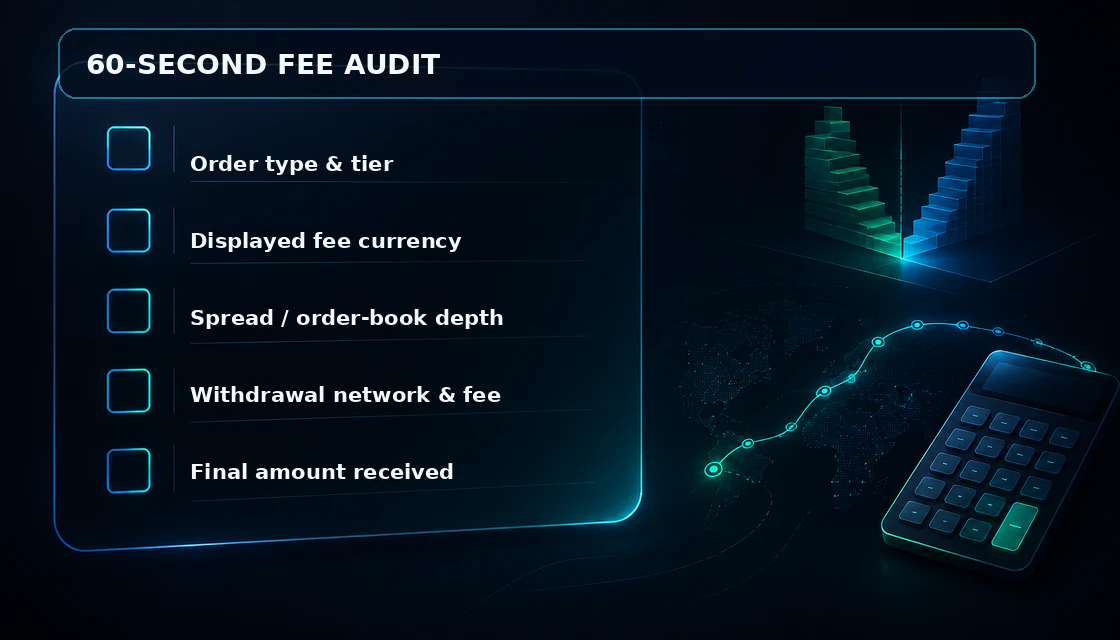
The 60-second fee audit
- I know whether the order will be maker or taker, or I accept the uncertainty.
- I know which asset pays the fee and whether a discount token adds exposure.
- I checked the bid, ask and enough order-book depth for my planned size.
- The recipient supports this exact asset on this exact network.
- I can state the estimated final amount and effective cost before confirming.
FAQ
What is a normal crypto exchange trading fee?
There is no universal rate. It varies by exchange entity, region, product, pair, rolling volume, maker or taker role and promotions. Check the current schedule and your order preview on the same date.
Are maker fees always lower than taker fees?
Often, but not always. Some pairs or tiers have equal rates, promotions or maker rebates. A limit order earns maker treatment only when it adds liquidity.
Is a zero-fee crypto trade really free?
Not necessarily. The platform may include a spread, use a conversion rate, charge for funding or withdrawal, or limit the zero-fee benefit by product and volume. Compare the final quantity received.
What is the difference between spread and slippage?
Spread is the gap between current bid and ask prices. Slippage is the difference between the expected reference price and the average executed price. A market order can incur both.
Who pays the blockchain fee on an exchange withdrawal?
The withdrawing user normally sees a deduction. The exchange may batch transfers or set a fee that differs from the exact on-chain cost. Treat the live net-receipt quote as decisive.
Why did my limit order pay a taker fee?
If the limit price crossed an existing order, it removed liquidity immediately. Post-only can cancel the order instead, but then it may not execute.
Should I buy an exchange token to reduce fees?
Only after considering price risk, holding requirements, tax treatment and the break-even saving. Taking token exposure to save a small fee can add much larger market risk.
How do I compare fees when exchanges deduct different assets?
Convert each deduction into one reference currency at the execution time. Preserve the gross fill, fee asset, fee quantity, reference price and net receipt.
Do withdrawal fees include network fees?
Sometimes the displayed withdrawal fee is the platform's all-in deduction; sometimes documentation distinguishes components. Do not assume it equals the exact validator or miner fee.
Can I avoid all fees by transferring internally?
An internal transfer may avoid an on-chain charge when both parties use the same service, but it keeps funds within the platform and adds counterparty, account and availability constraints.
QX HUB / CRYPTO
Built for decisions, not hype
Each guide starts with the action a reader needs to complete, separates changing platform details from durable safety rules, and keeps the final check inside the live account interface.


