risk management in volatile markets
Risk Management in Volatile Markets on Quotex: 2026 Guide
Learn how to manage risk in volatile markets on Quotex using volatility regimes, position sizing, loss limits, news filters, correlation controls and a 30-case demo test.

Key points
- Classify conditions as normal, elevated or extreme against a matched asset, timeframe and session baseline.
- Calculate the stake before the signal and reduce it when volatility expands; skip when price discovery becomes chaotic.
- Use fixed risk, daily and weekly limits, and never increase the amount after a loss with Martingale.
- Treat correlated positions as one combined exposure rather than several independent trades.
Risk Management in Volatile Markets on Quotex
Volatility is the speed and size of price movement. It can create opportunity, but it also increases false breaks, oversized candles, late entries and expiry risk. On a fixed-time trade, you cannot move a stop or wait indefinitely for the idea to recover. The result is decided at a fixed time, so volatility changes both the probability of direction and the probability that timing will be wrong.
Good risk management begins before the signal. A trader defines the maximum stake, session loss limit, accepted volatility regime and no-trade conditions while calm. Once the market accelerates, those rules prevent an emotional response from becoming a larger financial loss.
Risk warning: Digital options can lose the full amount placed. Position sizing reduces damage; it does not turn a weak strategy into a profitable one. Use demo mode, verify local rules and never trade essential funds.
What Volatility Changes
| Normal market | Volatile market | Risk consequence |
|---|---|---|
| Smaller, more consistent candles | Large candles and long wicks | Entry can become late within seconds |
| Levels hold more cleanly | Levels are pierced repeatedly | First breakout is less reliable |
| Indicator readings change gradually | Indicators jump and lag | Signal may describe the spike after it happened |
| Several expiries may fit the rhythm | Short expiries become timing-sensitive | Same direction can still lose at expiry |
| Assets behave more independently | Correlations can rise during stress | Multiple positions may become one bet |
Classify the Volatility Regime
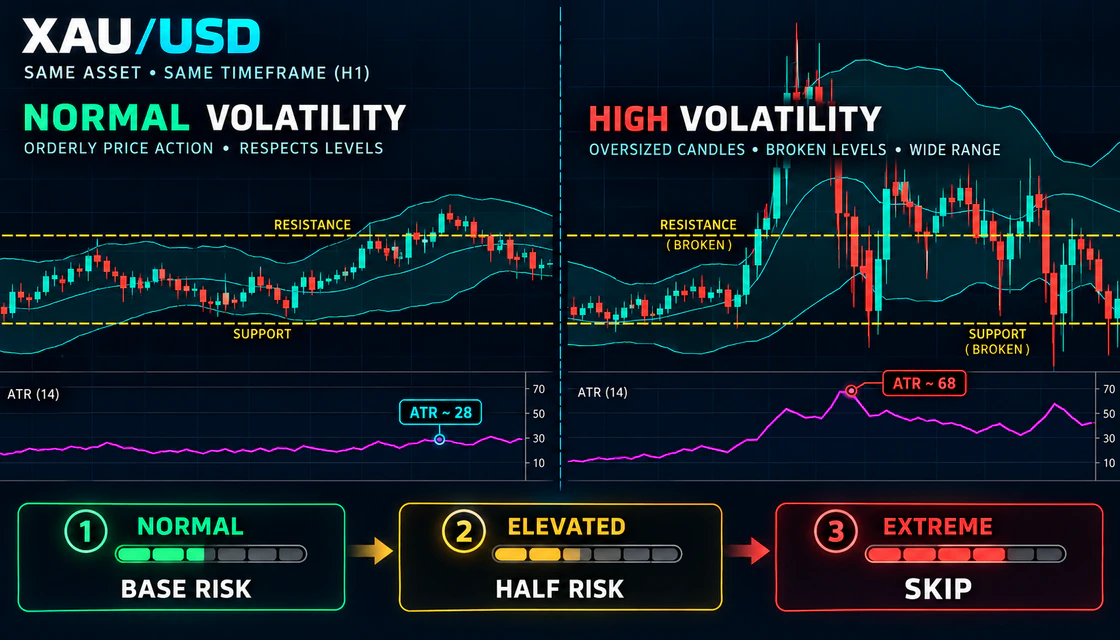
Do not label volatility by emotion. Compare the current chart with the same asset, timeframe and session over recent days. ATR can help quantify range expansion, but candle size, wick behavior, gaps, repeated level failure and scheduled news also matter.
Important: These labels are relative to the chosen asset and timeframe. An ATR value has no meaning without a baseline. Compare like with like.
| Regime | Observable evidence | Default risk decision |
|---|---|---|
| Normal | Candle range near baseline, levels readable, no major event close | Use tested base risk |
| Elevated | Candle range expands, wicks increase, ATR rises, structure still visible | Use half risk and stronger confirmation |
| Extreme | Oversized candles, both sides of levels swept, price discovery or headline shock | Skip until structure reforms |
Position Sizing Formula
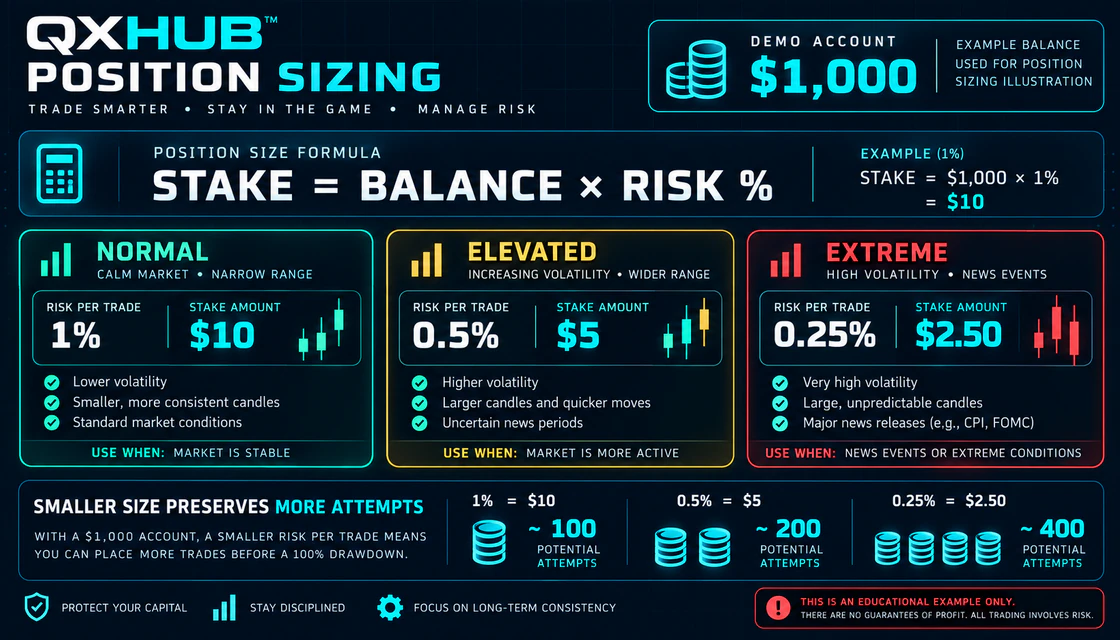
For a fixed-time trade where the entire amount can be lost, the stake is the amount at risk. The basic formula is balance multiplied by the selected risk percentage. Calculate it before the session and round down to a size supported by the platform.
A smaller stake does not improve the signal, but it increases the number of mistakes or normal losing trades the account can absorb. If the platform minimum is larger than the amount produced by the risk formula, the account may be too small for the chosen rule. Do not raise the percentage simply to make the trade possible.
| Demo balance | 1 percent | 0.5 percent | 0.25 percent |
|---|---|---|---|
| $100 | $1.00 | $0.50 | $0.25 |
| $250 | $2.50 | $1.25 | $0.63 |
| $500 | $5.00 | $2.50 | $1.25 |
| $1,000 | $10.00 | $5.00 | $2.50 |
| $2,000 | $20.00 | $10.00 | $5.00 |
Why Fixed Stake Beats Martingale
Martingale increases the stake after a loss. It assumes that a future win will arrive before the sequence becomes unaffordable. Volatility makes that assumption more dangerous because losses can cluster when one market regime invalidates the strategy.
On a 1,000 dollar account, five fixed 1% losses cost 5%. A simple doubling sequence costs 31%. Payouts below 100% may also prevent a doubled win from fully recovering prior losses. The safest recovery rule is no recovery sizing at all.
| Loss number | Fixed 1 percent stake | Martingale starting at 10 |
|---|---|---|
| 1 | $10 | $10 |
| 2 | $10 | $20 |
| 3 | $10 | $40 |
| 4 | $10 | $80 |
| 5 | $10 | $160 |
| Total loss | $50 | $310 |
Daily and Weekly Loss Limits
A session stop protects the trader from regime change and emotional deterioration. Choose one rule before trading: a percentage drawdown, a fixed number of full-risk losses or both. The first limit reached ends the session.
Do not reset: A deposit, withdrawal or platform refresh does not reset the daily loss. Measure from the documented start-of-session balance.
| Limit | Example rule | Required action |
|---|---|---|
| Per trade | Base 0.5–1%; elevated 0.25–0.5% | Stake fixed before signal |
| Consecutive losses | Two or three full-risk losses | Stop and review |
| Daily drawdown | 2–3% of starting session balance | End session |
| Rule violation | One impulsive or Martingale trade | End session immediately |
| Weekly drawdown | 5–7% or chosen tested threshold | Move to demo and audit |
| Extreme event | Price discovery remains chaotic | No trade regardless of daily P&L |
Skip the Spike and Trade the Structure
- Before the event, mark support, resistance and the time at which the release can affect the market.
- Do not open a trade whose expiry crosses the event unless news trading is separately tested.
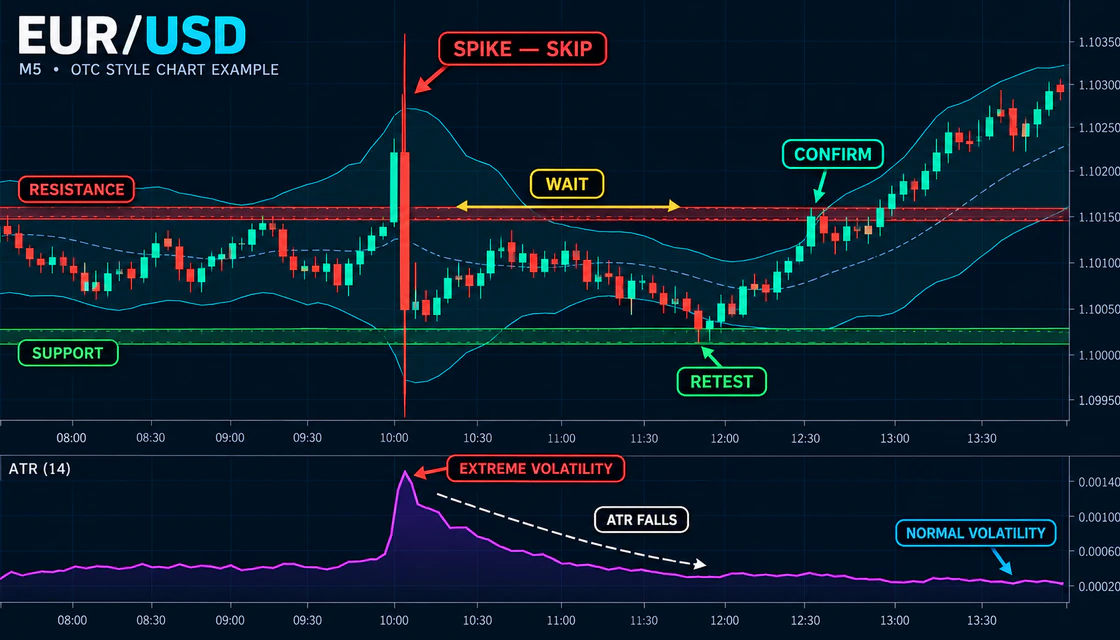
- Skip the first oversized reaction, even if direction looks obvious.
- Wait for candles to shrink, ATR to normalize and a new swing structure to appear.
- Redraw levels based on post-event price action rather than forcing old levels to work.
- Evaluate a retest only after a completed candle confirms the new structure.
No fixed waiting time: Ten minutes may be enough in one event and too short in another. Normalization is visible in price structure, not the clock alone.
Correlation and Hidden Concentration
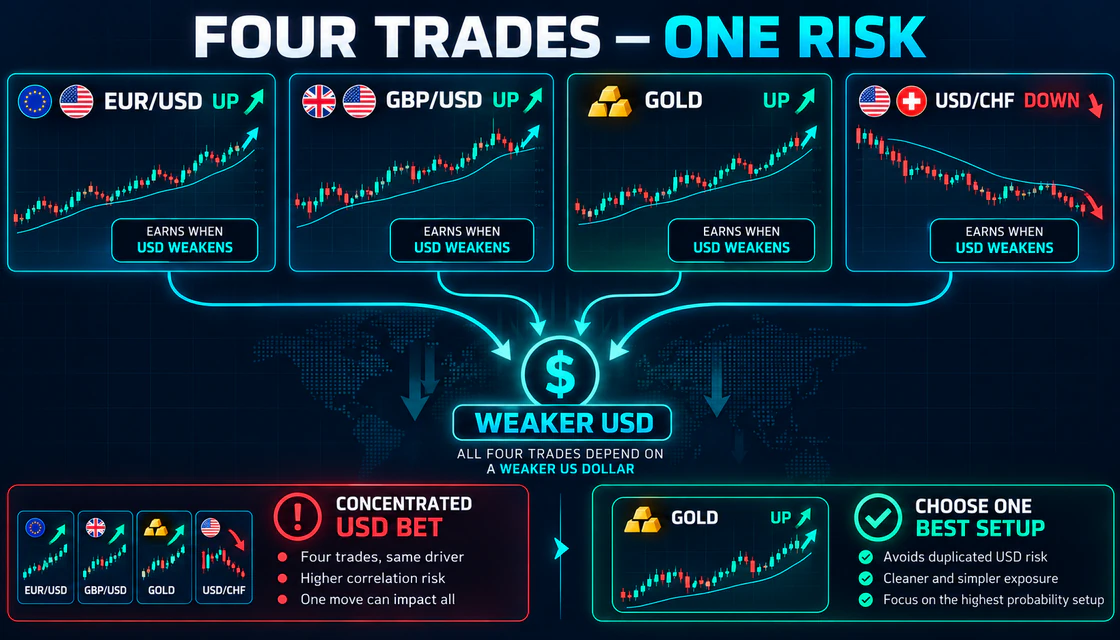
Trade count is not the same as independent risk. EUR/USD UP, GBP/USD UP, gold UP and USD/CHF DOWN can all depend on a weaker US dollar. One unexpected dollar move may cause every position to lose together. In volatile markets, correlations can strengthen precisely when diversification is expected to help.
Simple rule: Choose the clearest setup rather than opening several correlated trades. If multiple positions are allowed, divide the total risk across them instead of applying full risk to each.
| Before opening another trade | Question |
|---|---|
| Shared currency | Does the new setup rely on the same USD, EUR or GBP move? |
| Shared event | Will one CPI, FOMC or jobs release affect both? |
| Shared direction | Are several positions expressing the same risk-on or risk-off view? |
| Expiry overlap | Can all trades lose during the same shock window? |
| Total exposure | If all lose, does the combined loss exceed the per-session plan? |
Payout and Break Even Under Volatility
Higher volatility does not change the payout mathematics. If a win returns less than the amount lost on a losing trade, the break-even win rate remains above 50%. What volatility changes is the reliability of the signal and expiry timing.
Do not accept a lower payout because the market looks exciting. The combination of weak payout and unstable timing can remove the edge even when the directional analysis is reasonable.
| Payout | Break-even win rate | Required wins per 100 rounded up |
|---|---|---|
| 60% | 62.5% | 63 |
| 70% | 58.8% | 59 |
| 80% | 55.6% | 56 |
| 85% | 54.1% | 55 |
| 90% | 52.6% | 53 |
Expiry Risk in Fast Markets
| Problem | What happens | Better rule |
|---|---|---|
| One-candle expiry | Normal wick noise decides the result | Test three to five candles |
| Late entry | Impulse is already mature | Wait for pullback or skip |
| News inside expiry | Technical setup becomes event exposure | Finish before event or stay flat |
| Long expiry after regime change | Original structure may no longer apply | Reanalyse from the new chart |
| Changing expiry after losses | Sample becomes incomparable | Keep rule fixed for the test block |
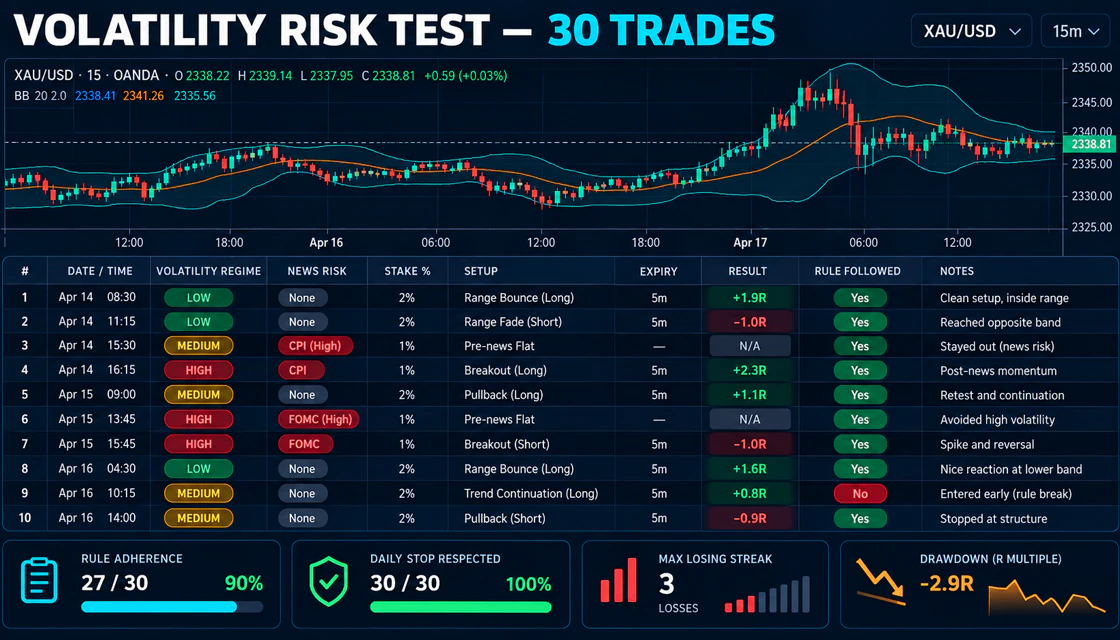
Volatility Risk Test
- Choose one asset, timeframe, session and setup.
- Define the normal ATR or candle-range baseline from comparable sessions.
- Classify each opportunity as normal, elevated or extreme before the result is known.
- Record news risk, stake percentage, expiry, payout and whether correlated exposure existed.
- Include skipped trades as correct decisions when rules prohibited entry.
- After 30 cases, compare results and rule adherence by regime.
- Review maximum losing streak and drawdown to confirm the daily stop was realistic.
| Journal field | Example |
|---|---|
| Volatility regime | Elevated; ATR 38% above baseline |
| News risk | No high-impact event during expiry |
| Stake | 0.5% after risk reduction |
| Setup | Support retest after spike normalized |
| Expiry | 4 candles on M5 |
| Payout | 81% before entry |
| Result | Loss |
| Rule followed | Yes; valid loss |
| Review note | Direction correct, reaction developed after expiry |
Common Mistakes
| Mistake | Why it fails | Better rule |
|---|---|---|
| Increasing stake after loss | Uncertainty has not decreased | Fixed or reduced stake |
| Trading every large candle | Impulse may be nearly complete | Wait for structure and retest |
| Using absolute ATR alone | Assets and timeframes differ | Compare with matched baseline |
| Opening correlated trades | Several positions become one bet | Cap combined exposure |
| Resetting daily loss | Extends emotional session | One documented daily stop |
| Ignoring skipped trades | Rewards activity instead of discipline | Journal valid no-trade decisions |
| Assuming risk control guarantees profit | Sizing cannot create an edge | Validate strategy and payout separately |
Pre Trade Risk Checklist
| Question | Check |
|---|---|
| What is the current volatility regime? | □ |
| Is a high-impact event inside the planned expiry? | □ |
| Was the stake calculated from the start-of-session balance? | □ |
| Has risk been reduced for elevated volatility? | □ |
| Is price structure readable after the latest spike? | □ |
| Does this position duplicate another currency or event risk? | □ |
| Is payout above the tested minimum? | □ |
| Are consecutive-loss and daily-drawdown limits still intact? | □ |
| Would I take this setup after a win as well as after a loss? | □ |
Conclusion
Risk management in volatile markets is a sequence of pre-committed decisions. Classify the regime, calculate the stake, check news and correlation, verify payout and stop when the market becomes unreadable or the session limit is reached. The purpose is not to remove losses; it is to prevent one unstable period from causing disproportionate damage.
For beginners, the strongest starting model is simple: 0.5–1% demo risk in normal conditions, half size during elevated volatility and no trade during extreme price discovery. Test the rules across thirty cases, include skipped trades in the journal and never use Martingale. Consistency is measured by rule adherence before it is measured by account balance.
Quick answers
What is a safe risk per trade on Quotex
There is no universally safe percentage. Many conservative demo plans start around 0.5–1% in normal conditions and reduce the amount during elevated volatility. The correct level must remain affordable through a realistic losing streak.
Should risk be reduced when volatility rises
Yes, when the same strategy becomes less reliable or candles widen beyond the tested range. Reduce the stake or skip; do not demand that the market fit the original rule.
How do I measure volatility
Compare candle ranges and ATR with the same asset, timeframe and session. Add qualitative evidence such as wick size, gaps, level failure and scheduled news.
How many losses should stop a session
Choose the limit before trading. Two or three full-risk losses or a 2–3% daily drawdown can be conservative demo starting points, but the final rule should come from tested strategy statistics.
Can multiple small trades reduce risk
Not when they are correlated. Several positions driven by the same currency or news event can create larger concentration than one trade.
Does risk management guarantee profit
No. Risk management controls the size and sequence of losses. Profitability still requires a tested strategy, sufficient payout and disciplined execution.
Next step
Choose a topic by task: brokers for platform selection, guides for access, strategies for setups, risk for discipline and investing for longer market logic.